 ecomtech-oss/pisc
Vérificateur de sécurité d'images OCI publiques (images Docker)

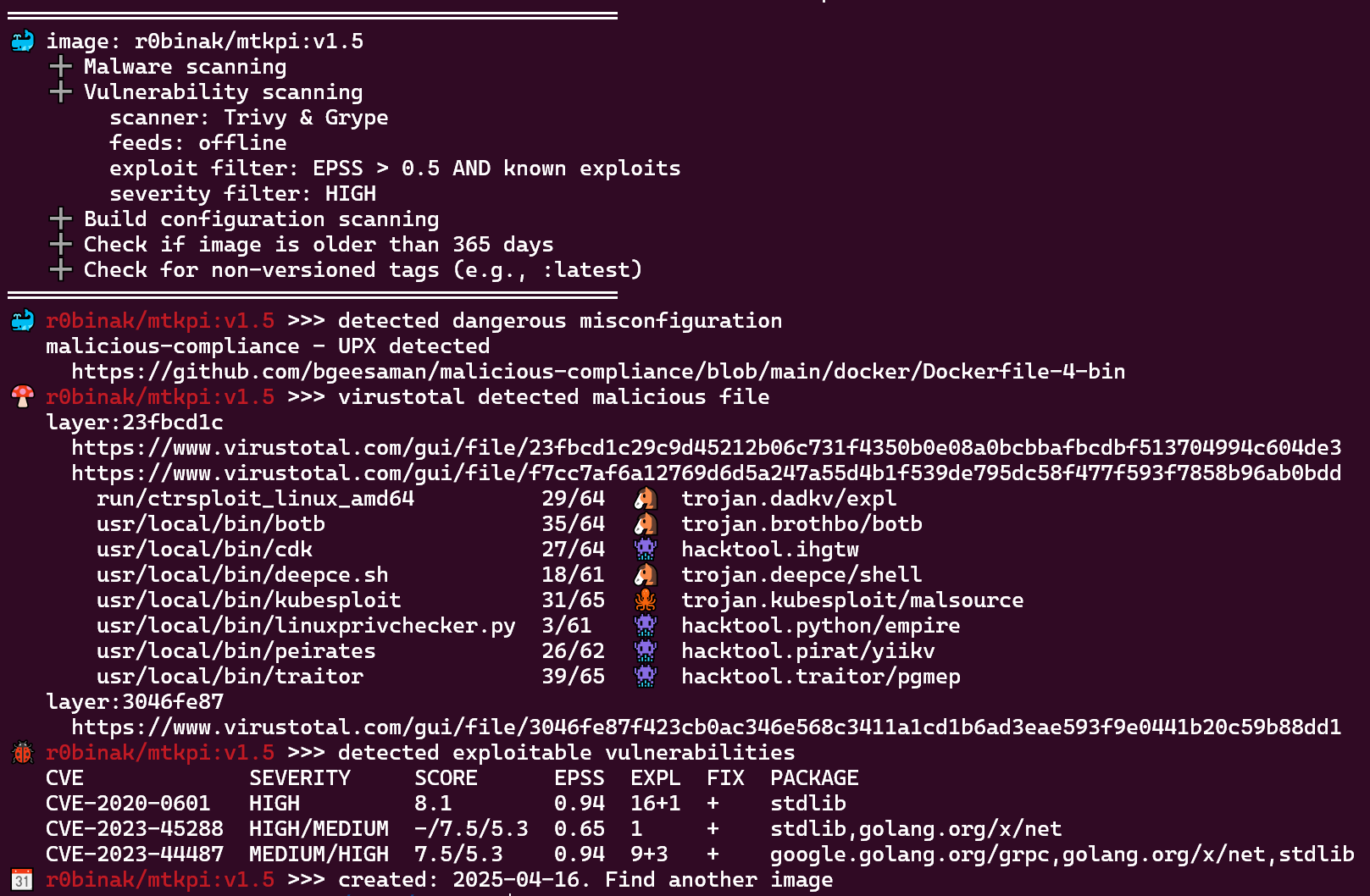
PISC (Vérificateur de sécurité d'images OCI publiques ou d'images Docker) est un outil en ligne de commande pour évaluer la sécurité des images de conteneurs OCI.
Se termine avec le code 1 si l'une des conditions suivantes est remplie :
Il peut être utilisé pour vérifier automatiquement la sécurité des images OCI publiques avant de les exécuter dans un environnement privé ou de les utiliser comme images de base dans un pipeline CI/CD.
Obtenez une clé API pour virustotal. Le compte utilisateur final gratuit standard a des limitations.
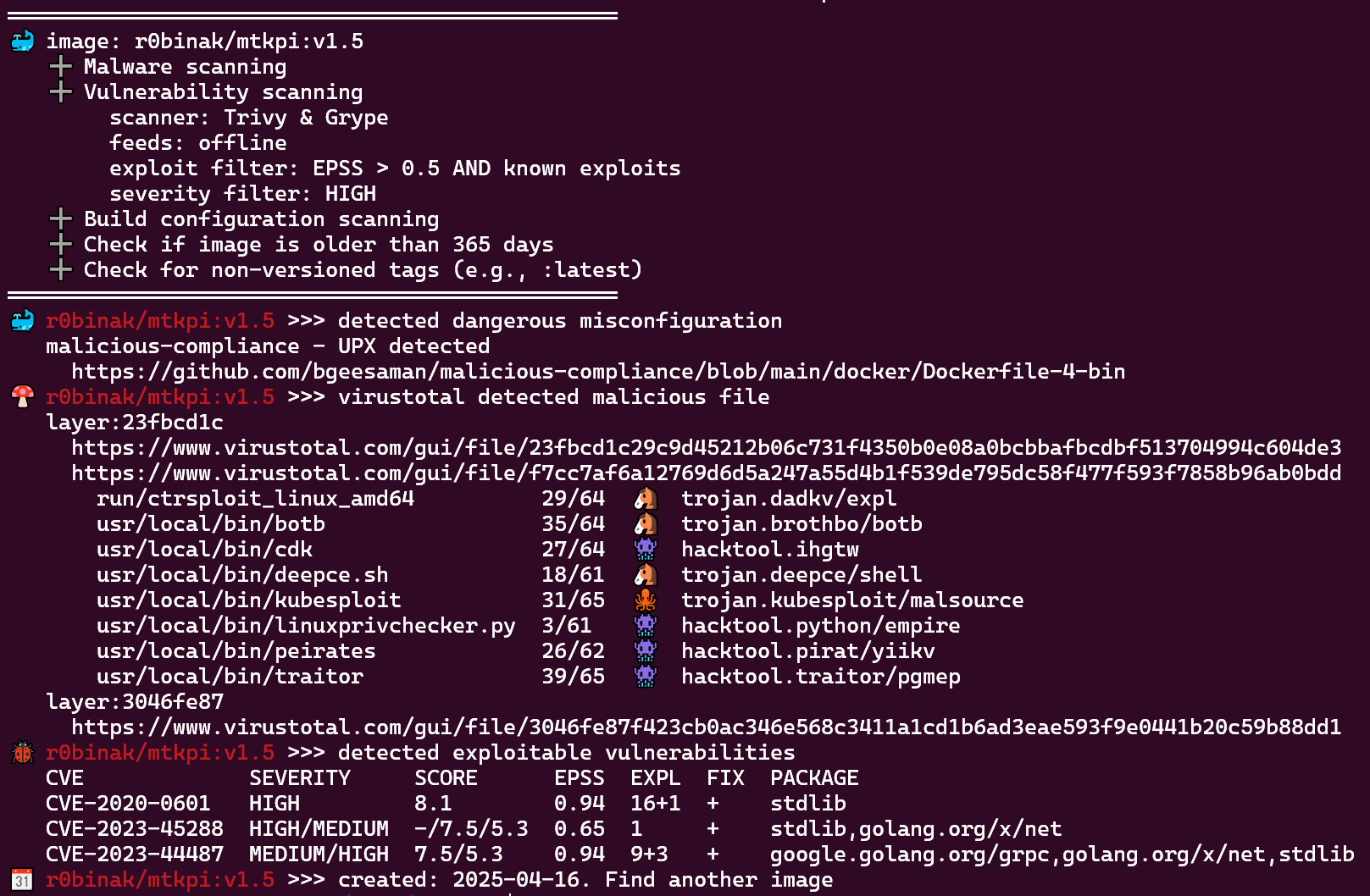
docker run kapistka/pisc:latest /bin/bash ./scan.sh -delm --virustotal-key <virustotal-api-key> -i r0binak/mtkpi:v1.5
docker run kapistka/pisc:latest-feeds /bin/bash ./scan.sh -delm --offline-feeds --virustotal-key <virustotal-api-key> -i r0binak/mtkpi:v1.5
Référez-vous au Dockerfile pour la liste des dépendances. Vous devez installer trivy, grype, skopeo, jq, et d'autres paquets selon la distribution que vous utilisez.
Usage:
  scan.sh [flags] [-i IMAGE | -f FILE | --tar TARFILE]

Flags:
  -d, --date                      Check image age against threshold (default: 365 days).
  --d-days <int>                  Custom threshold for build date check (in days). Example: '--d-days 180'.
  -e, --exploits                  Check for vulnerabilities with known exploits (using Trivy + Grype + inthewild.io + empiricalsecurity.com).
  --epss-and                      Use AND logic to combine EPSS score and exploit presence. If disabled, OR logic is applied (default: OR).
  --epss-min <float>              Minimum EPSS score threshold used for filtering vulnerabilities (default: 0.5).
  -f, --file <string>             Batch scan images from file. Example: '-f images.txt'.
  -h, --help                      Display this help message.
  --ignore-errors                 Ignore errors from external tools and continue execution.
  -i, --image <string>            Single image to scan. Example: '-i r0binak/mtkpi:v1.4'.
  -l, --latest                    Detect non-versioned tags (e.g., ':latest').
  -m, --misconfig                 Scan for dangerous build misconfigurations.
  --offline-feeds                 Use a self-contained offline image with pre-downloaded vulnerability feeds (e.g., :latest-feeds).
  --scanner [trivy|grype|all]     Choose which scanner to use: Trivy, Grype, or both (default: all)
  --severity-min <string>         Minimal severity of vulnerabilities [UNKNOWN|LOW|MEDIUM|HIGH|CRITICAL] default [HIGH]
  --show-exploits                 Show exploit details
  --tar <string>                  Scan local TAR archive of image layers. Example: '--tar /path/to/private-image.tar'.
  --trivy-server <string>         Trivy server endpoint URL. Example: '--trivy-server http://trivy.something.io:8080'.
  --trivy-token <string>          Authentication token for Trivy server. Example: '--trivy-token 0123456789abZ'.
  -v, --version                   Display version.
  --virustotal-key <string>       VirusTotal API key for malware scanning. Example: '--virustotal-key 0123456789abcdef'.
  --vulners-key <string>          Vulners.com API key (alternative to inthewild.io). Example: '--vulners-key 0123456789ABCDXYZ'.

Additional Notes:
- To authenticate with a registry, refer to 'scan-download-unpack.sh#L14'.
- To configure exclusions for specific CVEs or other criteria, see 'check-exclusion.sh#L5'.
Cet utilitaire peut être intégré dans un pipeline CI pour effectuer une analyse de sécurité des images de conteneurs avant de les pousser vers un registre privé. Combinez cette étape avec la signature d'images et le push automatisé vers un registre pour un workflow DevSecOps sécurisé. Voici un exemple de configuration :
security_scan:
  stage: security
  image: $SECURITY_IMAGE_FEEDS
  script:
    - |
      /bin/bash /home/nonroot/scan.sh -delm --offline-feeds --virustotal-key $VIRUSTOTAL_API_KEY -f ${NEW_IMAGES_FILE}

      # Auto-approve: If the scan fails (exit code >0), the pipeline stops before reaching this point.
  rules:
    - if: $CI_PIPELINE_SOURCE == 'merge_request_event'
# CVE-2024-3094 (XZ Utils) exploit
./scan.sh --virustotal-key <virustotal-api-key> -i r0binak/xzk8s:v1.1
════════════════════════════════════════
🍄 r0binak/xzk8s:v1.1 >>> virustotal detected malicious file
   layer:0f28dfeb
     https://www.virustotal.com/gui/file/0f28dfebbf3451ccfe3d5b11d17bc38cc8d1c4e721b842969466dc7989d835e3
     https://www.virustotal.com/gui/file/dc24581c3500b9640e03c7a4c14cd7c22f88c533b831a7f6a49aaf3ba39fcde4
   layer:230cc513
     https://www.virustotal.com/gui/file/230cc513debf36c5294ba6dd2babd27934bb231362cd8d916ea1c58e9495d38f
     https://www.virustotal.com/gui/file/935cfccfa8d31d0e03f2162e9b46b7f9df77db64efa2e4cfb4dbaebdf94be6d3
       root/liblzma.so.5.6.0.patch  37/64  🐴  trojan.xzbackdoor/cve20243094
# vulnerabilities: trivy + grype + epss + exploits (IngressNightmare)
./scan.sh -e -i registry.k8s.io/ingress-nginx/controller:v1.11.2
════════════════════════════════════════════════
🐞 registry.k8s.io/ingress-nginx/controller:v1.11.2 >>> detected exploitable vulnerabilities
   CVE            SEVERITY  SCORE  EPSS  EXPL  FIX  PACKAGE
   CVE-2025-1974  CRITICAL  9.8    0.87  0     +    k8s.io/ingress-nginx
📆 registry.k8s.io/ingress-nginx/controller:v1.11.2 >>> created: 2024-08-15. Last update: 2025-06-04
💡 registry.k8s.io/ingress-nginx/controller:v1.11.2 >>> use a newer tags:
   v1.11.3  v1.11.4         v1.11.5  v1.11.6  v1.11.7
   v1.12.0  v1.12.0-beta.0  v1.12.1  v1.12.2  v1.12.3
# dangerous image build misconfiguration cve-2024-21626
./scan.sh -m -i r0binak/cve-2024-21626:v4
════════════════════════════════════════
🐳 r0binak/cve-2024-21626:v4 >>> detected dangerous misconfiguration
   CVE-2024-21626 runC Escape
     https://nitroc.org/en/posts/cve-2024-21626-illustrated/
