
agent-bom v0.102.0
Scanner de sécurité open source et plan de contrôle auto-hébergé pour l'IA, MCP et le cloud. Un modèle de preuve unique — exécutez des scans dans votre environnement, centralisez les résultats, gouvernez dans votre VPC.
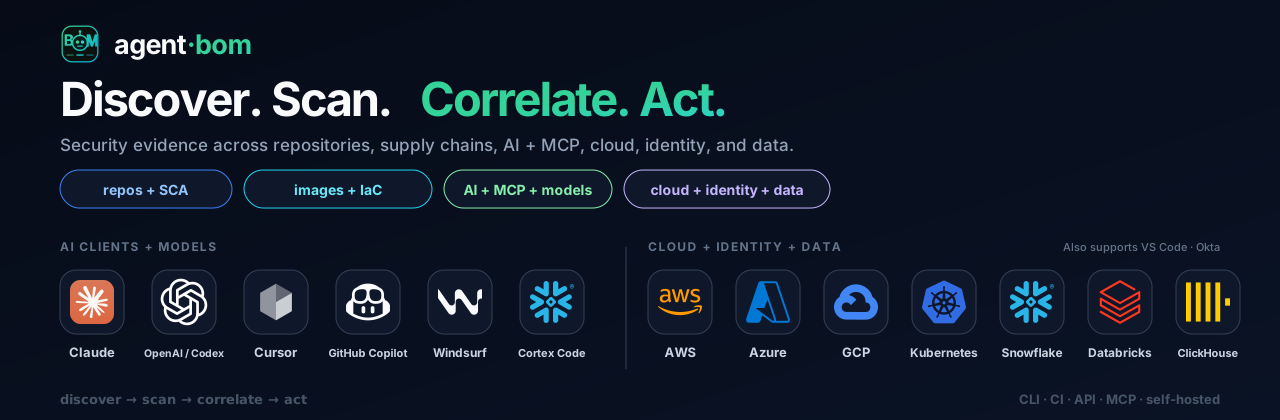





AI supply-chain BOM: supported agents, MCP servers and AI packages, and what each one can reach.
agent-bom maps the chain your AI tools create, agent → MCP server → tool → package → credential, and what each link can reach in code, cloud and data. For AppSec, platform and AI teams who run Claude Code, Cursor, Codex or any MCP client: findings are ranked by that reach on one graph that runs on your machine or your own infrastructure. Local scans need no account.
Quick start · Start by role · Try in browser · Laptop → team → org · Product tour · Docs
Quick start
From the repository you want to inspect, with uv installed:
uvx agent-bom scan . -f html -o agent-bom-report.html
Open agent-bom-report.html for inventory, findings and fix guidance. Run it
again later to see what changed. No MCP configuration in the project? Package
findings still apply. To explore the same chain as a graph, see
open the sample graph.
No project handy? uvx agent-bom scan --demo --offline scans a bundled sample.
Exit 1 is expected there: the sample trips the security gate. Elsewhere, a
non-zero exit can mean a security gate or incomplete assessment; inspect the
report and coverage (exit codes,
first-run guide).
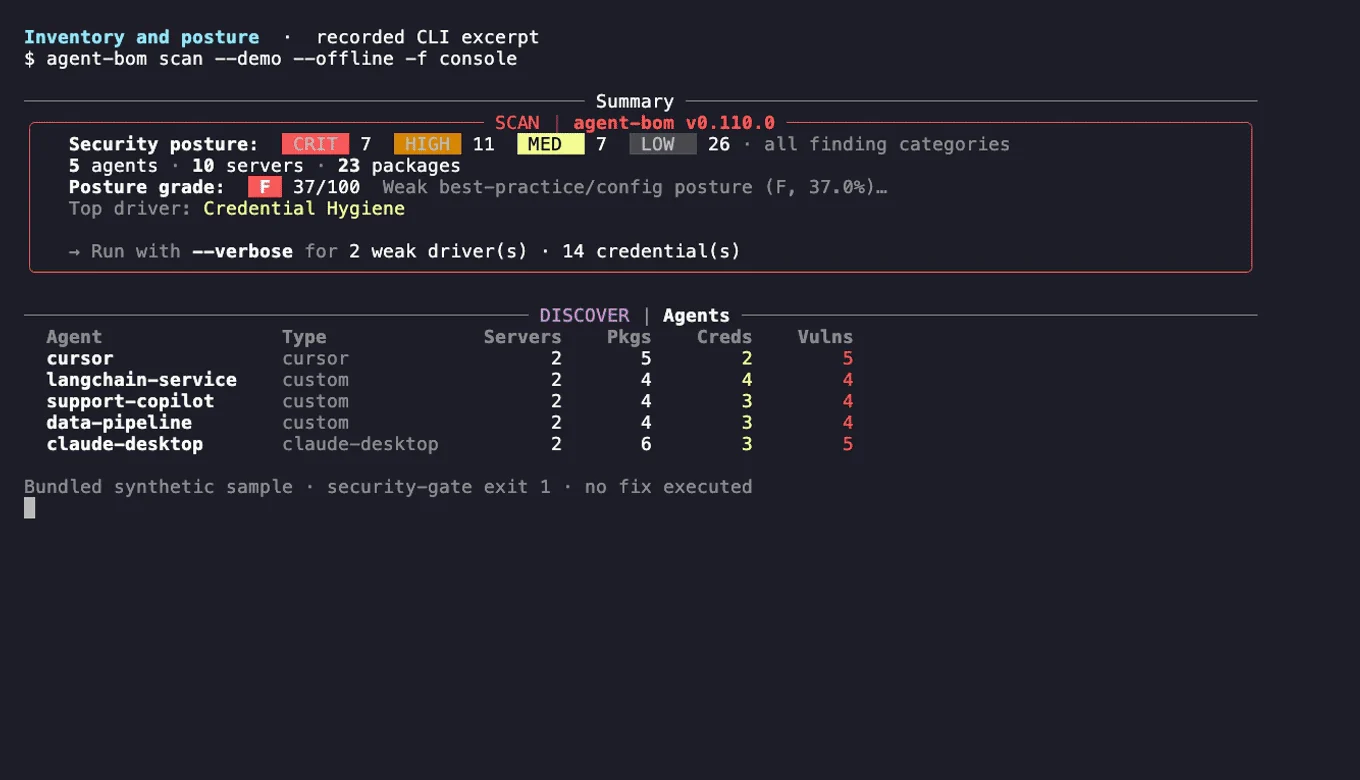
What the scan reads and what it does not establish
The scan stays inside this repository: packages, MCP configuration, secrets and personal data, skills and IaC. It does not read agent configuration elsewhere on the machine. Missing evidence is reported as partial, not clean. See what a scan does and does not establish.
From laptop to team to org
- On your laptop:
uvx agent-bom scan .for findings with fixes and a delta on every rescan;claude mcp add agent-bom -- uvx agent-bom mcp serverto use agent-bom as a tool inside your coding agent (MCP server, plugins). - In your team:
uses: koda-ai-studio/agent-bom@v0on pull requests and a weeklyschedule:for a PR gate with a findings comment, SARIF in code scanning and a weekly rescan that catches new CVEs in unchanged code (GitHub Action). - Across your org:
agent-bom uplocally, then Docker Compose or the Helm chart fromoci://ghcr.io/koda-ai-studio/charts/agent-bomfor retained scans, one graph of agents, MCP servers, packages and credentials, SSO and audit in your own infrastructure (self-host).
All three are free under Apache-2.0 and are adoption paths, not editions. There is no managed cloud offering today; community support runs on GitHub (deployment chooser, support model).
Why an AI supply-chain BOM
Why now. Coding agents and MCP servers give software new reach: they start local processes, load packages, hold API tokens and call tools on your behalf, often from configuration nobody reviews. Package inventories stop at the package, so nothing records which agent can use which credential through which server.
A CVE in an AI package, a poisoned tool description or an over-scoped credential matters by what the agent that loads it can reach. agent-bom records the chain, agent → MCP server → tool → package → credential → data, keeps the evidence for every edge, and ranks findings by that reach. Start with the five-minute path for your role.

Sample data. What the sample shows
What it covers
Agents and MCP servers, models and AI platforms, dependencies, code, containers and IaC, cloud and data platforms, and a runtime MCP proxy and gateway. Exports are SARIF, CycloneDX, SPDX, JSON and HTML.