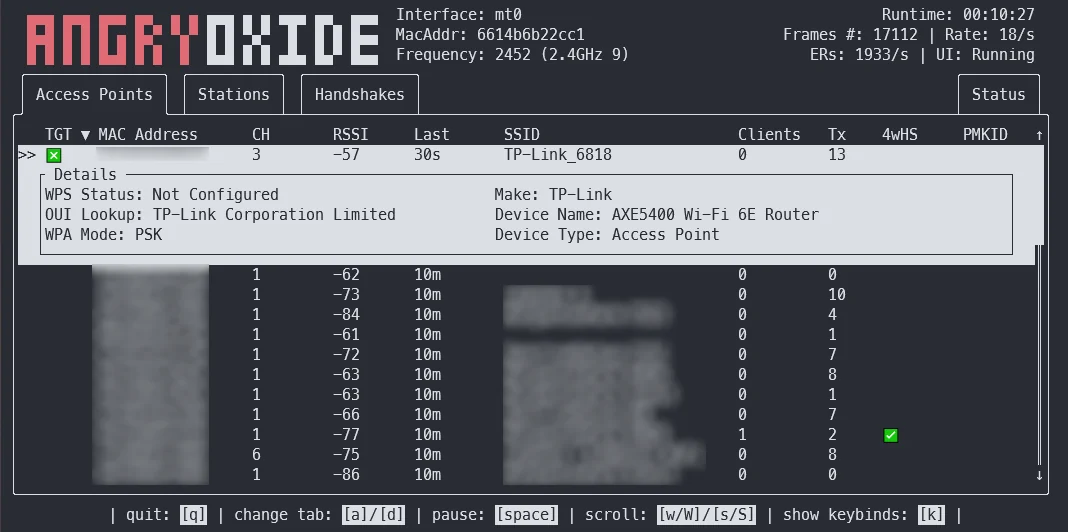
ragnt/angryoxide
Herramienta de auditoría ofensiva 802.11 que automatiza la captura de handshakes WPA/WPA2 y PMKID mediante ataques de desautenticación, cliente rogue y cambio de canal, con modo headless, registro GPS y salida lista para Hashcat.



Esta herramienta es solo para fines de investigación. No soy responsable de nada de lo que hagas o de los daños que causes mientras uses AngryOxide. Úsala únicamente contra redes para las que tengas permiso.
AngryOxide fue desarrollado como una forma de aprender Rust, netlink, sockets del kernel y explotación de WiFi al mismo tiempo.
Puedes obtener información sobre cómo usar AngryOxide en la Guía de Usuario.
NOTA: Este proyecto está bajo un desarrollo INTENSO y puedes esperar un ciclo de lanzamiento muy rápido.
El objetivo general de esta herramienta es proporcionar una capacidad de reconocimiento de interfaz única con ataques automatizados avanzados que produzcan líneas hash válidas que puedas crackear con Hashcat.
Esta herramienta está fuertemente inspirada en hcxdumptool y el desarrollo no habría sido posible sin la ayuda de ZerBea.
Si tienes preguntas o cualquier problema, puedes contactarme en el AngryOxide Discord.
Puedes descargar los binarios precompilados de AngryOxide en las publicaciones.
tar -xf angryoxide-linux-x86_64.tar.gz # Untar
chmod +x install.sh # Make executable
sudo ./install.sh # Install (as root, including zsh/bash completions)
Puedes obtener información sobre cómo usar AngryOxide en la Guía de Usuario.
sudo ./install.sh uninstall # Uninstall
Por defecto atacará a TODOS los puntos de acceso en el rango, a menos que se proporcione al menos un objetivo, en cuyo caso la herramienta solo transmitirá contra los objetivos definidos. (Pero aun así recopilará pasivamente en otros puntos de acceso).
Todos estos ataques están controlados por tasa (rate-controlled) tanto para evitar reinicios erróneos del temporizador EAPOL como para mantener cierto nivel de seguridad operativa.
❯ angryoxide --help
Does awesome things... with wifi.

Usage: angryoxide [OPTIONS] --interface <INTERFACE>

Options:
  -i, --interface <INTERFACE>     Interface to use
  -c, --channel <CHANNEL>         Optional - Channel to scan. Will use "-c 1,6,11" if none specified
  -b, --band <2 | 5 | 6 | 60>     Optional - Entire band to scan - will include all channels interface can support
  -o, --output <Output Filename>  Optional - Output filename
  -h, --help                      Print help
  -V, --version                   Print version

Targeting:
  -t, --target-entry <Target MAC/SSID>
          Optional - Target (MAC or SSID) to attack - will attack everything if none specified
  -w, --whitelist-entry <WhiteList MAC/SSID>
          Optional - Whitelist (MAC or SSID) to NOT attack
      --targetlist <Targets File>
          Optional - File to load target entries from
      --whitelist <Whitelist File>
          Optional - File to load whitelist entries from

Advanced Options:
  -r, --rate <Attack Rate>            Optional - Attack rate (1, 2, 3 || 3 is most aggressive) [default: 2]
      --combine                       Optional - Combine all hc22000 files into one large file for bulk processing
      --active                        Optional - Use Active Monitor mode - WARNING, may cause bugs.
      --rogue <MAC Address>           Optional - Tx MAC for rogue-based attacks - will randomize if excluded
      --gpsd <GPSD Host:Port>         Optional - Alter default HOST:Port for GPSD connection [default: 127.0.0.1:2947]
      --autohunt                      Optional - AO will auto-hunt all channels then lock in on the ones targets are on
      --headless                      Optional - Set the tool to headless mode without a UI. (useful with --autoexit)
      --autoexit                      Optional - AO will auto-exit when all targets have a valid hashline
      --notransmit                    Optional - Do not transmit - passive only
      --notar                         Optional - Do not tar output files
      --disablemouse                  Optional - Disable mouse capture (scroll wheel)
      --dwell <Dwell Time (seconds)>  Optional - Adjust channel hop dwell time [default: 2]

Geofencing:
      --geofence
          Optional - Enable geofencing using a specified latlng and distance
      --center <CENTER>
          Lat,Lng for geofencing (required if geofence is enabled)
      --distance <DISTANCE>
          Distance in meters from the center (required if geofence is enabled)
      --geofence-timeout <GEOFENCE_TIMEOUT>
          Timeout to disable geofence if GPS is lost. (default 300 seconds) [default: 300]