 moonnull/cve-2022-2590-analysis
Análisis en profundidad de CVE-2022-2590, una variante de Dirty COW en shmem del kernel de Linux, que incluye la causa raíz, la condición de carrera y el exploit de prueba de concepto.

versión del kernel de linux: Linux/x86 6.0.0-rc1 (commit 37887783b3fef877bf34b8992c9199864da4afcb)
esta vulnerabilidad permite al atacante escribir contenido arbitrario en una página de memoria compartida de solo lectura satisfaciendo la función can_follow_write_pte, que comprueba FOLL_FORCE, FOLL_COW y pte_dirty, usando UFFDIO_CONTINUE.
/*
 * FOLL_FORCE can write to even unwritable pte's, but only
 * after we've gone through a COW cycle and they are dirty.
 */
static inline bool can_follow_write_pte(pte_t pte, unsigned int flags)
{
	return pte_write(pte) ||
		((flags & FOLL_FORCE) && (flags & FOLL_COW) && pte_dirty(pte));
}
La función anterior determina si una pte es escribible.
Se considera que la pte es escribible si cumple una de las siguientes condiciones:
Para cumplir la condición 2, es necesario establecer las siguientes tres flags:
FOLL_FORCE
static ssize_t mem_rw(struct file *file, char __user *buf,
			size_t count, loff_t *ppos, int write)
{
	...

	flags = FOLL_FORCE | (write ? FOLL_WRITE : 0);

	while (count > 0) {
		size_t this_len = min_t(size_t, count, PAGE_SIZE);

		if (write && copy_from_user(page, buf, this_len)) {
			copied = -EFAULT;
			break;
		}

		this_len = access_remote_vm(mm, addr, page, this_len, flags); // __get_user_pages with FOLL_FORCE on
		if (!this_len) {
			if (!copied)
				copied = -EIO;
			break;
		}

		...
}
La función anterior realiza operaciones de lectura/escritura sobre /proc/<pid>/mem.
Mediante esta función, se puede llegar a la función __get_user_pages con la flag FOLL_FORCE activada.
Aunque FOLL_FORCE está pensada para usarse en ptrace, su necesidad ha sido demostrada en el siguiente commit: https://github.com/torvalds/linux/commit/f511c0b17b081562dca8ac5061dfa86db4c66cc2
FOLL_COW
/*
* mmap_lock must be held on entry.  If @locked != NULL and *@flags
* does not include FOLL_NOWAIT, the mmap_lock may be released.  If it
* is, *@locked will be set to 0 and -EBUSY returned.
*/
static int faultin_page(struct vm_area_struct *vma,
	unsigned long address, unsigned int *flags, bool unshare,
	int *locked)
{
  ...

  /*
  * The VM_FAULT_WRITE bit tells us that do_wp_page has broken COW when
  * necessary, even if maybe_mkwrite decided not to set pte_write. We
  * can thus safely do subsequent page lookups as if they were reads.
  * But only do so when looping for pte_write is futile: in some cases
  * userspace may also be wanting to write to the gotten user page,
  * which a read fault here might prevent (a readonly page might get
  * reCOWed by userspace write).
  */
  if ((ret & VM_FAULT_WRITE) && !(vma->vm_flags & VM_WRITE))
    *flags |= FOLL_COW;
  return 0;
}
Se puede usar la operación OR con FOLL_COW en la función faultin_page, que forma parte del parche para Dirty COW.
static long __get_user_pages(struct mm_struct *mm,
 		unsigned long start, unsigned long nr_pages,
 		unsigned int gup_flags, struct page **pages,
 		struct vm_area_struct **vmas, int *locked)
 {
 	...
 retry:
 		/*
 		 * If we have a pending SIGKILL, don't keep faulting pages and
 		 * potentially allocating memory.
 		 */
 		if (fatal_signal_pending(current)) {
 			ret = -EINTR;
 			goto out;
 		}
 		cond_resched();

 		page = follow_page_mask(vma, start, foll_flags, &ctx); // can_follow_write_pte
 		if (!page || PTR_ERR(page) == -EMLINK) {
 			ret = faultin_page(vma, start, &foll_flags,
 					   PTR_ERR(page) == -EMLINK, locked); // flags |= FOLL_COW
 			switch (ret) {
 			case 0:
 				goto retry; // try follow page again
 			case -EBUSY:
 			case -EAGAIN:
 				ret = 0;
 				fallthrough;
 			case -EFAULT:
 			case -ENOMEM:
 			case -EHWPOISON:
 				goto out;
 			}
 			BUG();
 		} else if (PTR_ERR(page) == -EEXIST) {
    ...
 }
Para llegar a la función can_follow_write_pte con la flag FOLL_COW activada, es necesario llamar a la función faultin_page dentro de __get_user_pages, redirigir a la etiqueta retry y volver a llamar a la función faultin_page.
pte_dirty
Esta condición se puede cumplir gracias al siguiente commit: https://github.com/torvalds/linux/commit/9ae0f87d009ca6c4aab2882641ddfc319727e3db
/*
* Install PTEs, to map dst_addr (within dst_vma) to page.
*
* This function handles both MCOPY_ATOMIC_NORMAL and _CONTINUE for both shmem
* and anon, and for both shared and private VMAs.
*/
int mfill_atomic_install_pte(struct mm_struct *dst_mm, pmd_t *dst_pmd,
		     struct vm_area_struct *dst_vma,
		     unsigned long dst_addr, struct page *page,
		     bool newly_allocated, bool wp_copy)
{
 	...

 	_dst_pte = mk_pte(page, dst_vma->vm_page_prot);
 	_dst_pte = pte_mkdirty(_dst_pte); // set pte dirty unconditionally
 	if (page_in_cache && !vm_shared)
 		writable = false;

 	...
}
Debido al parche anterior, es posible instalar una pte para la página de memoria compartida de solo lectura en estado dirty incondicionalmente.
Si esas tres flags se cumplen, la función can_follow_write_pte devolverá true.
static struct page *follow_page_pte(struct vm_area_struct *vma,
		unsigned long address, pmd_t *pmd, unsigned int flags,
		struct dev_pagemap **pgmap)
{
	...

	// true && !true == false
	if ((flags & FOLL_WRITE) && !can_follow_write_pte(pte, flags)) {
		pte_unmap_unlock(ptep, ptl);
		return NULL;
	}

	page = vm_normal_page(vma, address, pte); // get read-only shared memory page

	...

out:
	pte_unmap_unlock(ptep, ptl);
	return page;
no_page:
	pte_unmap_unlock(ptep, ptl);
	if (!pte_none(pte))
		return NULL;
	return no_page_table(vma, flags);
}
La función follow_page_pte devuelve la página de memoria compartida de solo lectura.
El siguiente es el escenario de carrera demostrado por el PoC, que se presentará más adelante.
| madvise and read | UFFDIO_CONTINUE ioctl | pwrite |
|---|---|---|
| madvise // zap the page | ||
| shmem_fault // read fault | ||
| handle_userfault | ||
| userfaultfd_continue | ||
| mcontinue_atomic_pte | ||
| ret = shmem_getpage(inode, pgoff, &page, SGP_NOALLOC); // get page | ||
| mfill_atomic_install_pte | ||
| _dst_pte = pte_mkdirty(_dst_pte); // make pte dirty | ||
| set_pte_at(dst_mm, dst_addr, dst_pte, _dst_pte); // install pte | mem_rw | |
| access_remote_vm // with FOLL_FORCE | ||
| __get_user_pages | ||
| can_follow_write_pte // no FOLL_COW, return 0 | ||
| faultin_page | ||
| flags | ||
| retry: | ||
| follow_page_pte | ||
| madvise // zap the page | ||
| shmem_fault // read fault | ||
| handle_userfault | ||
| userfaultfd_continue | ||
| mcontinue_atomic_pte | ||
| ret = shmem_getpage(inode, pgoff, &page, SGP_NOALLOC); // get page | ||
| mfill_atomic_install_pte | ||
| _dst_pte = pte_mkdirty(_dst_pte); // make pte dirty | ||
| set_pte_at(dst_mm, dst_addr, dst_pte, _dst_pte); // install pte | ||
| can_follow_write_pte // return 1 | ||
| copy_to_user(buf, page, this_len) // write content to read-only page |
Las rutinas de madvise y lectura se ejecutan dos veces; la primera ejecución induce un retry de __get_user_pages, y la segunda ejecución hace que follow_page_pte devuelva la página apuntada por la pte que ha sido marcada como dirty por mfill_atomic_install_pte.
Puedes consultar el reproductor de David Hildenbrand en el enlace anterior.
Sin embargo, dado que el reproductor dificulta reconocer el escenario de carrera exacto, modifiqué el reproductor para preferir una ejecución más lineal y, en consecuencia, modifiqué también el código fuente del kernel de Linux.
.config:
...
CONFIG_USERFAULTFD=y
CONFIG_HAVE_ARCH_USERFAULTFD_WP=y
CONFIG_HAVE_ARCH_USERFAULTFD_MINOR=y
...
PoC: (poc.c)
Parche: (poc_deayzl.patch)
Para las pruebas, se deben realizar los siguientes pasos preliminares. (Las instrucciones del reproductor de david indican que la ruta del archivo es /tmp/foo. Pero tmpfs no es memoria compartida en la versión actual, por lo que el registro de userfaultfd falla).
sudo -s
echo "asdf" > /dev/shm/foo
chmod 0404 /dev/shm/foo
exit
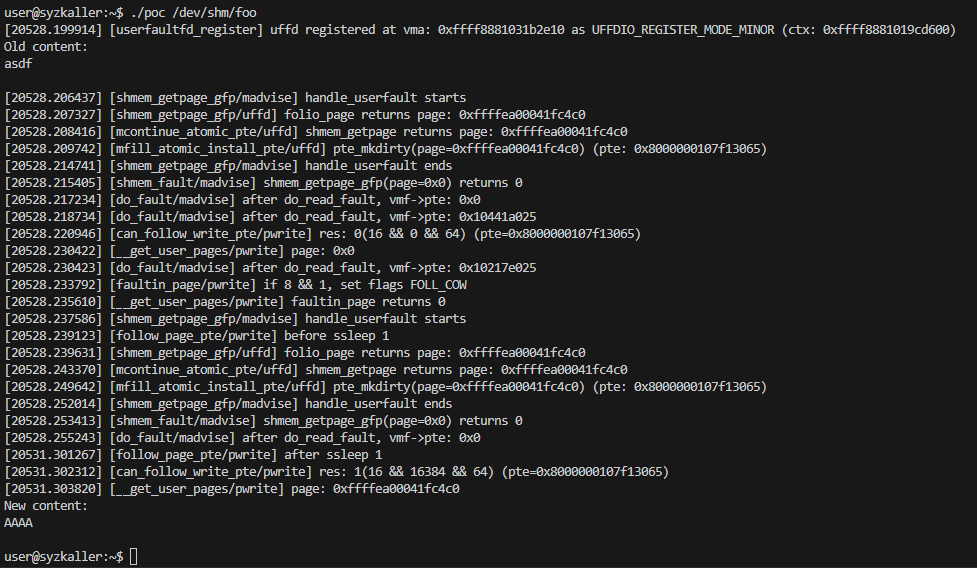
Después de ejecutar el PoC, verás la siguiente pantalla.
lore.kernel patch v1: https://lore.kernel.org/linux-mm/[email protected]/#r
lore.kernel patch v2: https://lore.kernel.org/all/[email protected]/T/#u
