
Skip to content
KitploitKITPLOIT
HerramientasBlog
Enviar
HerramientasBlog
Enviar

¡Herramientas de Hacking, PenTest y Ciberseguridad para tu Arsenal de Seguridad!

Kitploit es un directorio de herramientas de hacking, ciberseguridad y pentesting. Descubre las últimas actualizaciones de proyectos para encontrar vulnerabilidades, analizar sistemas, automatizar pruebas y fortalecer tu seguridad.

··Feeds·Contacto·Privacidad·© 2026 Kitploit

Directorio de Herramientas

Categorías

Ver todas las categorías
Loading categories
decode-spam-headers — Un script que te ayuda a entender por qué tu correo electrónico terminó en Spam | Kitploit
Herramientas/GitHubGitHub/mgeeky/decode-spam-headers
Herramientas de PhishingRecopilación de InformaciónRed TeamingSeguridad de Correo ElectrónicoAnálisis de Registros
GitHubmgeeky/decode-spam-headers

decode-spam-headers

Un script que te ayuda a entender por qué tu correo electrónico terminó en Spam

Ver Repositorio
69898hace 6 mesesRevisado por Kitploit

Más Populares

Ver todos →

Descubre las herramientas más usadas por nuestra comunidad.

Explora todas las herramientas

Explora nuestra colección de herramientas

Ver todas las herramientas →
Compartir

decode-spam-headers.py

Ya sea que estés tratando de entender por qué un correo electrónico específico terminó en SPAM/Correo no deseado para tus tareas administrativas diarias o para tus propósitos de simulación de phishing Red-Team, ¡este script está ahí para ayudarte!

La idea surgió al realizar ejercicios comerciales de simulación de phishing contra un entorno MS Office365 E5, equipado con MS Defender for Office365. Como uno puede imaginar, un stack de seguridad bastante difícil de manejar desde una perspectiva de simulación de phishing. Después de revisar manualmente todos estos encabezados SMTP de Office365 e intentar seleccionar los valores SCL, llegó el momento de escribir un parser adecuado para encabezados SMTP.

El tiempo pasó y fui añadiendo soporte para más y más encabezados SMTP - y aquí lo tenemos. Una herramienta que ahora comprende decenas de encabezados diferentes.

Información

Esta herramienta acepta como entrada un archivo *.EML o *.txt con todos los encabezados SMTP. Luego extraerá un subconjunto de encabezados interesantes y, mediante 105+ pruebas, intentará decodificarlos tanto como sea posible.

Este script también extrae todas las direcciones IPv4 y nombres de dominio, y realiza una resolución DNS completa de los mismos.

La salida resultante contendrá información útil sobre por qué este correo electrónico podría haber sido bloqueado.

Para embellecer tu código HTML de phishing antes de enviarlo a tu cliente, es posible que también quieras pasárselo a mi phishing-HTML-linter.py. Hace un trabajo bastante decente encontrando malos olores en tu HTML que harán que tu correo tenga un aumento en la puntuación de spam.

Capturas de ejemplo

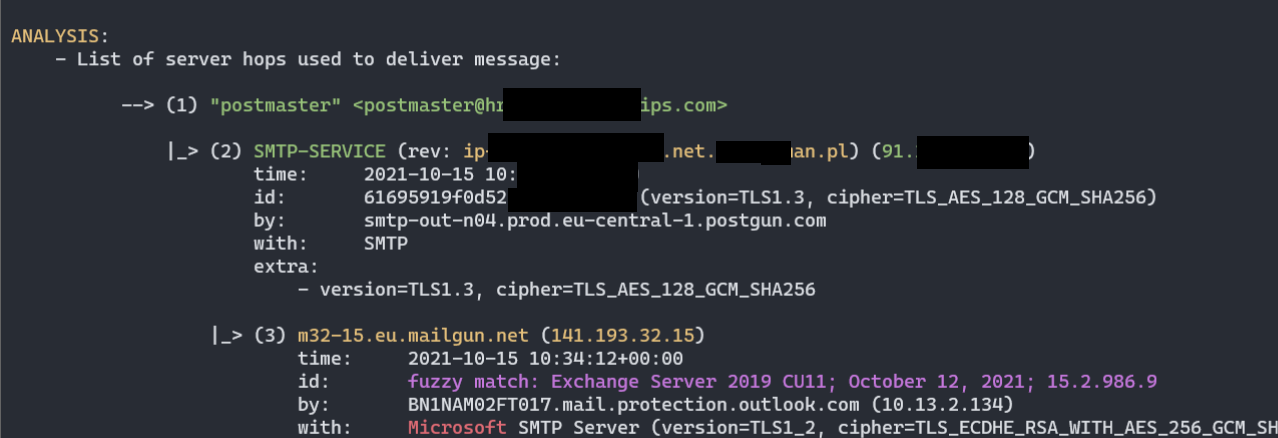
  • Cadena de servidores MTA (encabezados Received correctamente analizados):

1.png

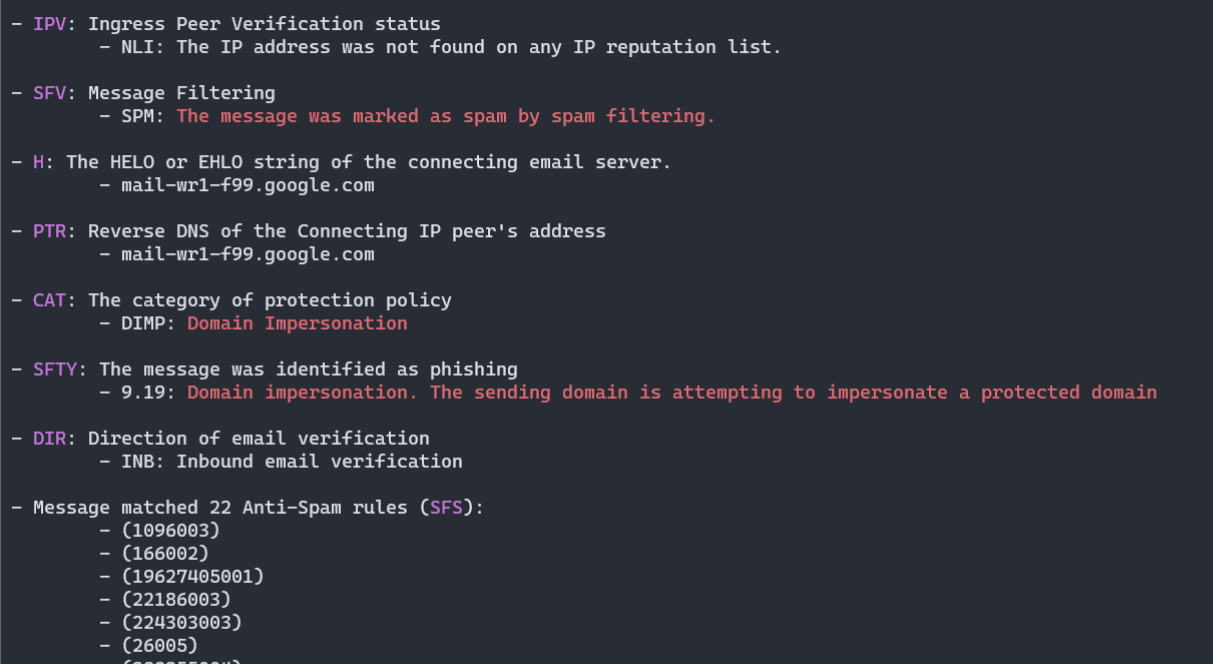
  • Diversos encabezados decodificados tanto como fue posible, según la documentación disponible públicamente (aquí Office365 ForeFront Spam Report):

2.png

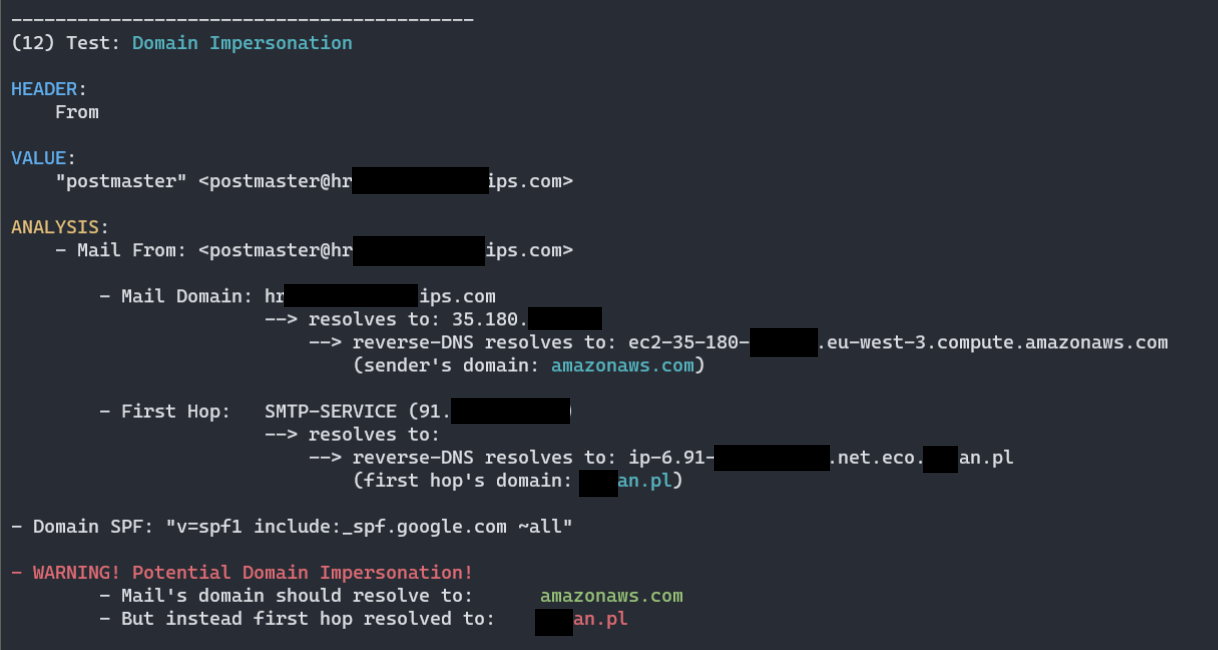
  • Diferentes heurísticas personalizadas implementadas para validar activamente y buscar pistas de categorización de spam; aquí, la lógica que detecta suplantación de dominio:

3.png

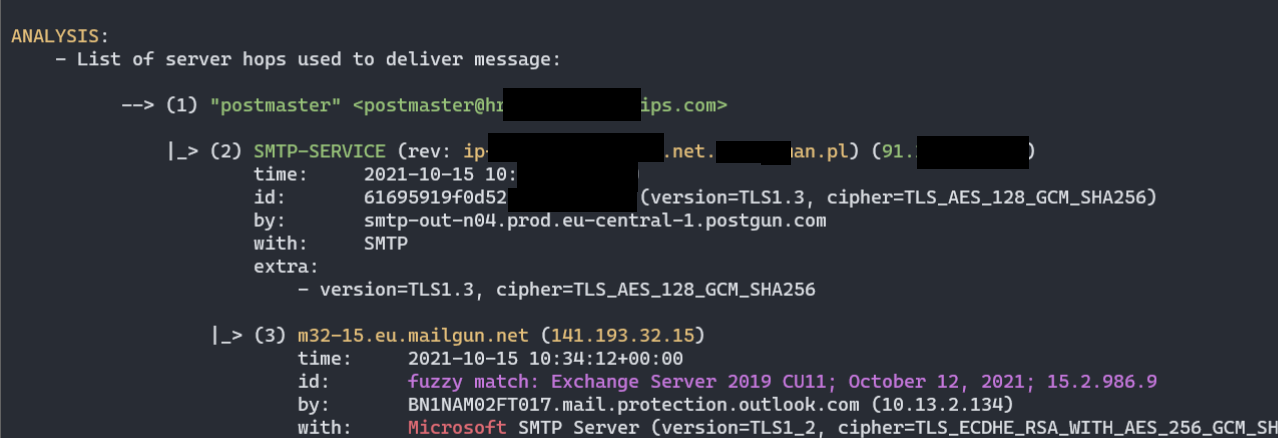
  • El script intenta realizar ingeniería inversa y documentar algunas de las reglas Anti-Spam de Office365, así como recopilar conocimiento público sobre otros encabezados Anti-Spam opacos:

4.png

  • El informe se puede generar en un HTML de buen aspecto (uso: py decode-spam-headers.py headers.txt -f html -o report.html ):
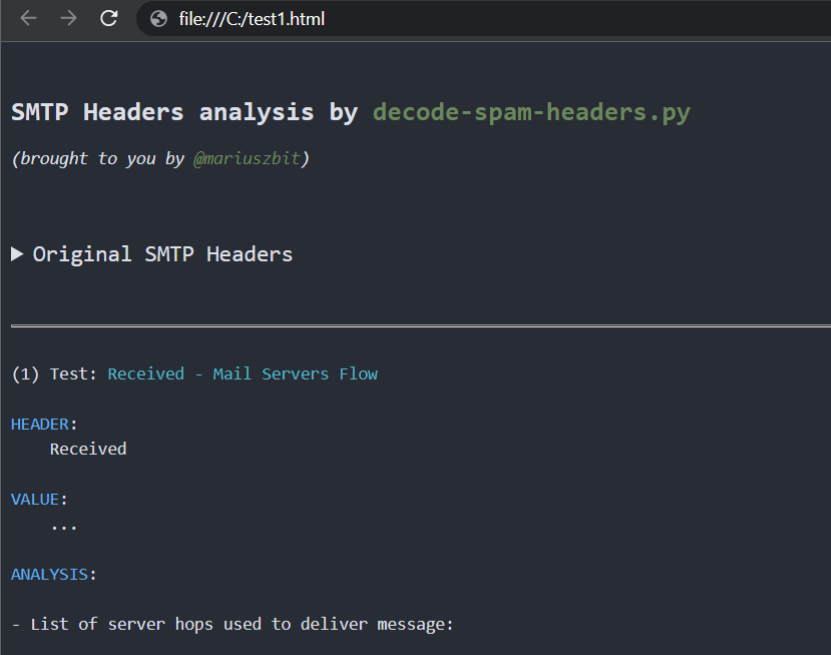
5.png

Encabezados procesados

Encabezados procesados (se analizan más de 85+ encabezados):

  • X-forefront-antispam-report
  • X-exchange-antispam
  • X-exchange-antispam-mailbox-delivery
  • X-exchange-antispam-message-info
  • X-microsoft-antispam-report-cfa-test
  • Received
  • From
  • To
  • Subject
  • Thread-topic
  • Received-spf
  • X-mailer
  • X-originating-ip
  • User-agent

La mayoría de estos encabezados no están completamente documentados, por lo que el script no puede precisar todos los detalles, pero al menos recopila todo lo que pude encontrar sobre ellos.

Esfuerzos de ingeniería inversa

Estoy haciendo esfuerzos significativos para detectar y comprender diferentes reglas Anti-Spam de Office365 ForeFront (SFS, ENG) a pesar de que no están documentadas públicamente.```

(5) Test: X-Forefront-Antispam-Report

HEADER: X-Forefront-Antispam-Report

VALUE: CIP:209.85.167.100;CTRY:US;LANG:de;SCL:5;SRV:;IPV:NLI;SFV:SPM;H:mail-lf1-f100.google.com;PTR:mail-l f1-f100.google.com;CAT:DIMP;SFTY:9.19;SFS:(4636009)(956004)(166002)(6916009)(356005)(336012)(19 625305002)(22186003)(5660300002)(4744005)(6666004)(35100500006)(82960400001)(26005)(7596003)(7636003)(554460 02)(224303003)(1096003)(58800400005)(86362001)(9686003)(43540500002);DIR:INB;SFTY:9.19;

[...]

root@kitploit:~
    - Message matched 24 Anti-Spam rules (SFS):           <============ opaque anti-spam rules
            - (1096003)
            - (166002)
            - (19625305002)
            - (22186003)
            - (224303003)
            - (26005)
            - (336012)
            - (356005)
            - (35100500006)         - (SPAM) Message contained embedded image.
root@kitploit:~
El proceso es puramente manual y recurre al envío de correos diseñados específicamente a los servidores de correo de Office365, y luego a la revisión y correlación manual de las reglas recopiladas.

Habiendo enviado ya más de 60 correos, esto es lo que puedo decir hasta ahora sobre las reglas de Microsoft:```py

    #
    # Below rules were collected solely in a trial-and-error manner or by scraping any 
    # pieces of information from all around the Internet.
    #
    # They do not represent the actual Anti-Spam rule name or context and surely represent 
    # something close to what is understood (or they may have totally different meaning).
    # 
    # Until we'll be able to review anti-spam rules documention, there is no viable mean to map
    # rule ID to its meaning.
    #

    Anti_Spam_Rules_ReverseEngineered = \
    {
        '35100500006' : logger.colored('(SPAM) Message contained embedded image.', 'red'),

        # https://docs.microsoft.com/en-us/answers/questions/416100/what-is-meanings-of-39x-microsoft-antispam-mailbox.html
        '520007050' : logger.colored('(SPAM) Moved message to Spam and created Email Rule to move messages from this particular sender to Junk.', 'red'),

        # triggered on an empty mail with subject being: "test123 - viagra"
        '162623004' : 'Subject line contained suspicious words (like Viagra).',

        # triggered on mail with subject "test123" and body being single word "viagra"
        '19618925003' : 'Mail body contained suspicious words (like Viagra).',

        # triggered on mail with empty body and subject "Click here"
        '28233001' : 'Subject line contained suspicious words luring action (ex. "Click here"). ',

        # triggered on a mail with test subject and 1500 words of http://nietzsche-ipsum.com/
        '30864003' : 'Mail body contained a lot of text (more than 10.000 characters).',

        # mails that had simple message such as "Hello world" triggered this rule, whereas mails with
        # more than 150 words did not.
        '564344004' : 'HTML mail body with less than 150 words of text (not sure how much less though)',

        # message was sent with a basic html and only one <u> tag in body.
        '67856001' : 'HTML mail body contained underline <u> tag.',

        # message with html,head,body and body containing simple text with no b/i/u formatting.
        '579124003' : 'HTML mail body contained text, but no text formatting (<b>, <i>, <u>) was present',

        # This is a strong signal. Mails without <a> doesnt have this rule.
        '166002' : 'HTML mail body contained URL <a> link.',

        # Message contained <a href="https://something.com/file.html?parameter=value" - GET parameter with value.
        '21615005' : 'Mail body contained <a> tag with URL containing GET parameter: ex. href="https://foo.bar/file?aaa=bbb"',

        # Message contained <a href="https://something.com/file.html?parameter=https://another.com/website" 
        # - GET parameter with value, being a URL to another website
        '45080400002' : 'Something about <a> tag\'s URL. Possibly it contained GET parameter with value of another URL: ex. href="https://foo.bar/file?aaa=https://baz.xyz/"',

        # Message contained <a> with href pointing to a file with dangerous extension, such as file.exe
        '460985005' : 'Mail body contained HTML <a> tag with href URL pointing to a file with dangerous extension (such as .exe)',

        #
        # Message1: GoPhish -> VPS 587/tcp redirector -> smtp.gmail.com:587 -> target
        # Message2: GoPhish -> VPS 587/tcp redirector -> smtp-relay.gmail.com:587 -> target
        #
        # These were the only differences I spotted:
        #   Message1 - FirstHop Gmail SMTP Received with ESMTPS.
        #   Message2 - FirstHop Gmail SMTP-Relay Received with ESMTPSA.
        #
        '121216002' : 'First Hop MTA SMTP Server used as a SMTP Relay. It\'s known to originate e-mails, but here it acted as a Relay. Or maybe due to use of "with ESMTPSA" instead of ESMTPS?',

        # Triggered on message with <a> added to HTML: <a href="https://support.spotify.com/is-en/">https://www.reddit.com/</a>
        '966005' : 'Mail body contained link tag with potentially masqueraded URL: <a href="https://attacker.com">https://example.com</a>',

        #
        # Message1: GoPhish EC2 -> another EC2 with socat to smtp.gmail.com:587 (authenticated) -> Target
        # Message2: GoPhish EC2 -> Gsuite -> Target
        #
        # Subject, mail body were exactly the same.
        #
        # Below two rules were added to the second message. My understanding is that they're somehow referring
        # to the reputation of the first-hop server, maybe reverse-DNS resolution.
        #
        '5002400100002' : "(GUESSING) Somehow related to First Hop server reputation, it's reverse-PTR resolution or domain impersonation",
        '58800400005'   : "(GUESSING) Somehow related to First Hop server reputation, it's reverse-PTR resolution or domain impersonation",

        '19625305002' : '(GUESSING) Something to do with the HTML code and used tags/structures',
        '43540500002' : '(GUESSING) Something to do with the HTML code and used tags/structures',

        '460985005' : '(GUESSING) Something to do with either more-complex HTML code or with the <a> tag and its URL.',

        # Triggered on an empty text message, subject "test" - that was marked with "Domain Impersonation", however 
        # ForeFront Anti-Spam headers did not support that Domain Impersonation. Weird.
        '22186003' : '(GUESSING) Something to do with either Text message (non-HTML) or probable Domain Impersonation',

        # Found by @ipSlav (https://github.com/mgeeky/decode-spam-headers/issues/15)
        '42882007' : 'Missing Reply-To Address. Might be fixed by adding -ReplyTo flag to Send-MailMessage',
        '78352004' : 'Missing Reply-To Address. Might be fixed by adding -ReplyTo flag to Send-MailMessage',
    }

Si sabes de alguna otra regla anti-spam de Office365 (o tienes sugerencias para las descritas anteriormente) - házmelo saber en los issues de este repo y lo añadiré enseguida :)

Uso

Instala las dependencias de Python3 necesarias antes del primer uso:``` bash$ pip3 install -r requirements.txt

root@kitploit:~
Ayuda:```
PS> py .\decode-spam-headers.py --help
usage: decode-spam-headers.py [options] <file | --list tests>

optional arguments:
  -h, --help            show this help message and exit

Required arguments:
  infile                Input file to be analysed or --list tests to show available tests.

Options:
  -o OUTFILE, --outfile OUTFILE
                        Output file with report
  -f {json,text,html}, --format {json,text,html}
                        Analysis report format. JSON, text. Default: text
  -N, --nocolor         Dont use colors in text output.
  -v, --verbose         Verbose mode.
  -d, --debug           Debug mode.
  -l, --list            List available tests and quit. Use it like so: --list tests

Tests:
  -i tests, --include-tests tests
                        Comma-separated list of test IDs to run. Ex. --include-tests 1,3,7
  -e tests, --exclude-tests tests
                        Comma-separated list of test IDs to skip. Ex. --exclude-tests 1,3,7
  -r, --resolve         Resolve IPv4 addresses / Domain names.
  -R, --dont-resolve    Do not resolve anything.
  -a, --decode-all      Decode all =?us-ascii?Q? mail encoded messages and print their contents.

Si quieres ejecutar solo un subconjunto de pruebas, primero necesitarás conocer los Test IDs que elegir. Ejecuta el script con -l tests para obtener esa lista.

Lista las pruebas disponibles y sus IDs correspondientes:``` C:> py decode-spam-headers.py -l tests

[.] Available tests:

root@kitploit:~
    TEST_ID - TEST_NAME
    --------------------------------------
          1 - Received - Mail Servers Flow
          2 - Extracted IP addresses
          3 - Extracted Domains
          4 - Bad Keywords In Headers
          5 - Sender Address Analysis
          6 - Subject and Thread Topic Difference
          7 - Authentication-Results
          8 - ARC-Authentication-Results
          9 - Received-SPF
         10 - Mail Client Version
         11 - User-Agent Version
         12 - X-Forefront-Antispam-Report
         13 - X-MS-Exchange-Organization-SCL
         14 - X-Microsoft-Antispam-Mailbox-Delivery
         15 - X-Microsoft-Antispam Bulk Mail
         16 - X-Exchange-Antispam-Report-CFA-Test
         17 - Domain Impersonation
         18 - SpamAssassin Spam Status
         19 - SpamAssassin Spam Level
         20 - SpamAssassin Spam Flag
         21 - SpamAssassin Spam Report
         22 - OVH's X-VR-SPAMCAUSE
         23 - OVH's X-Ovh-Spam-Reason
         24 - OVH's X-Ovh-Spam-Score
         25 - X-Virus-Scan
         26 - X-Spam-Checker-Version
         27 - X-IronPort-AV
         28 - X-IronPort-Anti-Spam-Filtered
         29 - X-IronPort-Anti-Spam-Result
         30 - X-Mimecast-Spam-Score
         31 - Spam Diagnostics Metadata
         32 - MS Defender ATP Message Properties
         33 - Message Feedback Loop
         34 - End-to-End Latency - Message Delivery Time
         36 - X-IP-Spam-Verdict
         37 - X-Amp-Result
         38 - X-IronPort-RemoteIP
         39 - X-IronPort-Reputation
         40 - X-SBRS
         41 - X-IronPort-SenderGroup
         42 - X-Policy
         43 - X-IronPort-MailFlowPolicy
         44 - X-SEA-Spam
         45 - X-FireEye
         46 - X-AntiAbuse
         47 - X-TMASE-Version
         48 - X-TM-AS-Product-Ver
         49 - X-TM-AS-Result
         50 - X-IMSS-Scan-Details
         51 - X-TM-AS-User-Approved-Sender
         52 - X-TM-AS-User-Blocked-Sender
         53 - X-TMASE-Result
         54 - X-TMASE-SNAP-Result
         55 - X-IMSS-DKIM-White-List
         56 - X-TM-AS-Result-Xfilter
         57 - X-TM-AS-SMTP
         58 - X-TMASE-SNAP-Result
         59 - X-TM-Authentication-Results
         60 - X-Scanned-By
         61 - X-Mimecast-Spam-Signature
         62 - X-Mimecast-Bulk-Signature
         63 - X-Forefront-Antispam-Report-Untrusted
         64 - X-Microsoft-Antispam-Untrusted
         65 - X-Mimecast-Impersonation-Protect
         66 - X-Proofpoint-Spam-Details
         67 - X-Proofpoint-Virus-Version
         68 - SPFCheck
         69 - X-Barracuda-Spam-Score
         70 - X-Barracuda-Spam-Status
         71 - X-Barracuda-Spam-Report
         72 - X-Barracuda-Bayes
         73 - X-Barracuda-Start-Time
         74 - Similar to SpamAssassin Spam Level headers
         75 - SMTP Header Contained IP address
         76 - Other unrecognized Spam Related Headers
         77 - Other interesting headers
         78 - Security Appliances Spotted
         79 - Email Providers Infrastructure Clues
         80 - X-Microsoft-Antispam-Message-Info (use -a to show its results)
         81 - Decoded Mail-encoded header values (use -a to show its results)
         82 - Header Containing Client IP
         83 - Office365 Tenant ID
         84 - Organization Name
         85 - MS Defender for Office365 Safe Links Version
         86 - Suspicious Words in Headers
         87 - AWS SES Outgoing
         88 - IronPort-Data
         89 - IronPort-HdrOrder
         90 - X-DKIM
         91 - DKIM-Filter
         92 - X-SpamExperts-Class
         93 - X-SpamExperts-Evidence
         94 - X-Recommended-Action
         95 - X-AppInfo
         96 - X-Spam
         97 - X-TM-AS-MatchedID
         98 - MTA Hostname Exposed
         99 - Office365 First Contact Safety Tip
        100 - EOP - Bypass Focused Inbox
        101 - EOP - Enhanced Filtering - SkipListedInternetSender
        102 - EOP - Enhanced Filtering - ExternalOriginalInternetSender
        103 - Cloudmark Analysis
        104 - The Real Sender - via Authenticated-Sender
        105 - Identified Sender Addresses
        106 - Unsual SMTP headers
root@kitploit:~
### Informe HTML

Para generar el informe HTML - utilice los siguientes parámetros:```
  PS> py decode-spam-headers.py headers.txt -f html -o report.html

Ejemplo de ejecución

Ejemplo de ejecución (la estructura y el contenido de la salida provienen de una versión desactualizada del script):``` PS> py decode-spam-headers.py headers.txt


(1) Test: Received - Mail Servers Flow

HEADER: Received

VALUE: ...

ANALYSIS: - List of server hops used to deliver message:

root@kitploit:~
      --> (1) "attacker" <[email protected]>

           |_> (2) SMTP-SERVICE (44.55.66.77)
                  time: 01 Jan 2021 12:34:20

              |_> (3) mail-wr1-f51.google.com (209.85.221.51)
                      time: 01 Jan 2021 12:34:20
                      version: fuzzy match: Exchange Server 2019 CU11; October 12, 2021; 15.2.986.9

                  |_> (4) SN1NAM02FT0061.eop-nam02.prod.protection.outlook.com (2603:10b6:806:131:cafe::e5)
                          time: 01 Jan 2021 12:34:20
                          version: fuzzy match: Exchange Server 2019 CU11; October 12, 2021; 15.2.986.9

                      |_> (5) SA0PR11CA0138.namprd11.prod.outlook.com (2603:10b6:806:131::23)
                              time: 01 Jan 2021 12:34:20
                              version: fuzzy match: Exchange Server 2019 CU11; October 12, 2021; 15.2.986.9

                          |_> (6) CP2PR80MB4114.lamprd80.prod.outlook.com (2603:10d6:102:3c::15)
                                  time: 01 Jan 2021 12:34:23

                              |_> (7) "Victim Surname" <[email protected]>

[...]


(4) Test: Mail Client Version

HEADER: X-Mailer

VALUE: OEM

ANALYSIS: - X-Mailer header was present and contained value: "OEM".


(5) Test: X-Forefront-Antispam-Report

HEADER: X-Forefront-Antispam-Report

VALUE: CIP:209.85.167.100;CTRY:US;LANG:de;SCL:5;SRV:;IPV:NLI;SFV:SPM;H:mail-lf1-f100.google.com;PTR:mail-l f1-f100.google.com;CAT:DIMP;SFTY:9.19;SFS:(4636009)(956004)(166002)(6916009)(356005)(336012)(19 625305002)(22186003)(5660300002)(4744005)(6666004)(35100500006)(82960400001)(26005)(7596003)(7636003)(554460 02)(224303003)(1096003)(58800400005)(86362001)(9686003)(43540500002);DIR:INB;SFTY:9.19;

ANALYSIS: - Microsoft Office365/Exchange ForeFront Anti-Spam report

root@kitploit:~
    - CIP: Connecting IP address: 209.85.167.100

    - CTRY: The source country as determined by the connecting IP address
            - US

    - LANG: The language in which the message was written
            - de

    - IPV: Ingress Peer Verification status
            - NLI: The IP address was not found on any IP reputation list.

    - SFV: Message Filtering
            - SPM: The message was marked as spam by spam filtering.

    - H: The HELO or EHLO string of the connecting email server.
            - mail-lf1-f100.google.com

    - PTR: Reverse DNS of the Connecting IP peer's address
            - mail-lf1-f100.google.com

    - CAT: The category of protection policy
            - DIMP: Domain Impersonation

    - SFTY: The message was identified as phishing
            - 9.19: Domain impersonation. The sending domain is attempting to impersonate a protected domain

    - DIR: Direction of email verification
            - INB: Inbound email verification

    - Message matched 24 Anti-Spam rules (SFS):
            - (1096003)
            - (166002)
            - (19625305002)
            - (22186003)
            - (224303003)
            - (26005)
            - (336012)
            - (356005)
            - (35100500006)         - (SPAM) Message contained embedded image.
            - (43540500002)
            - (4636009)
            - (4744005)
            - (55446002)
            - (5660300002)
            - (58800400005)
            - (6666004)
            - (6916009)
            - (7596003)
            - (7636003)
            - (82960400001)
            - (86362001)
            - (956004)
            - (9686003)

    - SCL: Spam Confidence Level: 5
            - SPAM: Spam filtering marked the message as Spam

More information: - https://docs.microsoft.com/en-us/microsoft-365/security/office-365-security/anti-spam-message-headers - https://docs.microsoft.com/en-us/exchange/antispam-and-antimalware/antispam-protection/antispam-stamps - https://docs.microsoft.com/en-us/microsoft-365/security/office-365-security/spam-confidence-levels - https://docs.microsoft.com/en-us/exchange/monitoring/trace-an-email-message/run-a-message-trace-and-view-results


(6) Test: X-Microsoft-Antispam-Mailbox-Delivery

HEADER: X-Microsoft-Antispam-Mailbox-Delivery

VALUE: ucf:0;jmr:1;auth:0;dest:J;ENG:(910001)(944506458)(944626604)(750132)(520011016);

ANALYSIS: - This header denotes what to do with received message, where to put it.

root@kitploit:~
    - auth: Message originating from Authenticated sender
            - 0: Not Authenticated

    - dest: Destination where message should be placed
            - J: JUNK directory

    - Message matched 6 Anti-Spam Delivery rules:
            - (520011016)
            - (750132)
            - (910001)
            - (944506458)
            - (944626604)

(7) Test: X-Microsoft-Antispam Bulk Mail

HEADER: X-Microsoft-Antispam VALUE: BCL:0;

ANALYSIS: - BCL: BULK Confidence Level: 0 The message isn't from a bulk sender.

root@kitploit:~
More information:
            - https://docs.microsoft.com/en-us/microsoft-365/security/office-365-security/bulk-complaint-level-values

[...]


(10) Test: MS Defender ATP Message Properties

HEADER: X-MS-Exchange-AtpMessageProperties

VALUE: SA|SL

ANALYSIS: - MS Defender Advanced Threat Protection enabled following protections on this message: - Safe Attachments Protection - Safe Links Protection


(11) Test: Domain Impersonation

HEADER: From

VALUE: "attacker" [email protected]

ANALYSIS: - Mail From: [email protected]

root@kitploit:~
            - Mail Domain: attacker.com
                   --> resolves to: 11.22.33.44
                       --> reverse-DNS resolves to: ec2-11-22-33-44.eu-west-3.compute.amazonaws.com
                           (sender's domain: amazonaws.com)

            - First Hop:   SMTP-SERVICE (44.55.66.77)
                   --> resolves to:
                       --> reverse-DNS resolves to: host44-55-66-77.static.arubacloud.pl
                           (first hop's domain: arubacloud.pl)

    - Domain SPF: "v=spf1 include:_spf.google.com ~all"

    - WARNING! Potential Domain Impersonation!
            - Mail's domain should resolve to:      amazonaws.com
            - But instead first hop resolved to:    arubacloud.pl
root@kitploit:~
---

### Créditos

- [ipSlav](https://github.com/ipSlav) - por [identificar dos reglas opacas de Office365](https://github.com/mgeeky/decode-spam-headers/issues/15): `42882007` y `78352004`

---

### Problemas Conocidos

- El método `getOffice365TenantNameById(tenantID)` aún no está terminado; conozco algunas formas de mapear el GUID de inquilino de Office365 al nombre de inquilino, pero aún no he podido establecer una forma estable de hacerlo.
- La cabecera `Authentication-Results` aún no está completamente analizada: hay que incluir el procesamiento de `reason` y otros campos según la [documentación de Microsoft](https://docs.microsoft.com/en-us/microsoft-365/security/office-365-security/anti-spam-message-headers?view=o365-worldwide)

---

### ☕ Muestra tu Apoyo ☕

Este y otros proyectos son el resultado de noches sin dormir y **mucho trabajo duro**. Si te gusta lo que hago y aprecias que siempre devuelvo algo a la comunidad,
[Considera invitarme a un café](https://github.com/sponsors/mgeeky) _(o mejor una cerveza)_ solo para decir ¡gracias! 💪 

---```
Mariusz Banach / mgeeky, (@mariuszbit)
<mb [at] binary-offensive.com>
Descargar herramienta
  • X-forefront-antispam-report
  • X-microsoft-antispam-mailbox-delivery
  • X-microsoft-antispam
  • X-exchange-antispam-report-cfa-test
  • X-spam-status
  • X-spam-level
  • X-spam-flag
  • X-spam-report
  • X-vr-spamcause
  • X-ovh-spam-reason
  • X-vr-spamscore
  • X-virus-scanned
  • X-spam-checker-version
  • X-ironport-av
  • X-ironport-anti-spam-filtered
  • X-ironport-anti-spam-result
  • X-mimecast-spam-score
  • Spamdiagnosticmetadata
  • X-ms-exchange-atpmessageproperties
  • X-msfbl
  • X-ms-exchange-transport-endtoendlatency
  • X-ms-oob-tlc-oobclassifiers
  • X-ip-spam-verdict
  • X-amp-result
  • X-ironport-remoteip
  • X-ironport-reputation
  • X-sbrs
  • X-ironport-sendergroup
  • X-policy
  • X-ironport-mailflowpolicy
  • X-remote-ip
  • X-sea-spam
  • X-fireeye
  • X-antiabuse
  • X-tmase-version
  • X-tm-as-product-ver
  • X-tm-as-result
  • X-imss-scan-details
  • X-tm-as-user-approved-sender
  • X-tm-as-user-blocked-sender
  • X-tmase-result
  • X-tmase-snap-result
  • X-imss-dkim-white-list
  • X-tm-as-result-xfilter
  • X-tm-as-smtp
  • X-scanned-by
  • X-mimecast-spam-signature
  • X-mimecast-bulk-signature
  • X-sender-ip
  • X-forefront-antispam-report-untrusted
  • X-microsoft-antispam-untrusted
  • X-sophos-senderhistory
  • X-sophos-rescan
  • X-MS-Exchange-CrossTenant-Id
  • X-OriginatorOrg
  • IronPort-Data
  • IronPort-HdrOrdr
  • X-DKIM
  • DKIM-Filter
  • X-SpamExperts-Class
  • X-SpamExperts-Evidence
  • X-Recommended-Action
  • X-AppInfo
  • X-Spam
  • X-TM-AS-MatchedID
  • X-MS-Exchange-EnableFirstContactSafetyTip
  • X-MS-Exchange-Organization-BypassFocusedInbox
  • X-MS-Exchange-SkipListedInternetSender
  • X-MS-Exchange-ExternalOriginalInternetSender
  • X-CNFS-Analysis
  • X-Authenticated-Sender
  • X-Apparently-From
  • X-Env-Sender
  • Sender