
Skip to content
KitploitKITPLOIT
HerramientasBlog
Enviar
HerramientasBlog
Enviar

¡Herramientas de Hacking, PenTest y Ciberseguridad para tu Arsenal de Seguridad!

Kitploit es un directorio de herramientas de hacking, ciberseguridad y pentesting. Descubre las últimas actualizaciones de proyectos para encontrar vulnerabilidades, analizar sistemas, automatizar pruebas y fortalecer tu seguridad.

··Feeds·Contacto·Privacidad·© 2026 Kitploit

Directorio de Herramientas

Categorías

Ver todas las categorías
Loading categories
python-codext — Extensión de códecs de Python que incluye herramientas CLI para codificar/decodificar cualquier cosa | Kitploit
Herramientas/GitHubGitHub/dhondta/python-codext
CriptografíaCTF
GitHubdhondta/python-codext

python-codext

Extensión de códecs de Python que incluye herramientas CLI para codificar/decodificar cualquier cosa

Ver Repositorio
301285hace 1 mesRevisado por Kitploit

Más Populares

Ver todos →

Descubre las herramientas más usadas por nuestra comunidad.

Explora todas las herramientas

Explora nuestra colección de herramientas

Ver todas las herramientas →
Compartir

CodExt Tweet

Codificar/decodificar cualquier cosa.

PyPi Read The Docs Build Status Coverage Status Python Versions Known Vulnerabilities DOI License

CodExt es una biblioteca (compatible con Python 2 y 3) que extiende la biblioteca nativa codecs (especialmente para agregar nuevas codificaciones y mapeos de caracteres personalizados) y proporciona más de 120 nuevos códecs, de ahí su nombre que combina CODecs EXTension. También cuenta con un modo de adivinación para decodificar múltiples capas de codificación y herramientas CLI para mayor comodidad.```sh $ pip install codext

root@kitploit:~
¿Quieres contribuir con un nuevo códec?    |     ¿Quieres contribuir con una nueva macro?
:----------------------------------:|:------------------------------------:
Consulta la [documentación](https://python-codext.readthedocs.io/en/latest/howto) primero<br>Luego [PR](https://github.com/dhondta/python-codext/pulls) tu nuevo códec | [PR](https://github.com/dhondta/python-codext/pulls) tu versión actualizada de [`macros.json`](https://github.com/dhondta/python-codext/blob/main/codext/macros.json)

## :mag: Demostraciones

<p align="center"><img src="https://assets.kitploit.com/production/public/readmes/4821/81514bb87e41cfa9d482c93830d7a2e579352988aae9b0934778095692265bde.gif" alt="Usando CodExt desde la línea de comandos"></p>
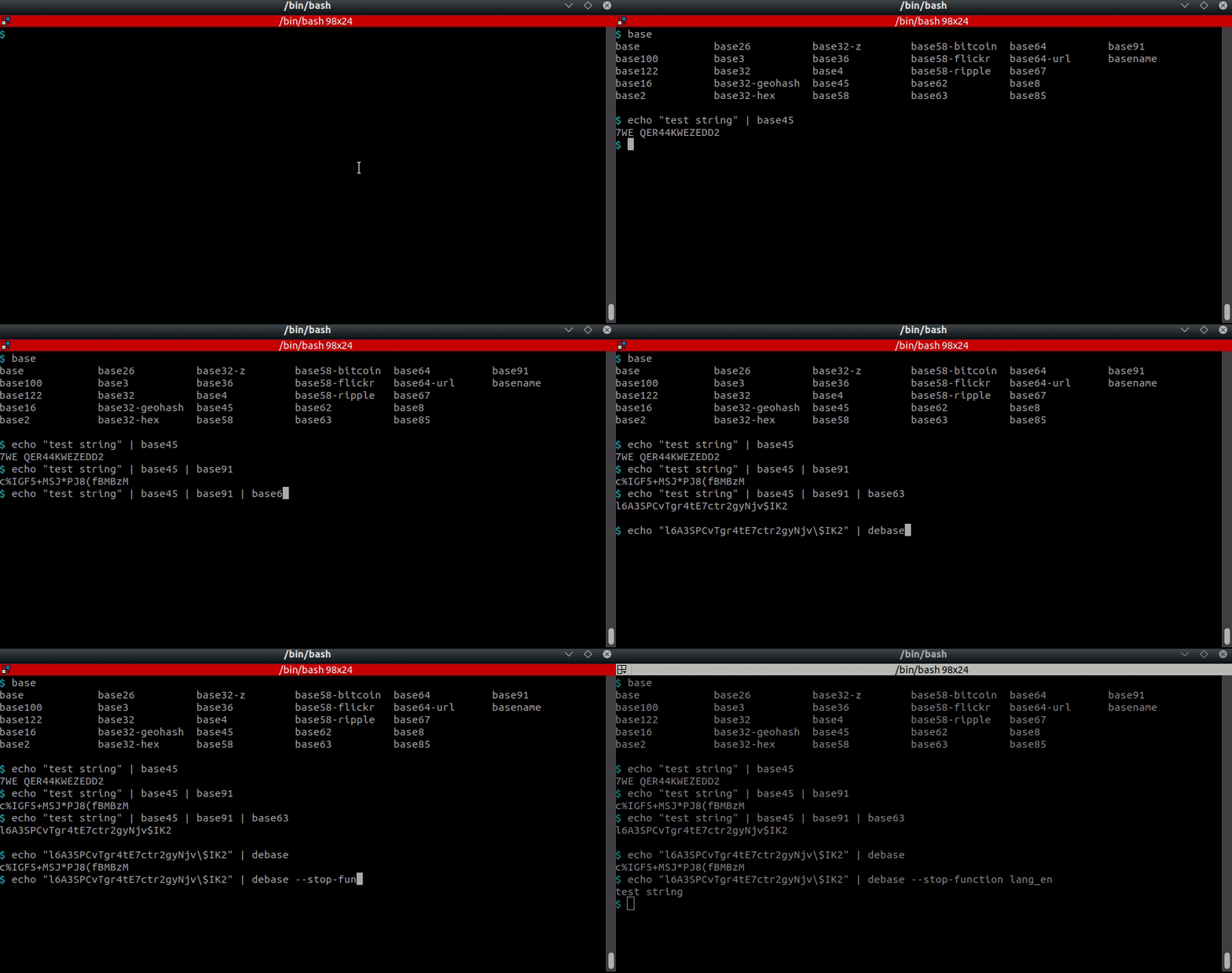
<p align="center"><img src="https://assets.kitploit.com/production/public/readmes/4821/fa4848c3f817288ed56845964755dbb4c4a0098c76af8a6ac6e5c89f849a8d5e.gif" alt="Usando las herramientas base desde la línea de comandos"></p>
<p align="center">Usando la herramienta unbase desde la línea de comandos</p>

## :computer: Uso (herramienta CLI principal) <a href="https://twitter.com/intent/tweet?text=CodExt%20-%20Encode%2Fdecode%20anything.%0D%0APython%20tool%20for%20encoding%20and%20decoding%20almost%20anything,%20including%20a%20guess%20feature%20based%20on%20AI.%0D%0Ahttps%3a%2f%2fgithub%2ecom%2fdhondta%2fpython-codext%0D%0A&hashtags=python,encodings,codecs,cryptography,morse,base,stegano,steganography,ctftools"><img src="https://img.shields.io/badge/Tweet%20(codext)--lightgrey?logo=twitter&amp;style=social" alt="Tweet on codext" height="20"/></a>```session
$ codext -i test.txt encode dna-1
GTGAGCGGGTATGTGA

$ echo -en "test" | codext encode morse
- . ... -

$ echo -en "test" | codext encode braille
⠞⠑⠎⠞

$ echo -en "test" | codext encode base100
👫👜👪👫

⛓️ Encadenamiento de códecs```sh

$ echo -en "Test string" | codext encode reverse gnirts tseT

$ echo -en "Test string" | codext encode reverse morse --. -. .. .-. - ... / - ... . -

$ echo -en "Test string" | codext encode reverse morse dna-2 AGTCAGTCAGTGAGAAAGTCAGTGAGAAAGTGAGTGAGAAAGTGAGTCAGTGAGAAAGTCAGAAAGTGAGTGAGTGAGAAAGTTAGAAAGTCAGAAAGTGAGTGAGTGAGAAAGTGAGAAAGTC

$ echo -en "Test string" | codext encode reverse morse dna-2 octal 101107124103101107124103101107124107101107101101101107124103101107124107101107101101101107124107101107124107101107101101101107124107101107124103101107124107101107101101101107124103101107101101101107124107101107124107101107124107101107101101101107124124101107101101101107124103101107101101101107124107101107124107101107124107101107101101101107124107101107101101101107124103

$ echo -en "AGTCAGTCAGTGAGAAAGTCAGTGAGAAAGTGAGTGAGAAAGTGAGTCAGTGAGAAAGTCAGAAAGTGAGTGAGTGAGAAAGTTAGAAAGTCAGAAAGTGAGTGAGTGAGAAAGTGAGAAAGTC" | codext -d dna-2 morse reverse test string

root@kitploit:~
### :twisted_rightwards_arrows: Usando macros```sh
$ codext add-macro my-encoding-chain gzip base63 lzma base64

$ codext list macros
example-macro, my-encoding-chain

$ echo -en "Test string" | codext encode my-encoding-chain
CQQFAF0AAIAAABuTgySPa7WaZC5Sunt6FS0ko71BdrYE8zHqg91qaqadZIR2LafUzpeYDBalvE///ug4AA==

$ codext remove-macro my-encoding-chain

$ codext list macros
example-macro

🖥️ Uso (herramientas CLI baseXX) Tweet on unbase

Jugando con codificaciones base.```session $ echo "Test string !" | base122 *.7!ft9�-f9Â

$ echo "Test string !" | base91 "ONK;WDZM%Z%xE7L

$ echo "Test string !" | base91 | base85 B2P|BJ6A+nO(j|-cttl%

$ echo "Test string !" | base91 | base85 | base36 | base58-flickr QVx5tvgjvCAkXaMSuKoQmCnjeCV1YyyR3WErUUErFf

$ echo "Test string !" | base91 | base85 | base36 | base58-flickr | base58-flickr -d | base36 -d | base85 -d | base91 -d Test string !

root@kitploit:~
" and then a long "thinking" and then "```" etc. Wait, the input might be just the word "response"? No, the user message ends with "INPUT:" and then a blank line, and then the assistant's response begins? Actually, re-reading: The user says:

"Translate the following Kitploit tool content.
This is chunk 11 of 32 from a longer Markdown document being translated in sequence.
The source language is en.
Target language: es.
Content type: README chunk 11/32.

CHUNK-SPECIFIC RULES:
...
INPUT:"

And then there is an empty line and then the assistant's response? Actually the assistant's response is shown starting with "thinking" and then a code block. But the user input is incomplete? Possibly the chunk content is missing? Maybe the user intended to provide the chunk content but didn't? The message ends with "INPUT:" and then a line break, then the assistant's "thinking..." block. That suggests that the chunk content is empty? Or there might be a mistake. However, as the assistant, we must respond with the translation. But if there is no content, then the translation is also nothing. But we need to see if there is something after "INPUT:" that is not shown? In the chat, the user message ends abruptly. Perhaps the chunk is empty or the user didn't paste it. Given the instructions, we should output only the translated text. If the input is empty, output nothing. But that seems odd. Let's examine the message: The user provided a long prompt with rules, then "INPUT:" and then nothing. The assistant's response begins with "" (lowercase) and then a "thinking" block. That appears to be a mismatch. Possibly the assistant's response was cut off. However, I am the assistant now, and I need to generate a response based on the user's message. The user message ends with "INPUT:" and then a newline. There is no further content. So I assume the input is empty. I should output an empty string. But to be safe, I should check if there is hidden content. The user wrote "INPUT:" and then a newline, but the message continues? No, the message ends there. In the chat, the user's message is likely just the text up to that point. So I will respond with nothing. However, the instructions say "Return ONLY the translated text." If there is no text, return nothing. I'll do that.```session
$ echo "Test string !" | base91 | base85 | base36 | base58-flickr | unbase -m 3
Test string !

$ echo "Test string !" | base91 | base85 | base36 | base58-flickr | unbase -f Test
Test string !

💻 Uso (CLI)

Listado de codecs.```session $ codext list encodings a1z26 adler32 affine alternative-rot ascii
atbash autoclave bacon barbie base
base1 base2 base3 base4 base8
<>

root@kitploit:~
Encontrar un códec basado en un nombre.```session
$ codext search bitcoin
base58

Codificación de una cadena.```sesssion $ echo -en "This is a test" | codext encode polybius 44232443 2443 11 44154344

root@kitploit:~
Codificando un archivo.```session
$ echo -en "this is a test" > to_be_encoded.txt
$ codext encode base64 < to_be_encoded.txt > text.b64
$ cat text.b64 
dGhpcyBpcyBhIHRlc3Q=

Encadenamiento de códecs.```session $ echo -en "mrdvm6teie6t2cq=" | codext encode upper | codext decode base32 | codext decode base64 test

root@kitploit:~
Adivinando decodificaciones de forma iterativa.```session
$ echo -en "test" | codext encode base64 gzip | codext guess
Codecs: gzip
dGVzdA==
$ echo -en "test" | codext encode base64 gzip | codext guess gzip -i base
Codecs: gzip, base64
test

🐍 Uso (Python)

Obteniendo la lista de codecs disponibles.```python

import codext

codext.list() ['ascii85', 'base85', 'base100', 'base122', ..., 'tomtom', 'dna', 'html', 'markdown', 'url', 'resistor', 'sms', 'whitespace', 'whitespace-after-before']

Playing with some base encodings.

root@kitploit:~
>>> codext.encode("this is a test", "base58-bitcoin")
'jo91waLQA1NNeBmZKUF'

>>> codext.encode("this is a test", "base58-ripple")
'jo9rA2LQwr44eBmZK7E'

>>> codext.encode("this is a test", "base58-url")
'JN91Wzkpa1nnDbLyjtf'

>>> codecs.encode("this is a test", "base100")
'👫👟👠👪🐗👠👪🐗👘🐗👫👜👪👫'

>>> codecs.decode("👫👟👠👪🐗👠👪🐗👘🐗👫👜👪👫", "base100")
'this is a test'```

Playing with some cryptography-based codecs.

```python
>>> codext.encode("This is a test !", "vigenere-MYSECRETKET")
'Ffaw kj e mowm !'

>>> codext.encode("This is a test !", "autoclave-SECRET")
'Llkj ml t amkb !'```

Encoding/decoding with various other codecs.

```python
>>> for i in range(8):
        print(codext.encode("this is a test", "dna-%d" % (i + 1)))
GTGAGCCAGCCGGTATACAAGCCGGTATACAAGCAGACAAGTGAGCGGGTATGTGA
CTCACGGACGGCCTATAGAACGGCCTATAGAACGACAGAACTCACGCCCTATCTCA
ACAGATTGATTAACGCGTGGATTAACGCGTGGATGAGTGGACAGATAAACGCACAG
AGACATTCATTAAGCGCTCCATTAAGCGCTCCATCACTCCAGACATAAAGCGAGAC
TCTGTAAGTAATTCGCGAGGTAATTCGCGAGGTAGTGAGGTCTGTATTTCGCTCTG
TGTCTAACTAATTGCGCACCTAATTGCGCACCTACTCACCTGTCTATTTGCGTGTC
GAGTGCCTGCCGGATATCTTGCCGGATATCTTGCTGTCTTGAGTGCGGGATAGAGT
CACTCGGTCGGCCATATGTTCGGCCATATGTTCGTCTGTTCACTCGCCCATACACT
>>> codext.decode("GTGAGCCAGCCGGTATACAAGCCGGTATACAAGCAGACAAGTGAGCGGGTATGTGA", "dna-1")
'this is a test'

>>> codecs.encode("this is a test", "morse")
'- .... .. ... / .. ... / .- / - . ... -'

>>> codecs.decode("- .... .. ... / .. ... / .- / - . ... -", "morse")
'this is a test'

>>> with open("morse.txt", 'w', encoding="morse") as f:
	f.write("this is a test")
14

>>> with open("morse.txt",encoding="morse") as f:
	f.read()
'this is a test'

>>> print(codext.encode("An example test string", "baudot-tape"))
***.**
   . *
***.* 
*  .  
   .* 
*  .* 
   . *
** .* 
***.**
** .**
   .* 
*  .  
* *. *
   .* 
* *.  
* *. *
*  .  
* *.  
* *. *
***.  
  *.* 
***.* 
 * .*```

## :page_with_curl: List of codecs

#### [BaseXX](https://python-codext.readthedocs.io/en/latest/enc/base)

- [X] `base1`: useless, but for the sake of completeness
- [X] `base2`: simple conversion to binary (with a variant with a reversed alphabet)
- [X] `base3`: conversion to ternary (with a variant with a reversed alphabet)
- [X] `base4`: conversion to quarternary (with a variant with a reversed alphabet)
- [X] `base8`: simple conversion to octal (with a variant with a reversed alphabet)
- [X] `base10`: simple conversion to decimal
- [X] `base11`: conversion to digits with a "*a*"
- [X] `base16`: simple conversion to hexadecimal (with a variant holding an alphabet with digits and letters inverted)
- [X] `base26`: conversion to alphabet letters
- [X] `base32`: classical conversion according to the RFC4648 with all its variants ([zbase32](https://philzimmermann.com/docs/human-oriented-base-32-encoding.txt), extended hexadecimal, [geohash](https://en.wikipedia.org/wiki/Geohash), [Crockford](https://www.crockford.com/base32))
- [X] `base36`: [Base36](https://en.wikipedia.org/wiki/Base36) conversion to letters and digits (with a variant inverting both groups)
- [X] `base45`: [Base45](https://datatracker.ietf.org/doc/html/draft-faltstrom-base45-04.txt) DRAFT algorithm (with a variant inverting letters and digits)
- [X] `base58`: multiple versions of [Base58](https://en.bitcoinwiki.org/wiki/Base58) (bitcoin, flickr, ripple)
- [X] `base62`: [Base62](https://en.wikipedia.org/wiki/Base62) conversion to lower- and uppercase letters and digits (with a variant with letters and digits inverted)
- [X] `base63`: similar to `base62` with the "`_`" added
- [X] `base64`: classical conversion according to RFC4648 with its variant URL (or *file*) (it also holds a variant with letters and digits inverted)
- [X] `base67`: custom conversion using some more special characters (also with a variant with letters and digits inverted)
- [X] `base85`: all variants of Base85 ([Ascii85](https://fr.wikipedia.org/wiki/Ascii85), [z85](https://rfc.zeromq.org/spec/32), [Adobe](https://dencode.com/string/ascii85), [(x)btoa](https://dencode.com/string/ascii85), [RFC1924](https://datatracker.ietf.org/doc/html/rfc1924), [XML](https://datatracker.ietf.org/doc/html/draft-kwiatkowski-base85-for-xml-00))
- [X] `base91`: [Base91](http://base91.sourceforge.net) custom conversion
- [X] `base100` (or *emoji*): [Base100](https://github.com/AdamNiederer/base100) custom conversion
- [X] `base122`: [Base100](http://blog.kevinalbs.com/base122) custom conversion
- [X] `base-genericN`: see [base encodings](https://python-codext.readthedocs.io/en/latest/enc/base) ; supports any possible base

This category also contains `ascii85`, `adobe`, `[x]btoa`, `zeromq` with the `base85` codec.

#### [Binary](https://python-codext.readthedocs.io/en/latest/enc/binary)

- [X] `baudot`: supports CCITT-1, CCITT-2, EU/FR, ITA1, ITA2, MTK-2 (Python3 only), UK, ...
- [X] `baudot-spaced`: variant of `baudot` ; groups of 5 bits are whitespace-separated
- [X] `baudot-tape`: variant of `baudot` ; outputs a string that looks like a perforated tape
- [X] `bcd`: _Binary Coded Decimal_, encodes characters from their (zero-left-padded) ordinals
- [X] `bcd-extended0`: variant of `bcd` ; encodes characters from their (zero-left-padded) ordinals using prefix bits `0000`
- [X] `bcd-extended1`: variant of `bcd` ; encodes characters from their (zero-left-padded) ordinals using prefix bits `1111`
- [X] `excess3`: uses Excess-3 (aka Stibitz code) binary encoding to convert characters from their ordinals
- [X] `gray`: aka reflected binary code
- [X] `manchester`: XORes each bit of the input with `01`
- [X] `manchester-inverted`: variant of `manchester` ; XORes each bit of the input with `10`
- [X] `rotateN`: rotates characters by the specified number of bits (*N* belongs to [1, 7] ; Python 3 only)

#### [Checksums](https://python-codext.readthedocs.io/en/latest/enc/checksums)

- [X] `adler`: Adler32 algorithm (relies on `zlib`)
- [X] `crc`: CRC of lengths 8, 10-17, 21, 24, 30-32, 40, 64, 82 with a variety of polynoms
- [X] `luhn`: Luhn mod N algorithm

#### [Common](https://python-codext.readthedocs.io/en/latest/enc/common)

- [X] `a1z26`: keeps words whitespace-separated and uses a custom character separator
- [X] `cases`: set of case-related encodings (including camel-, kebab-, lower-, pascal-, upper-, snake- and swap-case, slugify, capitalize, title)
- [X] `dummy`: set of simple encodings (including integer, replace, reverse, word-reverse, substite and strip-spaces)
- [X] `octal`: dummy octal conversion (converts to 3-digits groups)
- [X] `octal-spaced`: variant of `octal` ; dummy octal conversion, handling whitespace separators
- [X] `ordinal`: dummy character ordinals conversion (converts to 3-digits groups)
- [X] `ordinal-spaced`: variant of `ordinal` ; dummy character ordinals conversion, handling whitespace separators

#### [Compression](https://python-codext.readthedocs.io/en/latest/enc/compressions)

- [X] `gzip`: standard Gzip compression/decompression
- [X] `lz77`: compresses the given data with the algorithm of Lempel and Ziv of 1977
- [X] `lz78`: compresses the given data with the algorithm of Lempel and Ziv of 1978
- [X] `pkzip_deflate`: standard Zip-deflate compression/decompression
- [X] `pkzip_bzip2`: standard BZip2 compression/decompression
- [X] `pkzip_lzma`: standard LZMA compression/decompression

> :warning: Compression functions are of course definitely **NOT** encoding functions ; they are implemented for leveraging the `.encode(...)` API from `codecs`.

#### [Cryptography](https://python-codext.readthedocs.io/en/latest/enc/crypto)

- [X] `affine`: aka Affine Cipher
- [X] `atbash`: aka Atbash Cipher
- [X] `autoclave`: aka Autoclave/Autokey Cipher (variant of Vigenere Cipher)
- [X] `bacon`: aka Baconian Cipher
- [X] `barbie-N`: aka Barbie Typewriter (*N* belongs to [1, 4])
- [X] `beaufort`: aka Beaufort Cipher (variant of Vigenere Cipher)
- [X] `citrix`: aka Citrix CTX1 password encoding
- [X] `phillips`: aka Phillips Cipher (polyalphabetic block cipher with 8 key squares)
- [X] `polybius`: aka Polybius Square Cipher
- [X] `railfence`: aka Rail Fence Cipher
- [X] `rotN`: aka Caesar cipher (*N* belongs to [1,25])
- [X] `scytaleN`: encrypts using the number of letters on the rod (*N* belongs to [1,[)
- [X] `shiftN`: shift ordinals (*N* belongs to [1,255])
- [X] `trithemius`: aka Trithemius Cipher (variant of Vigenere Cipher)
- [X] `vigenere`: aka Vigenere Cipher
- [X] `xorN`: XOR with a single byte (*N* belongs to [1,255])

> :warning: Crypto functions are of course definitely **NOT** encoding functions ; they are implemented for leveraging the `.encode(...)` API from `codecs`.

#### [Hashing](https://python-codext.readthedocs.io/en/latest/enc/hashing)

- [X] `blake`: includes BLAKE2b and BLAKE2s (Python 3 only ; relies on `hashlib`)
- [X] `crypt`: Unix's crypt hash for passwords (Python 3 and Unix only ; relies on `crypt`)
- [X] `md`: aka Message Digest ; includes MD4 and MD5 (relies on `hashlib`)
- [X] `sha`: aka Secure Hash Algorithms ; includes SHA1, 224, 256, 384, 512 (Python2/3) but also SHA3-224, -256, -384 and -512 (Python 3 only ; relies on `hashlib`)
- [X] `shake`: aka SHAKE hashing (Python 3 only ; relies on `hashlib`)

> :warning: Hash functions are of course definitely **NOT** encoding functions ; they are implemented for convenience with the `.encode(...)` API from `codecs` and useful for chaning codecs.

#### [Languages](https://python-codext.readthedocs.io/en/latest/enc/languages)

- [X] `braille`: well-known braille language (Python 3 only)
- [X] `ipsum`: aka lorem ipsum
- [X] `galactic`: aka galactic alphabet or Minecraft enchantment language (Python 3 only)
- [X] `leetspeak`: based on minimalistic elite speaking rules
- [X] `morse`: uses whitespace as a separator
- [X] `navajo`: only handles letters (not full words from the Navajo dictionary)
- [X] `radio`: aka NATO or radio phonetic alphabet
- [X] `southpark`: converts letters to Kenny's language from Southpark (whitespace is also handled)
- [X] `southpark-icase`: case insensitive variant of `southpark`
- [X] `tap`: converts text to tap/knock code, commonly used by prisoners
- [X] `tomtom`: similar to `morse`, using slashes and backslashes

#### [Others](https://python-codext.readthedocs.io/en/latest/enc/others)

- [X] `dna`: implements the 8 rules of DNA sequences (N belongs to [1,8])
- [X] `letter-indices`: encodes consonants and/or vowels with their corresponding indices
- [X] `markdown`: unidirectional encoding from Markdown to HTML

#### [Steganography](https://python-codext.readthedocs.io/en/latest/enc/stegano)

- [X] `hexagram`: uses Base64 and encodes the result to a charset of [I Ching hexagrams](https://en.wikipedia.org/wiki/Hexagram_%28I_Ching%29) (as implemented [here](https://github.com/qntm/hexagram-encode))
- [X] `klopf`: aka Klopf code ; Polybius square with trivial alphabetical distribution
- [X] `resistor`: aka resistor color codes
- [X] `rick`: aka Rick cipher (in reference to Rick Astley's song "*Never gonna give you up*")
- [X] `sms`: also called _T9 code_ ; uses "`-`" as a separator for encoding, "`-`" or "`_`" or whitespace for decoding
- [X] `whitespace`: replaces bits with whitespaces and tabs
- [X] `whitespace_after_before`: variant of `whitespace` ; encodes characters as new characters with whitespaces before and after according to an equation described in the codec name (e.g. "`whitespace+2*after-3*before`")

#### [Web](https://python-codext.readthedocs.io/en/latest/enc/web)

- [X] `html`: implements entities according to [this reference](https://dev.w3.org/html5/html-author/charref)
- [X] `url`: aka URL encoding


## :clap:  Supporters

[![Stargazers repo roster for @dhondta/python-codext](https://assets.kitploit.com/production/public/readmes/placeholders/f0fc86cfe65f76d40e15aaec61704ec8220a56dc89d4be03c46f67cb31b9fa8c.svg)](https://github.com/dhondta/python-codext/stargazers)

[![Forkers repo roster for @dhondta/python-codext](https://assets.kitploit.com/production/public/readmes/placeholders/f0fc86cfe65f76d40e15aaec61704ec8220a56dc89d4be03c46f67cb31b9fa8c.svg)](https://github.com/dhondta/python-codext/network/members)

<p align="center"><a href="#top"><img src="https://img.shields.io/badge/Back%20to%20top--lightgrey?style=social" alt="Back to top" height="20"/></a></p>
Descargar herramienta




