
CVE-2023-23397-PoW
 theunknownsoul/cve-2023-23397-pow
Proof of Work of CVE-2023-23397 for vulnerable Microsoft Outlook client application.
email-securityexploitationpassword-attacks+3
1
theunknownsoul/cve-2023-23397-powProof of Work of CVE-2023-23397 for vulnerable Microsoft Outlook client application.
 materaj2/cve-2026-45185-detection-script
These detection scripts are property of the SECPlayground Platform. Two safe detection scripts. Neither drives the close_notify-mid-BDAT trigger, so…
 sensepost/ruler
A tool to abuse Exchange services
 xaitax/cve-2024-21413-microsoft-outlook-remote-code-execution-vulnerability
Microsoft-Outlook-Remote-Code-Execution-Vulnerability
 wyatu/cve-2018-8581
CVE-2018-8581 | Microsoft Exchange Server Elevation of Privilege Vulnerability
 arno0x/ntlmrelaytoews
ntlm relay attack to Exchange Web Services
 quickbreach/exchangerelayx
An NTLM relay tool to the EWS endpoint for on-premise exchange servers. Provides an OWA for hackers.
 api0cradle/cve-2023-23397-poc-powershell
PowerShell script to exploit CVE-2023-23397 by sending or saving malicious Outlook calendar invitations that trigger NTLM credential leakage via the…
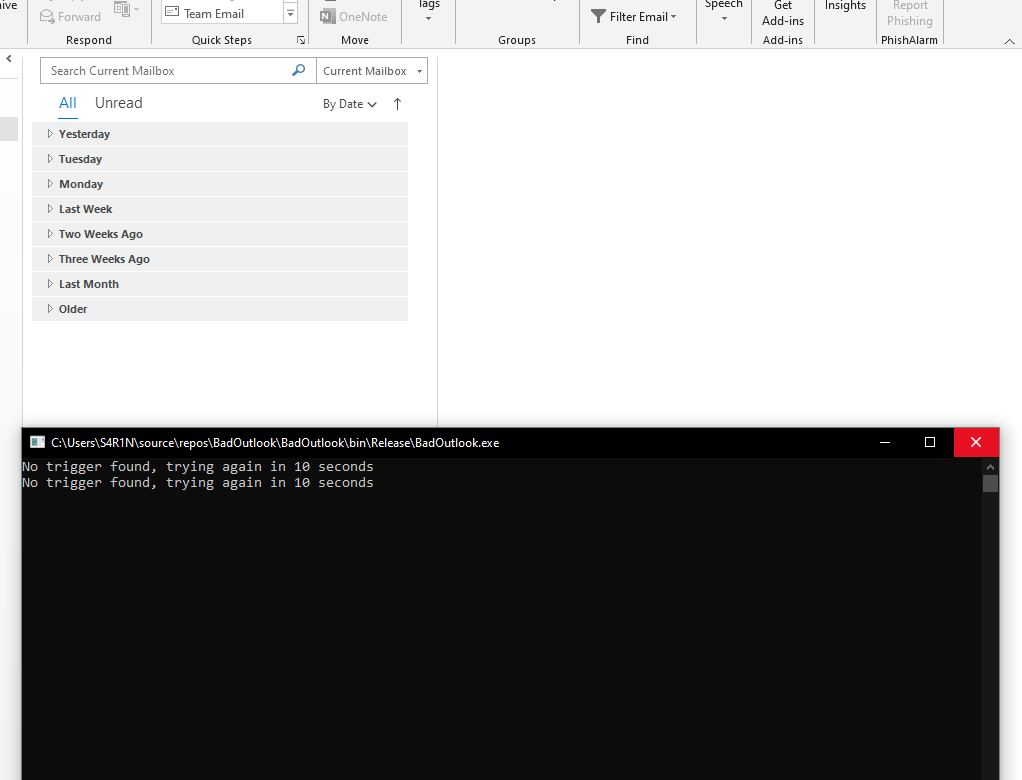 aahmad097/badoutlook
Proof-of-concept C# tool that reads Outlook emails via COM interface, extracts base64-encoded shellcode from trigger subject lines, and executes…
 trackflaw/cve-2023-23397
Simple PoC of the CVE-2023-23397 vulnerability with the payload sent by email.
 sqrtzeroknowledge/cve-2023-23397_exploit_0day
Exploit for the CVE-2023-23397
 mr-un1k0d3r/redteamscripts
Collection of offensive red team scripts including process termination, SPF bypass for phishing, password spraying, and ColdFusion password…
 0neb1n/cve-2020-16947
Proof-of-concept exploit for CVE-2020-16947, a Microsoft Outlook RCE triggered by malformed HTML content leading to a heap buffer overflow and remote…
 0neb1n/cve-2020-1493
Technical analysis and PoC details for CVE-2020-1493, a zero-click Outlook RCE triggered by malformed MS-TNEF attachments leading to remote code…
 themehackers/cve-2024-21413
CVE-2024-21413 | Microsoft Outlook Remote Code Execution Vulnerability PoC
 srvaccount/cve-2021-26855-poc
PoC exploit code for CVE-2021-26855
 tiepologian/cve-2023-23397
Proof of Concept for CVE-2023-23397 in Python
 demossl/cve-2021-33766-proxytoken
Proof-of-concept exploit for CVE-2021-33766 (ProxyToken) authentication bypass in Microsoft Exchange Server. Supports single and batch target…