Skip to content
KitploitKITPLOIT
ToolsBlog
Submit
ToolsBlog
Submit

Hacking, PenTest, and Cybersecurity Tools for Your Security Arsenal!

Kitploit is a directory of hacking, cybersecurity, and pentesting tools. Discover the latest project updates to find vulnerabilities, analyze systems, automate testing, and strengthen your security.

··Feeds·Contact·Privacy·© 2026 Kitploit

Tool Directory

Categories

View all categories
Loading categories
SharePointDumper — PowerShell SharePoint extraction + auditing tool for red/blue/purple teams. Enumerates all SharePoint sites/drives a user can access via Microsoft Graph, recursively downloads files, and logs every Graph + SharePoint HTTP request for SIEM correlation, detection engineering, and IR testing. | Kitploit
Tools/GitHubGitHub/zh54321/sharepointdumper
Defensive ToolsOSINT (Open Source Intelligence)Data ExfiltrationInformation GatheringPenetration TestingCloud SecurityAuthenticationRed TeamingIncident ResponseLog Analysis
GitHubzh54321/sharepointdumper

SharePointDumper

1671927 months agoReviewed by Kitploit

Most Popular

View all →

Discover the most used tools by our community.

Explore all tools

Browse our collection of tools

View all tools →
View Repository

About

PowerShell SharePoint extraction + auditing tool for red/blue/purple teams. Enumerates all SharePoint sites/drives a user can access via Microsoft Graph, recursively downloads files, and logs every Graph + SharePoint HTTP request for SIEM correlation, detection engineering, and IR testing.

Share

SharePointDumper

SharePointDumper is a PowerShell-based extraction and auditing utility that enumerates SharePoint sites a user can access via Microsoft Graph and downloads files via SharePoint.

It is designed for SOC / DLP testing, purple teaming, and non-sophisticated red-team assessments, and therefore produces detailed reports including downloaded files and every HTTP request (Graph + SharePoint) for SIEM correlation.

The tool does not perform authentication. Instead, it requires an already obtained OAuth2 access token with the appropriate Microsoft Graph permissions (Sites.Read.All or Sites.ReadWrite.All).
If you need help obtaining such a token, you can use EntraTokenAid (examples included below), which simplifies generating usable access tokens.


✨ Features

  • Enumerates SharePoint sites, drives, folders, and files via Microsoft Graph
  • Recursively dumps drives and folders (using SharePoint pre-authentication URLs)
  • No mandatory external dependencies (no Microsoft Graph PowerShell modules etc.)
  • Customize the User-Agent
  • Global download limits: max files & max total size
  • Include/exclude filtering for sites and file extensions
  • Adjustable request throttling with random jitter
  • Optional public-IP lookup
  • Supports simple HTTP proxy
  • Structured report including:
    • Summary (duration, limits, filters, public IP)
    • Accessed SharePoint sites
    • Complete HTTP request logs (CSV or JSON)
  • Redaction of SharePoint download tokens, with an option to log them unredacted
  • Graceful Ctrl+C handling that stops after the current file and still writes the full report and HTTP log before exiting
  • Resume mode, which re-enumerates but skips already downloaded files
  • Optional automatic access token refresh (requires EntraTokenAid https://github.com/zh54321/EntraTokenAid.git)

📦 Pictures

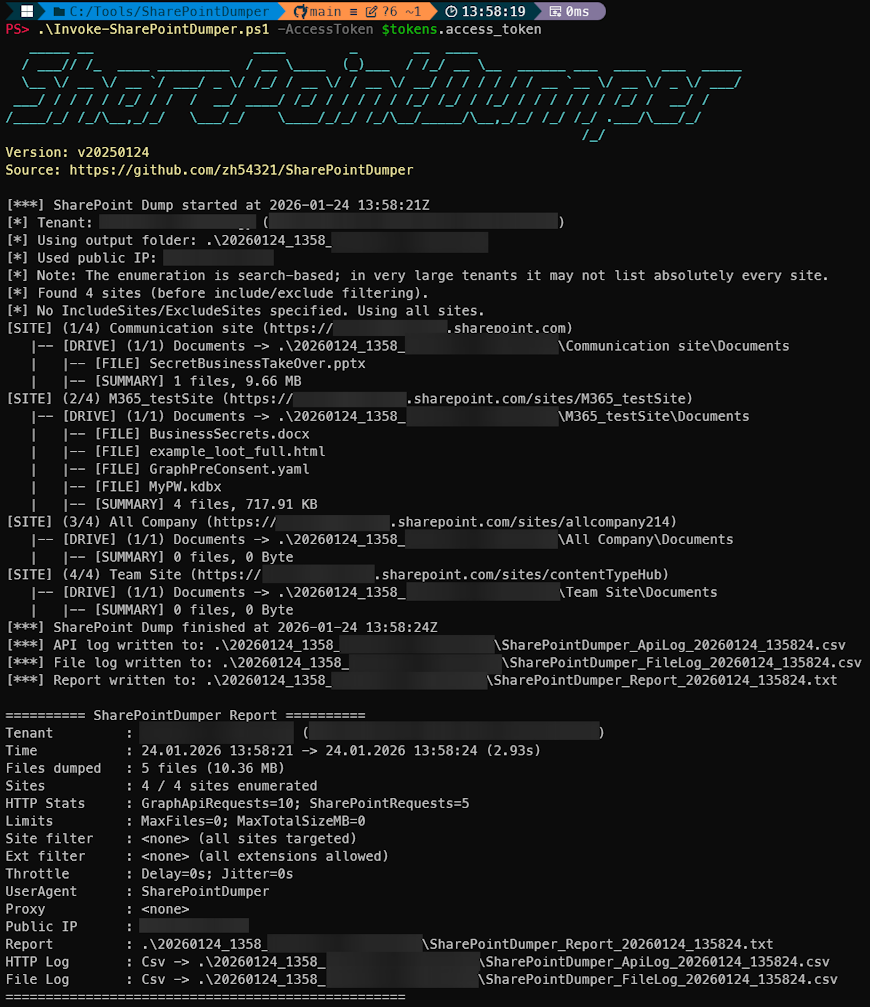
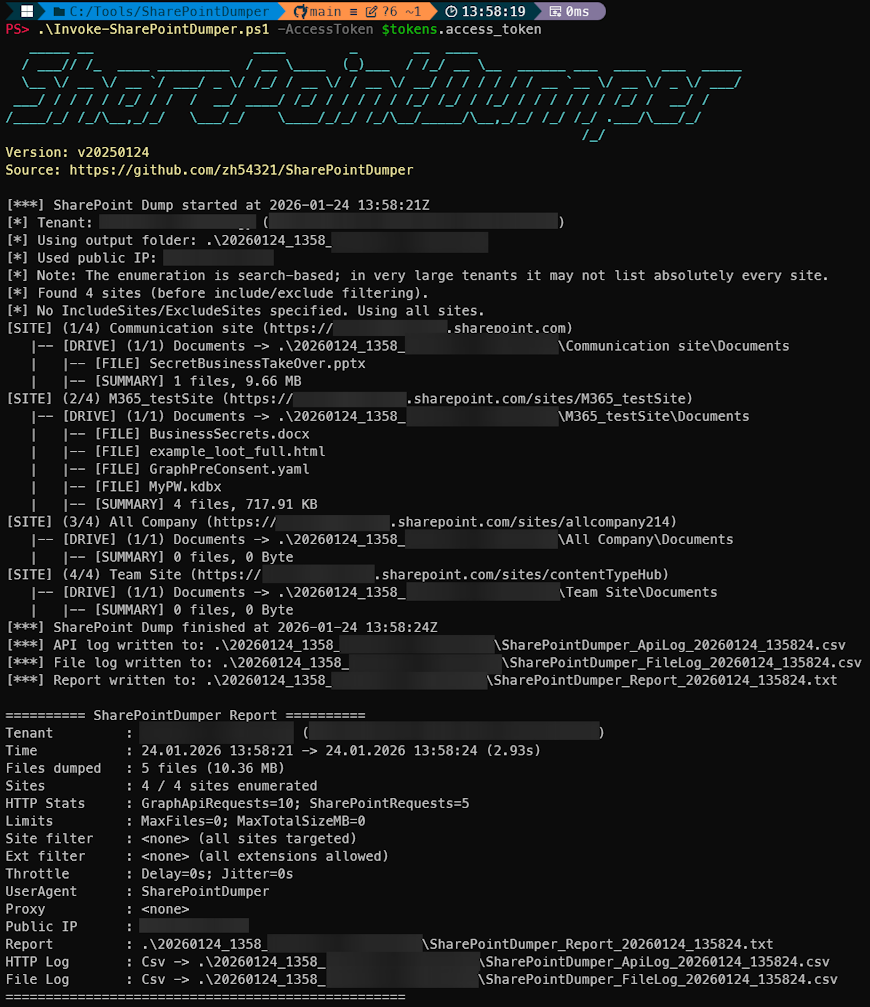
Execution:
alt text

Example CSV API Log (can be CSV or JSON): alt text

Example File Download Log (can be CSV or JSON) alt text


📦 Installation

Clone the repository

root@kitploit:~
git clone https://github.com/zh54321/SharePointDumper.git
cd SharePointDumper

🔑 Requirements

SharePointDumper requires a valid Microsoft Graph access token with delegated permissions to enumerate sites and files:

  • Sites.Read.All or
  • Sites.ReadWrite.All

Furthermore, the OAuth client must be allowed to call SharePoint API.

More than 23 Microsoft first-party applications already have pre-consented Sites.Read… permissions. They can download files from SharePoint, and can be used to obtain a valid token without additional tenant configuration.


Usable first party clients

Token lifetime recommendation

If possible, use a CAE-enabled access token, which remains valid for up to 24 hours and reduces interruptions during long-running dumps.

Obtaining a token with EntraTokenAid

You can use EntraTokenAid to obtain a suitable access token via PowerShell
(CAE tokens are requested by default):

root@kitploit:~
# Clone the module
git clone https://github.com/zh54321/EntraTokenAid.git
Import-Module EntraTokenAid/EntraTokenAid.psm1

# Get the the tokens
$tokens = Invoke-Auth -ClientID 'b26aadf8-566f-4478-926f-589f601d9c74' -RedirectUrl 'urn:ietf:wg:oauth:2.0:oob'

# Optional: Store in variable which is compatible with the examples below
$AccessToken = $tokens.access_token

🚀 Usage

Basic usage

root@kitploit:~
.\Invoke-SharePointDumper.ps1 -AccessToken $accesstoken -UserAgent "Not SharePointDumper"

Filter sites

root@kitploit:~
.\Invoke-SharePointDumper.ps1 -AccessToken $accesstoken -IncludeSites "Finance","Projects"
root@kitploit:~
.\Invoke-SharePointDumper.ps1 -AccessToken $accesstoken -ExcludeSites "HR","Legal"

Filter file extensions

root@kitploit:~
.\Invoke-SharePointDumper.ps1 -AccessToken $accesstoken -IncludeExtensions pdf,docx
root@kitploit:~
.\Invoke-SharePointDumper.ps1 -AccessToken $accesstoken -ExcludeExtensions jpg,bmp

Limit downloads

root@kitploit:~
.\Invoke-SharePointDumper.ps1 -AccessToken $accesstoken -MaxFiles 500
root@kitploit:~
.\Invoke-SharePointDumper.ps1 -AccessToken $accesstoken -MaxTotalSizeMB 100

Slow down requests

root@kitploit:~
.\Invoke-SharePointDumper.ps1 -AccessToken $accesstoken -RequestDelaySeconds 2

With jitter:

root@kitploit:~
.\Invoke-SharePointDumper.ps1 -AccessToken $accesstoken -RequestDelaySeconds 2 -Variation 3

Resume (example after token expiration)

root@kitploit:~
.\Invoke-SharePointDumper.ps1 -AccessToken $accesstoken -Resume -OutputFolder .\20251121_1551_MyTenant

In resume mode, -OutputFolder must point to your previous run’s folder.

Using Automatic Token Refresh

SharePointDumper can automatically refresh an expired access token (HTTP 401) using a refresh token and EntraTokenAid.

root@kitploit:~
# Mandatory: The module must be imported so the tool can use the Invoke-Refresh command
Import-Module .\EntraTokenAid\EntraTokenAid.psm1

# Optional: Obtain tokens using EntraTokenAid (other methods are also possible)
$tokens = Invoke-Auth -ClientId 'b26aadf8-566f-4478-926f-589f601d9c74' -RedirectUrl 'urn:ietf:wg:oauth:2.0:oob'

# Run SharePointDumper with refresh support
.\Invoke-SharePointDumper.ps1 -AccessToken $tokens.access_token -RefreshToken $tokens.refresh_token -RefreshClientId 'b26aadf8-566f-4478-926f-589f601d9c74'

Note: Token refresh attempts are NOT logged in the API log.


Parameters

🧾 Output Structure

Directory structure

root@kitploit:~
20261115_MySecureTenant/
 ├── SharePointDumper_Report_20261115_080333.txt
 ├── SharePointDumper_ApiLog_20261115_080333.csv
 ├── SharePointDumper_FileLog_20261115_080333.csv
 ├── Site A/
 │    └── Documents/
 │         ├── file1.docx
 │         └── file2.pdf
 └── Site B/
      └── Site Assets/

Logs

  • Report: high-level summary (Report_*.txt)
  • API Log: every Graph + SharePoint HTTP request
    (ApiLog_*.csv or .json)
  • Resume runs generate:
    • SharePointDumper_ReportResume_*
    • SharePointDumper_ApiLogResume_*

⚠️ Authentication Errors

401 – Unauthorized

Access Token is invalid or expired.

403 – Forbidden

Access Token is valid, but missing required Microsoft Graph or SharePoint permissions.


🔍 Detection

SharePointDumper activities are logged in:

  • Unified Audit Log (UAL): logs SharePoint search and download activity.
  • Graph Activity Logs: record all site and drive enumeration requests (/organization, /sites, /drives).

Example UAL:
asd

Example Graph Activity Log:
asd


📝 License

Released under the MIT License.


Download Tool
App NameClient IDFOCIEntraTokenAid Auth Command
Microsoft Teams1fec8e78-bce4-4aaf-ab1b-5451cc387264TRUE$tokens = Invoke-Auth -ClientID '1fec8e78-bce4-4aaf-ab1b-5451cc387264' -RedirectUrl 'https://login.microsoftonline.com/common/oauth2/nativeclient'
Outlook Mobile27922004-5251-4030-b22d-91ecd9a37ea4TRUE$tokens = Invoke-Auth -ClientID '27922004-5251-4030-b22d-91ecd9a37ea4' -RedirectUrl 'x-msauth-outlook-prod://com.microsoft.Office.Outlook'
OneDrive SyncEngineab9b8c07-8f02-4f72-87fa-80105867a763TRUE$tokens = Invoke-Auth -ClientID 'ab9b8c07-8f02-4f72-87fa-80105867a763' -RedirectUrl 'https://login.microsoftonline.com/common/oauth2/nativeclient'
OneDrive iOS Appaf124e86-4e96-495a-b70a-90f90ab96707TRUE$tokens = Invoke-Auth -ClientID 'af124e86-4e96-495a-b70a-90f90ab96707' -RedirectUrl 'ms-onedrive-auth://com.microsoft.skydrive.shareextension'
Microsoft Bing Searchcf36b471-5b44-428c-9ce7-313bf84528deTRUE$tokens = Invoke-Auth -ClientID 'cf36b471-5b44-428c-9ce7-313bf84528de' -RedirectUrl 'msauth.com.microsoft.bing://auth'
OneDriveb26aadf8-566f-4478-926f-589f601d9c74TRUE$tokens = Invoke-Auth -ClientID 'b26aadf8-566f-4478-926f-589f601d9c74' -RedirectUrl 'urn:ietf:wg:oauth:2.0:oob'
SharePointd326c1ce-6cc6-4de2-bebc-4591e5e13ef0TRUE$tokens = Invoke-Auth -ClientID 'd326c1ce-6cc6-4de2-bebc-4591e5e13ef0' -RedirectUrl 'msauth://code/ms-sharepoint-auth%3A%2F%2Fcom.microsoft.sharepoint'
SharePoint Androidf05ff7c9-f75a-4acd-a3b5-f4b6a870245dTRUE$tokens = Invoke-Auth -ClientID 'f05ff7c9-f75a-4acd-a3b5-f4b6a870245d' -RedirectUrl 'msauth://com.microsoft.sharepoint/gSoqzhbCjkyvI%2Fl7kC7IdG7KbPU%3D'
OfficeHome4765445b-32c6-49b0-83e6-1d93765276caFALSE$tokens = Invoke-Auth -ClientID '4765445b-32c6-49b0-83e6-1d93765276ca' -RedirectUrl 'https://scuprodprv.www.microsoft365.com/spalanding' -Origin 'https://doesnotmatter'
SharePoint Online Web Client Extensibility08e18876-6177-487e-b8b5-cf950c1e598cFALSE$tokens = Invoke-Auth -ClientID '08e18876-6177-487e-b8b5-cf950c1e598c' -RedirectUrl 'https://onedrive.cloud.microsoft/_forms/spfxsinglesignon.aspx' -Origin 'https://doesnotmatter'
Microsoft Teams Web Client5e3ce6c0-2b1f-4285-8d4b-75ee78787346FALSE$tokens = Invoke-Auth -ClientID '5e3ce6c0-2b1f-4285-8d4b-75ee78787346' -RedirectUrl 'https://teams.cloud.microsoft/convene/townhall' -Origin 'https://doesnotmatter'
Portfoliosf53895d3-095d-408f-8e93-8f94b391404eFALSE$tokens = Invoke-Auth -ClientID 'f53895d3-095d-408f-8e93-8f94b391404e' -RedirectUrl 'https://project.microsoft.com/msal-redirect2' -Origin 'https://doesnotmatter'
Microsoft Remote Assistfca5a20d-55aa-4395-9c2f-c6147f3c9ffaFALSE$tokens = Invoke-Auth -ClientID 'fca5a20d-55aa-4395-9c2f-c6147f3c9ffa' -RedirectUrl 'http://localhost:13824'
ProcessSimpleGCC38a893b6-d74c-4786-8fe7-bc3b4318e881FALSE$tokens = Invoke-Auth -ClientID '38a893b6-d74c-4786-8fe7-bc3b4318e881' -RedirectUrl 'https://make.gov.powerautomate.us/auth-redirect.html' -Origin 'https://doesnotmatter'
WindowsShareExperienceProda8759234-4b8b-4d94-8c0a-ee1ab73af270FALSE$tokens = Invoke-Auth -ClientID 'a8759234-4b8b-4d94-8c0a-ee1ab73af270' -RedirectUrl 'ms-appx-web://Microsoft.AAD.BrokerPlugin/a8759234-4b8b-4d94-8c0a-ee1ab73af270'
Office voice transcript generator AADd2eb9fef-f34c-40ec-b6a3-4bf524065158FALSE$tokens = Invoke-Auth -ClientID 'd2eb9fef-f34c-40ec-b6a3-4bf524065158' -RedirectUrl 'msauth.com.microsoft.Office.TestVoice.TestVoice2://auth'
Azure OpenAI Studiodc807dec-d211-4b3f-bc8a-43b3443c4874FALSE$tokens = Invoke-Auth -ClientID 'dc807dec-d211-4b3f-bc8a-43b3443c4874' -RedirectUrl 'https://dev.oai.azure.com' -Origin 'https://doesnotmatter'
Azure AI Studio Appcb2ff863-7f30-4ced-ab89-a00194bcf6d9FALSE$tokens = Invoke-Auth -ClientID 'cb2ff863-7f30-4ced-ab89-a00194bcf6d9' -RedirectUrl 'https://int.ai.azure.com/agents' -Origin 'https://doesnotmatter'
Azure Machine Learning Workbench Web Appd7304df8-741f-47d3-9bc2-df0e24e2071fFALSE$tokens = Invoke-Auth -ClientID 'd7304df8-741f-47d3-9bc2-df0e24e2071f' -RedirectUrl 'https://dev.ml.azure.com/redirect' -Origin 'https://doesnotmatter'
M365ChatClientc0ab8ce9-e9a0-42e7-b064-33d422df41f1FALSE$tokens = Invoke-Auth -ClientID 'c0ab8ce9-e9a0-42e7-b064-33d422df41f1' -RedirectUrl 'https://fa000000128.resources.office.net/f7024bdc-7caf-4ca8-807d-2908f09640d6/1.0.2412.19011/en-us_web/login.html' -Origin 'https://doesnotmatter'
Microsoft Loop Appa187e399-0c36-4b98-8f04-1edc167a0996FALSE$tokens = Invoke-Auth -ClientID 'a187e399-0c36-4b98-8f04-1edc167a0996' -RedirectUrl 'https://hosted.loop.cloud.dev.microsoft/authLanding.html' -Origin 'https://doesnotmatter'
Viva Goalsc8423563-e8f6-49f2-924b-90d9f664378aFALSE$tokens = Invoke-Auth -ClientID 'c8423563-e8f6-49f2-924b-90d9f664378a' -RedirectUrl 'https://goals-ppe.microsoft.com/aad/consume' -Origin 'https://doesnotmatter'
Microsoft Mesheea619ad-603a-4b03-a386-860fcc7410d1FALSE$tokens = Invoke-Auth -ClientID 'eea619ad-603a-4b03-a386-860fcc7410d1' -RedirectUrl 'http://localhost:13824'
ParameterRequiredTypeDescription
AccessTokenYesStringOAuth2 Access Token. No authentication performed inside the tool.
OutputFolderNoStringDirectory for the dump. Default: ".". In -Resume mode, must point to an existing previous dump folder.
UserAgentNoStringCustom UserAgent for all HTTP requests. Default: SharePointDumper
ProxyNoStringOptional HTTP proxy (e.g., http://127.0.0.1:8080).
IncludeExtensionsNoString[]Only download these extensions.
ExcludeExtensionsNoString[]Skip these extensions (ignored if IncludeExtensions is used).
IncludeSitesNoString[]Only process sites matching any of these values.
ExcludeSitesNoString[]Skip sites matching any of these values.
DisableIpLookupNoSwitchDo not query ifconfig.me for public IP.
RequestDelaySecondsNoDoubleBase delay before each HTTP request.
VariationNoDoubleRandom jitter added to base delay.
MaxFilesNoIntMaximum number of files to download. Default: no limit.
MaxTotalSizeMBNoDoubleMaximum total download size. Default: no limit.
ResumeNoSwitchSkips already-downloaded files. Requires -OutputFolder.
ApiLogFormatNoStringCsv (default), Json, or None.
ApiLogPathNoStringCustom output path for API log file.
FileLogFormatNoStringCsv (default), Json, or None.
FileLogPathNoStringCustom output path for file log file.
LogDownloadTokensNoSwitchLog full SharePoint download URLs including tempauth tokens (unsafe). Default: tokens are redacted.
RefreshTokenNoStringOAuth2 refresh token used for automatic access token renewal on HTTP 401.
RefreshClientIdNoStringClient ID used together with -RefreshToken.
RefreshTenantNoStringTenant authority for the refresh endpoint (default: common).