 yasindce1998/barzakh
Ring -4 to Ring 0: offense-defense firmware research platform. We build the bootkits, then we catch them. Closed-loop. Zero trust in silicon.

"Barzakh" (برزخ) — a barrier between two realms; the unseen boundary separating the living world from the world of spirits. Here it stands for the barrier between offense and defense, between vulnerability and detection.
The most comprehensive open-source UEFI firmware security research platform
Offense emulation from Ring 0 to Ring -4 | 132 detection engines | Closed-loop adversary validation



⚠️ ACADEMIC RESEARCH PROJECT — DEFENSIVE SECURITY ONLY
This platform exists to study firmware threats and build defenses against them. It contains live offense emulations with hardware-rooted kill-switches. By accessing this repository, you agree to use it solely for legitimate security research and educational purposes.
Barzakh is a full-stack firmware security research platform that models real-world bootkit TTPs across every privilege ring — from UEFI DXE drivers (Ring 0) down through SMM, Intel ME, AMD PSP, platform DMA controllers (Ring -3), and CPU microarchitectural threats (Ring -4). It pairs each offense technique with a corresponding detection engine, creating a closed-loop system where every attack is both reproducible and detectable.
Key capabilities:
barzakh-server serves a web dashboard and JSON API (port 8420) with scheduled scans and risk-score trendsbarzakh-agent watches firmware targets, records history, and forwards findings to SIEMs (Elastic ECS, ArcSight CEF, QRadar LEEF) or webhooks| Threat | Technique | Barzakh Coverage |
|---|---|---|
| BlackLotus (CVE-2023-24932) | Secure Boot bypass via vulnerable shim | blacklotus detector + blacklotus_mok payload |
| LogoFAIL (CVE-2023-40238) | Image parser overflow in UEFI firmware | logofail detector + logofail_image payload |
| PixieFail (CVE-2023-45229+) | Network stack buffer overflows in EDK2 | pixiefail detector + pixiefail_dhcp payload |
| CosmicStrand | SPI flash DXE persistence | FV integrity + SPI region + persistence detector |
| LoJax | First in-the-wild SPI implant | ME/SPI detector + flash descriptor analysis |
| MoonBounce | Modified core DXE in SPI flash | Boot Services hook + firmware volume diffing |
| MosaicRegressor | UEFI persistence framework | Multi-stage: FV tamper + PE inject + trampoline |
| Hacking Team (RCS) | UEFI rootkit with Option ROM | Option ROM detector + PCI expansion analysis |
| FinSpy | UEFI bootloader modification | ExitBootServices interception + memory scanning |
| Bootkitty (2024) | First Linux UEFI bootkit, GRUB signature bypass | linux_bootchain detector + bootkitty_grub_patch payload |
| CVE-2024-7344 | Signed reloader loads unsigned PE payloads | reloader detector + secureboot_reloader payload |
| CVE-2023-1017/1018 | TPM 2.0 reference implementation buffer overflow | tpm_command detector + tpm_ref_overflow payload |
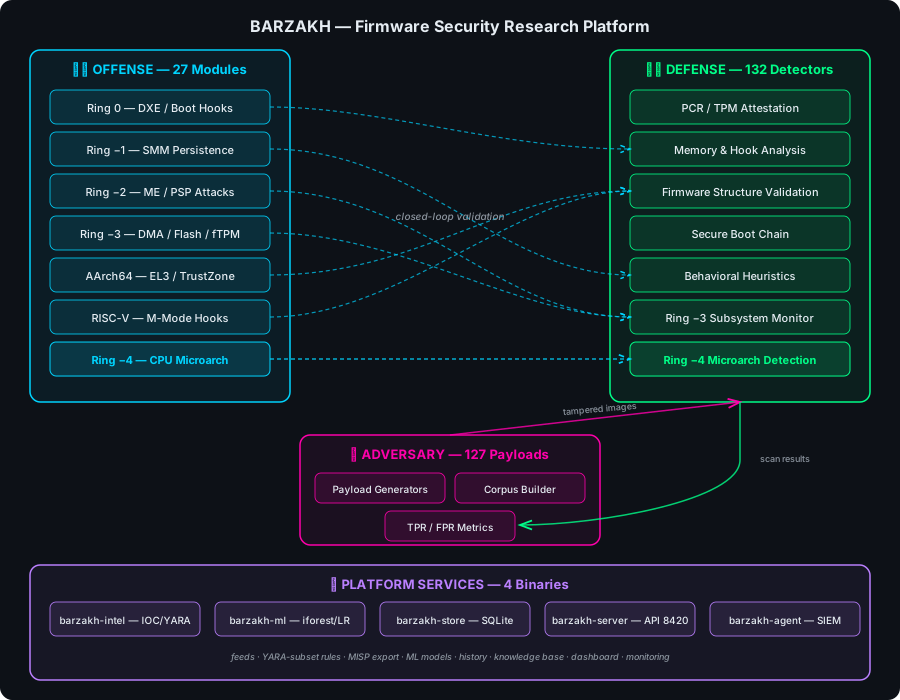
21 EDK II modules across 3 architectures (x86_64, AArch64, RISC-V) emulating every known firmware persistence technique:
| Module | Ring | Technique |
|---|---|---|
DxeInject | 0 | DXE phase driver injection — LoadImage/StartImage + SetVariable hooks, FV persistence, SPI flash emulator with FVB2/Boot Guard backends, kill-switches |
ExitBootHook | 0 | ExitBootServices interception + MSR hooking |
SpiChipsetEmulator | -1 | Chipset-level SPI interface simulation |
SmmPersistence | -1 | SMM handler installation and SMRAM persistence |
CapsuleHijack | -1 | UEFI capsule update mechanism abuse |
AcpiTableInject | -2 | ACPI table injection for kernel memory access |
VirtualAddressMapHook | -2 | EFI Runtime Services hooking |
PciOptionRom | -2 | PCI Option ROM implantation |
MeSpiManipulation | -3 | Intel ME SPI flash region manipulation |
HeciIntercept | -3 | Host-ME communication channel interception |
MeDmaAttack | -3 | ME-initiated DMA to host memory |
AmtSolChannel | -3 | AMT Serial-over-LAN covert channel |
FtpmCommandForge | -3 | AMD fTPM command forgery via PSP mailbox |
| Module | Technique |
|---|---|
Aarch64DxeInject | ARM64 DXE injection with EL-aware payloads |
ExceptionVectorHook | VBAR_EL1 exception table relocation |
El3SecureMonitor | EL3 Secure Monitor call interception |
TzascManipulation | TrustZone Address Space Controller bypass |
DeviceTreeInject | Device Tree Blob modification for persistence |
IbootTrustChain | Apple iBoot chain-of-trust subversion |
SepMailboxIntercept | Apple SEP (Secure Enclave) mailbox interception |
| Module | Technique |
|---|---|
RiscVDxeInject | M-mode firmware injection on RISC-V platforms |
All offense modules ship with SIMULATION_MODE = TRUE — they model behavior without executing real hardware operations. See docs/LAB_TESTING.md for the controlled path to real hardware testing.
132 specialized detectors organized by attack surface, plus runtime-extensible detection via TOML rules, IOC feeds, YARA-subset rules, and ML models:

