
Direct Memory Access (DMA) Attack Software
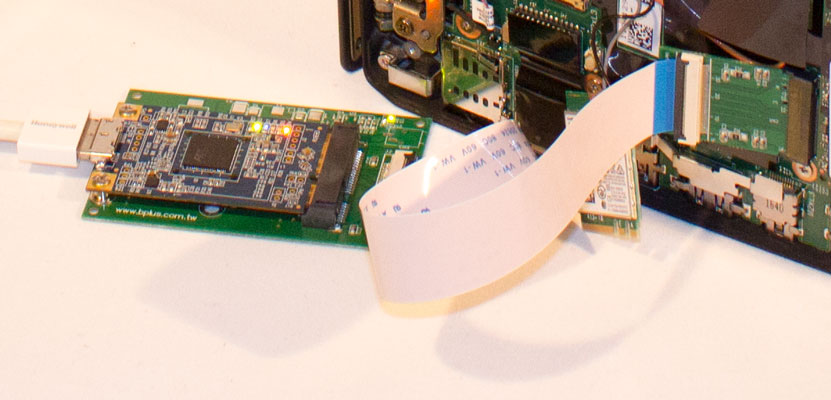
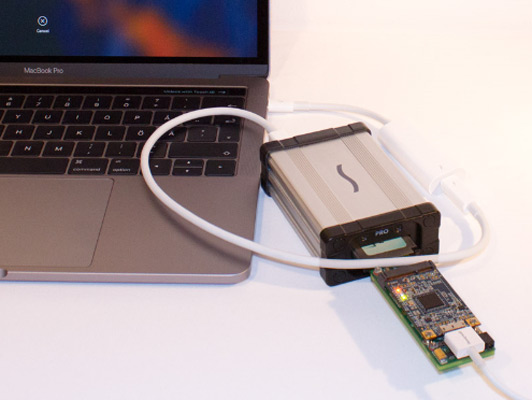
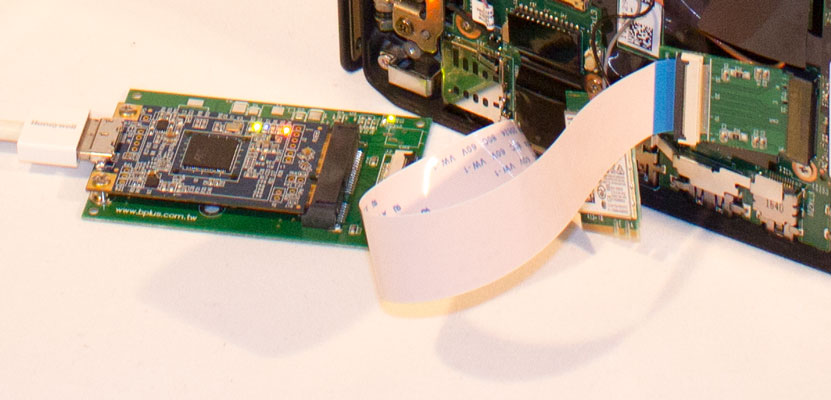
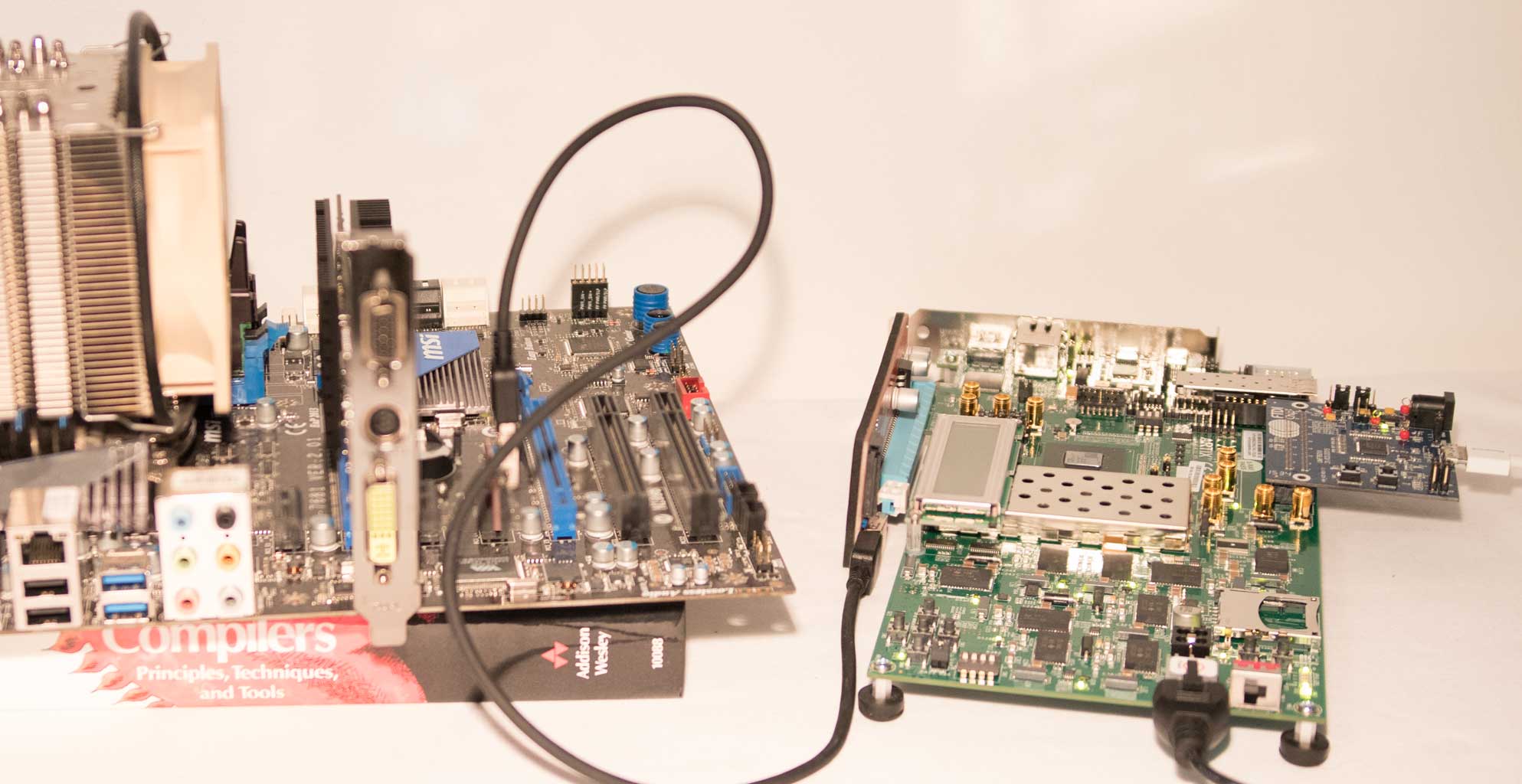
PCILeech uses PCIe hardware devices to read and write target system memory. This is achieved by using DMA over PCIe. No drivers are needed on the target system.
PCILeech also works without hardware together with a wide range of software memory acqusition methods supported by the LeechCore library - including capture of remote live memory using DumpIt or WinPmem. PCILeech also supports local capture of memory and a number of memory dump file formats.
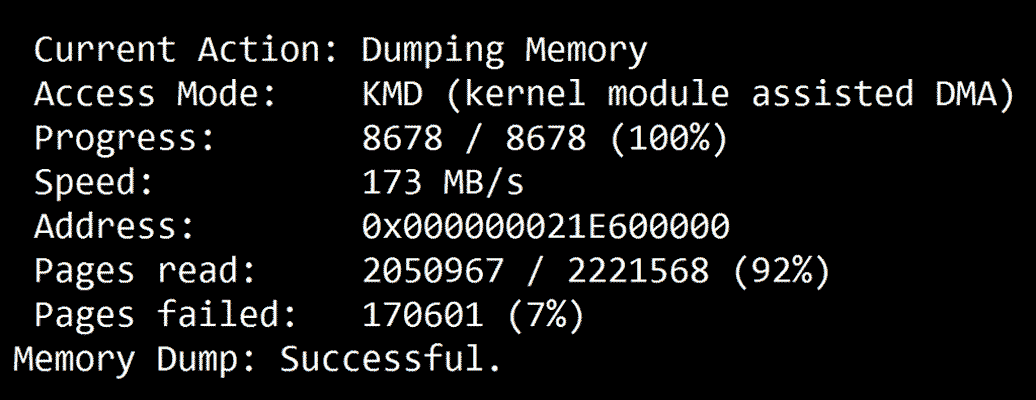
PCILeech supports multiple memory acquisition devices. Both hardware and software based. USB3380 based hardware is only able to read 4GB of memory natively, but is able to read all memory if a kernel module (KMD) is first inserted into the target system kernel. FPGA based hardware, and software based methods, are able to read all memory.
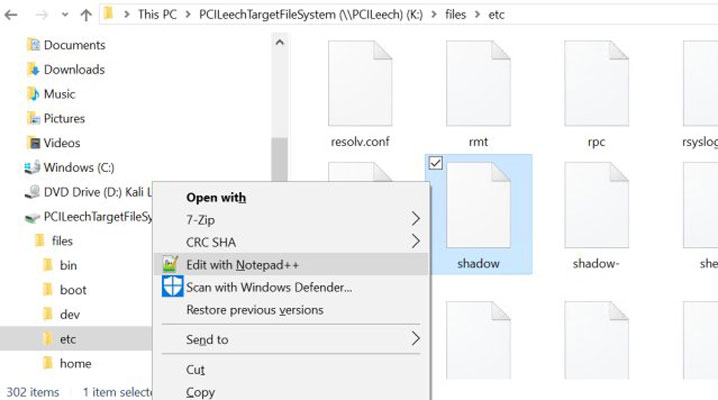
PCILeech is capable of inserting a wide range of kernel implants into the targeted kernels - allowing for easy access to live ram and the file system via a "mounted drive". It is also possible to remove the logon password requirement, loading unsigned drivers, executing code and spawn system shells. PCIleech runs on Windows and Linux. Supported target systems are currently the x64 versions of: UEFI, Linux, FreeBSD and Windows. This requires write access to memory (USB3380 hardware, FPGA hardware, LiveCloudKd or CVE-2018-1038 "Total Meltdown").
To get going clone the sources in the repository or download the latest binaries, modules and configuration files.
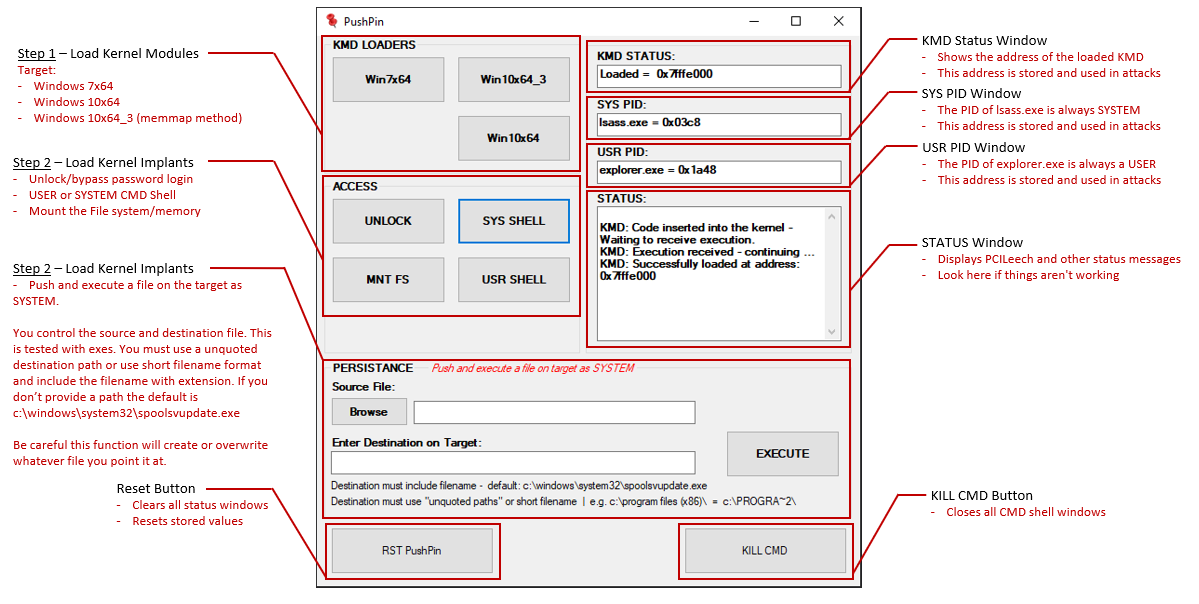
The PushPin GUI frontend for PCILeech makes common RedTeam tasks super easy. Note that PushPin is not part of the official PCILeech distribution.
*) macOS High Sierra and above are not supported.
PCILeech supports both hardware based and software based memory acqusition methods. All memory acqusition is handled by the LeechCore library.
Please find a summary of the supported hardware based memory acquisition methods listed below. All hardware based memory acquisition methods are supported on both Windows and Linux. The FPGA based methods however sports a slight performance penalty on Linux and will max out at approx: 90MB/s compared to 150MB/s on Windows.
| Device | Type | Interface | Speed | 64-bit memory access | PCIe TLP access | Project Sponsor |
|---|---|---|---|---|---|---|
| ZDMA | FPGA | Thunderbolt3 | 1000MB/s | Yes | Yes | 💖 |
| GBOX | FPGA | OCuLink | 400MB/s | Yes | Yes | 💖 |
| LeetDMA | FPGA | USB-C | 190MB/s | Yes | Yes | 💖 |
| CaptainDMA M2 | FPGA | USB-C | 190MB/s | Yes | Yes | 💖 |
| CaptainDMA M2 100T | FPGA | USB-C | 220MB/s | Yes | Yes | 💖 |
| CaptainDMA 4.1th | FPGA | USB-C | 190MB/s | Yes | Yes | 💖 |
| CaptainDMA 75T | FPGA | USB-C | 200MB/s | Yes | Yes | 💖 |
| CaptainDMA 100T | FPGA | USB-C | 220MB/s | Yes | Yes | 💖 |
| AC701/FT601 | FPGA | USB3 | 190MB/s | Yes | Yes | |
| USB3380-EVB | USB3380 | USB3 | 150MB/s | No | No | |
| DMA patched HP iLO | BMC | TCP | 1MB/s | Yes | No |
Please find a summary of the supported software based memory acquisition methods listed below. Please note that the LeechService only provides a network connection to a remote LeechCore library. It's possible to use both hardware and software based memory acquisition once connected.

