
Skip to content
KitploitKITPLOIT
ToolsBlog
Submit
ToolsBlog
Submit

Hacking, PenTest, and Cybersecurity Tools for Your Security Arsenal!

Kitploit is a directory of hacking, cybersecurity, and pentesting tools. Discover the latest project updates to find vulnerabilities, analyze systems, automate testing, and strengthen your security.

··Feeds·Contact·Privacy·© 2026 Kitploit

Tool Directory

Categories

View all categories
Loading categories
SeekYou — OSINT intelligence on any IP, domain, or ASN | Kitploit
Tools/GitHubGitHub/teycir/seekyou
OSINT (Open Source Intelligence)ReconnaissanceNetwork MappingThreat Feeds & AggregatorsVulnerability AnalysisInformation GatheringPenetration TestingCloud SecurityThreat IntelligenceIncident ResponseCrawlerDNS Analysis
1922 months agoNot yet reviewed

Most Popular

View all →

Discover the most used tools by our community.

Explore all tools

Browse our collection of tools

View all tools →
Share
GitHubteycir/seekyou

SeekYou

OSINT intelligence on any IP, domain, or ASN

View RepositoryWebsite

Support Development

If this project helps your work, support ongoing maintenance and new features.

ETH Donation Wallet
0x11282eE5726B3370c8B480e321b3B2aA13686582

Ethereum donation QR code

Scan the QR code or copy the wallet address above.

SeekYou

Unified host intelligence across 15 sources — Query any IP, domain, or ASN for instant security posture, infrastructure details, and threat correlations. Runs entirely on the Cloudflare free tier.

Live at: swiy.co/seekyou

root@kitploit:~
$ curl "https://seekyou.seekyou.workers.dev/api/lookup?q=1.1.1.1"

{
  "query": { "raw": "1.1.1.1", "type": "ip", "normalised": "1.1.1.1" },
  "core": {
    "internetdb":  { "status": "ok",     "data": { "ports": [80,443], "vulns": [] } },
    "geo":         { "status": "cached", "data": { "country": "US", "org": "AS13335 Cloudflare" } },
    "bgp":         { "status": "ok",     "data": { "name": "CLOUDFLARENET", "rir": "ARIN" } },
    ...
  },
  "meta": { "durationMs": 312, "cacheHits": 4, "sourcesQueried": 15, "sourcesFailed": 0 }
}
Screenshots

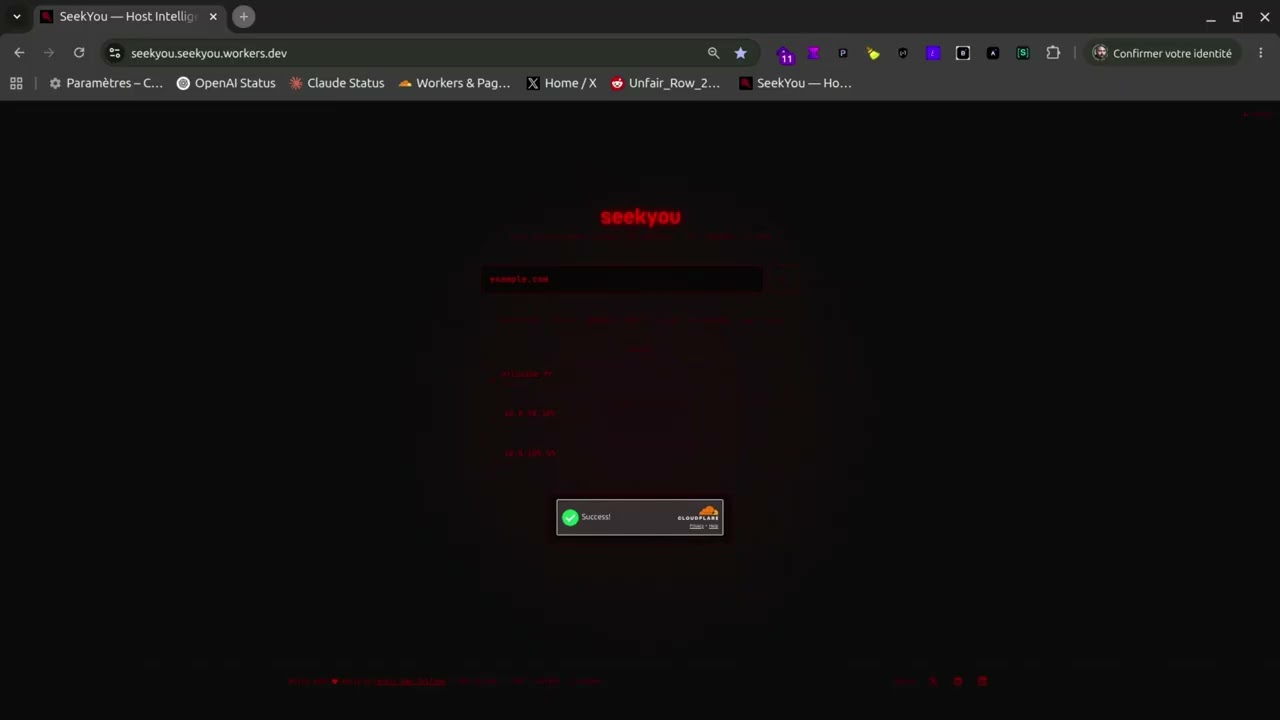
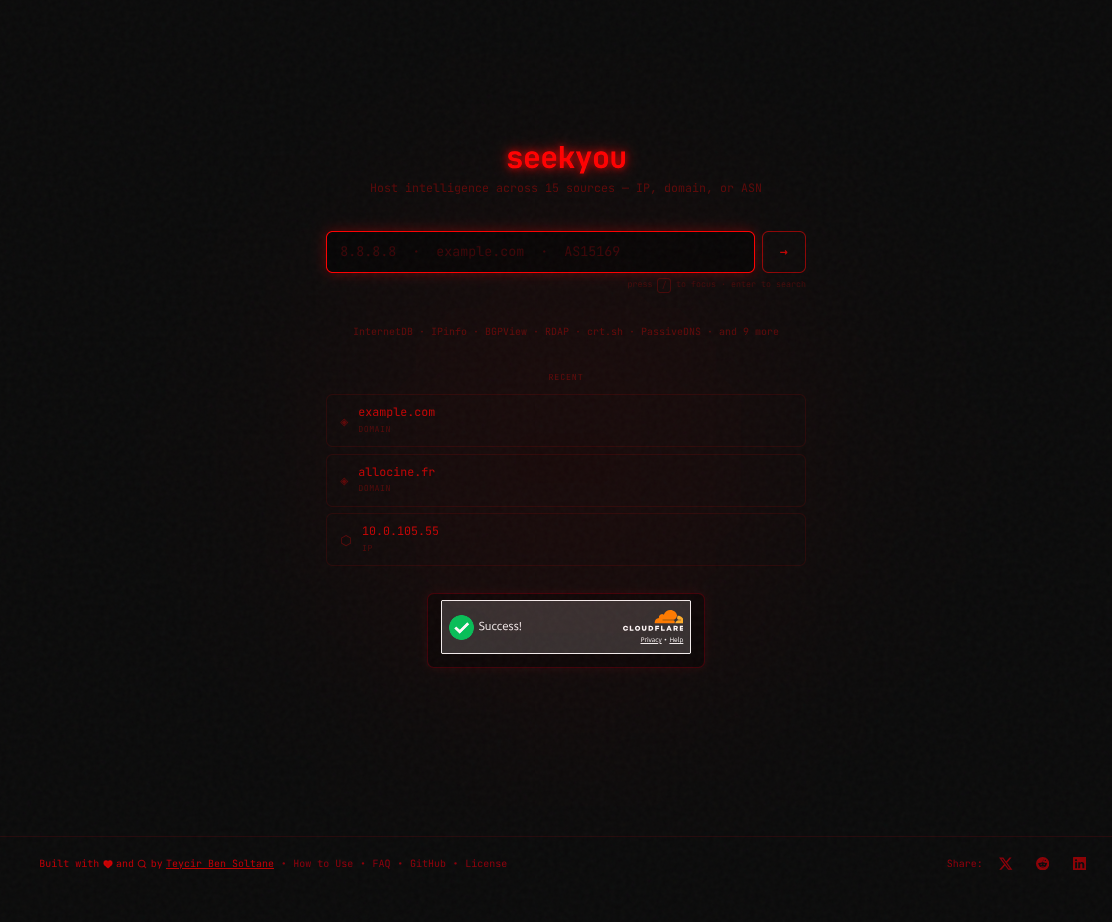
Landing Page

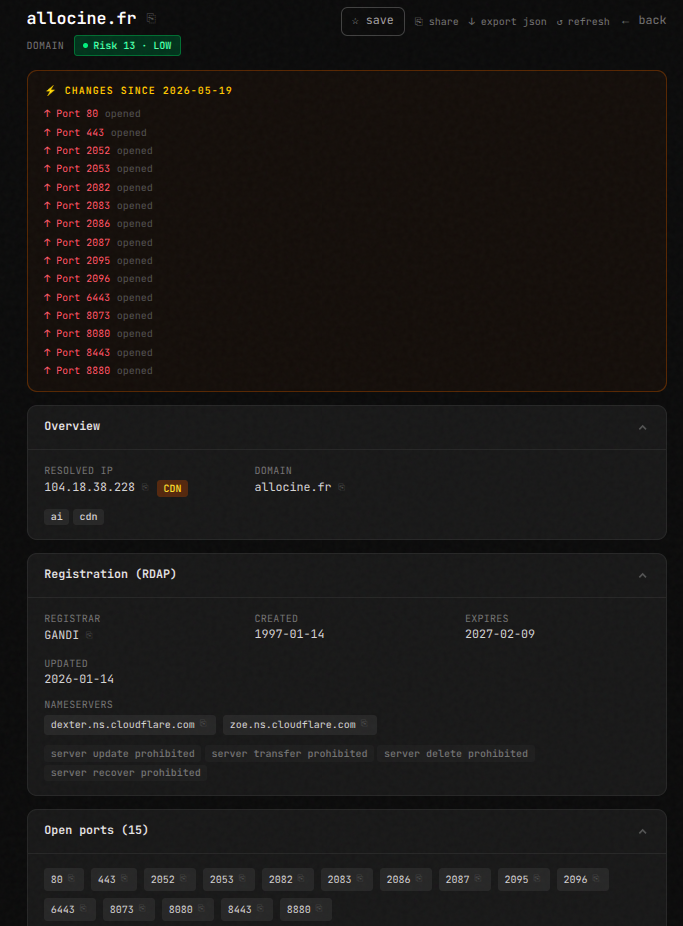
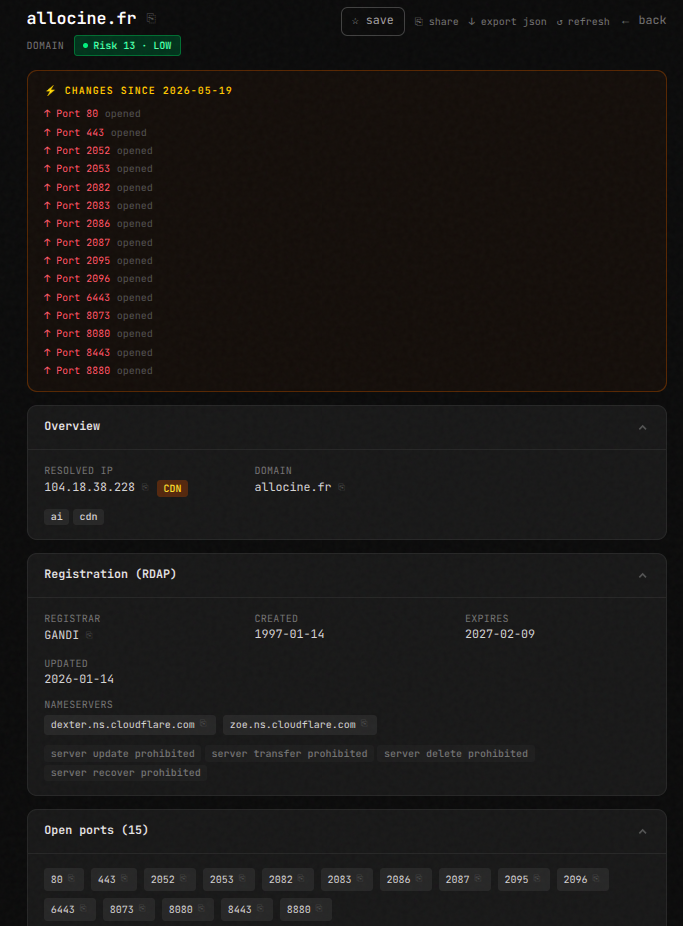
SeekYou Results Page

Results Page

SeekYou Landing Page

Demo

SeekYou Demo

Table of Contents

  • SeekYou
    • Screenshots
      • Landing Page
      • Results Page
      • Demo
    • Table of Contents
    • What SeekYou does
    • Use cases
    • Lawful-use policy
    • Related Tools
    • Architecture overview
    • Execution model
    • Data sources
    • Project structure
    • Key design decisions
      • Edge-first, no Node.js
      • Layered parallel execution
      • Graceful degradation
      • Split D1 + KV storage
      • Free-tier optimization
      • Fire-and-forget D1 writes
    • Caching strategy
    • Rate limiting
    • Circuit breakers
    • Key rotation — GrayHatWarfare
    • D1 persistence
      • Schema (schema.sql)
      • Apply schema
      • Helper functions
    • Cron worker
      • Typed diff (lib/diff.ts)
      • Webhook payload
    • Development setup
      • Prerequisites
      • Local development

What SeekYou does

SeekYou is a host intelligence tool — paste in an IP address, domain name, or ASN and get a unified report covering:

Every source is queried in parallel. A failing source degrades to an "unavailable" badge — it never breaks the page.


Use cases

Security Operations — Quickly profile suspicious IPs from logs, correlate IOCs, identify exposed services and CVEs, trace malicious domains.

Network Operations — Inspect BGP routing, RDAP/WHOIS allocation data, historical DNS records, SSL cert changes.

Penetration Testing — Enumerate ports/services/CPEs, discover exposed buckets, archived pages, subdomains, and ASN relationships.

Threat Intelligence — Check C2 infrastructure against five threat feeds in a single query.

Compliance & Risk — Profile vendor infrastructure, detect exposed cloud storage, identify shadow IT.


Lawful-use policy

SeekYou is designed for lawful security research, network operations, and threat intelligence. By using this tool, you agree to:

Permitted uses:

  • Security operations and incident response on networks you own or are authorized to monitor
  • Threat intelligence research and IOC correlation
  • Network troubleshooting and infrastructure auditing within your organization
  • Penetration testing with explicit written authorization from the target organization
  • Academic research and education in cybersecurity
  • Compliance audits and vendor risk assessments with proper authorization

Prohibited uses:

  • Unauthorized access, reconnaissance, or attacks against systems you do not own or have explicit permission to test
  • Harassment, stalking, or privacy violations against individuals or organizations
  • Facilitating illegal activities including fraud, identity theft, or cybercrime
  • Circumventing security controls or access restrictions without authorization
  • Violating applicable laws including CFAA (US), Computer Misuse Act (UK), GDPR (EU), or equivalent legislation in your jurisdiction

Your responsibilities:

  • Ensure you have proper authorization before querying infrastructure you do not own
  • Respect rate limits and do not abuse the service or upstream data sources
  • Comply with all applicable laws and regulations in your jurisdiction
  • Use the data responsibly and do not weaponize findings without coordinated disclosure
  • Understand that querying a host does not grant permission to access or exploit it

Disclaimer: The author and contributors assume no liability for misuse of this tool. Users are solely responsible for ensuring their activities comply with applicable laws. Data aggregated from public sources may be incomplete, outdated, or inaccurate — always verify findings through authoritative channels before taking action.

If you discover a vulnerability through SeekYou, follow responsible disclosure practices and notify the affected party before public disclosure.


Related Tools

SeekYou is part of a privacy-focused security toolkit. Explore the full suite:

All tools run on Cloudflare's edge network with privacy-first design principles.


Architecture overview

root@kitploit:~
Browser / curl
     │
     ▼
┌─────────────────────────────────────┐
│  Cloudflare Pages                   │
│  Next.js App Router (SSR)           │
│                                     │
│  app/page.tsx          search form  │
│  app/host/[query]/page.tsx          │
│    └─ streams /api/stream?q=…       │
│  app/api/recent/route.ts            │
│    └─ recent searches for homepage  │
│  app/targets/page.tsx               │
│    └─ monitoring dashboard          │
│  app/api/targets/route.ts           │
│    └─ saved targets CRUD            │
│        returns riskScore + lastDiff │
└──────────────┬──────────────────────┘
               │
               ▼
┌─────────────────────────────────────┐
│  app/api/lookup/route.ts            │
│  (Workers runtime via opennextjs)   │
│  • input validation                 │
│  • per-IP rate limiting (KV)        │
│  • ctx.waitUntil(recordSearch())    │
└──────────────┬──────────────────────┘
               │ runLookup()
               ▼
┌─────────────────────────────────────┐
│  worker/lookup.ts  — orchestrator   │
│  4-layer Promise.allSettled         │
└──┬──────────────────────────────────┘
   │
   ├─► Layer 1+2 (parallel, 12 sources):
   │     InternetDB · IPinfo · RIPE stat · RDAP · crt.sh · HackerTarget · Robtex
   │     URLhaus · ThreatFox · MalwareBazaar · Feodo · SSLBL
   ├─► Layer 3 (after L1): NVD CVE enrichment (only if vulns found, batched 10-at-a-time)
   └─► Layer 4 (parallel): GrayHatWarfare · Wayback (domain queries only)
               │
               ▼
┌──────────────────────┐   ┌──────────────────────┐
│ D1                   │   │ KV                   │
│ source response cache│   │ rate limiting        │
│ (TTL per source)     │   │ circuit breakers     │
│ searches             │   │ concurrency counters │
│ saved_targets        │   │                      │
└──────────────────────┘   └──────────────────────┘
               │
               ▼
┌─────────────────────────────────────┐
│  seekyou-cron (Worker)            │
│  wrangler.cron.toml                 │
│  • hourly blocklist refresh         │
│  • hourly saved-target re-query     │
│    + typed diff (lib/diff.ts)       │
│    + webhook on hasChanges          │
└─────────────────────────────────────┘

Execution model

Layers 1 and 2 fire simultaneously (12 sources in one Promise.allSettled). Layer 3 starts after Layer 1 settles — CVE IDs from InternetDB drive NVD enrichment, batched 10-at-a-time to avoid stampeding the API. Layer 4 fires in parallel with Layer 3 but only for domain queries; IP/ASN skip it entirely. Total wall-clock time ≈ max(Layer 1+2) + max(Layer 3+4).

Force-refresh any query with ?refresh=1 to bypass the D1 cache and pull live data from every upstream.


Data sources

Feodo and SSLBL are fetched as bulk blocklists and refreshed hourly by the cron worker — no per-query upstream call.


Project structure

root@kitploit:~
SeekYou/
├── app/
│   ├── page.tsx                      # Homepage — search form + recent searches
│   ├── layout.tsx                    # Root layout
│   ├── globals.css
│   ├── about/                        # About page
│   ├── faq/                          # FAQ page
│   ├── targets/
│   │   └── page.tsx                  # /targets — monitoring dashboard (risk + diffs)
│   ├── host/[query]/
│   │   └── page.tsx                  # SSR host report page (streams via /api/stream)
│   ├── api/
│   │   ├── lookup/route.ts           # GET /api/lookup?q=&refresh=1
│   │   ├── stream/route.ts           # GET /api/stream?q= (SSE streaming)
│   │   ├── recent/route.ts           # GET /api/recent?limit=5
│   │   ├── batch/route.ts            # POST /api/batch (multi-query)
│   │   ├── targets/route.ts          # GET /api/targets (+ riskScore, lastDiff) · POST
│   │   ├── targets/[id]/route.ts     # DELETE /api/targets/:id
│   │   └── admin/reset-breaker/      # POST — manual circuit-breaker reset
│   └── components/
│       ├── AnimatedTagline.tsx
│       ├── Card.tsx
│       ├── CopyButton.tsx
│       ├── CveDrawer.tsx
│       ├── DecryptedText.tsx
│       ├── ExportButton.tsx          # JSON export (client, zero backend)
│       ├── Footer.tsx
│       ├── RecentSearches.tsx        # Recent queries from D1 (client)
│       ├── RiskBadge.tsx             # Risk score pill with breakdown tooltip
│       ├── SaveButton.tsx            # Save/unsave target
│       ├── ScrollProgress.tsx
│       ├── ShareButton.tsx
│       ├── VulnsStream.tsx           # Streaming CVE results
│       └── ui/                       # Shared UI primitives
├── worker/
│   ├── lookup.ts                     # 4-layer orchestrator
│   ├── cron.ts                       # Hourly blocklist refresh + target sweep w/ typed diff
│   ├── index.ts
│   └── sources/
│       ├── internetdb.ts
│       ├── ipapi.ts
│       ├── bgpview.ts
│       ├── rdap.ts
│       ├── crtsh.ts
│       ├── passivedns.ts
│       ├── robtex.ts
│       ├── abusech.ts                # URLhaus + ThreatFox + MalwareBazaar
│       ├── nvd.ts                    # NVD + CIRCL CVE enrichment
│       ├── osv.ts                    # OSV.dev re-export (via nvd.ts)
│       ├── grayhatwarfare.ts
│       └── wayback.ts
├── lib/
│   ├── types.ts                      # All TypeScript interfaces
│   ├── cache.ts                      # D1 cache wrapper (cacheGet/cachePut, bypass on forceRefresh)
│   ├── config.ts                     # All magic numbers: TTLs, timeouts, limits
│   ├── diff.ts                       # TargetDiff — typed change detection between snapshots
│   ├── errors.ts                     # Unified error format + ErrorCode enum
│   ├── hooks.ts                      # Shared React hooks
│   ├── keyring.ts                    # GHW 18-key rotation
│   ├── logger.ts                     # Structured logging
│   ├── merge.ts                      # Result merging
│   ├── normalize.ts                  # Threat indicator normalization
│   ├── ratelimit.ts                  # KV-based per-IP rate limiter + circuit breakers
│   ├── results.ts                    # SourceResult helpers
│   ├── risk.ts                       # computeRiskScore — scored 0–100 with breakdown
│   ├── searches.ts                   # D1 helpers: recordSearch, getRecentSearches
│   ├── targets.ts                    # D1 helpers: saveTarget, listTargets, removeTarget
│   ├── textAnimation.ts              # Text animation utility
│   ├── useHostStream.ts              # SSE streaming hook for host results
│   ├── validate.ts                   # Query parsing (IPv4/v6/domain/ASN)
│   └── utils.ts
├── test/
│   ├── cache.test.ts
│   ├── diff.test.ts                  # Tests for diffHostResults + summariseDiff
│   ├── keyring.test.ts
│   ├── logger.test.ts
│   ├── merge.test.ts
│   ├── normalize.test.ts
│   ├── results.test.ts
│   ├── risk.test.ts
│   ├── validate.test.ts
│   └── sources/
├── docs/
│   ├── ROADMAP.md
│   ├── Spec.md
│   └── LICENSE.md
├── public/
│   └── publiceth.svg                 # Donation QR code
├── schema.sql                        # D1 schema (apply with wrangler d1 execute)
├── wrangler.toml                     # Pages build config (KV + D1 bindings)
├── wrangler.cron.toml                # Cron worker config (separate deploy)
├── next.config.ts
├── open-next.config.ts
└── vitest.config.ts

Key design decisions

Edge-first, no Node.js

Workers runtime via @opennextjs/cloudflare — no runtime = 'edge' export needed. Pure Web APIs throughout. Cold starts under 50 ms globally.

Layered parallel execution

Layers 1+2 fire together (12 sources). Layer 3 (CVE enrichment) only runs if InternetDB finds vulns, batched 10-at-a-time. Layer 4 (GHW + Wayback) runs in parallel with Layer 3, but is skipped entirely for IP/ASN queries. Total time ≈ slowest source in each wave, not the sum of all sources.

Graceful degradation

Every source is wrapped in a circuit breaker + try/catch. A failed source becomes an { status: 'error' } badge. The page always renders.

Split D1 + KV storage

Source response caches live in D1 (not KV) — values are written once, read occasionally, and are large enough that KV's write-quota cost adds up fast. KV is reserved exclusively for hot-path counters: rate limiting, circuit breakers, and in-flight concurrency tracking. Each source has its own TTL (30 days for CVEs, 24h for BGP/RDAP, 1h for core geo/ports, 30m for abuse.ch). ?refresh=1 threads forceRefresh: true through every fetcher to bypass the D1 cache on demand.

Free-tier optimization

GrayHatWarfare has 18-key rotation (1,800 req/day). NVD uses request batching (10 concurrent max). Feodo/SSLBL are fetched as bulk lists by the cron worker and cached in KV — zero per-query upstream cost.

Fire-and-forget D1 writes

recordSearch() is called inside ctx.waitUntil() — it does not add any latency to the API response. D1 writes happen after the response is flushed.


Caching strategy

Source responses are cached in D1 with a manual TTL enforced via an expires_at column. KV is not used for response caching — it is reserved for rate limiting, circuit breakers, and in-flight concurrency counters where low-latency atomic increments matter.

root@kitploit:~
// lib/cache.ts
export async function cacheGet<T>(
  db: D1Database,
  key: string,
  bypass?: boolean,        // true when ?refresh=1
): Promise<T | null>

export async function cachePut<T>(
  db: D1Database,
  key: string,
  value: T,
  ttl: number,             // seconds
): Promise<void>

Cache keys follow the pattern source:normalised_query — e.g. internetdb:1.1.1.1, crtsh:example.com.

TTLs by source (from lib/cache.ts):

Errors are never cached — a failed fetch always retries on the next request. Expired rows are returned as a miss and lazily overwritten; no background cleanup is needed.


Rate limiting

KV-based sliding window: 100 requests per IP per hour. Implemented in lib/ratelimit.ts, enforced in app/api/lookup/route.ts before any lookup runs.

Rate-limit headers are returned on every response:

root@kitploit:~
X-RateLimit-Limit: 100
X-RateLimit-Remaining: 87
X-RateLimit-Reset: 1716912000

On exhaustion, the API returns 429 with Retry-After.


Circuit breakers

Each source has a circuit breaker tracked in KV. If a source exceeds 50% failure rate in a 5-minute window (minimum 4 requests), the breaker opens and the source is skipped (returns { status: 'skipped' }) for 15 minutes, then auto-recovers.

The current state of every breaker is included in meta.circuitBreakers on every API response.

To manually reset a breaker in production:

root@kitploit:~
curl -X POST https://seekyou.seekyou.workers.dev/api/admin/reset-breaker \
  -H "Authorization: Bearer $ADMIN_TOKEN" \
  -H "Content-Type: application/json" \
  -d '{"source": "nvd"}'

Key rotation — GrayHatWarfare

GrayHatWarfare allows 100 requests/day per API key. SeekYou rotates across up to 18 keys for an effective 1,800 requests/day:

root@kitploit:~
// lib/keyring.ts — round-robin across keys with remaining quota
const key = await keyRing.next(env, 'GRAYHATWARFARE_API_KEY')

Keys are named GRAYHATWARFARE_API_KEY_1 through GRAYHATWARFARE_API_KEY_18 and stored as Wrangler secrets.


D1 persistence

Schema (schema.sql)

root@kitploit:~
CREATE TABLE IF NOT EXISTS searches (
  id          TEXT PRIMARY KEY DEFAULT (lower(hex(randomblob(8)))),
  query       TEXT NOT NULL,
  query_type  TEXT NOT NULL CHECK (query_type IN ('ip','domain','asn')),
  result_json TEXT NOT NULL,
  duration_ms INTEGER,
  created_at  INTEGER NOT NULL DEFAULT (unixepoch())
);

CREATE INDEX IF NOT EXISTS idx_searches_query
  ON searches (query, created_at DESC);

CREATE TABLE IF NOT EXISTS saved_targets (
  id          TEXT PRIMARY KEY DEFAULT (lower(hex(randomblob(8)))),
  query       TEXT NOT NULL UNIQUE,
  label       TEXT,
  notes       TEXT,
  result_json TEXT,       -- snapshot of last cron lookup
  checked_at  INTEGER,    -- unix seconds — when cron last re-queried
  created_at  INTEGER NOT NULL DEFAULT (unixepoch())
);

CREATE INDEX IF NOT EXISTS idx_saved_targets_created
  ON saved_targets (created_at DESC);

Apply schema

root@kitploit:~
wrangler d1 execute seekyou --file=schema.sql

Helper functions

lib/searches.ts — search history:

root@kitploit:~
// Write a search row (fire-and-forget safe)
await recordSearch(db, query, queryType, resultJson, durationMs)

// Read last N distinct queries for the homepage (default 5)
const recent = await getRecentSearches(db, 5)
// → [{ query: '1.1.1.1', query_type: 'ip', created_at: 1716912000 }, ...]

lib/targets.ts — saved targets:

root@kitploit:~
// Upsert a target (idempotent on query)
const id = await saveTarget(db, query, label, notes)

// List all saved targets
const targets = await listTargets(db)

// Remove by id
await removeTarget(db, id)

// Fetch one (used by cron before re-querying)
const target = await getTarget(db, id)

// Write latest snapshot after cron re-query
await updateTargetSnapshot(db, id, resultJson)

Cron worker

A standalone Worker (worker/cron.ts) is deployed separately via wrangler.cron.toml. It runs on an hourly trigger and performs two jobs:

  1. Blocklist refresh — checks if Feodo/SSLBL bulk lists are stale and re-downloads them if needed.
  2. Saved-target sweep — re-queries every saved target, computes a typed TargetDiff, persists the fresh snapshot to D1, and POSTs a webhook payload when changes are detected.

Typed diff (lib/diff.ts)

After each re-query, diffHostResults(prev, next) produces a structured TargetDiff covering:

summariseDiff(diff, query) converts the struct to a human-readable string for logs and webhook relay.

Webhook payload

When diff.hasChanges is true and WEBHOOK_URL is set, the cron POSTs:

root@kitploit:~
{
  "sentAt": 1716912000,
  "events": [
    {
      "targetId": "abc123",
      "query": "1.2.3.4",
      "checkedAt": 1716912000,
      "summary": "1.2.3.4:\n  port 3389 opened\n  CVE-2021-44228 appeared [CRITICAL 10]",
      "diff": {
        "diffedAt": 1716912000,
        "hasChanges": true,
        "ports": [{ "port": 3389, "direction": "opened" }],
        "cves": [{ "id": "CVE-2021-44228", "direction": "appeared", "severity": "CRITICAL", "score": 10 }],
        "threats": [],
        "geo": [],
        "certExpiry": [],
        "risk": { "prev": 20, "next": 55, "delta": 35 }
      }
    }
  ]
}

The diff field is fully structured — consumers can branch on specific change types without parsing string lines. The summary field is pre-formatted for Slack/Discord relays.

Deploy the cron worker:

root@kitploit:~
wrangler deploy --config wrangler.cron.toml

Secrets for the cron worker are set separately:

root@kitploit:~
wrangler secret put NVD_KEY     --config wrangler.cron.toml
wrangler secret put ABUSECH_KEY --config wrangler.cron.toml
wrangler secret put WEBHOOK_URL --config wrangler.cron.toml  # optional — fires on any hasChanges

Development setup

Prerequisites

  • Node.js 18+
  • Wrangler CLI (npm i -g wrangler)
  • Cloudflare account (free tier is sufficient)

Local development

root@kitploit:~
git clone https://github.com/Teycir/SeekYou
cd SeekYou
npm install

# Copy example env — fill in your keys
cp .env.example .env

# Run Next.js dev server (KV/D1 stubbed via Wrangler local)
npm run dev

The app is available at http://localhost:3000. In local dev, KV and D1 use Wrangler's local SQLite-backed emulation — no Cloudflare account access needed for basic testing.

Create Cloudflare resources (first time)

root@kitploit:~
# Create KV namespace — copy the ID into wrangler.toml
wrangler kv namespace create KV

# Create D1 database — copy the ID into wrangler.toml
wrangler d1 create seekyou

# Apply schema
wrangler d1 execute seekyou --file=schema.sql

Deployment

Build and deploy

root@kitploit:~
# Build + deploy to Cloudflare Pages
bash scripts/deploy.sh

The script runs opennextjs-cloudflare build, prepares the Pages output directory, and calls wrangler pages deploy .open-next. Do not use npm run deploy or bare wrangler deploy — those target the Workers (non-Pages) runtime and will fail.

To deploy the cron worker separately:

root@kitploit:~
wrangler deploy --config wrangler.cron.toml

Wrangler configuration (wrangler.toml)

root@kitploit:~
name = "seekyou"
pages_build_output_dir = ".open-next"
compatibility_date = "2025-05-01"
compatibility_flags = ["nodejs_compat"]

[[kv_namespaces]]
binding = "KV"
id = "<your-kv-id>"

[[d1_databases]]
binding = "DB"
database_name = "seekyou"
database_id = "<your-d1-id>"

Secrets and environment variables

All secrets are stored as Wrangler secrets — never in source code or .env.

Required secrets

root@kitploit:~
wrangler secret put NVD_KEY             # NVD API key (optional — higher rate limits)
wrangler secret put ABUSECH_KEY         # abuse.ch API key (URLhaus/ThreatFox/MalwareBazaar)
wrangler secret put ADMIN_TOKEN         # Bearer token for /api/admin/* endpoints

# GrayHatWarfare — repeat for each key you have (1–18)
wrangler secret put GRAYHATWARFARE_API_KEY_1
wrangler secret put GRAYHATWARFARE_API_KEY_2
# ... up to GRAYHATWARFARE_API_KEY_18

.env.example (local dev only)

root@kitploit:~
NVD_KEY=your_nvd_key_here
ABUSECH_KEY=your_abusech_key_here
ADMIN_TOKEN=change_me
GRAYHATWARFARE_API_KEY_1=your_ghw_key_here

Security note: Never commit .env. It is in .gitignore. If secrets were ever committed, rotate all keys and clean git history with BFG (bfg --delete-files .env).


License

Business Source License 1.1 (BSL)

Copyright © 2026 Teycir Ben Soltane [email protected]

Permitted: personal use, research, education, non-commercial projects, internal business tools.
Restricted: commercial SaaS offerings, reselling as a service, competitive products.

After 4 years from the release date, this software converts to Apache 2.0.

See docs/LICENSE.md for full terms.


Author

Teycir Ben Soltane
Email: [email protected]
GitHub: @Teycir


Acknowledgments

  • InternetDB (Shodan)
  • IPinfo
  • RIPE stat
  • RDAP
  • crt.sh
  • HackerTarget
  • Robtex
  • abuse.ch — URLhaus, ThreatFox, MalwareBazaar, Feodo, SSLBL
  • NVD (NIST)
  • CIRCL
  • OSV.dev
  • GrayHatWarfare
  • Internet Archive (Wayback Machine)

🌐 Related Projects

Explore more privacy-first and security tools:

Privacy & Encryption

  • Timeseal - Time-locked encryption vault with Dead Man's Switch. AES-256 split-key crypto, ephemeral seals.
  • Sanctum - Zero-trust encrypted vault with cryptographic plausible deniability. XChaCha20-Poly1305, Argon2id.
  • GhostChat - True P2P encrypted chat via WebRTC. No servers, no storage, self-destructing messages.
  • xmrproof - Monero payment verification, 100% client-side.
  • GhostReceipt - Anonymous receipt generation with zero-knowledge proofs.

Security Tools

  • BurpAPISecuritySuite - Burp Suite extension for API security testing. 15 attack types, 108+ payloads, BOLA/IDOR detection.
  • Mcpwn - Automated security scanner for Model Context Protocol servers. Detects RCE, path traversal, prompt injection.
  • DiffCatcher - Git repo discovery, diff capture, code element extraction.
  • HoneypotScan - Honeypot detection service for security research.
  • CheckAPI - LLM API key validator for multiple providers. Privacy-first, client-side validation.

MCP Security Servers

  • burp-mcp-server - MCP server for Burp Suite Professional. Vulnerability scanning via AI assistants.
  • nuclei-mcp - MCP server for Nuclei. Multi-target scanning, severity filtering.
  • nmap-mcp - MCP server for Nmap. Stealth recon, vuln/NSE scanning.
  • frida-mcp - MCP server for Frida. Dynamic instrumentation, SSL pinning bypass.

💼 Services Offered

  • 🔒 Privacy-First Development - P2P applications, encrypted communication, zero-knowledge systems
  • 🚀 Web Application Development - Full-stack development with Next.js, React, TypeScript
  • 🔧 Edge Computing Solutions - Cloudflare Workers, Pages, D1, KV, Durable Objects
  • 🛡️ Security Tool Development - Burp extensions, penetration testing tools, automation frameworks
  • 🤖 AI Integration - LLM-powered applications, intelligent automation, custom AI solutions
  • 🔍 OSINT & Threat Intelligence - Custom reconnaissance tools, threat feed aggregation, IOC correlation

Get in Touch: teycirbensoltane.tn | Available for freelance projects and consulting


Built with 💚 by Teycir Ben Soltane

Download Tool
  • Create Cloudflare resources (first time)
  • Deployment
    • Build and deploy
    • Wrangler configuration (wrangler.toml)
  • Secrets and environment variables
    • Required secrets
    • .env.example (local dev only)
  • License
  • Author
  • Acknowledgments
  • CategoryWhat you get
    NetworkOpen ports, CPEs, BGP prefixes, upstreams, peers, RIR
    IdentityRDAP registration, contacts, registrar, nameservers
    GeoCountry, city, ISP, proxy / hosting / mobile flags
    Certificatescrt.sh history, SANs, issuer chain
    DNSPassive DNS records, Robtex reverse/forward DNS
    ThreatsURLhaus, ThreatFox, MalwareBazaar, Feodo, SSLBL
    CVEsNVD + CIRCL enrichment for every CVE ID InternetDB reports
    ReconGrayHatWarfare exposed buckets, Wayback CDX snapshots
    ToolDescriptionLive URL
    TimeSealCryptographic timestamping service — prove document existence at a specific time without revealing contenttimeseal.online
    SanctumVaultZero-knowledge encrypted vault — client-side encryption for sensitive data storagesanctumvault.online
    GhostChatEphemeral encrypted messaging — self-destructing conversations with no server logsghost-chat.pages.dev
    XMRProofMonero payment verification — generate cryptographic proofs of XMR transactionsxmrproof.pages.dev
    GhostReceiptAnonymous receipt generation — create verifiable transaction records without identity exposureghostreceipt.pages.dev
    SeekYouHost intelligence aggregator — unified OSINT across 15 sources for IPs, domains, and ASNsseekyou.seekyou.workers.dev
    HoneypotScanHoneypot detection service — identify decoy systems and avoid false positives in security researchhoneypotscan.pages.dev
    LayerSourceWhat it providesAuth required
    1InternetDBOpen ports, CPEs, CVE IDsNo
    1IPinfoGeo, ISP, ASN, anycast flagNo
    1RIPE statBGP prefixes, ASN holder, RIRNo
    1RDAPRegistration, contacts, nameservers, CIDRNo
    2crt.shCertificate history, SANs, issuer chainNo
    2HackerTargetPassive DNS — reverse IP & hostsearchNo
    2RobtexReverse/forward DNS, AS infoNo
    2URLhausMalware distribution URLsABUSECH_KEY
    2ThreatFoxIOC databaseABUSECH_KEY
    2MalwareBazaarMalware sample metadataABUSECH_KEY
    2Feodo TrackerBotnet C2 IPsNo (bulk download)
    2SSLBLMalicious SSL certificatesNo (bulk download)
    3NVD + CIRCLCVE details, CVSS v2/v3 scoresNVD_KEY (optional)
    4GrayHatWarfareExposed S3/Azure/GCS bucketsGRAYHATWARFARE_API_KEY_1..18
    4WaybackHistorical CDX snapshotsNo
    Source(s)TTL
    CVE (NVD/CIRCL)30 days
    Wayback7 days
    BGP, RDAP, Robtex24 hours
    crt.sh, HackerTarget passive DNS12 hours
    GrayHatWarfare6 hours
    InternetDB, IPinfo1 hour
    Feodo, SSLBL (bulk)1 hour
    URLhaus, ThreatFox, MalwareBazaar30 minutes
    SignalWhat it detects
    portsOpened / closed ports (direction per port)
    cvesCVEs appeared / resolved, with CVSS severity and score
    threatsURLhaus, Feodo, SSLBL, ThreatFox feed changes
    geoCountry, ASN, or primary hostname changes
    certExpiryCerts expiring within 30 days or newly expired (fires once per cert)
    riskRisk score delta — only surfaces in hasChanges when Δ ≥ 5 points