 tanuj8124/cve-2026-106781
Proof-of-concept and technical write-up for CVE-2026-106781, a DLL search-order hijacking flaw in the WCH CH340/CH341 Windows driver installer that enables privilege escalation.

Disclosure status: Vendor remediation status has not been independently confirmed. Coordinate publication with WCH before making this repository public.
| Field | Details |
|---|---|
| CVE | CVE-2026-106781 |
| Vendor | WCH (Nanjing Qinheng Microelectronics) |
| Affected package | CH341SER.EXE, version 4.0 |
| Vulnerable component | DRVSETUP64.EXE |
| Weakness | CWE-427 — Uncontrolled Search Path Element |
| Researcher-assessed severity | High (preliminary; vendor assessment pending) |
| Validation | Controlled, non-destructive proof of concept |
| Vendor fix status | Not confirmed |
A DLL search-order hijacking vulnerability was identified in the WCH CH340/CH341 USB-to-Serial Windows Driver installation package, CH341SER.EXE version 4.0.
According to the research report, the installer extracts components beneath C:\WCH.CN\CH341SER into directories writable by standard users. During installation, the elevated DRVSETUP64.EXE process searches its application directory for DLL dependencies before loading corresponding trusted DLLs from C:\Windows\System32.
A controlled, non-destructive proof of concept confirmed that the elevated installer process loaded a test DLL from its application directory. The issue requires the normal Windows UAC prompt to be approved; it is not a silent UAC bypass.
If the preconditions are met, a local user who can modify the staging directory may be able to cause attacker-controlled code to execute with the privileges held by the elevated installer. The actual impact depends on the approving account and system configuration.
The research report does not demonstrate remote exploitation or exploitation without running the installation workflow.
CH341SER.EXE version 4.0.The report describes the following observations:
C:\WCH.CN\CH341SER.Authenticated Users.TextShaping.dll before loading the Windows system copy.DRVSETUP64.EXE loaded a benign TextShaping.dll placed in the application directory.The validation DLL was described as non-destructive. It did not attempt to bypass UAC, establish persistence, access credentials, or modify security settings.
A preliminary researcher-assessed CVSS v3.1 score of 8.2 (High) has been proposed:
CVSS:3.1/AV:L/AC:L/PR:L/UI:R/S:C/C:H/I:H/A:H
This is a researcher assessment, not a confirmed vendor or CVE-authority rating. The score and vector should be independently reviewed against the exact threat model and demonstrated impact before being treated as final.
Reference: FIRST — CVSS v3.1 Specification
Place sanitized evidence images in the screenshots/ directory and update the filenames below to match the images you add. Do not leave placeholders in a public release.


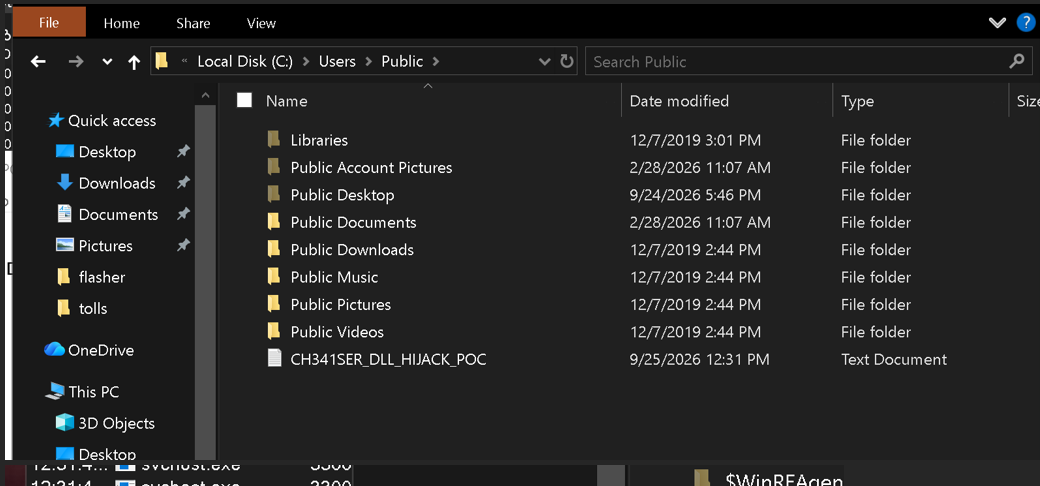
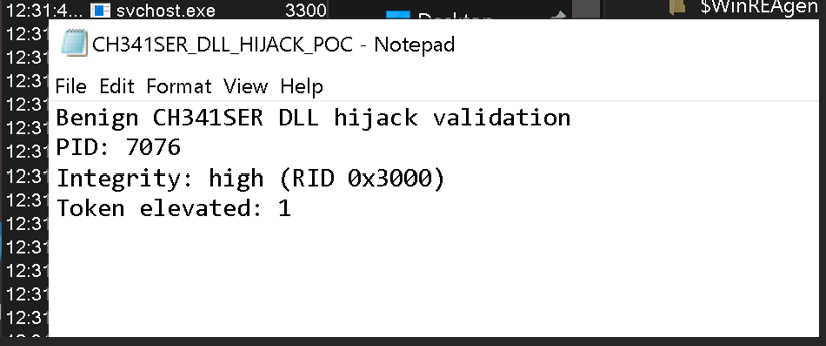
Only publish screenshots that support the accompanying claims. Redact usernames, unrelated paths, host identifiers, and other personal or sensitive information where appropriate.
WCH should consider:
These are remediation recommendations; this repository does not claim that a fix has been released.
The researcher reports that CVE-2026-106781 has been assigned by MITRE. Vendor acknowledgment, a corrected release, and the current remediation timeline have not been independently confirmed here.
For responsible disclosure, contact WCH through its official contact page. Update this section when verified information becomes available.
This document summarizes a reported security finding for defensive awareness, remediation, and responsible disclosure. Testing was reported to have been performed in a controlled environment using a non-destructive proof of concept.
Researcher contact: [email protected]






