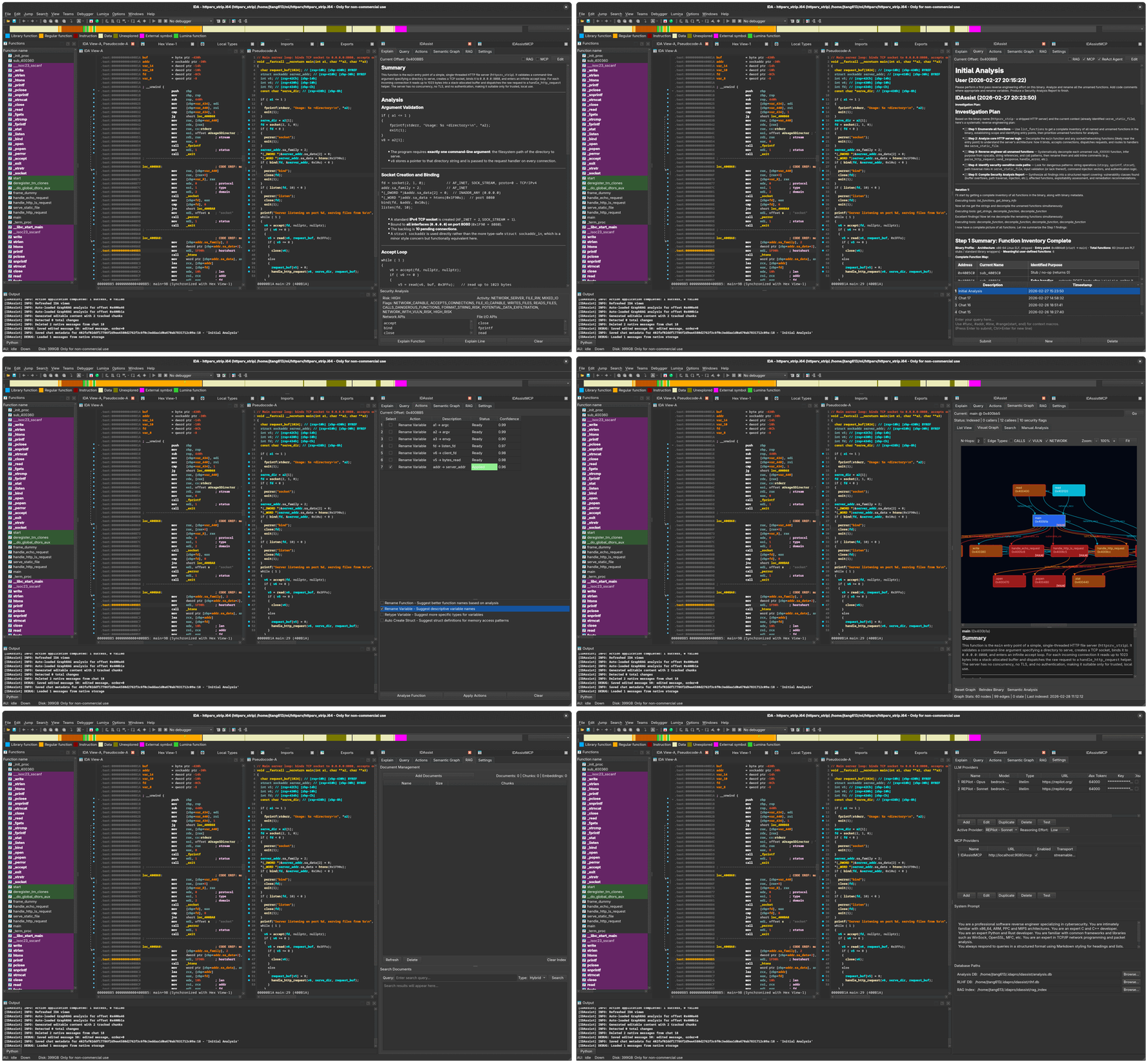
AI-Powered Reverse Engineering Plugin for IDA Pro
AI-Powered Reverse Engineering Plugin for IDA Pro
Author: Jason Tang
IDAssist is an IDA Pro plugin that integrates LLM-powered analysis directly into IDA's interface, providing AI-assisted binary reverse engineering through configurable LLM providers, semantic knowledge graphs, RAG document search, and supports a wide diversity of LLM providers.
Built with Python and PySide6, IDAssist runs as a dockable panel inside IDA Pro 9.0+ and communicates with LLM providers (OpenAI, Anthropic, Ollama, LiteLLM, and more) to analyze functions, suggest renames, answer questions about code, and build a searchable knowledge graph of an entire binary.
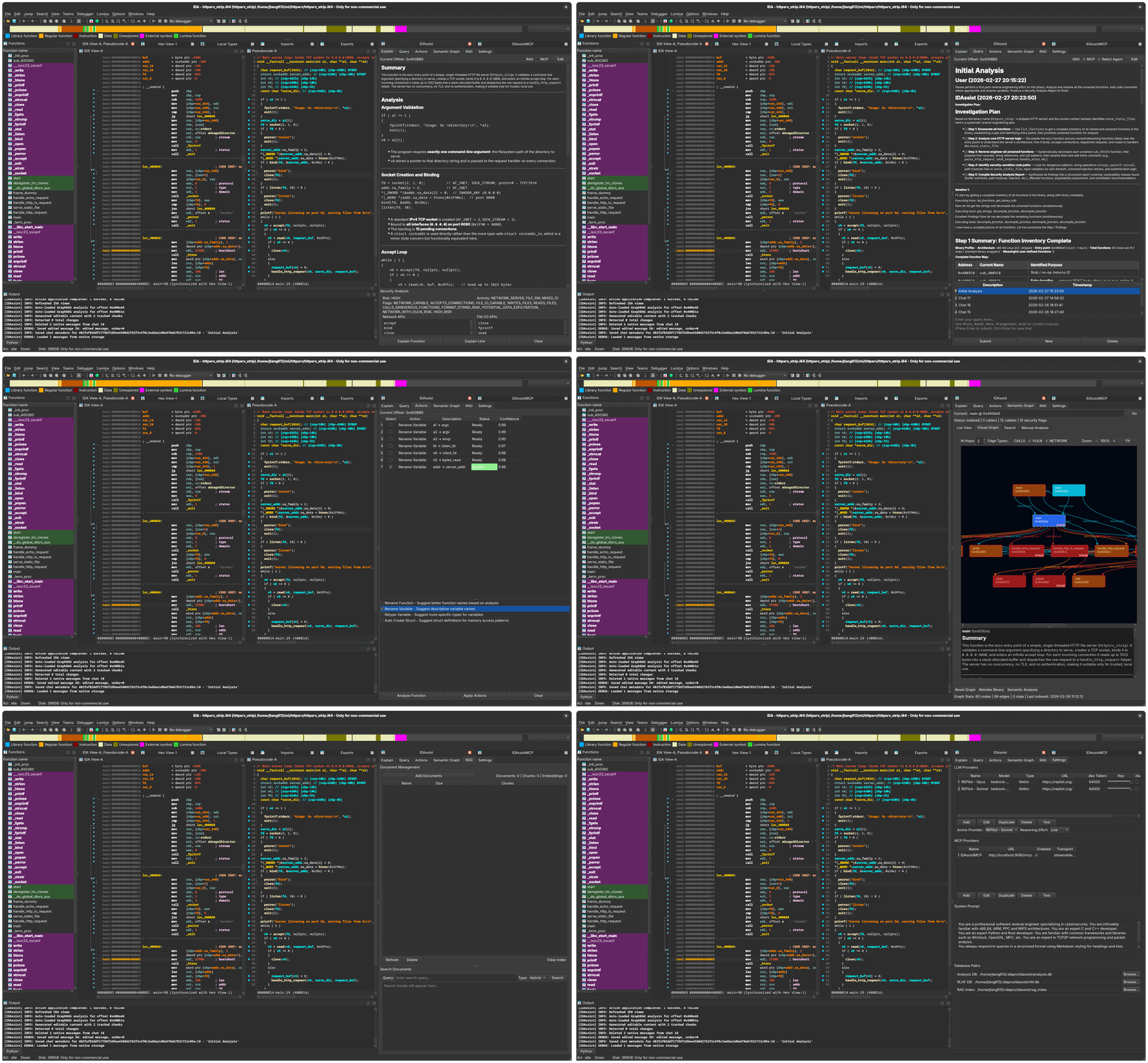
Function Explanation — Generate detailed natural-language explanations of decompiled functions with automatic security analysis including risk level, activity profile, security flags, and API detection.
Interactive Query Chat — Ask questions about the binary with persistent chat history. Use context macros (#func, #addr, #line, #range) to inject function code, addresses, or disassembly ranges into queries.
Automated Actions — AI-powered rename suggestions for functions, variables, and types. Review proposed changes in a table with confidence scores, then apply selected actions back to the IDB.
Semantic Knowledge Graph — Build and explore a knowledge graph of the binary's functions, call relationships, data flows, and security characteristics. Includes visual graph rendering, semantic search, and community detection.
RAG Document Search — Upload reference documents (.txt, .md, .rst, .pdf) and use them as context during LLM queries. Supports hybrid text+vector search via Whoosh indexing.
SymGraph Integration — Push and pull function names, variable names, types, and graph data to the SymGraph collaborative platform. Includes a multi-step wizard with conflict resolution for pulls.
Settings Management — Configure multiple LLM and MCP providers, manage SymGraph API credentials, customize the system prompt, and set database paths.
The Query tab supports an autonomous ReAct (Reasoning + Acting) agent mode. When enabled, the LLM plans an investigation strategy, executes tools to gather information, reflects on findings, and synthesizes a comprehensive answer — all automatically across multiple reasoning rounds.
Configure reasoning effort levels to control how much the LLM "thinks" before responding:
| Level | Thinking Budget | Best For |
|---|---|---|
| None | Disabled | Fast, simple queries |
| Low | ~2K tokens | Straightforward analysis |
| Medium | ~10K tokens | Moderate complexity |
| High | ~25K tokens | Deep analysis, complex code |
IDAssist can connect to external MCP servers for tool-augmented LLM interactions where the model can programmatically inspect functions, read disassembly, query cross-references, and modify the IDB during reasoning. Both URL-based MCP servers (SSE or Streamable HTTP) and stdio-based MCP servers started from a local CLI command are supported. IDAssist also provides built-in internal tools for function calling without requiring an external MCP server.
LLM providers with tool-calling support can invoke IDA analysis functions mid-conversation, enabling iterative investigation without manual intervention.
Provide thumbs-up/thumbs-down feedback on explanations and query responses. Feedback is stored locally and can be used to improve prompt engineering and model selection.
IDAssist follows an MVC (Model-View-Controller) pattern:
src/views/) — PySide6 tab widgets that emit signals on user interactionsrc/controllers/) — Connect view signals to service calls, manage statesrc/services/) — Business logic, LLM providers, database access, graph analysissrc/services/internal_tools.py) — IDA-specific tool definitions for LLM function callingsrc/services/graphrag/graphrag_tools.py) — Semantic graph read/write tools for LLM interactionKey design principles:
execute_on_main_thread()Install the plugin (recommended — IDA Plugin Manager):
hcli plugin install idassist
This automatically installs the plugin and its Python dependencies into IDA's environment.
Or install manually (from release tarball):
Download the latest release zip from GitHub Releases and extract it into your IDA plugins directory:
Linux / macOS:
unzip IDAssist-*.zip -d ~/.idapro/plugins/
Windows:
Extract the zip into %APPDATA%\Hex-Rays\IDA Pro\plugins\.
Then install dependencies using IDA's bundled Python (not your system Python):
Linux / macOS:
<IDA_INSTALL_DIR>/python3/bin/pip3 install -r ~/.idapro/plugins/IDAssist/requirements.txt
Windows:
"<IDA_INSTALL_DIR>\python3\python.exe" -m pip install -r "%APPDATA%\Hex-Rays\IDA Pro\plugins\IDAssist\requirements.txt"
Replace
<IDA_INSTALL_DIR>with your IDA Pro installation path (e.g.,/opt/idapro-9.0orC:\Program Files\IDA Pro 9.0).Tip: You can also set the
IDAUSRenvironment variable to a custom directory containing aplugins/subdirectory.
Open IDAssist: Launch IDA Pro, open a binary, and press Ctrl+Shift+A (or Edit > Plugins > IDAssist).
Configure a provider: Go to the Settings tab, click Add under LLM Providers, and configure your preferred provider.
Analyze a function: Navigate to any function, click the Explain tab, and press Explain Function.
For detailed setup instructions, see Getting Started.
IDAssist supports the following provider types:
| Type | Auth Method | Notes |
|---|---|---|
anthropic_platform | API Key | Anthropic API direct |
anthropic_oauth | OAuth (browser) | Browser-based authentication |
anthropic_claude_cli | Local CLI | Uses the claude CLI binary |
bedrock | AWS Credentials | Direct AWS Bedrock Converse API |
openai_platform | API Key | OpenAI API direct |
openai_oauth | OAuth (browser) | Browser-based authentication |
ollama | None (local) | Self-hosted models |
litellm | Proxy URL | Multi-provider proxy |
| Provider | Model | Strengths |
|---|---|---|
| Anthropic | claude-sonnet-4-6 | Strong code analysis, extended thinking |
| OpenAI | gpt-5.3-codex | Fast, good general analysis |
| Ollama | qwen2.5-coder:32b | Local, no API key needed |
The Semantic Graph tab provides a knowledge graph of the binary: