 sumitchongder/q-trace
Physics-based zero-day attack detection for decoy-state QKD: no attack data needed, provable detectability limits, and BB84 with physical eavesdroppers on IBM Quantum hardware.




Physics-based zero-day attack detection for decoy-state quantum key distribution, with information-theoretic detectability bounds and validation on IBM Quantum hardware.
📄 Paper: Sumit Tapas Chongder, Q-TRACE: Physics-based zero-day attack detection for decoy-state quantum key distribution, arXiv:2611.28945 [quant-ph] (2026). The manuscript sources are in
paper/, and every number in the paper is regenerated from this repository bypaper/build_numbers.py.
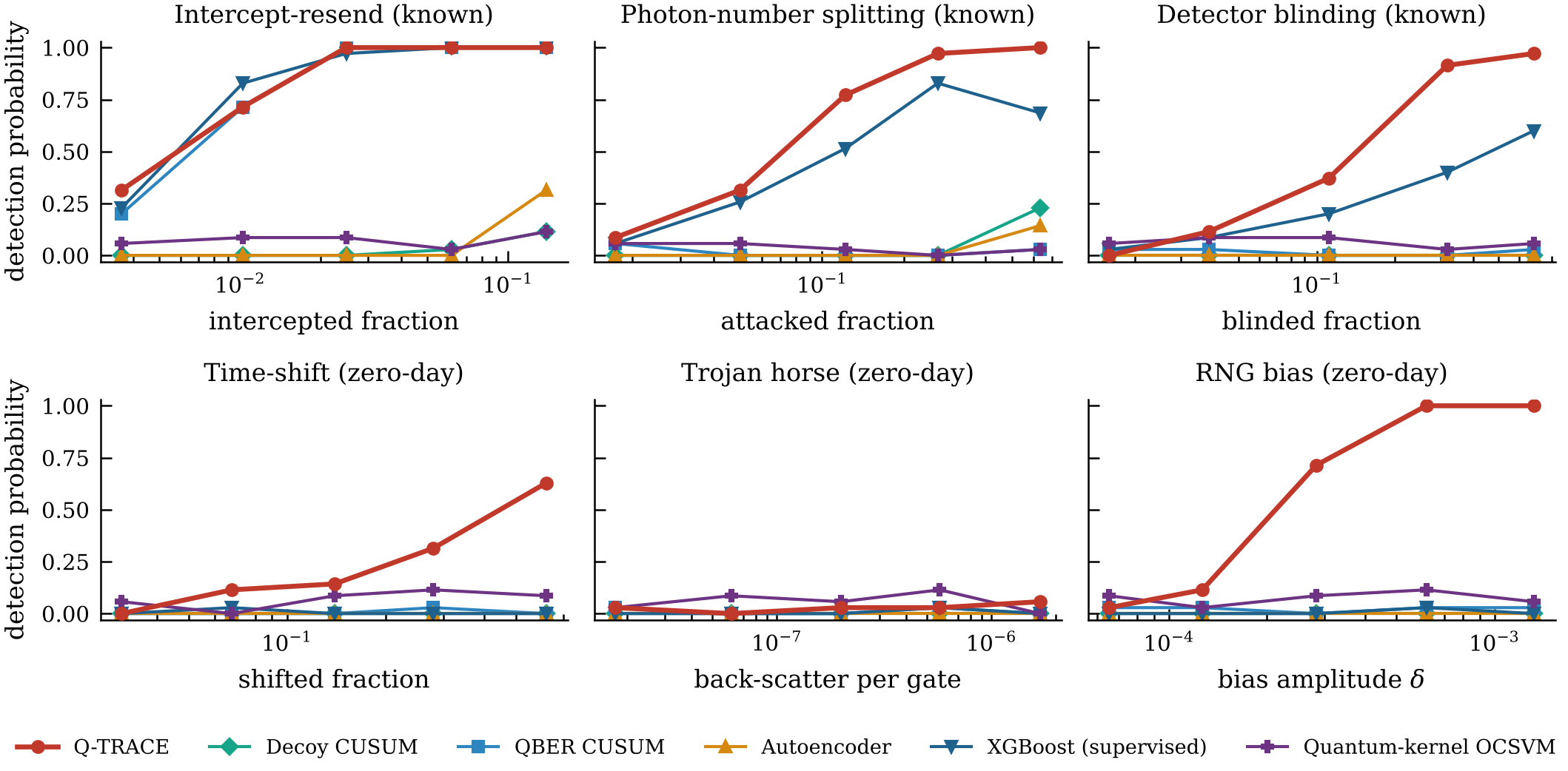
Q-TRACE detects implementation attacks on a quantum-key-distribution link without ever seeing an
attack. It tests every telemetry window against the honest-device manifold, the set of outcome
statistics that an attack-free decoy-state BB84 link can produce under arbitrary channel loss, and
raises an alarm when no honest explanation remains. The same construction yields a detector-independent
detectability exponent D* that bounds how fast any telemetry monitor (classical, deep or
quantum) can detect a given attack, and identifies attacks that no monitor can detect at all.
e_Z, e_X, p_d0, p_d1, κ, ρ) on commissioning data; per-window profiling of the transmittance as a
nuisance parameter (loss is not a security-relevant deviation in decoy-state QKD); three families of
alarm channels: an omnibus Freeman–Tukey residual test, a physics score test (Rao / Neyman C(α)) over
the directions in which device parameters can move, and a setting-allocation test, each with a
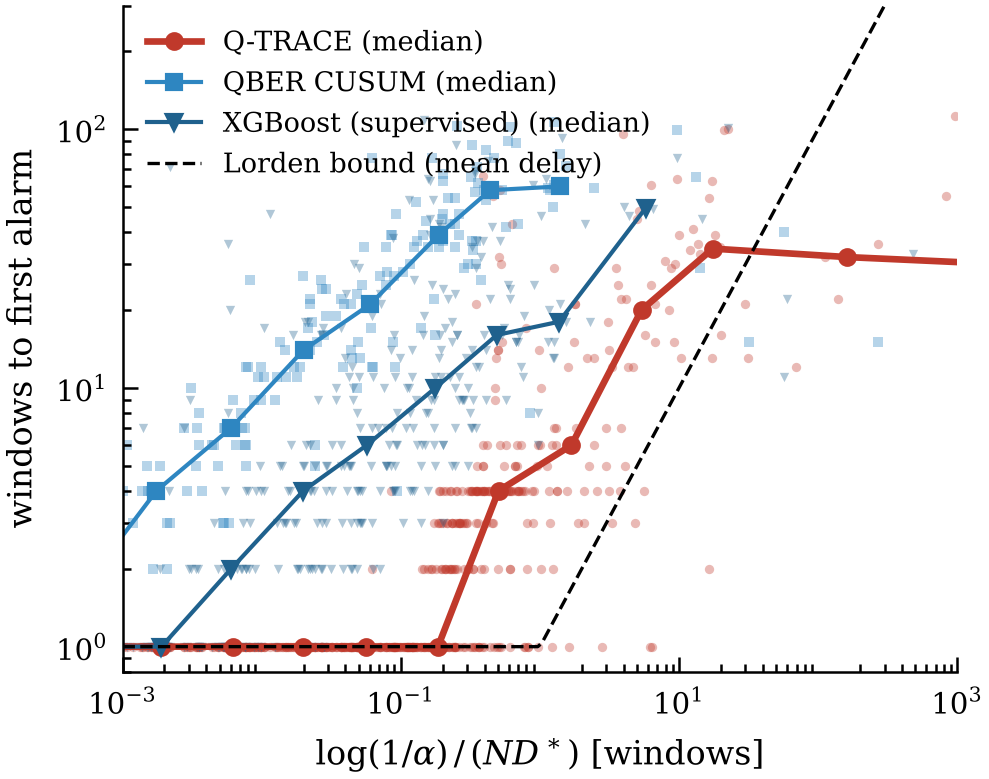
drift-robust moving-reference variant. No attack data are used anywhere.D* = min_η KL(Q ‖ P_η) per pulse gives, through Lorden's theorem, a lower
bound log(1/α)/(N D*) on the mean detection delay of any detector at false-alarm rate α. A
Trojan-horse attack with filtered back-reflection has D* = 0 exactly: it is provably invisible to
every telemetry-based monitor.ibm_marrakesh, with eavesdroppers physically executed as tunable entangling
(RZX/RXX) and amplitude-damping probes. Eve's ancilla is measured, giving her information gain
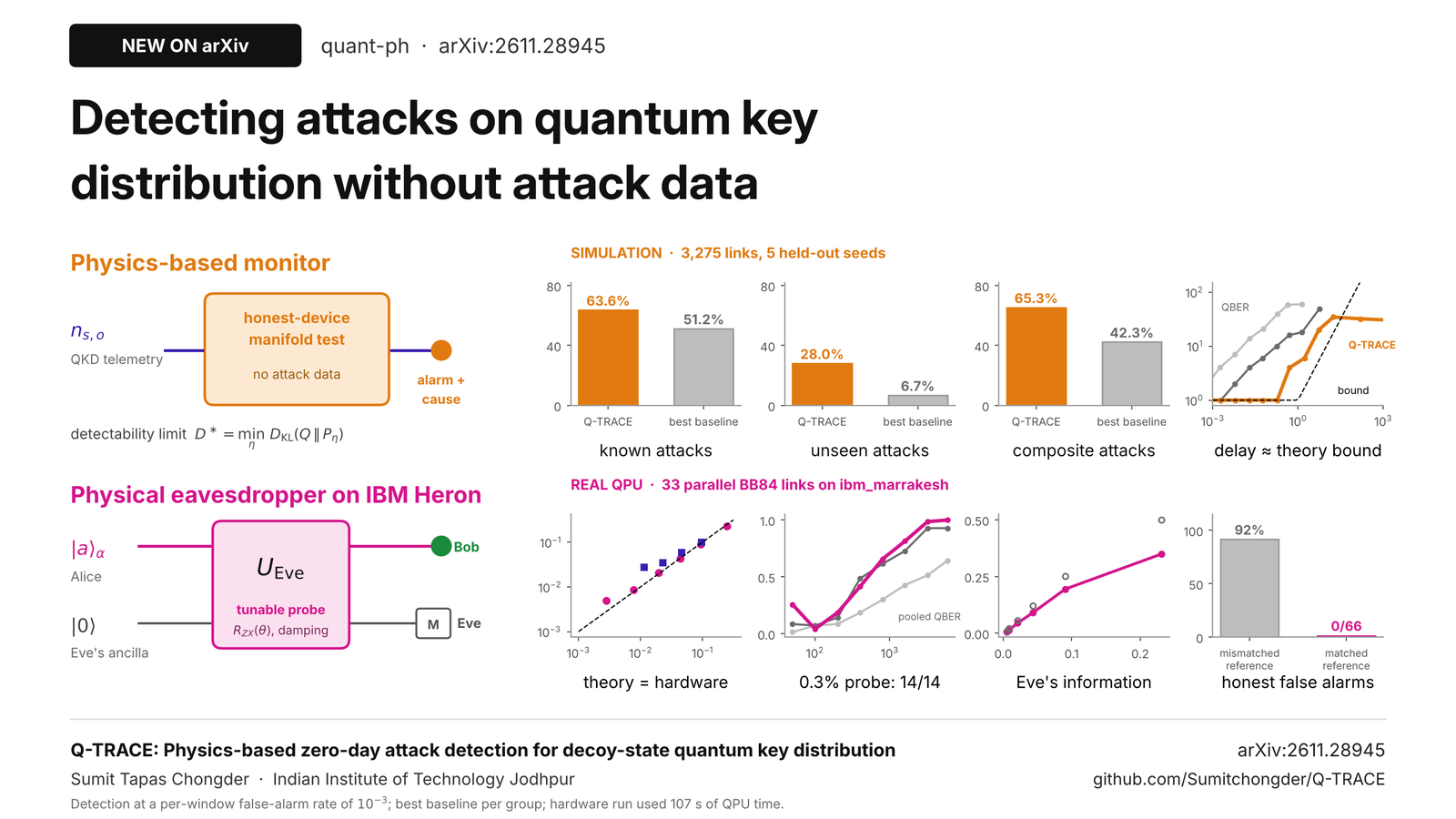
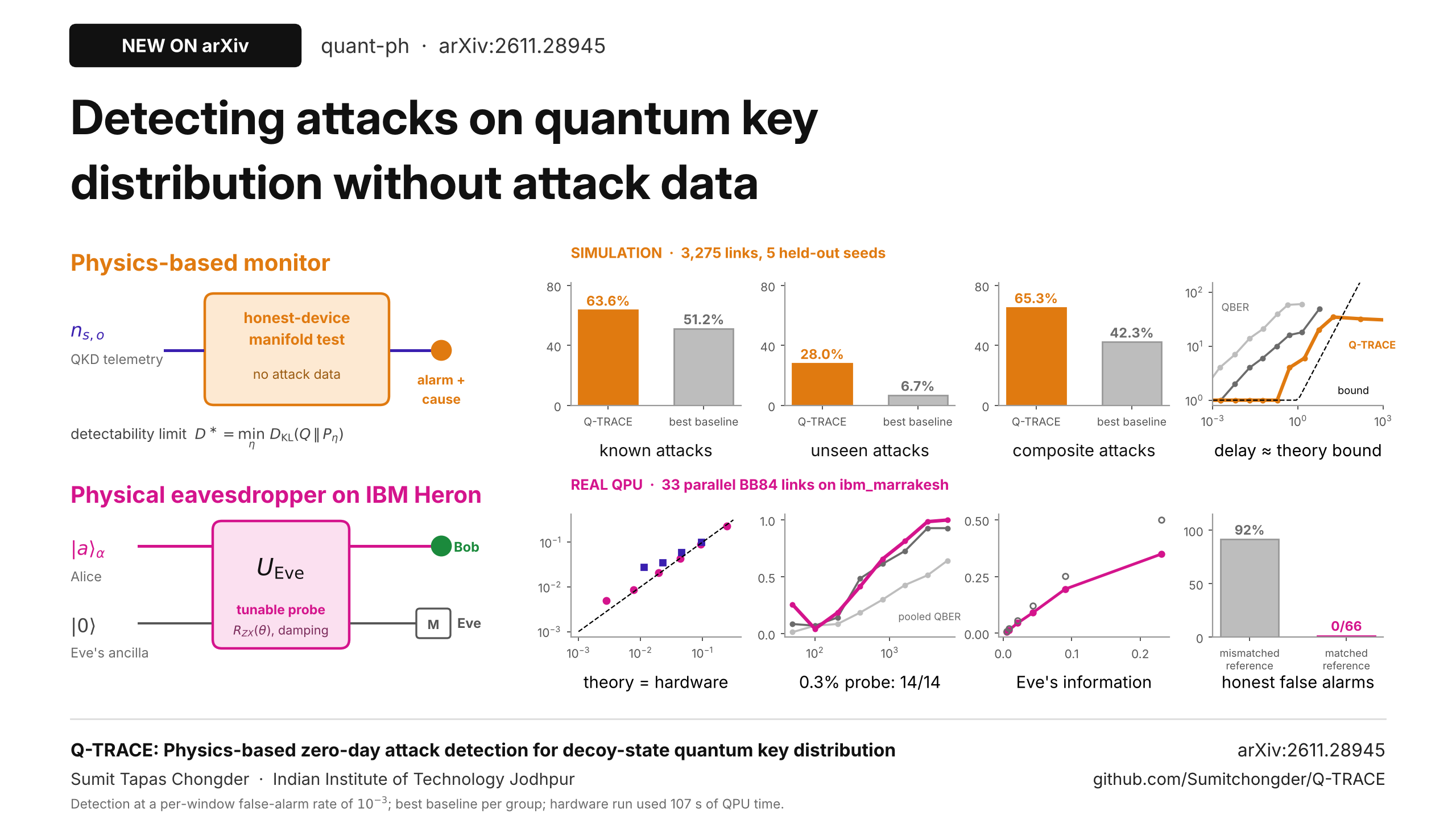
(and the information leaked before the first alarm) on real hardware.Attacked links detected (%) and attack-free links with any alarm (FA, %) at a per-window false-alarm rate of 10⁻³; mean ± 95 % CI over 5 held-out seeds (3,275 links, 655,000 telemetry windows). "Long links" is the 60 to 120 km regime absent from training.
| Method | Known | Zero-day | Composite | Long links | FA honest | FA loss fault | FA long links |
|---|---|---|---|---|---|---|---|
| Q-TRACE | 63.6 ± 6.6 | 28.0 ± 2.5 | 65.3 ± 9.1 | 32.0 ± 7.5 | 5.2 ± 3.8 | 0.0 ± 0.0 | 3.2 ± 2.2 |
| XGBoost (supervised) | 51.2 ± 8.5 | 0.6 ± 0.6 | 42.3 ± 10.8 | 24.4 ± 9.2 | 0.8 ± 1.4 | 8.8 ± 6.5 | 0.0 ± 0.0 |
| QBER CUSUM | 27.2 ± 5.3 | 1.3 ± 2.5 | 21.0 ± 3.8 | 9.8 ± 3.7 | 1.2 ± 2.2 | 1.6 ± 2.7 | 0.0 ± 0.0 |
| Decoy CUSUM | 2.5 ± 2.8 | 0.0 ± 0.0 | 0.3 ± 0.9 | 0.0 ± 0.0 | 0.0 ± 0.0 | 3.2 ± 2.2 | 0.0 ± 0.0 |
| QBER static | 13.1 ± 6.0 | 1.7 ± 1.3 | 11.7 ± 7.3 | 50.7 ± 7.4 ¹ | 2.8 ± 2.8 | 0.8 ± 2.2 | 45.6 ± 16.7 |
| Autoencoder | 3.0 ± 2.7 | 0.0 ± 0.0 | 1.3 ± 1.7 | 0.9 ± 1.5 | 0.0 ± 0.0 | 4.0 ± 8.6 | 0.0 ± 0.0 |
| Isolation Forest | 3.6 ± 4.6 | 0.4 ± 1.1 | 5.0 ± 8.5 | 0.0 ± 0.0 | 0.0 ± 0.0 | 12.0 ± 8.6 | 0.0 ± 0.0 |
| One-class SVM | 0.0 ± 0.0 | 0.0 ± 0.0 | 0.0 ± 0.0 | 0.0 ± 0.0 | 0.0 ± 0.0 | 0.0 ± 0.0 | 0.0 ± 0.0 |
| Quantum-kernel OCSVM | 5.7 ± 2.5 | 6.7 ± 2.4 ² | 4.3 ± 2.8 | 8.9 ± 6.2 | 10.4 ± 3.2 | 12.8 ± 4.2 | 7.2 ± 5.4 |
¹ An artefact: the static 11 % threshold also alarms on 45.6 % of honest long links, whose QBER can exceed 11 %. ² Not genuine detection: the same method alarms on 10.4 % of attack-free links.
Window-level AUROC (mean ± 95 % CI):
| Method | Known | Zero-day | Composite | Long links |
|---|---|---|---|---|
| Q-TRACE | 0.859 ± 0.033 | 0.636 ± 0.032 | 0.858 ± 0.034 | 0.699 ± 0.032 |
| XGBoost (supervised) | 0.848 ± 0.026 | 0.499 ± 0.043 | 0.771 ± 0.041 | 0.718 ± 0.041 |
| QBER CUSUM | 0.664 ± 0.043 | 0.533 ± 0.045 | 0.664 ± 0.034 | 0.624 ± 0.019 |
| Decoy CUSUM | 0.746 ± 0.022 | 0.546 ± 0.031 | 0.724 ± 0.067 | 0.660 ± 0.036 |
| QBER static | 0.567 ± 0.064 | 0.487 ± 0.072 | 0.545 ± 0.065 | 0.571 ± 0.075 |
| Autoencoder | 0.800 ± 0.036 | 0.573 ± 0.017 | 0.766 ± 0.020 | 0.663 ± 0.036 |
| Isolation Forest | 0.767 ± 0.033 | 0.554 ± 0.014 | 0.745 ± 0.049 | 0.677 ± 0.033 |
| One-class SVM | 0.814 ± 0.021 | 0.571 ± 0.027 | 0.775 ± 0.029 | 0.677 ± 0.026 |
| Quantum-kernel OCSVM | 0.523 ± 0.018 | 0.498 ± 0.013 | 0.521 ± 0.014 | 0.501 ± 0.025 |
IBM Quantum hardware (ibm_marrakesh, 33 parallel links, 64 circuits × 5,900 shots, 107 s of QPU
time). Link-epochs flagged at α = 10⁻³ with a condition-matched reference (each link's honest
monitoring epochs). ΔQBER is the increase of the sifted QBER caused by the probe.
| Probe | Link-epochs | Ideal ΔQBER | Measured ΔQBER | Q-TRACE | QBER per basis | QBER pooled |
|---|---|---|---|---|---|---|
| Honest (no probe) | 66 | 0 | 0 | 0/66 | 0/66 | 0/66 |
| Entangling, θ = 0.15 | 14 | 0.28 % | 0.49 % | 14/14 | 13/14 | 9/14 |
| Entangling, θ = 0.25 | 13 | 0.78 % | 0.87 % | 12/13 | 11/13 | 11/13 |
| Entangling, θ = 0.40 | 14 | 1.97 % | 2.11 % | 14/14 | 14/14 | 14/14 |
| Entangling, θ = 0.60 | 14 | 4.37 % | 4.34 % | 14/14 | 14/14 | 14/14 |
| Entangling, θ = 0.90 | 13 | 9.46 % | 9.05 % | 13/13 | 13/13 | 13/13 |
| Entangling, θ = π/2 (intercept–resend) | 13 | 25.00 % | 23.10 % | 13/13 | 13/13 | 13/13 |
| Amplitude damping, γ = 0.03 | 13 | 1.13 % | 2.82 % | 13/13 | 13/13 | 13/13 |
| Amplitude damping, γ = 0.06 | 12 | 2.26 % | 3.49 % | 12/12 | 12/12 | 12/12 |
| Amplitude damping, γ = 0.12 | 12 | 4.55 % | 5.99 % | 12/12 | 12/12 | 12/12 |
| Amplitude damping, γ = 0.25 | 14 | 9.60 % | 10.05 % | 14/14 | 14/14 | 14/14 |