 strongcourage/uafuzz
Binary-level directed fuzzer specialized in detecting Use-After-Free vulnerabilities via ordering-aware input metrics and static analysis, enabling bug reproduction, patch testing, and report verification.


Directed Greybox Fuzzing (DGF) like AFLGo aims to perform stress testing on pre-selected potentially vulnerable target locations, with applications to different security contexts: (1) bug reproduction, (2) patch testing or (3) static analysis report verification. There are recently more research work that improved directed fuzzing's effectiveness and efficiency (see awesome-directed-fuzzing).
We propose UAFuzz which is a directed fuzzer dedicated to Use-After-Free (UAF) bugs at binary-level by carefully tuning the key components of directed fuzzing to meet specific characteristics of this bug class. UAF bugs appear when a heap element is used after having been freed. Detecting UAF bugs is hard: (1) complexity because a Proof-of-Concept (PoC) input needs to trigger a sequence of three events – alloc, free and use – on the same memory location, spanning multiple functions of the tested program and (2) silence with no segmentation fault.
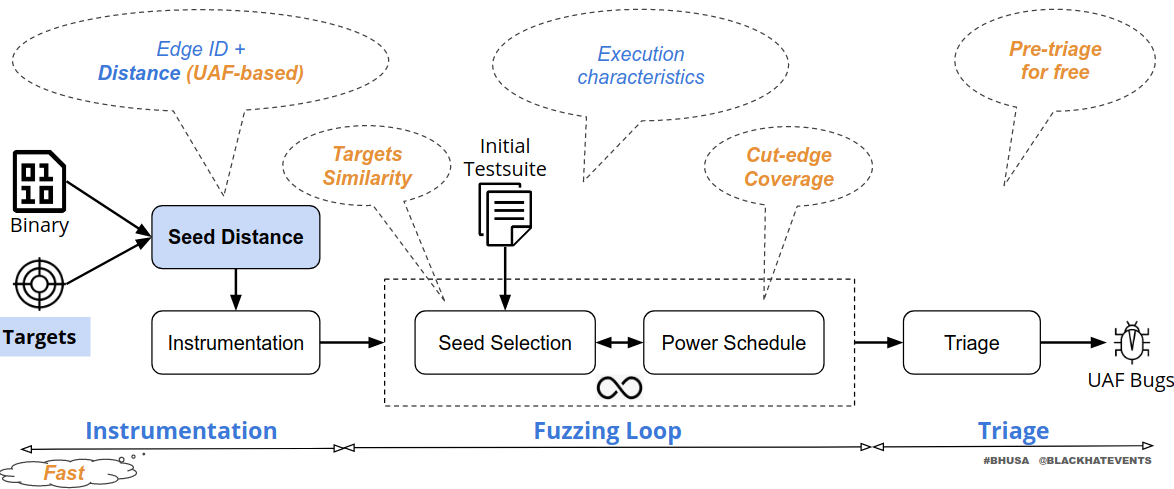
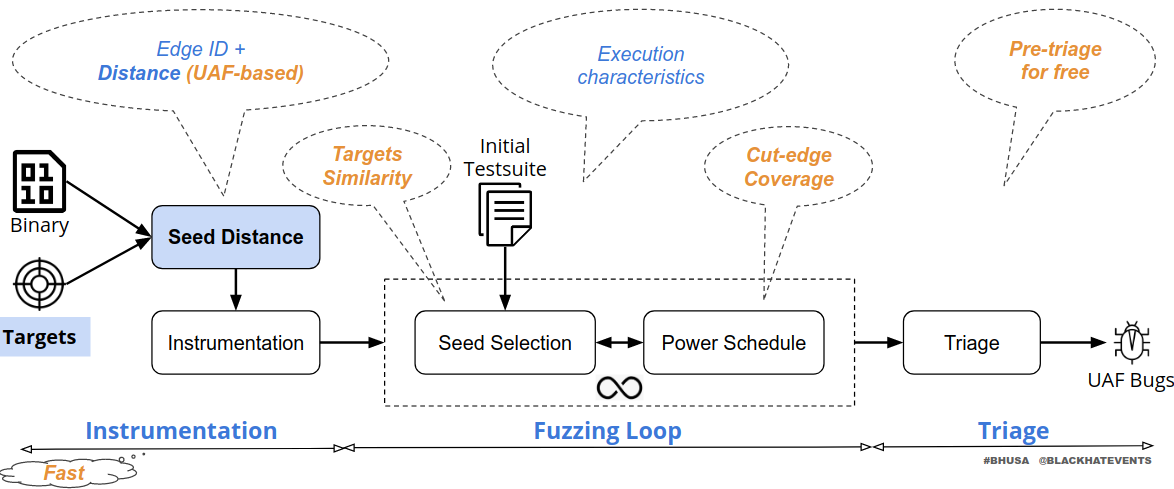
Overall, UAFuzz has the similar workflow as directed fuzzers with our modifications highlighted in orange along the whole fuzzing process, as shown in the following figure. As we focus on (1) bug reproduction and (2) patch testing applications, it is more likely we have (mostly) complete stack traces of all memory-related UAF events. Unlike existing general directed approaches where targets could be selected independently, we take into account the relationship among targets (e.g., the ordering which is essential for UAFs) to improve the directedness. First, the static precomputation of UAFuzz is fast at binary level. Second, we introduce new ordering-aware input metrics to guide the fuzzer towards targets at runtime. Finally, we triage only potential inputs covering all targets in the expected trace and pre-filter for free inputs that are less likely to trigger the bug.
More details in our paper at RAID'20 and our talk at Black Hat USA'20. Thanks also to Sébastien Bardin, Matthieu Lemerre, Prof. Roland Groz and especially Richard Bonichon (@rbonichon) for his help on Ocaml.
Our tested environment is Ubuntu 16.04 64-bit.
# Install Ocaml and prerequisite packages for BINSEC via OPAM
sudo apt update
sudo apt update
sudo apt install ocaml ocaml-native-compilers camlp4-extra opam emacs llvm-6.0-dev pkg-config protobuf-compiler libgmp-dev libzmq3-dev cmake valgrind
opam init
opam switch 4.05.0
opam depext conf-m4.1
opam install merlin ocp-indent caml-mode tuareg menhir ocamlgraph ocamlfind piqi zmq.5.0.0 zarith llvm.6.0.0
eval `opam config env`

# Install Python's packages (Python 2 for IDA's scripts)
sudo python -m pip install networkx pydot
sudo apt install graphviz

# Install Graph Easy
wget https://cpan.metacpan.org/authors/id/S/SH/SHLOMIF/Graph-Easy-0.76.tar.gz
tar xzf Graph-Easy-0.76.tar.gz
cd Graph-Easy-0.76
perl Makefile.PL; make test; sudo make install
export GRAPH_EASY_PATH=/usr/local/bin/graph-easy

# Checkout source code
git clone https://github.com/strongcourage/uafuzz.git

# Environment variables
export IDA_PATH = /path/to/ida-6.9/idaq
export GRAPH_EASY_PATH=/path/to/graph-easy
cd uafuzz; export UAFUZZ_PATH=`pwd`

# Compile source code
./scripts/build.sh uafuzz

# Help for IDA/UAFuzz interface
./binsec/src/binsec -ida-help
./binsec/src/binsec -uafuzz-help
Our fuzzer is built upon AFL v2.52b in QEMU mode for fuzzing and BINSEC for lightweight static analysis (see uafuzz/README.md). We currently use IDA Pro v6.9 to extract control flow graphs (CFGs) and call graph of the tested binary (see ida/README.md).
uafuzz
├── binsec/src
│   └── ida: a plugin to import and process IDA's CFGs and call graph
│   └── uafuzz: fuzzing code
│   │   └── afl-2.52b: core fuzzing built on top of AFL-QEMU
│   │   └── uafuzz_*.ml(i): a plugin to compute static information and communicate with AFL-QEMU
└── scripts: some scripts for building and bug triaging
We first consider a simple UAF bug. Both AFL-QEMU and even directed fuzzer AFLGo with targets at source-level can't detect this bug within 6 hours, while UAFuzz can detect it within minutes with the help of a Valgrind's UAF report.
# Run AFL-QEMU
$UAFUZZ_PATH/tests/example.sh aflqemu 360
# Run AFLGo given targets at source-level
$UAFUZZ_PATH/tests/example.sh aflgo 360
# Run UAFuzz
$UAFUZZ_PATH/tests/example.sh uafuzz 360 $UAFUZZ_PATH/tests/example/example.valgrind
For real-world programs, we use the UAF Fuzzing Benchmark for our evaluations.
# Checkout the benchmark
git clone https://github.com/strongcourage/uafbench.git
cd uafbench; export UAFBENCH_PATH=`pwd`
We show in details how to run UAFuzz for bug reproduction application of CVE-2018-20623 of readelf (Binutils). The stack traces of this UAF bug obtained by Valgrind are as follows:
    // stack trace for the bad Use
    ==5358== Invalid read of size 1
    ==5358==    at 0x40A9393: vfprintf (vfprintf.c:1632)
    ==5358==    by 0x40A9680: buffered_vfprintf (vfprintf.c:2320)
    ==5358==    by 0x40A72E0: vfprintf (vfprintf.c:1293)
[6] ==5358==    by 0x80AB881: error (elfcomm.c:43)
[5] ==5358==    by 0x8086217: process_archive (readelf.c:19409)
[1] ==5358==    by 0x80868EA: process_file (readelf.c:19588)
[0] ==5358==    by 0x8086B01: main (readelf.c:19664)

    // stack trace for the Free
    ==5358==  Address 0x4221dc0 is 0 bytes inside a block of size 80 free'd
    ==5358==    at 0x402D358: free (in /usr/lib/valgrind/vgpreload_memcheck-x86-linux.so)
[4] ==5358==    by 0x8086647: process_archive (readelf.c:19524)
[1] ==5358==    by 0x80868EA: process_file (readelf.c:19588)
[0] ==5358==    by 0x8086B01: main (readelf.c:19664)

    // stack trace for the Alloc
    ==5358==  Block was alloc'd at
    ==5358==    at 0x402C17C: malloc (in /usr/lib/valgrind/vgpreload_memcheck-x86-linux.so)
[3] ==5358==    by 0x80AD97E: make_qualified_name (elfcomm.c:906)
[2] ==5358==    by 0x8086350: process_archive (readelf.c:19435)
[1] ==5358==    by 0x80868EA: process_file (readelf.c:19588)
[0] ==5358==    by 0x8086B01: main (readelf.c:19664)
