
Skip to content
KitploitKITPLOIT
ToolsBlog
Submit
ToolsBlog
Submit

Hacking, PenTest, and Cybersecurity Tools for Your Security Arsenal!

Kitploit is a directory of hacking, cybersecurity, and pentesting tools. Discover the latest project updates to find vulnerabilities, analyze systems, automate testing, and strengthen your security.

··Feeds·Contact·Privacy·© 2026 Kitploit

Tool Directory

Categories

View all categories
Loading categories
stealth_call — Header-only Windows x64 indirect syscall library. Zero CRT, zero IAT, VEH anti-BP, AMSI/ETW bypass, W^X memory, per-call dynamic stubs. | Kitploit
Tools/GitHubGitHub/share-devn/stealth_call
Privilege EscalationMemory ForensicsExploitationIDS/IPS EvasionShellcodePost-ExploitationRed TeamingPayload Development
GitHubshare-devn/stealth_call

stealth_call

Header-only Windows x64 indirect syscall library. Zero CRT, zero IAT, VEH anti-BP, AMSI/ETW bypass, W^X memory, per-call dynamic stubs.

View Repository
74 months agoNot yet reviewed

Most Popular

View all →

Discover the most used tools by our community.

Explore all tools

Browse our collection of tools

View all tools →
Share

stealth_call


What is this?

Header-only library for Windows x64 that lets you invoke any NT syscall without touching ntdll imports, without leaving strings in your binary, and without the usual red flags that make EDRs lose their minds.

No CRT. No STL. No IAT. The whole thing compiles down to ~19KB with literally zero DLL dependencies.

Built to avoid the common pitfalls of existing syscall libraries — plaintext strings, known hash constants, direct syscall from non-ntdll memory, IAT imports that scream "I'm doing something weird", SEC_NO_CHANGE IOC, CRT bloat. None of that here.


Features

Syscall Engine

  • Indirect syscalls — stubs jump into ntdll's own syscall; ret gadget, so RIP is always inside ntdll when the syscall instruction fires
  • Per-call stub generation — every single invocation builds a fresh stub with random junk, random layout, XOR'd syscall number. Nothing is reused
  • W^X enforcement — scratch pages go RW → RX → RW. RWX is never allocated, period
  • Stubs wiped immediately after each call
  • Syscalls extracted from \KnownDlls\ntdll.dll section mapping (no filesystem access, invisible to ProcMon)
  • 977 syscalls resolved on a typical Win11 system

Anti-Breakpoint

  • VEH-based approach — if a debugger drops a 0xCC on your target function, the exception handler silently restores the original byte, executes the instruction under single-step, then puts the breakpoint back. Debugger never knows it was bypassed. Zero timing window
  • Works on any function in any DLL, not just ntdll

Evasion

  • AMSI bypass — patches AmsiScanBuffer to return S_OK
  • ETW bypass — patches EtwEventWrite to return SUCCESS
  • All patching done through direct syscalls, not VirtualProtect
  • XOR-encrypted strings everywhere — DLL names, paths, everything. Decrypted on stack, wiped after use
  • Custom hash algorithm (not FNV-1a, not CRC32 — no known YARA signatures)
  • PEB walk for all module/function resolution — no GetModuleHandle, no GetProcAddress

Code Quality

  • Header-only, drop the stealth/ folder into your project and go
  • Thread-safe via per-thread scratch pages + spinlocks
  • Full cleanup on shutdown — scratch pages freed, maps zeroed, VEH removed
  • Hook detection for common EDR trampolines (jmp rel32, jmp [rip], mov rax + jmp rax)

How It Works

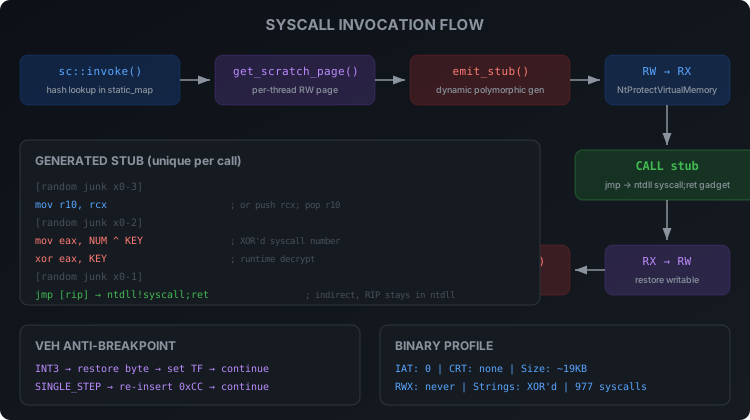
flow

Syscall Path

  1. initialize() opens ntdll through \KnownDlls section, parses PE exports, grabs every syscall number
  2. Scans ntdll .text for a syscall; ret gadget — this is where the actual syscall instruction will execute from
  3. When you call sc::invoke():
    • Looks up the syscall entry by hash
    • Grabs the calling thread's scratch page (or allocates one, RW only)
    • emit_stub() builds a unique polymorphic stub — random junk instructions before/after, XOR-obfuscated syscall number with a per-call key, indirect jmp to the ntdll gadget
    • Flips the page RW → RX
    • Calls through the stub
    • Flips back RX → RW
    • Zeroes out the stub bytes

At no point does RWX memory exist. At no point does a syscall instruction execute outside of ntdll. At no point are syscall numbers stored in plaintext.

VEH Trampoline

You call tramp::invoke() with the target function. If there's no breakpoint — the function just runs normally with zero overhead. If a debugger placed 0xCC:

  1. INT3 exception fires
  2. Our VEH handler checks if the address is in our table (hash lookup, not linear scan)
  3. Restores the original byte from a clean copy read off disk
  4. Sets the Trap Flag
  5. Continues execution — the real instruction runs
  6. Single-step exception fires
  7. Handler puts 0xCC back

The debugger's breakpoint list still shows it as active. The breakpoint just never triggers on our calls.


Build

root@kitploit:~
cmake -B build -A x64
cmake --build build --config Release

Needs MSVC (VS 2019+) and CMake 3.15+. Output is ~19KB with zero imports.


Usage

Syscalls

root@kitploit:~
#include "stealth/syscall.hpp"

stealth::sc::initialize();

PVOID base = nullptr;
SIZE_T size = 0x1000;
NTSTATUS status = stealth::sc::invoke<NTSTATUS>(
    HASH("NtAllocateVirtualMemory"),
    NtCurrentProcess(), &base, (ULONG_PTR)0, &size,
    (ULONG)(MEM_COMMIT | MEM_RESERVE), (ULONG)PAGE_READWRITE
);

Anti-Breakpoint

root@kitploit:~
#include "stealth/trampoline.hpp"

// works even if x64dbg has a BP on MessageBoxA
int ret = stealth::tramp::invoke<int>(
    HASH_CI("user32.dll"), HASH("MessageBoxA"),
    (HWND)nullptr, (LPCSTR)"hello", (LPCSTR)"title", (UINT)MB_OK
);

AMSI / ETW

root@kitploit:~
#include "stealth/bypass.hpp"

stealth::bypass::patch_etw();
stealth::bypass::patch_amsi();

Cleanup

root@kitploit:~
stealth::tramp::shutdown();
stealth::sc::shutdown();

Project Structure

root@kitploit:~
stealth/
  common.hpp      — memory ops, spinlock, static_map, PRNG, debug output
  hash.hpp        — compile-time custom hash
  xorstr.hpp      — compile-time XOR string encryption
  peb.hpp         — PEB walk, PE export parser, hook detection
  syscall.hpp     — indirect syscall engine, stub generator, W^X, anti-dump
  trampoline.hpp  — VEH-based anti-breakpoint
  bypass.hpp      — AMSI + ETW patching

License

MIT — do whatever you want with it.

Download Tool
