
Zero-Trust SSH CA






Ephemera is a lightweight, self-hosted SSH Certificate Authority designed to enforce Zero-Trust access for infrastructure. It replaces static SSH keys with short-lived certificates, integrates hardware-backed WebAuthn MFA, and maintains cryptographically verifiable audit trails.
[!NOTE] Canonical Source: Codeberg
GitHub Mirror: GitHub (for availability and hosting)
graph LR
    subgraph Client["User (Operator)"]
        SSH["SSH Client"]
        HW["Hardware Key<br/>WebAuthn / YubiKey"]
    end

    subgraph Auth["Authentication Boundary"]
        MFA["WebAuthn MFA<br/><i>Human presence required</i>"]
        OIDC["OIDC<br/><i>Optional</i>"]
    end

    subgraph CA["Ephemera SSH Certificate Authority"]
        CORE["Self-hosted CA<br/>Air-gap capable"]
        POLICY["Policy Engine<br/><i>Governance at issuance</i>"]
        BUDGET["Trust Budgeting<br/><i>Optional</i>"]
    end

    subgraph Targets["Target Servers"]
        NATIVE["Native OpenSSH<br/>TrustedUserCAKeys"]
        NOAGENT["No agents<br/>No SSH proxy"]
    end

    subgraph Audit["Audit & Recovery"]
        LOG["Tamper-Evident<br/>Audit Log"]
        BACKUP["Encrypted Backups<br/>Shamir Recovery"]
    end

    Client --> Auth
    Auth -->|"Short-lived cert"| CA
    CA -->|"Certificate expires<br/>automatically"| Targets
    CA -.->|"Post-fact integrity"| Audit

    style Auth fill:#e8f5e9,stroke:#2e7d32
    style CA fill:#e3f2fd,stroke:#1565c0
    style Audit fill:#fff3e0,stroke:#ef6c00
What Ephemera does: Governs who may receive access and for how long.
What Ephemera does NOT do: Runtime monitoring, MITM proxying, command inspection.
Enforcement: Entirely within native OpenSSH — no Ephemera agent on target servers.
Key rotation: Not needed — certificates expire automatically.
Ephemera is a self-hosted SSH Certificate Authority built on native OpenSSH features. It replaces long-lived SSH keys with short-lived certificates issued just-in-time, with explicit physical presence and auditable privilege escalation.
It is designed for teams that want centralized SSH governance without MITM proxies, custom protocols, or cloud dependencies.
Core SSH CA functionality: Production-ready
Trust Budgeting: Experimental (opt-in, subject to change)
The experimental features are clearly isolated and disabled by default.
Traditional SSH relies on long-lived private keys spread across laptops and servers. Once a key leaks, access persists until you discover it and rotate keys everywhere. Ephemera replaces static keys with short-lived certificates that expire automatically, shrinking the window of misuse from months to minutes.
Just-in-Time Access : Certificates expire in minutes (default 5m), reducing the window of opportunity for stolen credentials.
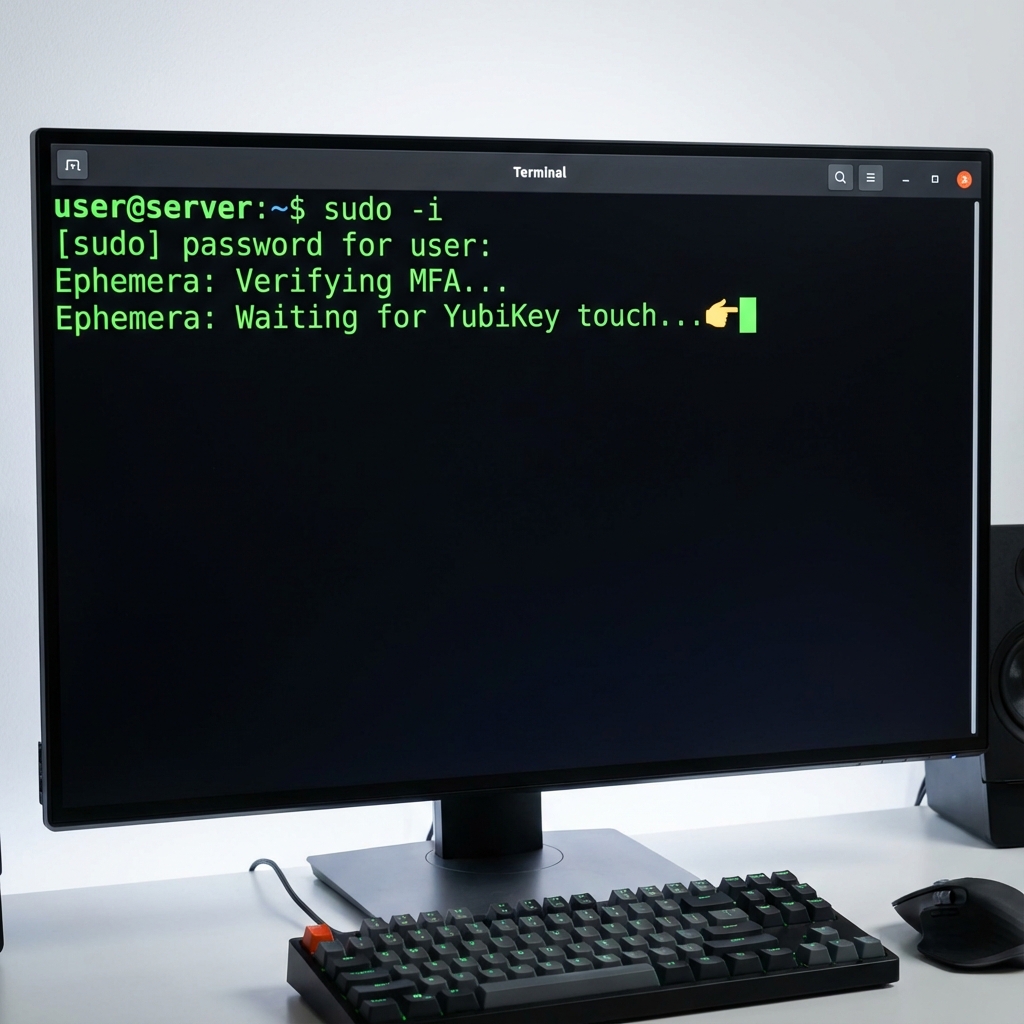
WebAuthn Enforcement : Certificate issuance requires physical MFA (FIDO2) interaction via YubiKey or TouchID.
Sovereign Recovery : Encrypted backups are protected via Shamir's Secret Sharing, requiring a quorum to restore.
Verifiable Audit : All CA actions are logged to a Merkle-chained ledger for tamper-evident history.
Granular RBAC : A YAML-based policy engine defines access based on roles, resources, and conditions.
Ephemera includes an experimental, opt-in governance primitive called Trust Budgeting.
Trust Budgeting limits cumulative privileged authority at certificate issuance time by treating access as a finite, visible resource. Each certificate issuance consumes an explicit budget. When the budget is exhausted, normal issuance stops until the budget resets or a separate emergency (break-glass) path is used.
This mechanism:
Trust Budgeting is experimental and may change or be removed.
Documentation: docs/trust_budgeting.md
Ephemera includes GateBridge, a shadow evaluation system that validates policy decisions against an alternate engine (Gate0) without affecting production behavior.
policy-shadow.log)Each entry contains:
| Field | Description |
|---|---|
timestamp | ISO 8601 UTC timestamp |
match | Boolean — did both engines agree? |
versions.bridge | GateBridge Python version |
versions.gate0 | Gate0 CLI version |
versions.policy_hash | SHA256 hash of policy.yaml |
context_hash | SHA256 hash of canonicalized input |
yaml_decision | YAML engine result |
gate0_decision | Gate0 engine result |
snapshot | Full context (only on mismatch, size-capped) |
GET /api/admin/gate0/status
Returns:
{
  "bridge_version": "1.0.0",
  "gate0_version": "v0.2.1",
  "policy_hash": "sha256:8f4b...",
  "status": "healthy",
  "last_mismatch": null,
  "telemetry": {
    "latency_p50_ms": 2.3,
    "latency_p95_ms": 5.1,
    "latency_p99_ms": 8.7
  }
}
GateBridge can be disabled via configuration flag. Shadow mode is fail-open and does not affect authorization decisions.
No breaking changes to Gate0 CLI interface. Shadow logs gain new fields but remain backward parseable.


