A community‑driven cybersecurity knowledge base with 400+ notes, mind‑maps, and cheat‑sheets – built from first principles. Ideal for students, SOC analysts, and pentesters.
A modern, open-source cybersecurity knowledge base designed to help students, professionals, and lifelong learners build practical security skills through structured notes, hands-on labs, and real-world concepts.
Built with Quartz • Powered by Markdown • Community Driven • MIT Licensed

Learn cybersecurity with clarity — from fundamentals to advanced concepts, all in one searchable, open-source handbook.
| 📚 Notes | 🧪 Labs | 🔍 Search | ⚡ Performance | 🤝 Community |
|---|---|---|---|---|
| Continuously Growing | Hands-on Learning |
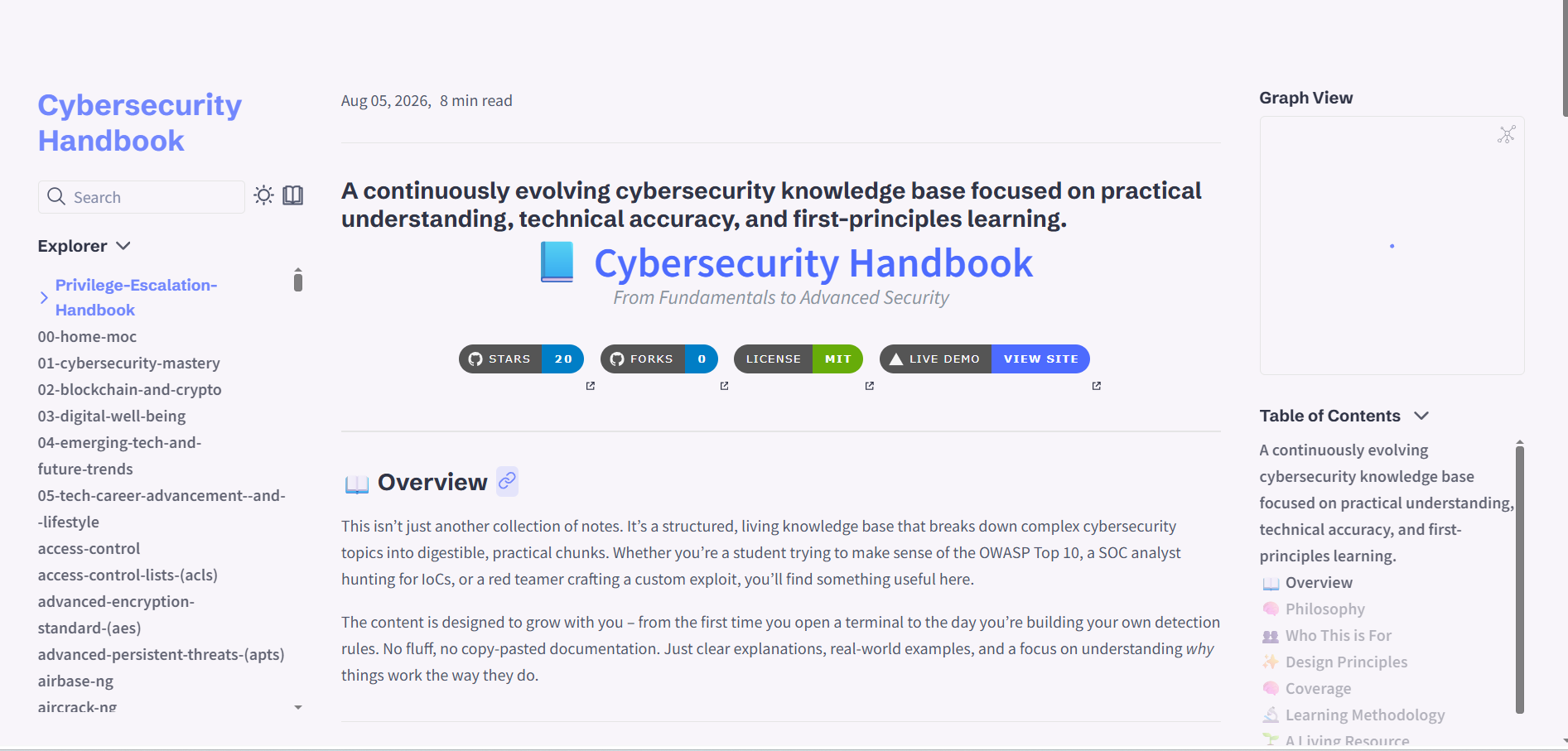
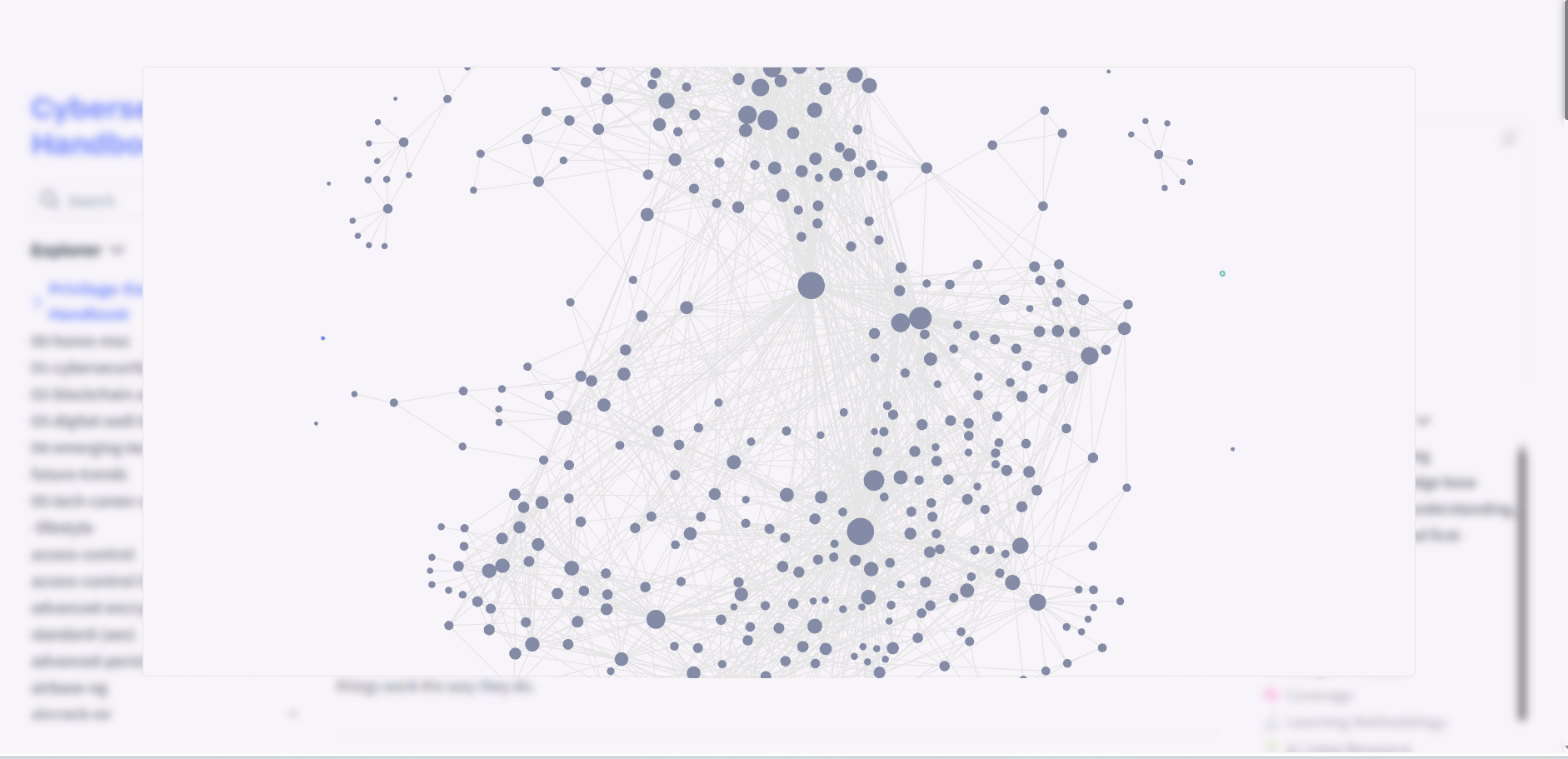
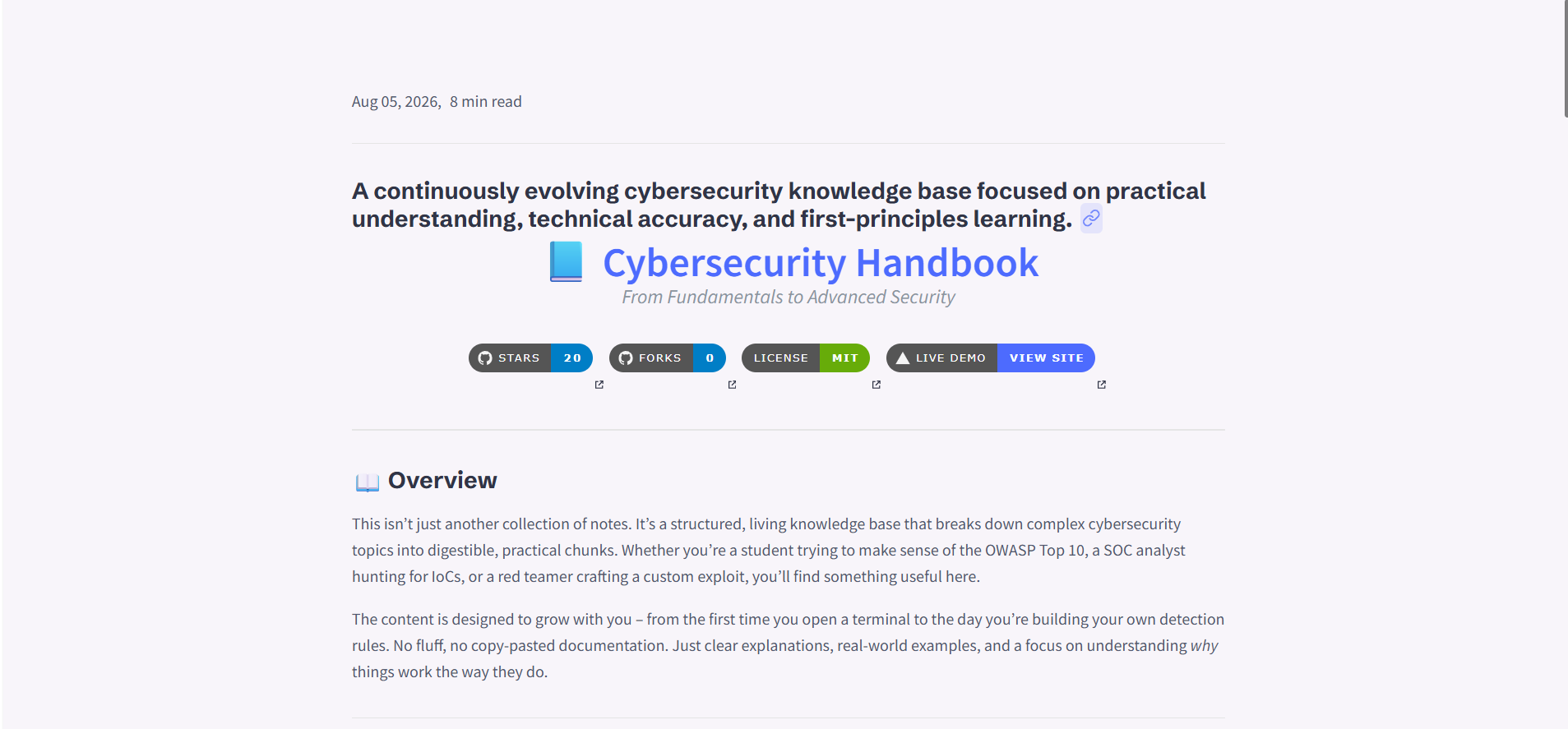
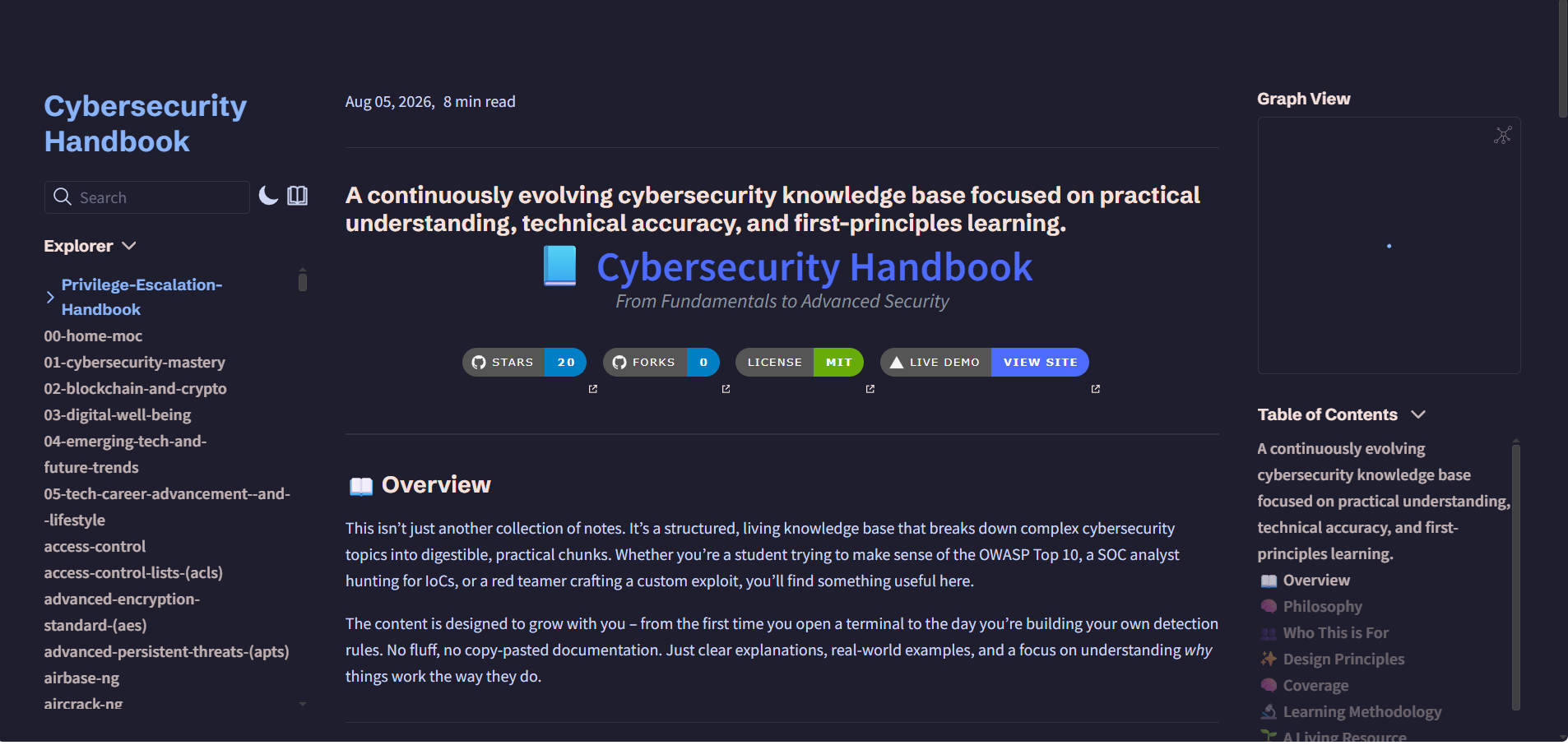
🧼 Clean Homepage | 🕸️ Interactive Graph | 📖 Reader Mode
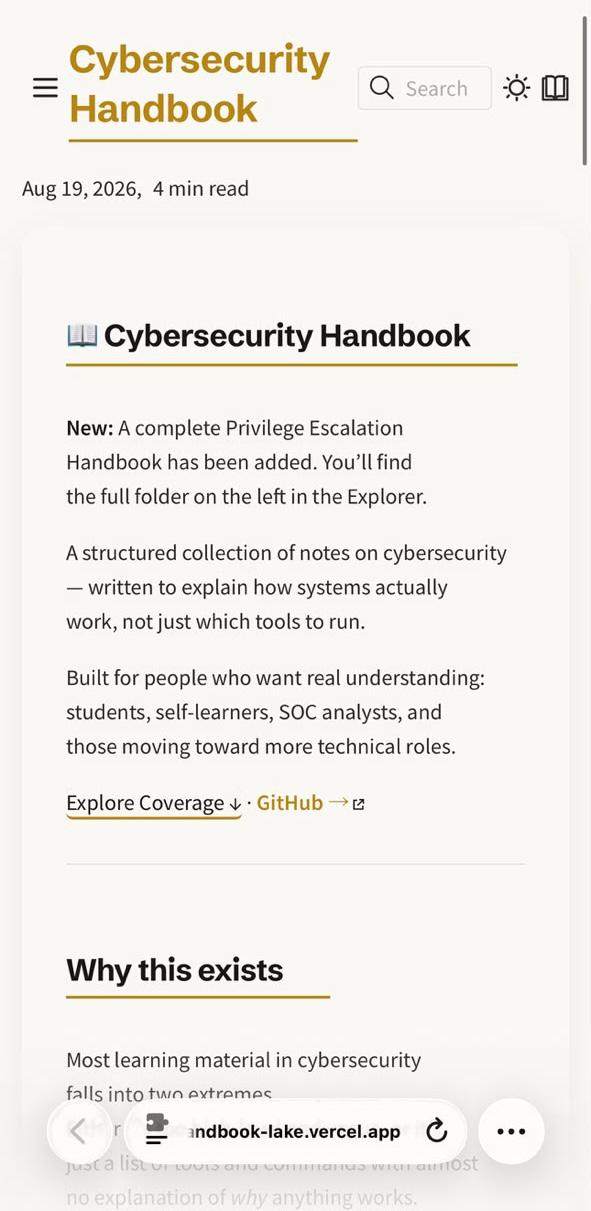
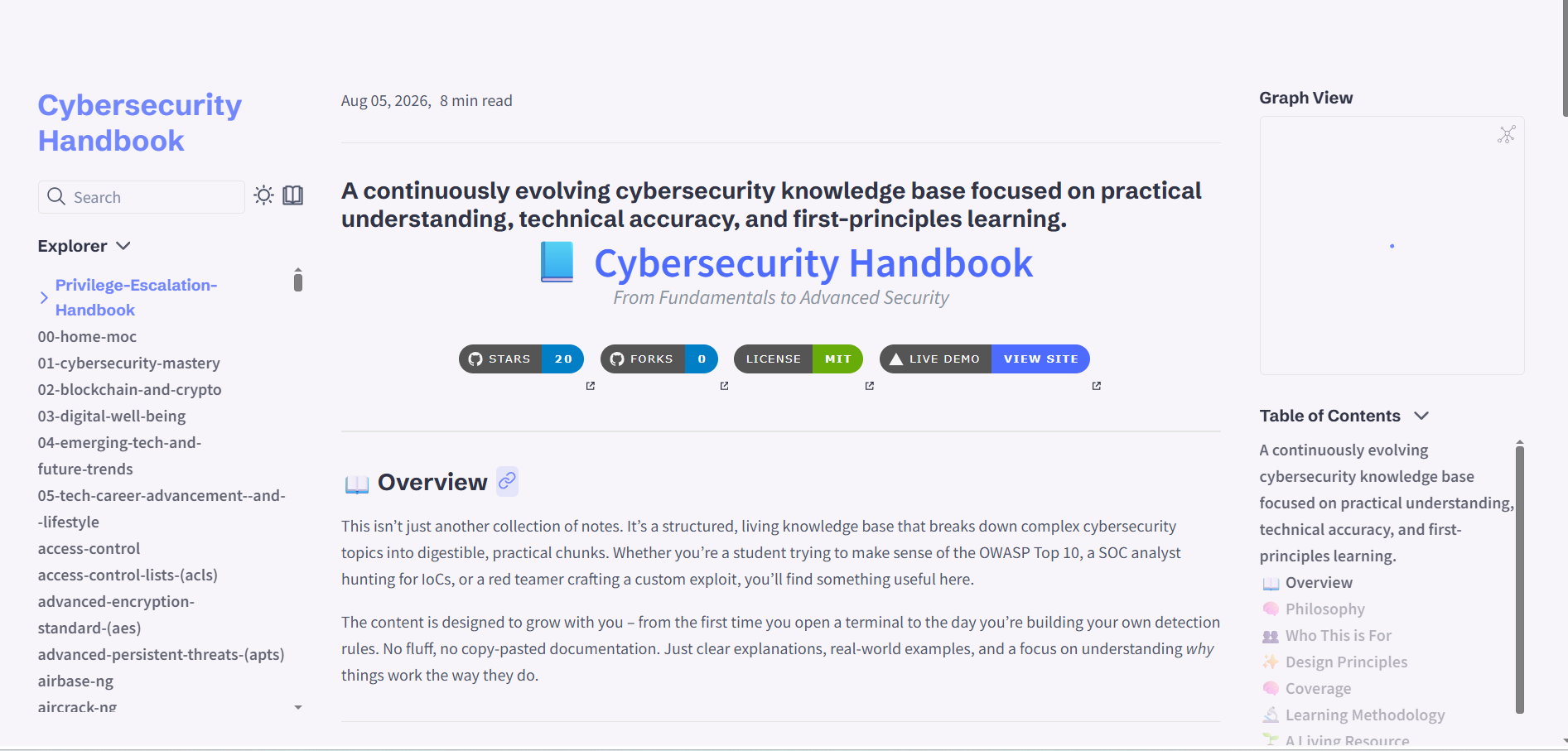
The clean, distraction-free homepage — designed for reading.
See how topics connect. Every note is linked to related concepts.
Focus on what matters. No distractions, just learning.
Easy on the eyes — perfect for late-night reading sessions.
Fully responsive — access from any device, anywhere.
The world of cybersecurity moves fast. New vulnerabilities, tools, and best practices emerge daily. Yet, most resources are scattered across forums, blogs, and paid courses — inaccessible to many who need them most.
This handbook is different.
Whether you're preparing for your first security certification, defending a corporate network, or just curious about how the digital world stays safe, this handbook is for you.
Get the handbook running locally in under 2 minutes.
# Clone the repository
git clone https://github.com/priyanshu-rawa/Cybersecurity-Handbook.git
cd Cybersecurity-Handbook
# Install dependencies
npm install
# Start the development server
npm run quartz:dev
# Clone the repository
git clone https://github.com/priyanshu-rawa/Cybersecurity-Handbook.git
cd Cybersecurity-Handbook
# Install dependencies
npm install
# Start the development server
npm run quartz:dev
# Build static site
npm run quartz:build
# Preview the build locally
npm run quartz:serve
| Category | Topics |
|---|---|
| Linux | Linux Internals, Commands, Security |
| Windows | Windows Internals, Active Directory, Security |
| Networking | TCP/IP, DNS, HTTP/HTTPS, VPN, Firewalls |
| Category | Topics |
|---|---|
| Web Security | OWASP Top 10, SQL Injection, XSS |
| Vulnerability Assessment | Scanning, Enumeration, Exploitation |
| Penetration Testing | Methodologies, Tools, Reporting |
| Post-Exploitation | Persistence, Lateral Movement, Privilege Escalation |
| Category | Topics |
|---|---|
| Security Operations (SOC) | Monitoring, Incident Response |
| Detection Engineering | SIEM, Log Analysis, Threat Hunting |
| Digital Forensics | Memory Forensics, Network Forensics, Malware Analysis |
| Category | Topics |
|---|---|
| Cloud Security | AWS, Azure, GCP, Zero Trust |
| Container Security | Docker, Kubernetes, DevSecOps |
| IAM | Identity Management, Federation, MFA |
| Category | Topics |
|---|---|
| Languages | Python, Bash, PowerShell |
| Automation | Scripting, CI/CD, Git |
| Category | Topics |
|---|---|
| Encryption | Symmetric, Asymmetric, AES, RSA |
| Hashing | SHA-256, MD5, Hash Functions |
| PKI | Digital Signatures, TLS, Certificates |
Cybersecurity is fundamentally built on understanding systems.
Without a solid grasp of operating systems, networking, protocols, authentication, memory, processes, and application architecture, tools become little more than buttons to press.
This handbook is built around one principle:
Understand the technology before learning how to secure or exploit it.
Each topic aims to answer not only what something does, but also how it works internally and why it behaves that way.
Planned improvements include:
We welcome contributions of all kinds! Whether you're fixing a typo, adding a new topic, or improving the visual design, your help makes this handbook better for everyone.
git checkout -b feature/your-feature-name
git commit -m "Add: New section on ransomware defense strategies"
git push origin feature/your-feature-name
main branchWe welcome contributions of all kinds — from fixing a single typo to adding an entire new topic. Every contribution, no matter how small, helps make this handbook better for everyone.
💡 First time contributing to open source? No worries! I'll guide you through it.
###📍 Where You Can Contribute
| File Type | Location |
|---|---|
| Cybersecurity notes | content/ (in the relevant category folder) |
Thank you for helping make this a world-class resource! 🚀
This handbook is — and will always be — completely free and open-source. If it has helped you in any way, here are some meaningful ways you can support the project:
"Open source is built by people who care. Every contribution, no matter how small, makes a difference."
A simple "thank you" or "this helped me" goes a long way. If this handbook made a difference in your learning journey, I'd love to hear about it.
[email protected]The best way to support this project is to share it with others who might find it useful.
Copy this and share it:
"I found this free Cybersecurity Handbook with 400+ notes, built with Obsidian + Quartz. Check it out: https://github.com/priyanshu-rawa/Cybersecurity-Handbook"
Thank you for being part of this journey. Every star, share, and contribution matters. ❤️
This project is licensed under the MIT License — see the LICENSE file for details.
You are free to use, modify, distribute, and even commercialize this work, as long as you retain the copyright notice. We encourage you to contribute back improvements!
If you find this handbook useful:
Every star and share helps someone discover this resource.
📖 Cybersecurity Handbook
A continuously evolving cybersecurity knowledge base built through documentation, experimentation, and practical learning.
Always Learning · Always Documenting · Always Improving
If this helped you, drop a ⭐ – it motivates me to keep building.
| Lightning Fast |
| Powered by Quartz |
| Open Source |
| Area | Examples |
|---|
| 📝 Content | Add new topics, fix errors, improve explanations, add practical examples |
| 🎨 Design | Improve visuals, add diagrams, enhance layout |
| 🔧 Code | Fix bugs, improve the Quartz setup, add features |
| 📖 Documentation | Improve clarity, fix formatting, add cross-references |
| 💬 Community | Report issues, suggest improvements, help others |
| Step | Action |
|---|
| 1 | Fork the repository — click the "Fork" button at the top right |
| 2 | Clone your fork locally: git clone https://github.com/your-username/Cybersecurity-Handbook.git |
| 3 | Create a branch for your changes: git checkout -b feature/your-feature-name |
| 4 | Make your changes — add notes, fix typos, update content |
| 5 | Stage your changes: git add . |
| 6 | Commit with a clear message: git commit -m "Add: New section on ransomware defense" |
| 7 | Push to your fork: git push origin feature/your-feature-name |
| 8 | Open a Pull Request — go to the original repo and click "Compare & pull request" |
| Aspect | Guideline |
|---|
| Content | Write in clear, accessible English. Include practical examples and real-world scenarios. |
| Formatting | Use proper Markdown headings (##, ###). Keep code blocks with language specifiers (e.g., ```bash, ```python). |
| Images | Store in assets/images/. Use descriptive, lowercase filenames (e.g., network-osi-model.png). |
| Style | Follow the existing visual tone. No markdown errors. Keep it concise and practical. |
| Scope | If you're unsure where to place a topic, open an issue first — we'll discuss the best location. |
| Type | Description |
|---|
| 📚 New Topics | Missing a subject? Add it! Check the coverage section to avoid duplicates. |
| 🛠️ Corrections | Found an error or outdated info? Fix it! |
| 💡 Improvements | Think something can be explained better? Reword it! |
| 🧪 Labs & Exercises | Practical walkthroughs and hands-on exercises. |
| 📊 Diagrams | Visual explanations of complex concepts. |
| 🔗 Links & References | Add relevant external resources. |
| Images | assets/images/ |
| Diagrams | assets/diagrams/ |
| Labs | content/ (in the relevant lab folder) |
| Resource | Description |
|---|
| 📧 Open an Issue | Create a new issue — I'll respond as soon as possible. |
| 💬 Start a Discussion | Use the Discussions tab to share ideas, ask questions, or suggest improvements. |
| 📄 Contribution Guide | See CONTRIBUTING.md for contribution guidelines. |
| 📋 Code of Conduct | Please read the Code of Conduct before contributing. |
| Way | What It Does | Why It Helps |
|---|
| ⭐ Star the repo | Click the star button at the top | Helps others discover the handbook |
| 🔗 Share the handbook | Post it on LinkedIn, Twitter, Reddit, Discord | Brings more learners to the community |
| 📝 Contribute content | Add new topics, fix typos, improve explanations | Makes the handbook better for everyone |
| 💬 Give feedback | Open an issue or start a discussion | Helps me understand what to improve next |
| 👥 Tell a friend | Share with someone learning cybersecurity | Grows the community organically |
| 🐛 Report bugs | Let me know if something is broken | Keeps the handbook accurate and reliable |
| 📖 Use it daily | Reference it in your learning or work | The best support is using it! |
| Area | What You Can Do |
|---|
| 📝 Content | Add new topics, fix errors, improve explanations |
| 🎨 Design | Suggest improvements to layout, visuals, diagrams |
| 🔧 Code | Improve the Quartz setup, fix bugs, add features |
| 📖 Documentation | Improve clarity, formatting, cross-references |
| 💬 Community | Help others in issues/discussions, spread the word |