
 opposum0112/cusimanse
Composable research-contract and YAML-recipe framework for agent-operated security experiments on disposable compute





Status: Beta — Research Framework & Runtime Kit
Cusimanse is actively being developed. Fork it, test it, run the reference experiments, report bugs, and submit pull requests. Expect APIs, recipes, documentation and integrations to evolve during beta.
AI use and responsible contribution: Cusimanse uses AI-assisted development and agentic AI as part of its research framework, documentation, analysis workflows and engineering process. AI-generated or AI-assisted output is not automatically authoritative, secure, correct, original or suitable for production use. Contributors are responsible for reviewing, testing and validating AI-assisted changes before submission. Do not rely on an AI system as the sole authority for security decisions, authorization, evidence interpretation or safety-critical actions. Use Cusimanse only for authorized research, respect applicable laws and policies, protect credentials and sensitive data, and keep execution within the project's declared policy and disposable-compute boundaries. Contributions should clearly identify material AI assistance where appropriate, preserve human accountability, and follow the repository's tests, review requirements and responsible-use expectations.
Declarative, agent-operated security research on disposable compute. Researchers declare intent and requirements; agents plan, select and analyze; the Go capability API and policy decide whether and how execution may occur.
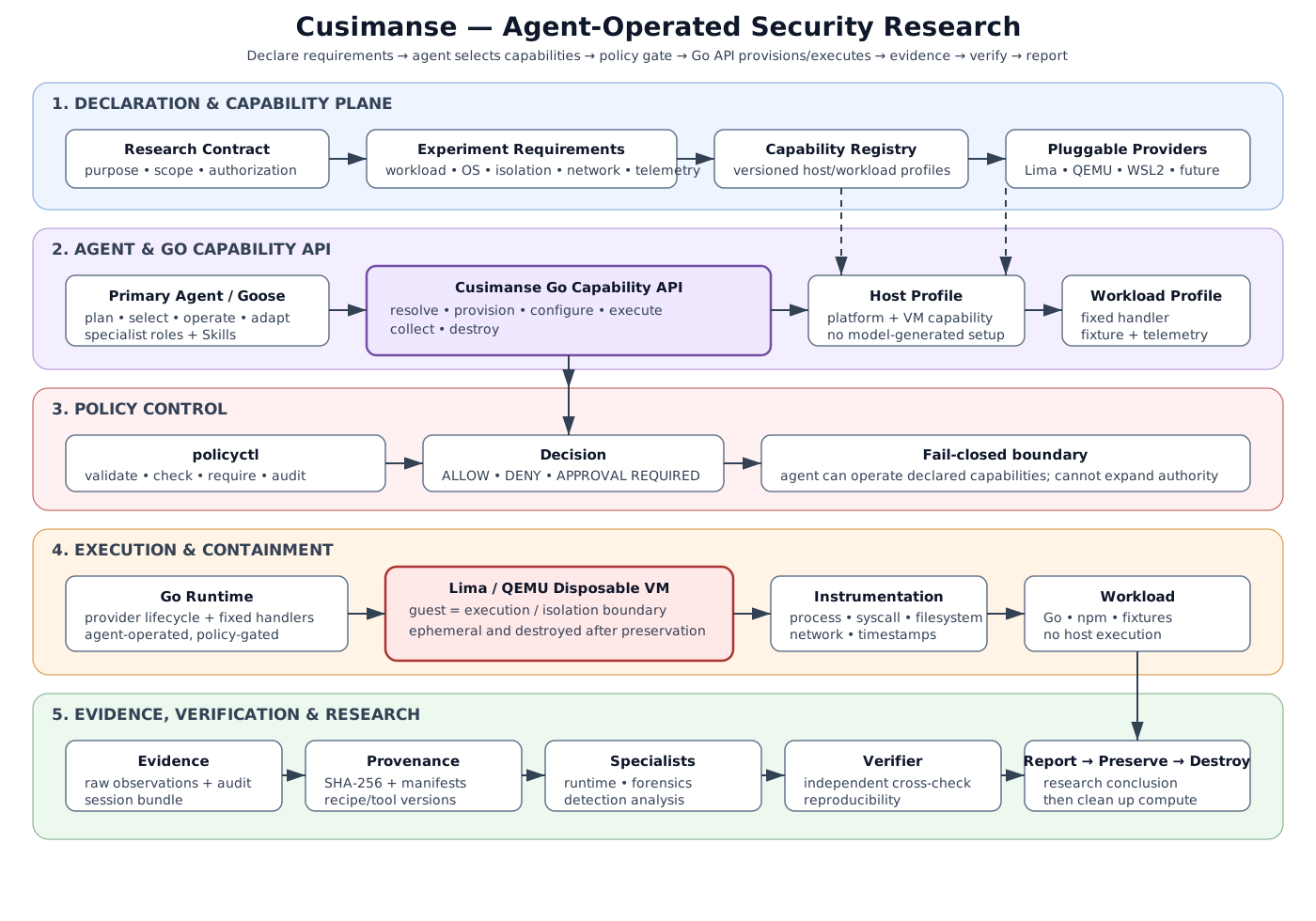
Contract → requirements → prompt handoff → agent → capability resolution → Go runtime → policy/approval → Lima/QEMU → instrumentation/workload → evidence → analysis → independent verification → report → preservation → destroy.
| Layer | Responsibility | Source of truth |
|---|---|---|
| Contract | purpose, authorization, scope, acceptance | contracts/ |
| Requirements | OS, isolation, workload, network, instrumentation | recipes/experiments/ |
| Prompt library | agent-neutral handoff | prompts/experiments/ |
| Operator guides | thin adapter handoff | prompts/operators/ |
| Profiles | trusted reusable capabilities | recipes/profiles/ |
| Runtime | resolution, policy, lifecycle, execution boundary | cmd/cusimanse/, internal/ |
| Policy | authority and approval | policies/, internal/policy/ |
| Containment | disposable compute | recipes/lima/, Lima/QEMU |
| Evidence | observations, provenance, verification | runs/<session-id>/ |
The agent cannot create trusted profiles, expand policy, mutate trusted recipes or execute an untrusted workload directly on the host.
Boundary rule: the agent decides what research to do; Cusimanse decides whether and how it may execute.
Write contracts/<experiment>.md with research question, authorization, scope, acceptance criteria and safety constraints. Declare only requirements in recipes/experiments/<experiment>.yaml.
Example:
requirements:
  execution: disposable
  os: linux
  workload: npm-threat
  network: localhost-only
  instrumentation: [process, syscall, filesystem, network]
./scripts/install.sh
export PATH="$HOME/.local/bin:$HOME/go/bin:$PATH"
cusimanse doctor
cusimanse validate
cusimanse preflight
cusimanse policy validate
cusimanse test
cusimanse integration-test
goose recipe validate recipes/npm-threat-001/recipe.yaml
goose recipe validate recipes/subrecipes/evidence-analysis.yaml
goose recipe validate recipes/subrecipes/verification.yaml
goose recipe validate recipes/subrecipes/report.yaml
goose run --recipe ./recipes/npm-threat-001/recipe.yaml --interactive
The recipe explicitly declares the summon platform extension. Summon provides delegation/orchestration only; it does not authorize execution.
cusimanse resolve npm-threat-001
cusimanse policy explain vm
cusimanse policy explain network
cusimanse policy check-all
cusimanse policy require vm --approved
cusimanse --approved run npm-threat-001 <session-id>
cusimanse observability report <session-id>
cusimanse policy audit
Lifecycle: resolve → policy → provision → configure → instrument → execute → collect → verify → report → preserve → destroy.
The prompt is a handoff, not an authority layer and not a second recipe.
prompts/experiments/<experiment>.md       shared research handoff
prompts/operators/<operator>.md           thin operator guidance
recipes/experiments/<experiment>.yaml     requirements source of truth
recipes/<experiment>/recipe.yaml          Goose/runtime recipe
contracts/<experiment>.md                 authorization/scope source
For OpenCode, Hermes, Antigravity or Pi, provide the same contract, experiment YAML, recipe references, shared prompt and matching operator guide. The alternate operator may plan/delegate/analyze using its native features, but must invoke Cusimanse for capability execution. Unsupported capabilities are recorded as PARTIAL; adapters cannot mutate policy, profiles or trusted recipes.

