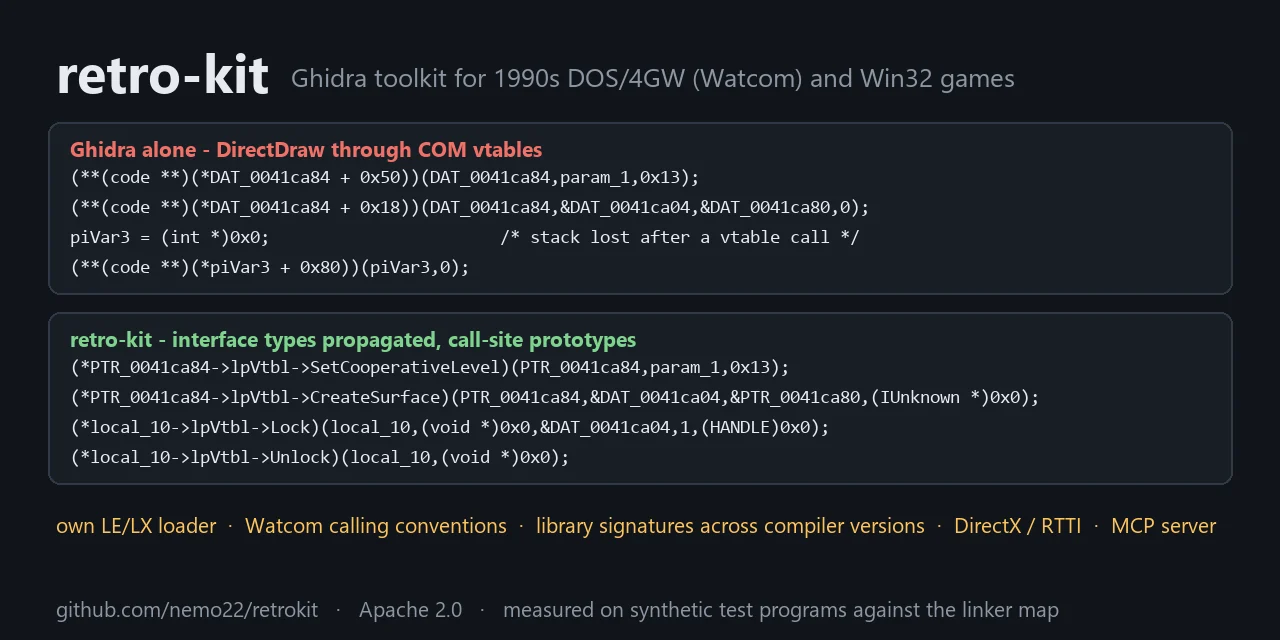
 nemo22/retrokit
Headless-Ghidra toolkit for reverse engineering 32-bit DOS and Win32 games (1993-2010): own LE/LX loader, Watcom calling conventions, library signatures, MCP server

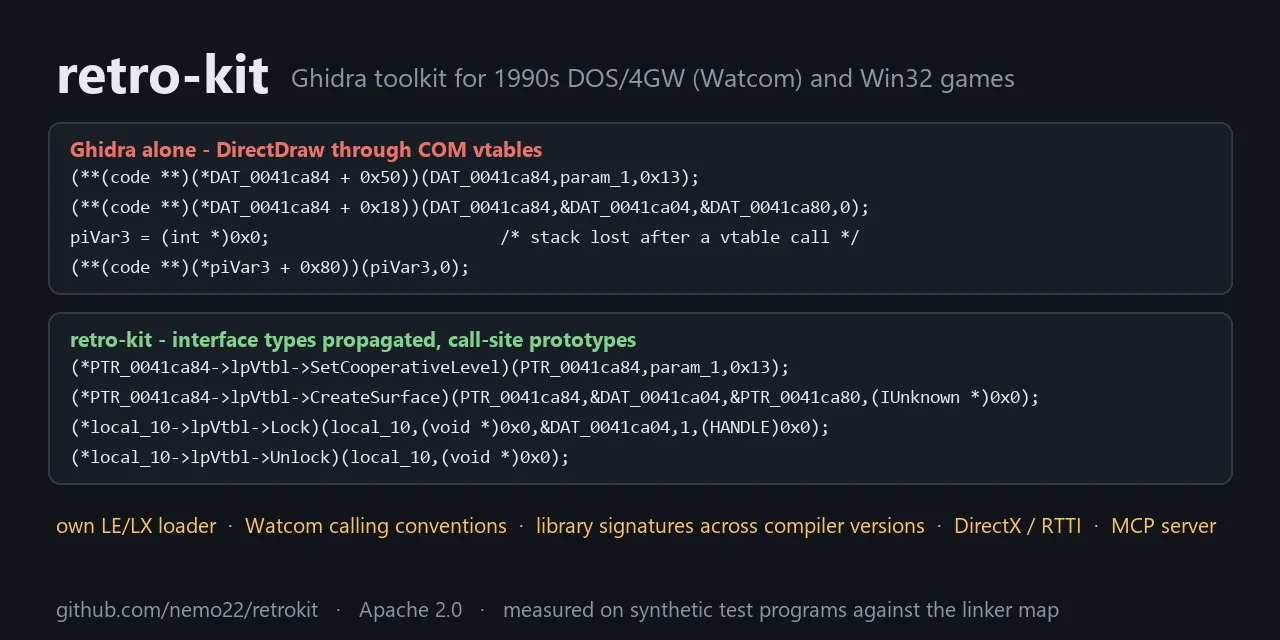
A toolkit for decompiling 32-bit games from roughly 1993–2010 with headless Ghidra:
The output is a workspace with one large .c file holding every function plus indexes
(functions, call graph, strings, fixups/pointer tables, imports) that you can grep and split up
between people or AI agents. Names found during the analysis go back into Ghidra and the export
is regenerated.
Prerequisites: Ghidra 12.x
(unpacked), a JDK 21+ (JAVA_HOME), Python 3.10+.
pipx install git+https://github.com/nemo22/retrokit   # or from a checkout: pip install .  (or python -m retrokit)
retrokit doctor                                    # checks Python, Ghidra, Java, loader, cspecs
retrokit install-loader                            # once per Ghidra install (DOS LE/LX only)
Ghidra is found via --ghidra DIR, $GHIDRA_INSTALL_DIR, or a ghidra/ghidra_* directory next
to the game or the kit. install-loader compiles the loader with javac against that Ghidra
(no Gradle), installs it into Ghidra/Extensions and registers the Watcom compiler specs; run it
again after updating Ghidra (doctor tells you when).
retrokit info GAME.EXE              # format, DOS extender, compiler, calling convention
retrokit analyze GAME.EXE           # full pipeline -> GAME_analysis/  (-o DIR to choose)
retrokit show GAME_analysis FUN_00012345 main
retrokit tables GAME_analysis       # function-pointer and string tables (from fixups)
retrokit names GAME_analysis        # apply notes/names_*.csv, re-export
retrokit reexport GAME_analysis     # re-run the fix-up passes + export without re-importing
analyze detects the format, the loader and – for Watcom – the calling convention
(--cspec watcom|watcomreg overrides it) and stores them in GAME_analysis/retrokit.json;
later commands only need the workspace. A workspace:
GAME_analysis/
  retrokit.json        how the binary was analysed
  decomp/              <exe>_decompiled.c, functions.csv (addr,name,size,callers,callees,cc,signature),
                       calls.txt, strings.txt, data_symbols.txt, memory_blocks.txt,
                       fixups.txt (source -> target of every pointer: the key to pointer tables
                       and to which function uses which string), imports.txt (PE)
  notes/               findings, names_<topic>.csv proposals
  ghidra_project/      the Ghidra project (open it in the Ghidra GUI too)
  logs/
AI agents: retrokit mcp GAME_analysis is an MCP server (stdio, no extra packages) over
the workspace: functions, decompiled code, call graph, cross references, strings, pointer
tables, disassembly and bytes, libraries; it records name proposals and notes and can
re-export with the names applied (on request, in the background). Claude Code:
claude mcp add retrokit -- retrokit mcp /path/to/GAME_analysis
Setup for other clients, every tool and how an agent should work: docs/MCP.md; a short version for agents in AGENTS.md.
Names: write proposals to notes/names_<topic>.csv (addr,name,confidence,comment, confidence
V verified or G guess); retrokit names WS renames functions/labels (V wins over G,
collisions get _<addr>) and re-exports.
What the pipeline does:
retrokit libs (also part of info and analyze ->
notes/libraries.md) recognises ~20 libraries of the period - Miles/AIL, HMI SOS, DIGPAK,
Smacker, Bink, FMOD, BASS, DirectX, zlib, libjpeg, libpng, PKWARE DCL, Lua, ... - from
strings, imports and data files, with version, notes on their formats and port hints.
Library code is found by signature (shipped: Watcom C/C++ run-time, math and C++ libraries
from Open Watcom, zlib 1.0.4-1.2.3, libjpeg 6b; retrokit sigs build makes them from
libraries you own, sigs learn from functions you identified) - exact matches first, then
similar code from other compiler versions - named, and typed from retrokit/knowledge/*.h.switch jump tables
kept inside their functions, wrong "no return" flags undone, short strings defined and string
literals shown as "text", parameter counts from the ADD ESP,n cleanups at call sites,
prototypes recovered callees-first, export.Other commands: classes (MSVC C++ classes from RTTI), libs (libraries in use), convert (XMIDI/HMI/HMP -> MIDI, VOC -> WAV,
Smacker/Bink/FLIC -> MP4, by content), sigs match|build|learn (library signatures, see
docs/WORKFLOW.md),
entries (PE: code addresses without a function), modules --rules FILE
(PE: functions → original source files via assert paths), strings EXE OUT (PE string inventory
without Ghidra), match (transfer names to a related EXE: sequel, add-on, other version),
le EXE info|dump|rec|s16|s32 (read tables from an LE at Ghidra addresses), rnc (RNC ProPack),
flic info|png|video (Autodesk FLI/FLC). retrokit COMMAND --help for options.
The detailed procedure, what to expect and the known pitfalls are in docs/WORKFLOW.md; the
MCP server in docs/MCP.md; task templates for AI agents in docs/AGENT_PROMPTS.md; planned
work in docs/ROADMAP.md; maintaining and releasing in docs/MAINTAINING.md.
retrokit/               Python package (CLI: retrokit/cli.py)
  ghidra_scripts/       headless Ghidra scripts used by the pipelines
  tools/                standalone Python tools behind the CLI commands
  le-loader/            LE/LX loader for Ghidra (Java) + Watcom compiler specs (data/languages/)
  sigs/                 library signatures (Open Watcom C run-time)
  knowledge/            libraries.json (library catalog), library prototypes as C headers
scripts/                build_sigs.py: rebuilds the shipped signatures
tests/                  synthetic test programs, scoring against the linker map, baseline
docs/                   WORKFLOW, AGENT_PROMPTS, ROADMAP
