 mym0us3r/dirty-frag-detection-with-wazuh-4.14.4
Wazuh 4.14.4 detection rules for CVE-2026-43284 / CVE-2026-43500 (Dirty Frag) - Linux Local Privilege Escalation via page cache write

Detection engineering for the Dirty Frag kernel LPE - Ubuntu / RHEL / Debian / Amazon Linux





CVE-2026-43284 / CVE-2026-43500 is a Linux kernel Local Privilege Escalation (LPE) that chains two independent page-cache write primitives to achieve root from an unprivileged user account. A single compiled binary achieves root on all major Linux distributions. No race condition. No heap spray. No kernel offset required.
Variant 1 - CVE-2026-43284 (xfrm-ESP):
unshare(CLONE_NEWUSER|CLONE_NEWNET)
-> register XFRM SA via netlink (CAP_NET_ADMIN inside new namespace)
-> vmsplice(ESP header into pipe)
-> splice(target file into pipe)
-> splice(pipe to UDP socket)
-> esp_input() in-place AEAD decrypt writes 4 bytes into page cache
Variant 2 - CVE-2026-43500 (RxRPC):
add_key("rxrpc", ...)       no privileges required
-> socket(AF_RXRPC=35)
-> RxRPC handshake + forged DATA packet
-> vmsplice(RxRPC wire header into pipe)
-> splice(target file into pipe)
-> splice(pipe to UDP socket)
-> rxkad_verify_packet_1() in-place pcbc(fcrypt) decrypt writes 8 bytes into page cache
When CLONE_NEWUSER is blocked by AppArmor (Ubuntu 24.04+ default), the exploit automatically falls back from the ESP variant to the RxRPC variant. The same binary achieves root on both cases.
CRITICAL: The Copy Fail mitigation (blacklisting
algif_aead) does not protect against Dirty Frag. Both vulnerabilities share the same authencesn sink, but Dirty Frag is triggered through a completely different code path. If you deployed the Copy Fail mitigation, you are still exposed.
Discovered and published by V4bel - https://github.com/V4bel/dirtyfrag
Dirty Frag writes directly into the in-memory page cache. The on-disk binary is never modified. The kernel never marks the corrupted page as dirty, so writeback never runs. The disk file is byte-for-byte identical to the original before and after exploitation.
Traditional FIM approach:
  read file from disk -> compute hash -> compare -> no anomaly reported

Dirty Frag reality:
  on-disk /usr/bin/su = UNCHANGED
  page cache of /usr/bin/su = CONTAINS ROOT SHELL ELF
  FIM result = BLIND
The only effective detection is behavioral, via syscall monitoring at the kernel level. This repository provides production-validated Wazuh rules that detect both exploit variants at the syscall level, regardless of kernel version or patch status.
ESP variant (CVE-2026-43284):
  unshare(CLONE_NEWUSER)    privilege boundary bypass via user namespace
  -> XFRM SA registration  CAP_NET_ADMIN gained inside new netns
  -> vmsplice()        [!]  ESP header planted into pipe
  -> splice()          [!]  /usr/bin/su page cache enters pipe
  -> splice()               pipe delivered to UDP socket
  -> esp_input() decrypt    4 bytes written deterministically into page cache
  -> execve(/usr/bin/su)    corrupted setuid binary runs shellcode as UID 0

RxRPC variant (CVE-2026-43500):
  add_key("rxrpc")          session key K planted - no privileges needed
  -> socket(AF_RXRPC)       rxrpc.ko auto-loaded
  -> vmsplice()        [!]  RxRPC wire header planted into pipe
  -> splice()          [!]  /etc/passwd page cache enters pipe
  -> splice()               pipe delivered to UDP socket
  -> rxkad_verify_packet_1() 8 bytes written deterministically into page cache
  -> su -                   /etc/passwd root entry has empty password field
The page cache corruption is the core primitive in both variants. vmsplice plants the attacker-controlled protocol header into a pipe. splice delivers the target file's page cache pages into the same pipe without copying. When the kernel processes the combined buffer through the decrypt path, it writes the attacker-controlled bytes into the page cache of the target file.
All Linux kernels since 2017 are affected. AppArmor unprivileged_userns restriction on Ubuntu 24.04+ blocks the ESP variant but the RxRPC variant bypasses it entirely.
CVE-2026-43284 (ESP): in scope from commit
cac2661c53f3(2017-01-17) up tof4c50a4034e6(2026-05-05) - PATCHED in mainlineCVE-2026-43500 (RxRPC): in scope from commit
2dc334f1a63a(2023-06-08) up to upstream - NO PATCH EXISTS YET
DIRTY-FRAG-Detection-with-Wazuh-4.14.4/
|
|- rules/
|   '- local_rules.xml              # 9 Wazuh detection rules (200000-200008)
|
|- auditd/
|   '- cve-dirty-frag.rules         # auditd syscall sensor rules (v2 - auid fix)
|
|- sca/
|   '- cve-dirty-frag.yml           # SCA policy - kernel-version independent
|
'- docs/
    |- dirty_frag_dash_rules.png    # Wazuh Rules Management - 200000-200008 deployed and active
    |- SCA.png                      # SCA policy score 50% - 3 passed / 3 failed
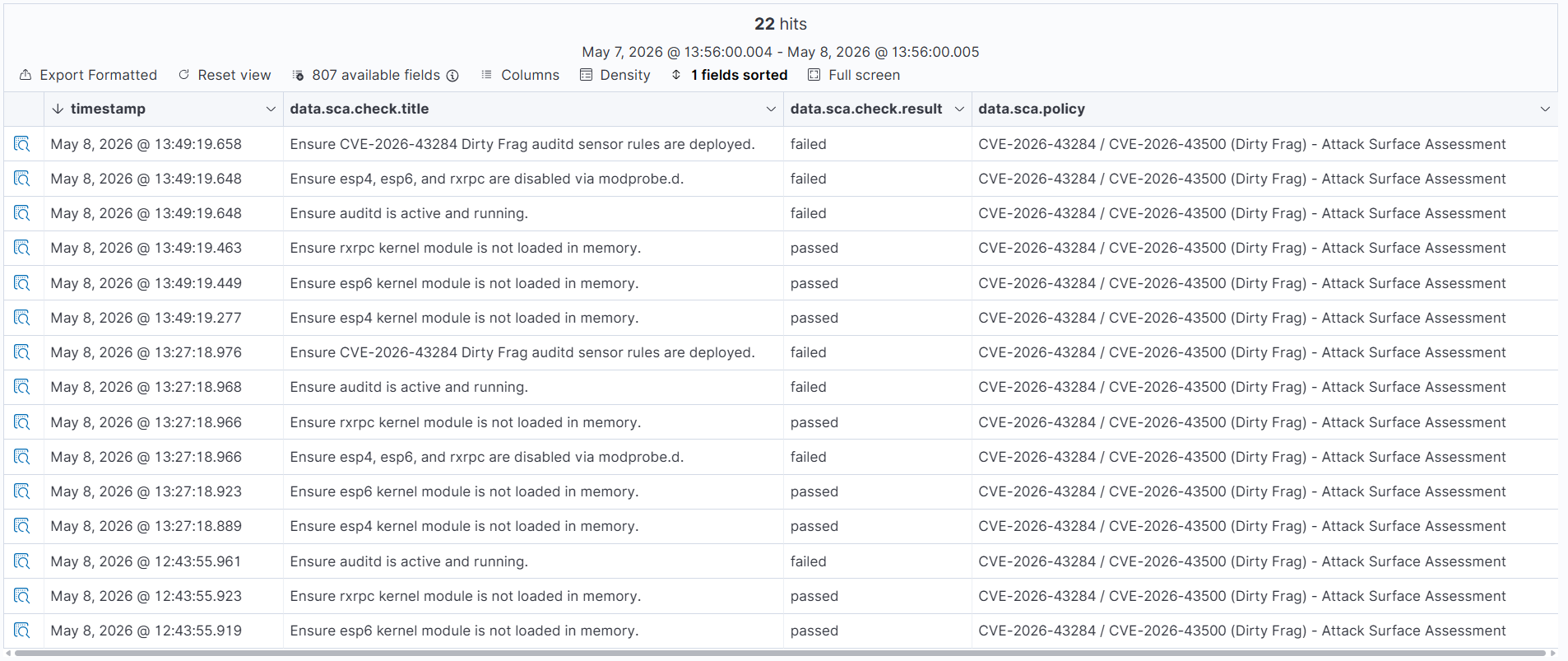
    |- SCA-hits.png                 # Wazuh Discover - SCA check results across 3 scan cycles
    |- discover-dirty-frag.png      # Wazuh Discover - 52 hits - initial validation run (May 8)
    '- discover-dirty-frag_more.png # Wazuh Discover - 13 hits - chain rule 200007 level 15 (May 15)
Note on local_rules.xml: The rules are delivered in
local_rules.xml, which is the standard Wazuh file for custom rules at/var/ossec/etc/rules/local_rules.xml. If you prefer to keep your detection rules organized by CVE, you can deploy the content as a standalone file (e.g.cve-2026-43284_rules.xml) in the same directory. Both approaches work equally.
Two independent layers - neither depends on kernel version or patch status.
Important note on uid vs auid: The ESP variant child process calls unshare(CLONE_NEWUSER) and maps itself as uid=0 inside the new user namespace. The Linux audit subsystem records the namespace-local uid in SYSCALL events, which means -F uid!=0 filters do not capture vmsplice and splice events from the exploit child. auid (audit uid / login uid) is set at login time and never changes with namespace remapping. The sensor rules for vmsplice and splice use -F auid>=1000 to correctly capture the real login user regardless of what the exploit does inside a namespace.
Auditd sensor rules (auditd/cve-dirty-frag.rules):
-a always,exit -F arch=b64 -S vmsplice -F auid>=1000 -F auid!=-1 -k dirty_frag_vmsplice
-a always,exit -F arch=b32 -S vmsplice -F auid>=1000 -F auid!=-1 -k dirty_frag_vmsplice
-a always,exit -F arch=b64 -S splice   -F auid>=1000 -F auid!=-1 -k dirty_frag_splice
-a always,exit -F arch=b32 -S splice   -F auid>=1000 -F auid!=-1 -k dirty_frag_splice
-a always,exit -F arch=b64 -S unshare  -F uid!=0                  -k dirty_frag_ns_escape
-a always,exit -F arch=b64 -S add_key  -F uid!=0                  -k dirty_frag_add_key
-a always,exit -F arch=b64 -S socket   -F a0=0x23 -F uid!=0       -k dirty_frag_rxrpc_socket
-w /usr/bin/kmod -p x                                             -k dirty_frag_modload
-a always,exit -F arch=b64 -S execve -F exe=/usr/bin/su -F auid>=1000 -F auid!=-1 -k dirty_frag_execve_su
Automated configuration checks via sca/cve-dirty-frag.yml. Runs every 12 hours on all enrolled agents. No kernel version check required.
Engineering note: The chain rules (200007/200008) fire when two signals from the same process arrive within 120 seconds.
vmsplicefollowed bysplicefrom the same pid is the core pipe-plant sequence of both variants. AF_RXRPC socket followed bysplicefrom the same pid is specific to the RxRPC path. Both chains are validated viawazuh-logtestwith 9/9 pass.

Rules 200000-200008 deployed and active. Compliance tags: PCI_DSS, HIPAA, GDPR, NIST_800_53, MITRE ATT&CK. Rules 200007 and 200008 reach level 15 (Critical) on correlated chain detection.
# Ubuntu / Debian
apt install auditd audispd-plugins -y
systemctl enable --now auditd
auditctl -s | grep enabled

# RHEL / Amazon Linux
yum install audit -y
systemctl enable --now auditd

# SUSE
zypper install audit -y
systemctl enable --now auditd
cp auditd/cve-dirty-frag.rules /etc/audit/rules.d/
augenrules --load
auditctl -l | grep dirty_frag
Expected output (9 rules loaded):
-a always,exit -F arch=b64 -S vmsplice -F auid>=1000 -F auid!=-1 -F key=dirty_frag_vmsplice
-a always,exit -F arch=b32 -S vmsplice -F auid>=1000 -F auid!=-1 -F key=dirty_frag_vmsplice
-a always,exit -F arch=b64 -S splice   -F auid>=1000 -F auid!=-1 -F key=dirty_frag_splice
-a always,exit -F arch=b32 -S splice   -F auid>=1000 -F auid!=-1 -F key=dirty_frag_splice
-a always,exit -F arch=b64 -S unshare  -F uid!=0 -F key=dirty_frag_ns_escape
-a always,exit -F arch=b64 -S add_key  -F uid!=0 -F key=dirty_frag_add_key
-a always,exit -F arch=b64 -S socket   -F a0=0x23 -F uid!=0 -F key=dirty_frag_rxrpc_socket
-w /usr/bin/kmod -p x -k dirty_frag_modload
-a always,exit -F arch=b64 -S execve -F exe=/usr/bin/su -F auid>=1000 -F auid!=-1 -F key=dirty_frag_execve_su
Append the content of rules/local_rules.xml to your existing /var/ossec/etc/rules/local_rules.xml, or deploy as a standalone file if you prefer to keep rules organized by CVE:
# Option A - append to local_rules.xml (recommended)
cat rules/local_rules.xml >> /var/ossec/etc/rules/local_rules.xml

# Option B - standalone file
cp rules/local_rules.xml /var/ossec/etc/rules/cve-2026-43284_rules.xml
# Validate syntax - must exit 0 with zero warnings
/var/ossec/bin/wazuh-analysisd -t 2>&1 | tail -5

# Restart manager
systemctl restart wazuh-manager
# On the Wazuh manager - distribute to all agents via shared group
cp sca/cve-dirty-frag.yml /var/ossec/etc/shared/default/
chown root:wazuh /var/ossec/etc/shared/default/cve-dirty-frag.yml
chmod 660 /var/ossec/etc/shared/default/cve-dirty-frag.yml
Add to the agent group configuration (/var/ossec/etc/shared/default/agent.conf):
<agent_config>
  <sca>
    <policies>
      <policy>/var/ossec/etc/shared/cve-dirty-frag.yml</policy>
    </policies>
  </sca>
</agent_config>
Required: Remote command execution must be enabled on each agent for the
c:lsmodandc:systemctlchecks to run:echo "sca.remote_commands=1" >> /var/ossec/etc/local_internal_options.conf systemctl restart wazuh-agent
systemctl restart wazuh-manager
Ensure the Wazuh agent ingests the auditd log. Add inside <ossec_config> in /var/ossec/etc/ossec.conf on each monitored host, or distribute via agent.conf:
<localfile>
  <log_format>audit</log_format>
  <location>/var/log/audit/audit.log</location>
</localfile>
# SIGNAL 1 - vmsplice (rule 200000)
echo 'type=SYSCALL msg=audit(1778261582.230:1155): arch=c000003e syscall=316 success=yes exit=8 a0=3 a1=7fff00000000 a2=1 a3=0 items=0 ppid=1000 pid=93321 auid=1000 uid=1000 gid=1000 euid=1000 suid=1000 fsuid=1000 egid=1000 sgid=1000 fsgid=1000 tty=pts0 ses=58 comm="exp" exe="/home/kr/exp" subj=unconfined key="dirty_frag_vmsplice"' | /var/ossec/bin/wazuh-logtest 2>&1 | grep -E "rule|level|200"

# SIGNAL 7 - CHAIN ESP (rules 200000 + 200007, same pid)
printf 'type=SYSCALL msg=audit(1777570010.000:200): arch=c000003e syscall=316 success=yes exit=8 a0=3 a1=7fff00000000 a2=1 a3=0 items=0 ppid=1000 pid=55001 auid=1000 uid=1000 gid=1000 euid=1000 suid=1000 fsuid=1000 egid=1000 sgid=1000 fsgid=1000 tty=pts0 ses=58 comm="exp" exe="/home/kr/exp" key="dirty_frag_vmsplice"\ntype=SYSCALL msg=audit(1777570011.000:201): arch=c000003e syscall=275 success=yes exit=4 a0=4 a1=5 a2=6 a3=0 items=0 ppid=1000 pid=55001 auid=1000 uid=1000 gid=1000 euid=1000 suid=1000 fsuid=1000 egid=1000 sgid=1000 fsgid=1000 tty=pts0 ses=58 comm="exp" exe="/home/kr/exp" key="dirty_frag_splice"\n' | /var/ossec/bin/wazuh-logtest 2>&1 | grep -E "rule|level|200"
Expected for the chain test:
id: '200000' level: '10'   <- vmsplice signal
id: '200007' level: '15'   <- CHAIN ESP confirmed - IMMEDIATE INVESTIGATION REQUIRED
ausearch -k dirty_frag_vmsplice --start today 2>/dev/null | grep "exe=" | head -5
ausearch -k dirty_frag_ns_escape --start today 2>/dev/null | grep "exe=" | head -5
ausearch -k dirty_frag_execve_su --start today 2>/dev/null | grep "EUID=" | head -5
grep -E "200002|200005|200006" /var/ossec/logs/alerts/alerts.log | tail -10
Expected SCA score (baseline system without sensor or auditd deployed): 50% (3 passed / 3 failed).
kr@wazuh5beta:~$ ./exp
root@wazuh5beta:~# date ; uname -a ; id ; whoami
Sat May 9 04:59:08 AM UTC 2026
Linux wazuh5beta 6.8.0-111-generic #111-Ubuntu SMP PREEMPT_DYNAMIC Sat Apr 11 23:16:02 UTC 2026 x86_64
uid=0(root) gid=0(root) groups=0(root)
root
User kr (uid=1000) with no privileges executed the PoC binary and obtained root shell (uid=0). Wazuh captured and alerted in real time.

| Rule | Hits | Description |
|---|---|---|
| 200002 | confirmed | unshare(CLONE_NEWUSER) - AppArmor AUDIT - ESP attempt captured |
| 200005 | confirmed | kmod/modprobe execution - esp4/esp6/rxrpc module load |
| 200006 |
Context: This run was executed before the complete auditd sensor rules were deployed. Rules 200002, 200005, and 200006 fired via baseline auditd coverage. The full chain rule (200007) requires the
cve-dirty-frag.rulessensor file to be active - see the full validation run below.

Rule 200007 fired after deploying the complete auditd sensor rules (cve-dirty-frag.rules). The chain correlated vmsplice() + splice() from pid=5670 (exe=/home/kr/exp) within the 120-second window. This is the highest-confidence signal in the detection set.


Score 50% represents a clean baseline system with the vulnerable modules absent (unloaded) but without the detection and hardening stack deployed. This is the expected starting point for a system that has not yet applied the remediation steps in this repository.
wazuh-analysisd -t: exit 0 - zero warnings - all 9 rules loaded.
Ubuntu 24.04 ships with apparmor_restrict_unprivileged_userns=1 by default (kernel 6.1+). This setting restricts unshare(CLONE_NEWUSER) for unprivileged processes, which partially mitigates the ESP variant (CVE-2026-43284). The kernel logs an AppArmor AUDIT event for the attempt, which is what triggers rule 200002 in our lab.
The exploit binary automatically falls back to the RxRPC variant (CVE-2026-43500) when the ESP path fails. The RxRPC variant does not require CLONE_NEWUSER and bypasses this restriction.
# Check if your Ubuntu system has this restriction active
cat /proc/sys/kernel/apparmor_restrict_unprivileged_userns
# 1 = restricted (ESP variant blocked, RxRPC still active)
# 0 = not restricted (both variants active)
Rules 200000/200001 (vmsplice/splice) remain active and relevant for:
apparmor_restrict_unprivileged_userns=0The full 9/9 rule coverage was validated via wazuh-logtest on Wazuh 4.14.4.
For the RxRPC variant (CVE-2026-43500):
echo 'install rxrpc /bin/false' >> /etc/modprobe.d/dirty-frag.conf
rmmod rxrpc 2>/dev/null || true
Safe on all non-AFS systems. Does not affect IPsec, kTLS, SSH or general network stack.
For the ESP variant (CVE-2026-43284) - only if no IPsec tunnels in use:
echo 'install esp4 /bin/false' >> /etc/modprobe.d/dirty-frag.conf
echo 'install esp6 /bin/false' >> /etc/modprobe.d/dirty-frag.conf
rmmod esp4 esp6 2>/dev/null || true
WARNING: Blacklisting
esp4/esp6breaks strongSwan/Libreswan IPsec tunnels. Do not apply on hosts running active IPsec connections.
Apply kernel commit f4c50a4034e6 via your distribution kernel update.
# Ubuntu / Debian
apt update && apt upgrade linux-generic

# RHEL / Amazon Linux
dnf update kernel

# SUSE
zypper update kernel-default
Both vulnerabilities exploit the same authencesn decrypt sink in the Linux kernel to write attacker-controlled bytes into the page cache. The difference is in how they reach that sink.
Both rulesets can coexist safely on the same Wazuh manager. The auditd key namespaces are separate and there are no rule ID conflicts.
| Date | Event |
|---|---|
| 2026-04-29 | Copy Fail (CVE-2026-31431) public disclosure |
| 2026-05-07 | Dirty Frag public disclosure by V4bel - PoC published |
| 2026-05-08 | Detection lab completed - Wazuh 4.14.4 rules validated |
| 2026-05-08 | Community deliverable published |
Detection rules, auditd sensor configuration and SCA policy validated on Wazuh 4.14.4, Ubuntu 24.04.2 LTS (kernel 6.8.0-111-generic).
Kislley Rodrigues (m0us3r) Wazuh Ambassador | Detection Engineering | Blue Team
This project was developed as part of the Wazuh Ambassador Program.
Wazuh is a free, open source security platform that provides unified XDR and SIEM protection. Learn more at wazuh.com.
| Resource | Link |
|---|
| PoC - dirtyfrag (exp.c) | https://github.com/V4bel/dirtyfrag |
| CVE-2026-43284 | https://github.com/V4bel/dirtyfrag |
| CVE-2026-43500 | https://github.com/V4bel/dirtyfrag |
| Kernel Fix - commit f4c50a4034e6 | https://github.com/torvalds/linux/commit/f4c50a4034e6 |
| Mitigation Reference - CloudLinux | https://blog.cloudlinux.com/dirty-frag-mitigation-and-kernel-update |
| Related - Copy Fail (CVE-2026-31431) | https://github.com/mym0us3r/COPY-FAIL-Detection-with-Wazuh-4.14.4 |
| MITRE ATT&CK T1068 | https://attack.mitre.org/techniques/T1068/ |
| Distribution | Kernel | AppArmor userns | Variant active | Reason | Status |
|---|
| Wazuh Server - Ubuntu 24.04.2 LTS | 6.8.0-111-generic | Restricted (default) | RxRPC | AppArmor blocks ESP, rxrpc.ko loaded by default | VULNERABLE |
| Wazuh Beta 5 - Ubuntu 24.04.2 LTS | 6.8.0-111-generic | Restricted (default) | RxRPC | AppArmor blocks ESP, rxrpc.ko loaded by default | VULNERABLE |
| Distribution | Kernel | AppArmor userns | Variant active | Reason |
|---|
| Ubuntu 24.04.4 | 6.17.0-23-generic | Restricted (default) | RxRPC | AppArmor blocks ESP + ESP patched in kernel 6.17 |
| RHEL 10.1 | 6.12.0-124.49.1.el10_1.x86_64 | Not restricted | ESP + RxRPC | No namespace restriction, kernel predates ESP patch |
| openSUSE Tumbleweed | 7.0.2-1-default | Not restricted | ESP + RxRPC | No namespace restriction |
| CentOS Stream 10 | 6.12.0-224.el10.x86_64 | Not restricted | ESP + RxRPC | No namespace restriction |
| AlmaLinux 10 | 6.12.0-124.52.3.el10_1.x86_64 | Not restricted | ESP + RxRPC | No namespace restriction |
| Fedora 44 | 6.19.14-300.fc44.x86_64 | Not restricted | ESP + RxRPC | No namespace restriction |
| Rule | Parent | Signal | Key | Depth | Level |
|---|
| 80700 | decoded_as=auditd | auditd anchor (Wazuh built-in) | - | 0 | 0 |
| 200000 | 80700 | vmsplice() - protocol header plant | dirty_frag_vmsplice | 1 | 10 |
| 200001 | 80700 | splice() - page cache plant | dirty_frag_splice | 1 | 10 |
| 200002 | 80700 | unshare(CLONE_NEWUSER) - ESP path | dirty_frag_ns_escape | 1 | 12 |
| 200003 | 80700 | add_key("rxrpc") - RxRPC key plant | dirty_frag_add_key | 1 | 8 |
| 200004 | 80700 | socket(AF_RXRPC) - RxRPC trigger | dirty_frag_rxrpc_socket | 1 | 10 |
| 200005 | 80700 | kmod/modprobe execution | dirty_frag_modload | 1 | 12 |
| 200006 | 80700 | execve /usr/bin/su euid=root | dirty_frag_execve_su | 1 | 6 |
| 200007 | 200001 + if_matched=200000 | CHAIN ESP: vmsplice + splice same pid/120s | - | 2 | 15 |
| 200008 | 200001 + if_matched=200004 | CHAIN RXRPC: AF_RXRPC + splice same pid/120s | - | 2 | 15 |
| confirmed |
| execve /usr/bin/su - uid=kr euid=root - LPE confirmed |
| Rule | Level | Key | Note |
|---|
| 200002 | 12 | dirty_frag_ns_escape | unshare(CLONE_NEWUSER) - ESP namespace escape |
| 200003 | 8 | dirty_frag_add_key | add_key() - RxRPC session key plant |
| 200000 | 10 | dirty_frag_vmsplice | vmsplice() - protocol header plant |
| 200007 | 15 | dirty_frag_splice | EXPLOIT CHAIN DETECTED: vmsplice + splice same pid/120s - IMMEDIATE INVESTIGATION REQUIRED |
| Check | Title | Result |
|---|
| 43284001 | esp4 kernel module not loaded | Passed |
| 43284002 | esp6 kernel module not loaded | Passed |
| 43284003 | rxrpc kernel module not loaded | Passed |
| 43284004 | esp4/esp6/rxrpc disabled via modprobe.d | Failed |
| 43284005 | auditd active and running | Failed |
| 43284006 | CVE-2026-43284 auditd sensor rules deployed | Failed |
| Copy Fail (CVE-2026-31431) | Dirty Frag (CVE-2026-43284/43500) |
|---|
| Trigger path | AF_ALG socket + splice via algif_aead | vmsplice + splice via esp_input or rxkad |
| Privileges required | None | None (RxRPC) / User namespace (ESP) |
| Mitigation overlap | Blacklist algif_aead | Blacklist rxrpc / esp4 / esp6 |
| Cross-mitigation | algif_aead blacklist does NOT stop Dirty Frag | rxrpc blacklist does NOT stop Copy Fail |
| FIM detection | No | No |
| Auditd keys | copy_fail_* | dirty_frag_* |
| Wazuh rules | 199600-199607 | 200000-200008 |
| Check ID | Title | Risk |
|---|
| 43284001 | esp4 kernel module not loaded in memory | HIGH |
| 43284002 | esp6 kernel module not loaded in memory | HIGH |
| 43284003 | rxrpc kernel module not loaded in memory | HIGH |
| 43284004 | esp4/esp6/rxrpc disabled via modprobe.d | HIGH |
| 43284005 | auditd active and running | HIGH |
| 43284006 | CVE-2026-43284 Dirty Frag auditd sensor rules deployed | HIGH |

