
Skip to content
KitploitKITPLOIT
ToolsExploitsBlog
Log in
Submit
ToolsExploitsBlog
Submit

Hacking, PenTest, and Cybersecurity Tools for Your Security Arsenal!

Kitploit is a directory of hacking, cybersecurity, and pentesting tools. Discover the latest project updates to find vulnerabilities, analyze systems, automate testing, and strengthen your security.

FeedsContactPrivacy© 2026 Kitploit

Tool Directory

Categories

View all categories
Loading categories
illusion-rs — Rusty Hypervisor - Windows UEFI Blue Pill Type-1 Hypervisor in Rust (Codename: Illusion) | Kitploit
Tools/GitHubGitHub/memn0ps/illusion-rs
Defensive ToolsMemory ForensicsPersistence MechanismsReverse EngineeringSecurity VirtualizationMalware AnalysisHardware SecurityBinary AnalysisPapers & ResearchRed TeamingArchived
413604 months agoReviewed by Kitploit

Most Popular

View all →

Discover the most used tools by our community.

Explore all tools

Browse our collection of tools

View all tools →
GitHub
memn0ps/illusion-rs

illusion-rs

Rusty Hypervisor - Windows UEFI Blue Pill Type-1 Hypervisor in Rust (Codename: Illusion)

View RepositoryWebsite
Share

Windows UEFI Blue Pill Type-1 Hypervisor in Rust (Codename: Illusion)

License Issues Forks Stars

Blog: https://memn0ps.github.io/hypervisors-for-memory-introspection-and-reverse-engineering/

A lightweight, memory-safe, and blazingly fast Rust-based type-1 research hypervisor with hooks for Intel VT-x, focused on studying the core concepts of virtualization.

Note: The Illusion hypervisor (Windows UEFI Blue Pill Type-1 Hypervisor in Rust) is more stable, supports more features, and is overall better designed. The Matrix hypervisor (Windows Kernel Blue Pill Type-2 Hypervisor in Rust) is an older, experimental version and is not intended for production use. Both projects serve as templates to help people get started with hypervisor development in Rust.

Description

Paging: Translating x64 Virtual Addresses to Physical Addresses

This diagram illustrates the mechanism of translating x64 virtual addresses to physical addresses in traditional paging systems. In x64 architecture, this translation involves four levels of page tables: PML4, PDPT, PDT, and PT (Page Map Level 4, Page Directory Pointer Table, Page Directory Table, and Page Table). Each level uses 9 bits of the virtual address to index into the next level, ultimately pointing to a specific physical address in RAM. This process is managed by the operating system and the Memory Management Unit (MMU), which translates virtual addresses used by software into physical addresses used by hardware.
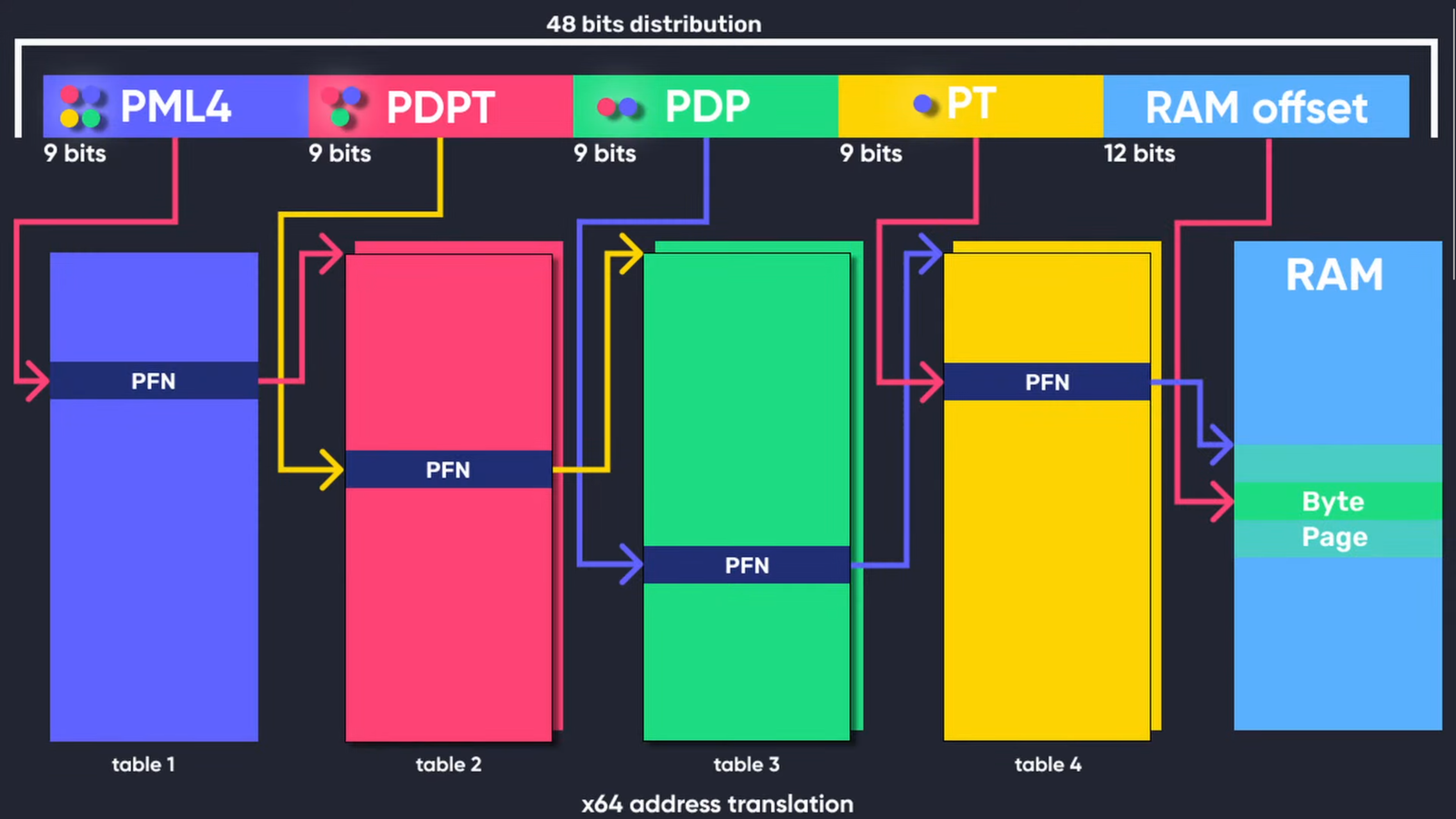
x64 Virtual Address Translation
Figure 1: x64 Virtual Address Translation (Full Credits: Guided Hacking)

Extended Page Tables (EPT): Second Level Address Translation (SLAT)

Extended Page Tables (EPT) are a feature of hardware-assisted virtualization technologies such as Intel VT-x and AMD-V's Nested Page Tables (NPT). EPT implements Second Level Address Translation (SLAT), specifically designed for virtualized environments. While traditional paging translates virtual addresses to physical addresses within the guest OS, EPT adds an additional layer by translating guest physical addresses (used by the guest OS) to host physical addresses (used by the hypervisor). This second layer of translation is managed by the hypervisor, allowing guest operating systems to manage their own page tables independently. SLAT improves performance by minimizing the need for VM exits during memory operations, which reduces overhead and enhances virtualization efficiency.

The diagram below demonstrates how to implement hidden EPT hooks in the Windows UEFI Blue Pill Type-1 Hypervisor (Codename: Illusion) written in Rust.
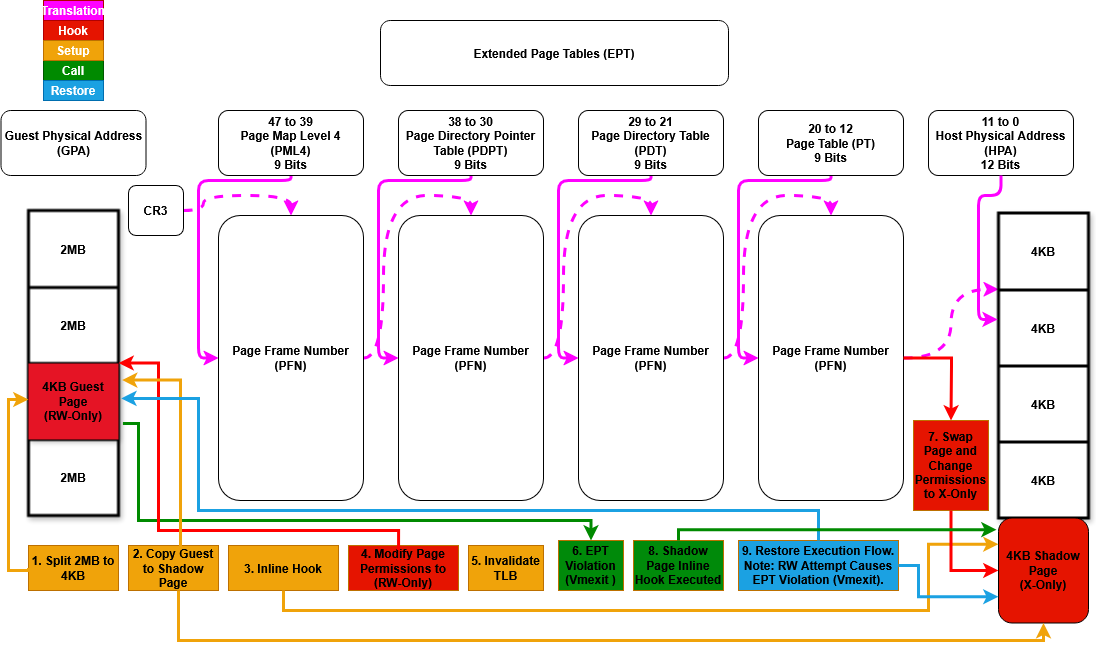
EPT Hooks
Figure 2: Extended Page Tables (EPT) Hooks (Illusion)

Features

PatchGuard Compatible Features

  • ✅ Hidden System Call (Syscall) Hooks Via System Service Descriptor Table (SSDT).
  • ✅ Hidden Kernel Inline Hooks.
  • ✅ Hidden Model Specific Registers (MSR) Hooks.

Processor-Specific Features

  • ✅ Extended Page Tables (EPT).
  • ✅ Memory Type Range Registers (MTRRs).
  • ❌ Intel Processor Trace (PT).

Microsoft Hyper-V Compatible Features

  • ❌ Support for running as a nested hypervisor under Microsoft Hyper-V (Type-2) with Virtualization Based Security (VBS) Enabled.
  • ❌ Support for running as the primary hypervisor on top of Microsoft Hyper-V (Type-1) with Virtualization Based Security (VBS) Enabled.

VM Exit Handling

  • ✅ VM Exit Handling: ExceptionOrNmi (#GP, #PF, #BP, #UD) (0), InitSignal (3), StartupIpi (4), Cpuid (10), Getsec (11), Hlt (12), Invd (13), Vmcall (18), Vmclear (19), Vmlaunch (20), Vmptrld (21), Vmptrst (22), Vmresume (24), Vmxon (27), Vmxoff (26), ControlRegisterAccesses (28), Rdmsr (31), Wrmsr (32), MonitorTrapFlag (37), Rdtsc (49), EptViolation (48), EptMisconfiguration (50), Invept (53), Invvpid (55), Xsetbv (55).

Hypervisor Detection

  • ✅ Hide hypervisor memory from guest using EPT (redirect guest memory that points to host memory to a dummy page filled with 0xFFs).
  • ✅ Custom Page Table-based hypervisor detection bypass (provides isolation and security from guest, including CR3 trashing).
  • ✅ Custom GDT and IDT-based hypervisor detection bypass (ensures isolation and security from guest).
  • ✅ CPUID-based hypervisor detection bypass (unset HypervisorPresent and remove vendor ID signature for Feature Information and Hypervisor Vendor).
  • ✅ MSR-based hypervisor detection bypass (inject #GP for invalid, unsupported, and reserved Hyper-V MSR vmexits).
  • ✅ CR-based hypervisor detection bypass (shadow CR0 and CR4 to hide hypervisor-specific bits).
  • ✅ XSETBV-based hypervisor detection bypass (inject #GP for invalid or unsupported XSETBV vmexits).
  • ✅ VMCALL-based hypervisor detection bypass (inject #GP for invalid or unsupported VMCALL vmexits).
  • ✅ ExceptionOrNMI-based hypervisor detection bypass (inject #GP, #PF, #BP, #UD for specific exception vmexits).
  • ✅ Unconditional vmexits (inject #UD for unconditional vmexits, but for Vmxon, inject #UD if it does not contain VMXE; otherwise, inject #GP if it contains VMXE).
  • ❌ EPT-based hypervisor detection bypass (write check, timing check, and thread check).
  • ❌ RDTSC-based hypervisor detection bypass.
  • ✅ Remove hypervisor memory from the UEFI memory map/table (identify the memory regions occupied by the hypervisor and modifies the UEFI memory map to mark those regions as UNUSABLE).

Isolation and Security

  • ✅ Custom implementations of the Global Descriptor Table (GDT), Interrupt Descriptor Table (IDT), and Page Tables to enhance the security and isolation of the hypervisor.

Supported Hardware

  • ✅ Intel processors with VT-x and Extended Page Tables (EPT) support.
  • ❌ AMD processors with AMD-V (SVM) and Nested Page Tables (NPT) support.

Supported Platforms

  • ✅ Windows 10 - Windows 11, x64 only.

Installation

  • Install Rust from here.
  • Install cargo-make: cargo install cargo-make.

Building the Project

  • Debug: cargo make build-debug.
  • Release: cargo make build-release.

Running the Project

  • Debug: cargo make run-debug.
  • Release: cargo make run-release.

Debugging

  • Serial Port Logging: Use a serial port logger to capture logs from the hypervisor.

Enabling Debug Modes

  • Test Mode: Activate test signing with bcdedit.exe /set testsigning on.
  • Windows Debugging: Follow the steps in this Microsoft guide.
bcdedit.exe /bootdebug {bootmgr} on
bcdedit.exe /bootdebug on
bcdedit.exe /debug on

Network Debugging with Windbg

  • Setup: bcdedit.exe /dbgsettings net hostip:w.x.y.z port:n.

Usage

Download Tool