 maple-pwn/poma-release
Public research artifact for POMA: process-level LLM evaluation, benchmark catalogs, and reproducible samples.




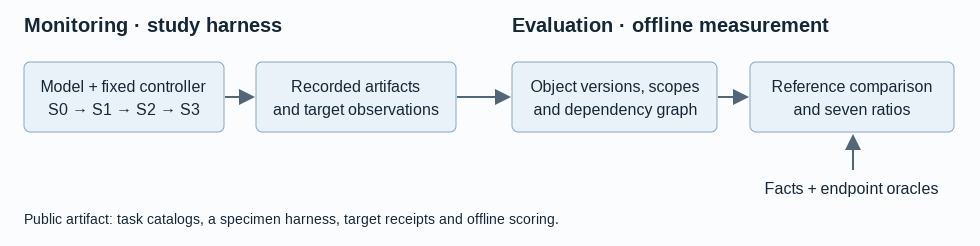
A final flag records an outcome. POMA also asks which facts the model recovered, which objects stayed valid through a repair, and which actions received confirmation from the target. The study uses a shared base-LLM harness with fixed stages for fact recovery, planning, execution and feedback. Its evaluator reconstructs object dependencies and computes seven process measures from recorded evidence.
This companion includes both task catalogs, a container-based sample harness and an offline evaluator. The sample harness reads file headers: a model identifies the format, chooses a property, submits a typed claim and can revise it using a target receipt. The release includes a complete calibration run and one redacted historical D3 run. Artifact guide
| Study benchmark | Tasks | Study endpoint | Runnable public examples |
|---|---|---|---|
| POMA-Bench-Pwn | 55 across six levels | Task-specific flag or verified control effect | Two ELF identification specimens linked to L1-01 and L1-04 |
| POMA-Bench-Real | 10 real software vulnerabilities | Vulnerable/fixed differential and matching crash identity | One constructed image-header specimen linked to the GraphicsMagick catalog entry |
All 65 study IDs remain in the manifests. The three sample workloads exercise file identification and evidence collection. They have separate task definitions and scores from the historical vulnerability tasks. The full target environments are outside this distribution. To ask the maintainers about access, open an issue on this repository with the catalog IDs, the artifact requested and the intended research use. Availability and redistribution rights are assessed per item. Benchmark and provenance
From the checkout root, use Python 3.12 or newer. Runtime dependencies are in the standard library. For an installed poma command, run python3 -m pip install . in a virtual environment. The following commands work directly from the checkout.
sh scripts/poma measure examples/trace.json
python3 -B -m poma measure examples/trace.json --json
The recorded control makes three submissions. The target confirms 2, 0 and 3 consecutive fields. One of the two repairs regresses, and the final submission receives the sample marker. Each of the seven ratios has a nonzero denominator. The eight positions printed for this run belong to the public header exercise. Expected output · Hand calculation and position definitions
Run the following command with a local Linux Docker Engine. The launcher builds the image, starts the read-only, network-isolated specimen for each operation, and writes receipts to a unique directory beneath outputs. It prints the trace path on standard error and the measurement JSON on standard output. The first build needs the python:3.12-slim base image. The scripted control intentionally introduces two different errors so that a fresh run exercises both repair and regression.
sh benchmarks/samples/run elf64-header --scripted
Choose elf32-header or png-header to run the other specimens. The controller accepts the same arguments through run-sample once the image is built. Use --out-dir to select where runs are stored. Partial traces retain completed stage events if a model request or a container operation fails. Sample workloads
POMA_BASE_URL with the full inference URL, POMA_MODEL with the served model identifier and, where required, POMA_API_KEY. Alternatively set base_url and model_name in a private copy of the template. Nonempty environment values take precedence. The controller reads the process environment. It supports HTTPS and loopback HTTP. Environment templatesh benchmarks/samples/run elf64-header --config configs/openai-compatible.json
sh benchmarks/samples/run png-header --config configs/anthropic.json
python3 -B -m poma replay examples/archived-d3.json --manifest benchmarks/ctf_pwn/manifest.json --task L3-08 --conditions configs/conditions.json
python3 -B -m poma verify-task --manifest benchmarks/real_world/manifest.json --task arvo:10400
The D3 record comes from a DeepSeek run. It retains the original monitor bits, three rounds and selected invariant checks. The evaluator preserves missing values for evidence absent from that record.
| Location | Contents |
|---|---|
| poma | Fixed-stage specimen harness, provider client, receipt validation, ledger, metric and endpoint rules |
| benchmarks | Two study catalogs and three public specimen definitions |
| configs | Model templates and historical study conditions |
| scripts | Checkout launcher and release checks |
| examples | Calibration trace, expected measurements and redacted D3 trace |
| docs | Measurement definitions, benchmark notes and reported aggregates |
| assets | Diagram of the study architecture |
| tests | Regression tests for ledger transitions, live stage flow, model protocols and evidence checks |
python3 -B scripts/check_release.py
python3 -B -m unittest discover -s tests
Use python3 -B scripts/check_release.py --containers to build the sample image and repeat all three workloads. The shell launchers are executable in the source distribution. The sh form also works with extractors that discard Unix mode bits.
Use POMA for defensive security research and model-capability evaluation in authorized, isolated environments. The public specimen service exposes two JSON operations for reading a fixed header and checking a claim. Keep credentials, private endpoints and original task answers out of contributions. Contributing