Security research and SOC investigation of CVE-2026-39987 using Docker, Nginx, Linux process monitoring, Splunk SIEM, and SPL detection rules.

A research, reproduction, and analysis project for CVE-2026-39987 — a missing authentication vulnerability in Marimo's terminal WebSocket endpoint that can lead to pre-authentication remote code execution (RCE) in affected configurations.
The project combines vulnerability research with Blue Team/SOC-oriented monitoring and investigation, using Docker, Nginx, Linux process monitoring, and Splunk SIEM.
Main contents include: root cause analysis, PoC validation in a controlled environment, patch comparison, WebSocket and process log collection, SPL detection query development, and attack timeline reconstruction.
| Information | Details |
|---|---|
| CVE ID | CVE-2026-39987 |
| Product | Marimo |
| Vulnerability type | Missing authentication / Pre-authentication RCE |
| CWE classification | CWE-306 |
| Severity | Critical |
| Tested affected version | 0.20.4 |
| Tested patched version | 0.23.0 |
| Affected endpoint | /terminal/ws |
| Security advisory | GHSA-2679-6mx9-h9xc |
The root cause lies in the Marimo terminal WebSocket endpoint lacking the necessary authentication step. In the affected deployment, the system checks the terminal usage condition and application mode but does not fully verify the identity of the connecting client.
In a vulnerable configuration, this can allow unauthenticated users to access server-side terminal functionality.
The project consists of two complementary tracks.
| Component | Configuration |
|---|---|
| Host operating system | Windows 11 |
| Container platform | Docker Desktop |
| Vulnerable Marimo | 0.20.4 |
| Patched Marimo | 0.23.0 |
| Python in container | Python 3.12 |
| Regression testing | Python 3.13, pytest |
| Reverse proxy server | Nginx |
| SIEM platform | Splunk Enterprise |
| Process monitoring | Custom Python script reading /proc |
| Network scope | Localhost only |
The two Marimo versions run in separate Docker environments. The SOC extension is tested against the vulnerable Marimo through an internal Nginx reverse proxy.
All testing activities were performed on systems under the control of the author.
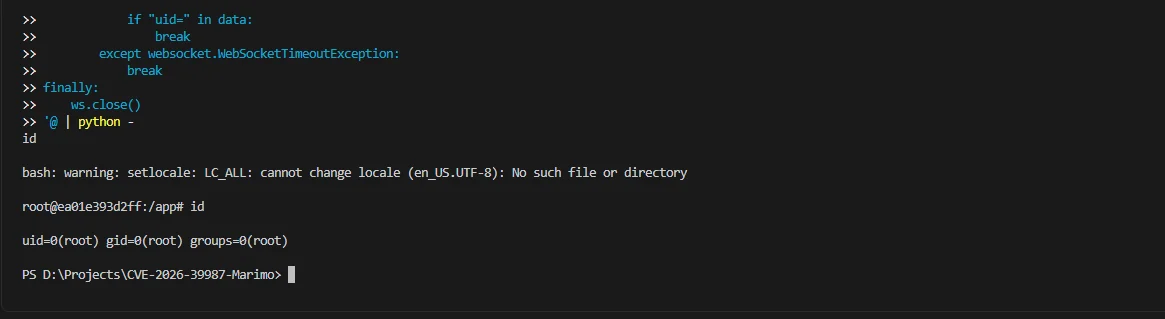
PoC connects to the terminal WebSocket endpoint without providing authentication credentials and recorded the results of server-side command execution inside the Docker container.
Execution privilege result:
uid=0(root) gid=0(root) groups=0(root)
The test also recorded the container's hostname and working directory.
The results are consistent with successfully reproducing the Pre-authentication RCE behavior in an isolated lab. The root privilege here is the privilege inside the container, and does not prove that the Windows host has been compromised or that privileges have been escalated beyond the existing privileges of the container process.
Evidence screenshot:
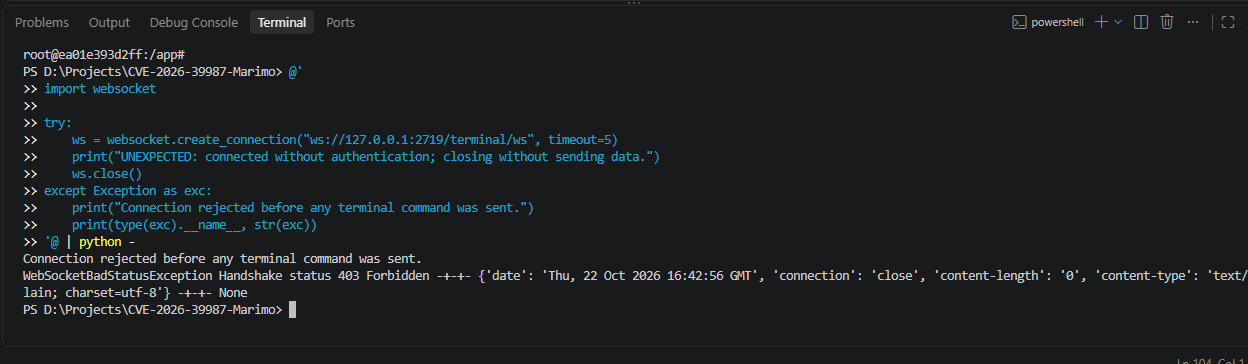
Attempt an unauthenticated WebSocket connection to the patched version.
Observed results:
WebSocketBadStatusException
Handshake status 403 Forbidden
The server refused the connection during the WebSocket connection setup phase.
Evidence screenshot:
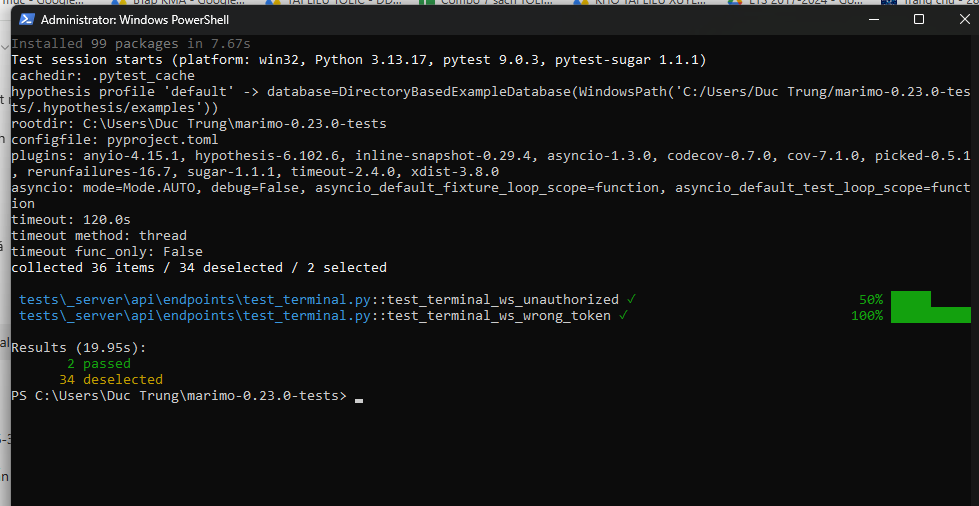
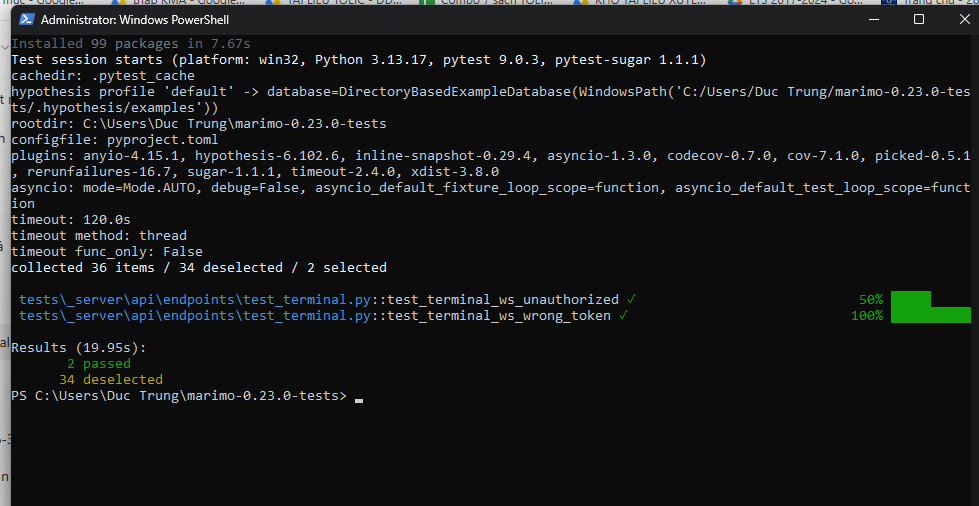
Two official Marimo authentication validation tests were run against the source code of version 0.23.0.
| Test | Result |
|---|---|
test_terminal_ws_unauthorized | PASSED |
test_terminal_ws_wrong_token | PASSED |
pytest summary:
2 passed
34 deselected
The tests confirm the expected authentication rejection behavior in the test environment. They use Starlette's TestClient and are run separately from the manual verification with Docker.
Evidence screenshot:
The WebSocket terminal endpoint in Marimo 0.20.4 lacked the authentication check mechanism added in the official patch. The patch adds an authentication check step before processing the WebSocket terminal when authentication mode is enabled.
The following contents were analyzed:
terminal.py.test_terminal.py.Official patch: Marimo PR #9098
| Document | Content |
|---|---|
| Marimo overview | Application and vulnerability overview |
| Root cause analysis | Missing authentication check |
| WebSocket flow analysis | Connection flow diagram |
| Patch change analysis | Comparison with the official patch |
| Patch verification | Manual testing and regression |
| Security research report | Summary of research results |
| Mitigation measures | Recommendations for protecting systems |
The Blue Team/SOC extension aims to detect and analyze traces when reproducing CVE-2026-39987 in the lab.
Data was aggregated from Nginx WebSocket access logs, Linux process observation, and Splunk SIEM to reconstruct the sequence of suspicious command execution behavior.