 kaandemir993/advanced-loader-reverse-engineering
"In-depth reverse engineering analysis of an advanced multi-phase loader targeting Shellhost.exe, amsi.dll, mstscax.dll, and clbcatq.dll using module stomping, CFG bypass, COM hijacking, and downgrade attacks."

This analysis covers a sophisticated multi-phase loader targeting Shellhost.exe, amsi.dll, mstscax.dll, and clbcatq.dll. The loader uses module stomping, CFG bypass, COM hijacking, and downgrade attacks.
The loader targets Shellhost.exe as its primary process for payload injection. It uses module stomping to overwrite the legitimate code of Shellhost with its own malicious payload.
push 70207369h = "is p") and invalid instructions (jb, outs, ins).fothk section: A custom section filled with INT3 traps and a single jmp to the CFG bypass routine.WinDbg view of the obfuscated payload in Shellhost.exe.

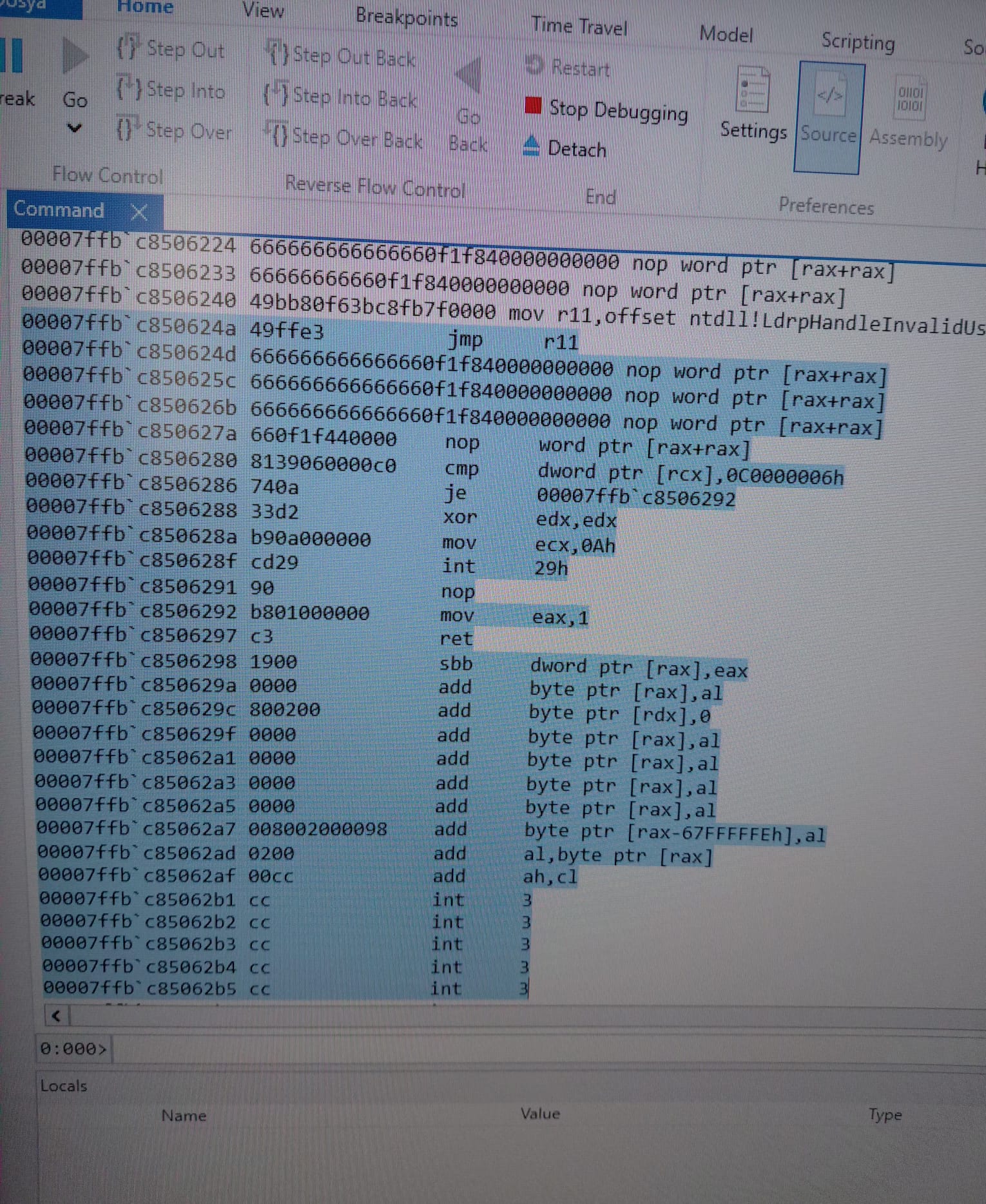
The loader injects a custom section into amsi.dll filled with INT3 (0xCC) anti-disassembly traps. A single jmp redirects to a Control Flow Guard (CFG) bypass routine, which jumps to the final shellcode via jmp rax.
INT3 instructions.jmp: jmp 0x00007ffbc85060c0 leads to the CFG bypass routine.
WinDbg view of INT3 traps and the single jmp instruction.
The loader uses LocalAlloc to manually allocate memory for the payload. A custom structure is filled with a file handle and vtable assignment for COM hijacking.
LocalAlloc(0x40, 0x68): Allocates 104 bytes of memory.*puVar12 = &PTR_FUN_180699290 for COM hijacking.puVar12[4] = hFile suggests the loader reads from a file.
Ghidra view of LocalAlloc usage and manual struct allocation.
The loader uses a fixed memory address (lRam0000000000000000) and vtable calls to manipulate kernel objects. This technique is used for privilege escalation.
lRam0000000000000000 used for kernel object manipulation.+0x18, +0x40, +0x60 indicate kernel-level operations.FUN_180031f18 and FUN_1800330c8.
Ghidra view of fixed memory address and vtable calls.
HKLM\Software\Microsoft\COM3\RemoteAccessEnabledamsi.dll, mstscax.dll, clbcatq.dllShellhost.exefothkThis loader demonstrates advanced evasion techniques, including module stomping, CFG bypass, COM hijacking, and downgrade attacks. It targets multiple system components to ensure stealth and persistence.
StructBreaker – Malware Analyst & Reverse Engineer
