 iocx-dev/iocx
An extensible, deterministic static‑analysis engine that extracts high‑signal IOCs from PE binaries and text, built for SOC automation and modern threat‑analysis pipelines.

# IOCX
### **Deterministic, Zero‑Risk IOC Extraction for Modern Security Pipelines**
<p align="center">
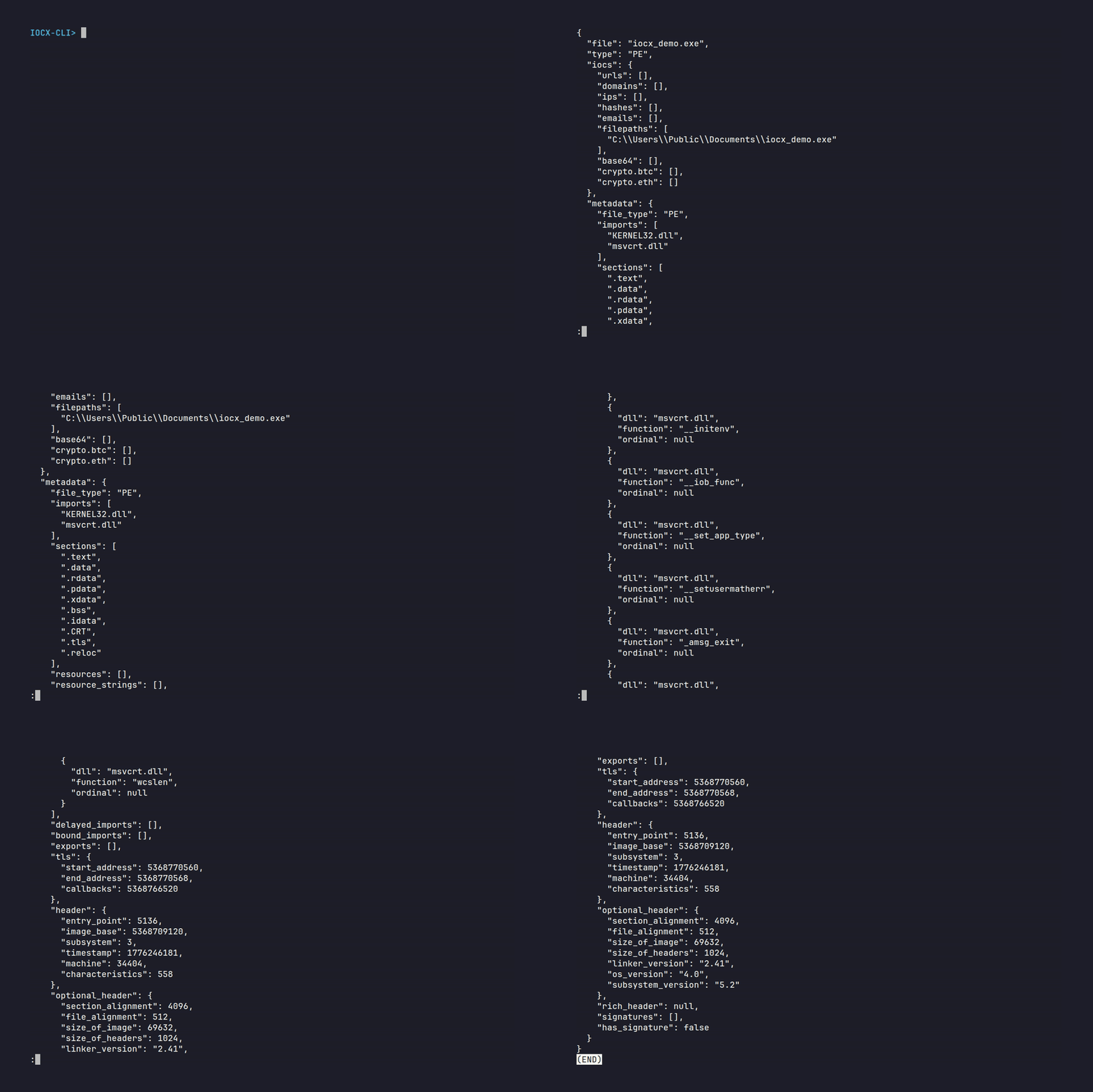
<img src="https://assets.kitploit.com/production/public/readmes/7470/35e58092394d24631c5bf5a2ef49c2c64bb1726cc5798d35bdaa36800597e402.gif" width="720" alt="IOCX Demo">
</p>
<p align="center"><sub>Static IOC extraction from a PE file using the IOCX CLI</sub></p>
<p align="center">
<a href="https://pypi.org/project/iocx/"><img src="https://img.shields.io/pypi/v/iocx?logo=pypi&logoColor=white"></a>
<img src="https://img.shields.io/badge/tests-2802_passed-brightgreen">
<img src="https://img.shields.io/badge/coverage-100%25-brightgreen">
<img src="https://img.shields.io/badge/python-3.12-blue">
<a href="https://github.com/iocx-dev/iocx/actions"><img src="https://img.shields.io/github/actions/workflow/status/iocx-dev/iocx/ci.yml?label=build"></a>
<a href="https://github.com/iocx-dev/iocx/blob/main/LICENSE"><img src="https://img.shields.io/github/license/iocx-dev/iocx"></a>
</p>
# Official IOCX Project
This is the original IOCX engine for deterministic static IOC extraction and PE analysis.
Any other repositories using the name "iocx" are **not affiliated** with this project.
**Official links:**
- PyPI: [https://pypi.org/project/iocx/](https://pypi.org/project/iocx/)
- Github: [https://github.com/iocx-dev/iocx](https://github.com/iocx-dev/iocx)
- Website: [https://iocx.dev/](https://iocx.dev/)
---
# Why IOCX Matters
Modern malware is **adversarial by default** — malformed, evasive, and engineered to break naive extractors.
- **Binary‑unaware tools** collapse under malformed PEs
- **Sandboxes** are unsafe and unusable in CI/CD
- **Reproducibility** is essential for automated pipelines
**IOCX is built for environments where correctness and determinism actually matter.**
---
# The IOCX Engine
**IOCX is the official static IOC extraction engine** — a deterministic, binary‑aware system built for DFIR, SOC automation, CI/CD security, and large‑scale threat‑intel pipelines.
Unlike regex‑only extractors or sandbox‑dependent tools, IOCX performs:
- **pure static analysis**
- **zero execution risk**
- **stable, deterministic output**
- **adversarial‑tested heuristics**
It is a core component of the MalX Labs ecosystem for scalable, modern threat analysis.
---
# Try IOCX in 10 Seconds
```bash
echo "http://malicious.example" | iocx -
```
Or scan a PE file safely:
```bash
iocx suspicious.exe -a deep
```
---
# Why IOCX Exists
Security teams face three persistent problems:
1. **Regex extractors** break under adversarial input
2. **Sandboxing** is unsafe, slow, and unsuitable for automation
3. **Most IOC tools** are inconsistent, slow, or produce subtly different output between runs
IOCX solves this with a **deterministic, static‑only engine** designed for automation, safety, and scale.
---
# What IOCX *Is Not*
IOCX is intentionally **not**:
- a sandbox
- a behavioural analysis tool
- an emulator
- an enrichment engine
It never executes untrusted code.
It never performs dynamic analysis.
It is **static‑only by design** — for safety, determinism, and CI/CD compatibility.
---
# Design Philosophy
IOCX is engineered for the realities of modern malware, not the assumptions of legacy tools.
### **1. Determinism over ambiguity**
Stable, reproducible output — no randomness, no volatility.
### **2. Static over dynamic**
Execution is unsafe. Static analysis is predictable, scalable, and CI‑friendly.
### **3. Adversarial‑first engineering**
Malformed PEs, corrupted RVAs, hostile strings — IOCX treats them as normal input.
### **4. Schema stability as a contract**
Downstream systems should never break on upgrade.
### **5. Performance without compromise**
150–300 MB/s on raw text.
6–15 MB/s on typical PEs.
Predictable even under worst‑case adversarial load.
---
These commitments are derived from a published research methodology for PE structural analysis — deterministic fixture construction, single-anomaly discipline, and Windows loader behaviour as the correctness oracle. See docs/methodology.md for the full methodology, and [paax.dev](https://paax.dev) for the broader adversarial-PE taxonomy and commercial fixture suite.
# What Makes IOCX Different
| Capability | **IOCX** | Typical IOC Extractors | Sandbox / Dynamic Tools |
|-----------|-----------|------------------------|--------------------------|
| **Safety** | Zero‑execution, static‑only | Regex‑only, no binary safety | Executes untrusted code (high‑risk) |
| **Determinism** | Fully deterministic output | Non‑deterministic under noise | Non‑deterministic by design |
| **Binary Awareness** | Full PE parsing, heuristics | No binary support | Yes, but unsafe + slow |
| **Adversarial Resilience** | Tested against malformed PEs, hostile strings | Easily bypassed | Often crashes or misclassifies |
| **Performance** | 150–300 MB/s (text), 6–15 MB/s (PE) | Highly variable | Extremely slow |
| **CI/CD Friendly** | Yes — safe, deterministic, fast | Partial | No — unsafe for pipelines |
| **Schema Stability** | Guaranteed | Rare | None |
**In short:** IOCX is built for *real adversarial reality*, not idealized input.
---
# Use Cases
### CI/CD & DevSecOps
- Scan binaries before release
- Detect accidental URLs, IPs, or secrets in builds
- Enforce security gates with zero execution risk
### SOC & Incident Response
- Extract indicators from alerts or analyst clipboard text
- Safely inspect malware samples without execution
- Normalize IOCs into structured JSON
### Threat Intelligence
- Process feeds at scale
- Parse unstructured reports
- Build enrichment pipelines on deterministic output
### Automation & Scripting
- Pipe logs or artifacts through IOCX
- Use the Python API for ETL or batch workflows
- Extend with custom detectors
---
# Performance Profiles
### **1. Raw IOC Extraction (Text, Logs, Buffers)**
**150–300 MB/s** sustained throughput
Fast path — no PE parsing.
| Detector | 1 MB Time | Throughput |
|-----------|-----------|------------|
| Crypto | 0.0037 s | ~270 MB/s |
| Filepaths | 0.0041 s | ~250 MB/s |
| IP | 0.0065 s | ~156 MB/s |
| Domains | 0.0035 s | ~300 MB/s |
---
### **2. Typical PE Files (~39 KB)**
- **0.0122 s** (typical)
- **0.0145 s** (with heuristics)
- **6–15 MB/s** throughput
---
### **3. Adversarial Dense PE (1.5 MB)**
- **0.192 s**
- **~7.6 MB/s** throughput
- Triggers TLS anomalies, structural anomalies, anti‑debug patterns
---
### **4. Full Engine (Non‑PE)**
- **1 MB:** 0.038 s
---
# Version Highlights
<details>
<summary><strong>Show Version History</strong></summary>
<br>
### v0.7.6.2 — Import Table Validator
- New deterministic **import table structural validator** (`IMPORT_*` reason codes).
- `version_info` now parsed and surfaced at **every** analysis level (not just `-a full`), via a new bounded public projection.
- Rebuilt CLI: branded `--version` output, clearer `--help` text, reorganised argument groups.
- Fixed a relocation-parser crash reachable from any entry, a PE32+ data-directory offset bug, and several silent export/resource error drops.
- New static CI check that prevents parser error tags from silently going unconsumed by validators.
- Test suite: 2,136 → 2,802 tests.
---
### v0.7.6.1 — Exception Directory Validator
- Adds deep semantic validation of the PE exception (`.pdata`) directory; 14 new reason codes; 15 validators total.
- Fixes a defect that had been suppressing structural findings across the engine.
- Four further checks found to be dead in production: two directory placement, a section-mapping, and a resource-directory bounds check.
- **Output-visible:** findings previously suppressed or mislabelled will now appear.
- Tests: 1620 → 2136. Coverage: 100%.
---
### **v0.7.6 — Structural Validator Expansion: Debug and relocations directories**
- Two new PE structural validators - relocations and debug
- WIN_CERTIFICATE and tls validators now source structural truth from dedicated struct parsers, independent of pefile
- 12 new reason codes with priority-resolved sub-reason taxonomies
- Deterministic byte-level parsing - no reliance on pefile's lazy interpretation
- 1620 tests at 100% coverage
---
### **v0.7.5 — Structural Validator Expansion**
- Four new PE structural validators — exports, delay-load imports, VS_VERSIONINFO, and resource hierarchy
- 24 new reason codes with priority-resolved sub-reason taxonomies
- Deterministic byte-level parsing — no reliance on pefile's lazy interpretation
- Security-relevant metadata — DLL characteristics, subsystem/machine name decoding, per-resource entropy
- 1370 tests at 100% coverage — end-to-end verified against `dumpbin` on real binaries
---
### **v0.7.4.1 — Windows Compatibility Hotfix**
- Removed the `python-magic` dependency, which caused import failures on Windows systems
- Added a pure‑Python file‑type detector for full cross‑platform portability
- Improve PE detection logic by enforcing strict Windows-compatible PE validation.
- No behavioural changes to IOC extraction
- The `--min-length` consistency fix is planned for **v0.7.5**
---
### **v0.7.4 — Advanced Directory Parsing**
- Full **Load Config Directory** parsing and validation
- Extended Optional Header metadata for downstream heuristics
- New GuardCF, cookie, anomaly heuristics
- Faster PE Analysis
- 99 PE fixtures in test suite; 45 fully spec-validated
---
### **v0.7.3 — Structural Correctness & Deterministic Heuristics**
- Major hardening of all PE structural validators
- Deterministic, snapshot‑stable behaviour
- Clear, consistent ReasonCodes
- Stronger heuristics built on structural truth
---
### **v0.7.2 — Dependency Fix**
- Added missing `idna` dependency
- No behavioural or schema changes
---
### **v0.7.1 — Adversarial Heuristics Expansion & Parser Hardening**
- Six new PE heuristics
- Expanded adversarial PE corpus
- Hardened domain/URL/crypto/hash extractors
- Deterministic snapshot‑validated output
---
### **v0.7.0 — Deterministic Heuristics & Adversarial Testing Foundation**
- Deterministic heuristics
- Layer‑3 adversarial samples
- Snapshot‑contract tests
- Rich Header crash fix
---
### **v0.6.0 — Stable Output Schema & Deterministic Metadata**
- Fully stable JSON schema
- Normalised PE metadata
- Formalised analysis levels
---
### **v0.5.0 — Analysis Levels, PE Section Analysis, Obfuscation Hints**
- New analysis‑level system
- PE structural analysis
- Obfuscation heuristics
---
### **v0.4.0 — Plugin Architecture**
- Plugin‑ready rule engine
- Unified detection flow
---
### **v0.3.0 — Crypto IOC Detection**
- Ethereum & Bitcoin wallet detection
---
### **v0.2.0 — High‑Reliability IP Detection**
- Major IPv4/IPv6 improvements
</details>
---
# Quickstart
### Install
```bash
pip install iocx
```
### Extract IOCs from a file
```bash
iocx suspicious.exe
```
### Extract from text
```bash
echo "Visit http://bad.example.com" | iocx -
```
### Enable PE analysis
```bash
iocx suspicious.exe -a
```
### Python API
```python
from iocx.engine import Engine
engine = Engine()
results = engine.extract("suspicious.exe")
print(results)
```
---
# Example Output
> IOCX produces structured, deterministic JSON that includes IOCs, PE metadata, section analysis, heuristics, and obfuscation indicators.
>
> The example below is an abridged output from a real adversarial PE sample. It demonstrates the shape and depth of the schema while keeping the size manageable for documentation purposes.
<details>
<summary><strong>Show Example JSON Output</strong></summary>
```json
{
"file": "heuristic_rich.full.exe",
"type": "PE",
"iocs": {
"urls": ["http://not-a-real-domain.test/payload"],
"domains": ["example-malware.com"],
"ips": ["192.0.2.123"],
"hashes": [
"abcd1234ef567890abcd1234ef567890",
"1234567890",
"3333333333333333"
],
"filepaths": [
"/usr/src/mingw-w64-11.0.1-3build1/mingw-w64-crt/crt/crtexe.c",
"/usr/x86_64-w64-mingw32/include",
"/usr/src/mingw-w64-11.0.1-3build1/mingw-w64-crt/crt/pseudo-reloc.c"
]
},
"metadata": {
"file_type": "PE",
"imports": ["KERNEL32.dll", "msvcrt.dll", "USER32.dll"],
"sections": [
".text", ".data", ".rwx", ".rdata",
"UPX0", ".pdata", ".xdata", ".tls"
],
"resources": [],
"resource_strings": [],
"delayed_imports": [],
"bound_imports": [],
"exports": [],
"signatures": [],
"has_signature": false,
"tls": {
"start_address": 5368758272,
"end_address": 5368758280,
"callbacks": 5368754232
},
"header": {
"entry_point": 5088,
"image_base": 5368709120,
"machine": "AMD64",
"subsystem": "Windows GUI"
},
"optional_header": {
"section_alignment": 4096,
"file_alignment": 512,
"size_of_image": 155648
}
},
"analysis": {
"sections": [
{ "name": ".text", "entropy": 5.92 },
{ "name": ".rwx", "entropy": 0 },
{ "name": "UPX0", "entropy": 0.34 },
{ "name": ".rdata", "entropy": 4.03 }
],
"obfuscation": [
{
"value": "abnormal_section_layout_virtual_only",
"category": "obfuscation_hint",
"metadata": {
"section": ".bss",
"raw_size": 0,
"virtual_size": 384
}
}
],
"extended": [
{
"value": "summary",
"category": "pe_metadata",
"metadata": {
"dll_count": 3,
"import_count": 45,
"resource_count": 0,
"has_tls": true,
"has_signature": false
}
}
],
"heuristics": [
{
"value": "packer_suspected",
"metadata": {
"reason": "packer_section_name",
"section": "UPX0"
}
},
{
"value": "anti_debug_heuristic",
"metadata": {
"reason": "anti_debug_api_import",
"dll": "kernel32.dll",
"function": "CheckRemoteDebuggerPresent"
}
},
{
"value": "anti_debug_heuristic",
"metadata": {
"reason": "timing_api_import",
"dll": "kernel32.dll",
"function": "GetTickCount"
}
},
{
"value": "pe_structure_anomaly",
"metadata": {
"reason": "section_overlaps_headers",
"section": ".bss",
"raw_address": 0,
"size_of_headers": 1536
}
},
{
"value": "pe_structure_anomaly",
"metadata": {
"reason": "data_directory_overlap",
"directory_a": "IMAGE_DIRECTORY_ENTRY_IMPORT",
"directory_b": "IMAGE_DIRECTORY_ENTRY_IAT"
}
}
]
}
}
```
</details>
---
# Architecture
```
iocx/
├── examples/
├── docs/
├── tests/
└── iocx
├── detectors/
├── parsers/
├── plugins/
├── cli/
└── analysis/
```
---
# Plugin Ecosystem & Extensibility
IOCX is designed to be extended safely and predictably.
Plugins are **first‑class citizens**, validated by the same deterministic snapshot tests as the core engine.
You can build:
- custom IOC detectors
- custom regex rules
- binary‑aware plugins
- internal heuristics
- pipeline‑specific extractors
See:
- `docs/specs/overlap-suppression.md`
- `docs/specs/plugin-authoring-guidelines.md`
---
# Ecosystem Overview
IOCX is more than a single binary — it’s a modular ecosystem:
- **Core Engine** — deterministic IOC extraction + PE analysis
- **Plugin System** — custom detectors and analysis modules
- **Adversarial Corpus** — malformed PEs, hostile strings, fuzz samples
- **Snapshot Testing Framework** — ensures deterministic output
- **Performance Benchmarks** — enforced in CI
- **Documentation Suite** — specs, contracts, and plugin guides
---
# Who Uses IOCX?
IOCX is used across:
- DFIR teams
- SOC automation pipelines
- CI/CD security gates
- Threat‑intel platforms
- Malware research labs
- Security engineering teams
Anywhere indicators need to be extracted **safely**, **deterministically**, and **at scale**, IOCX fits.
---
# Safe Testing (No Malware Required)
All test samples are:
- Synthetic
- Benign
- Publicly safe (EICAR, GTUBE)
- Designed to avoid accidental malware handling
---
# Performance Guarantees
IOCX enforces strict performance thresholds in CI to ensure:
- No regex backtracking stalls
- No pathological slowdowns
- Stable performance across releases
See:
- `docs/performance.md`
---
# Project Identity & Naming
The name **IOCX** refers exclusively to the official engine published on:
- PyPI: [https://pypi.org/project/iocx/](https://pypi.org/project/iocx/)
- GitHub: [https://github.com/iocx-dev/iocx](https://github.com/iocx-dev/iocx)
### Not allowed
- Repositories named `iocx`
- Tools named “iocx” not part of this project
- Implying affiliation without permission
### Allowed
- `iocx-<plugin>`
- `iocx-extension-<name>`
- `iocx-detector-<feature>`
---
# Official IOCX Repositories
- Core Engine: [https://github.com/iocx-dev/iocx](https://github.com/iocx-dev/iocx)
- Plugins Meta‑Repo: [https://github.com/iocx-dev/iocx-plugins](https://github.com/iocx-dev/iocx-plugins)
- Documentation: [https://github.com/iocx-dev/iocx/tree/main/docs/specs](https://github.com/iocx-dev/iocx/tree/main/docs/specs)
- PyPI Package: [https://pypi.org/project/iocx/](https://pypi.org/project/iocx/)
---
# Roadmap
IOCX development focuses on stability, extensibility, and deeper static‑analysis coverage.
The items below represent ongoing areas of work and exploration.
- **Extended PE heuristics** (delay‑load behaviour, structural anomalies, relocation patterns)
- **Selective suppression rules** for OSINT, DFIR, and threat‑intel workflows
- **ELF and Mach‑O metadata extraction**
- **Batch analysis mode** for multi‑artifact workflows
- **YARA‑style output modes** and enrichment hooks
- **Binary‑agnostic static analysis**
- **Cross‑platform plugin ecosystem**
- **Language bindings** for Rust, Go, and Node.js
---
# Contributing
We welcome:
- New detectors
- Parser improvements
- Documentation updates
- Synthetic adversarial samples
See `CONTRIBUTING.md` for guidelines.
---
# Security
If you discover a security issue, **do not open a GitHub issue**.
Follow the instructions in `SECURITY.md`.
---
# License
MPL‑2.0 License — see `LICENSE`.