 haydenjames/cve-2026-31431-check
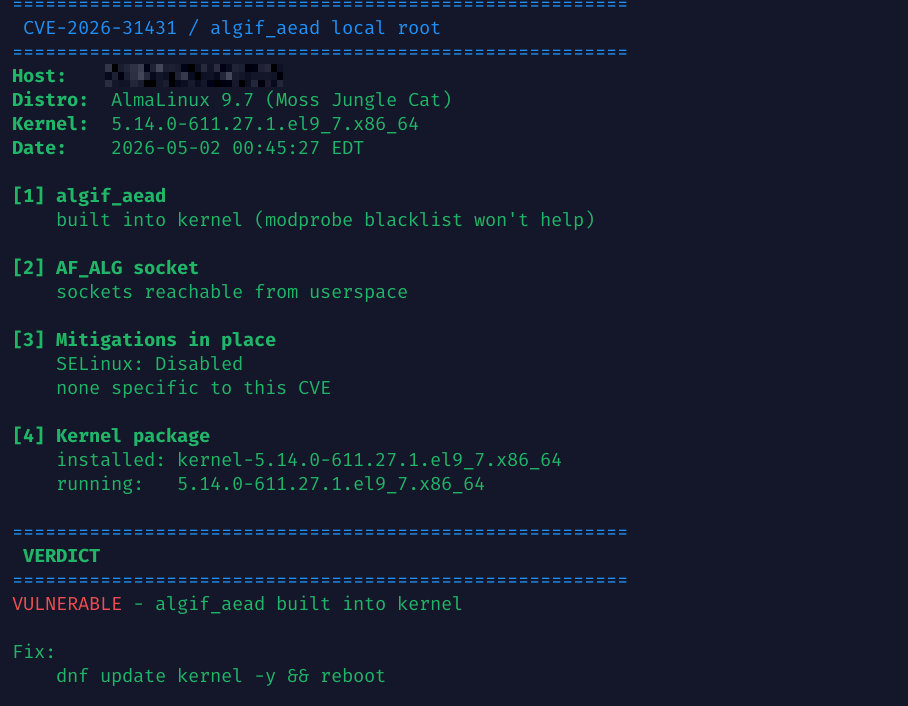
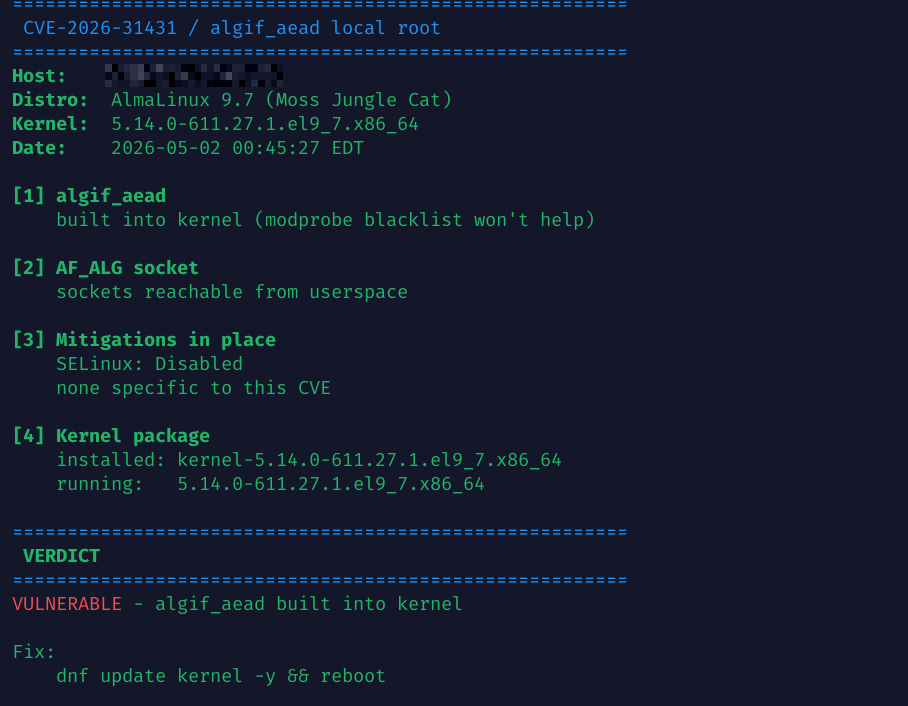
Read-only checker for CVE-2026-31431 (algif_aead local root). Reports kernel/module state and suggests mitigations.

Read-only checker for the algif_aead local-root vuln (CVE-2026-31431).
Looks at kernel config, module state, AF_ALG socket reachability, and any
mitigations you've put in place, then prints a verdict. It does not run
exploit code.
Companion to dirty-frag-check (CVE-2026-43284 / CVE-2026-43500).
Heads up: this is a heuristic. A green verdict isn't a guarantee. Cross-reference with your distro's advisory before you call a host safe. MIT, no warranty.
curl -fsSL https://github.com/haydenjames/CVE-2026-31431-check/releases/latest/download/cve-2026-31431.sh | bash
Read it first if you don't trust piping to bash:
curl -fsSLO https://github.com/haydenjames/CVE-2026-31431-check/releases/latest/download/cve-2026-31431.sh
less cve-2026-31431.sh
chmod +x cve-2026-31431.sh && ./cve-2026-31431.sh
Pin to a release tag for change control: https://raw.githubusercontent.com/haydenjames/CVE-2026-31431-check/v1.0.3/cve-2026-31431.sh.
-q for one-line fleet output. -h for help. Exit 0 ok, 1 vulnerable, 2 unknown.
-q prints one line per host, so you can pipe it through whatever remote
runner you already use:
# parallel-ssh
parallel-ssh -h hosts.txt -i 'bash -s -- -q' < cve-2026-31431.sh

# ansible
ansible all -m script -a "cve-2026-31431.sh -q"
Exit codes (0 ok, 1 vulnerable, 2 unknown) also work if your tooling aggregates by status.
bash 4+, plus the usual awk/grep/sed/lsmod/modprobe. If python3
is around it'll also test AF_ALG socket reachability; if not, that check is
skipped. The check itself doesn't need root. Applying the mitigation does.
algif_aead state. Built-in, loadable module, loaded, or absent. Reads
/boot/config-* or /proc/config.gz, falls back to lsmod.
1b. authencesn state. Per the upstream advisory, this is the module
that actually contains the bug — algif_aead is one reach-in path,
IPsec is another. Detected via lsmod/modinfo and config.modprobe -n -v. Also flags
the broken DefaultRestrictAddressFamilies systemd [Manager] trick
that's been making the rounds — that directive only works on units, not
in system.conf.d. Reports SELinux and AppArmor status.algif_aead is built in. Best-effort verdict; it leans on dnf check-update exit codes, which can be non-zero for unrelated reasons (network, stale metadata). Don't assume you're stuck waiting without checking your distro tracker.Per the upstream advisory,
the bug actually lives in the authencesn crypto module — algif_aead is
just one of the reach-in paths. Blacklist both to be safe:
sudo tee /etc/modprobe.d/disable-cve-2026-31431.conf <<'EOF'
install algif_aead /bin/false
install authencesn /bin/false
EOF
sudo rmmod authencesn algif_aead 2>/dev/null || true
If rmmod says "module is in use", something on the box actively uses
AF_ALG or IPsec (some VPNs, disk encryption, crypto userspace tooling).
Don't force-unload it. Patch and reboot.
If the vulnerable code is compiled into your kernel, blacklisting won't help. Only a kernel update fixes it.
AlmaLinux 8, AlmaLinux 9.7, CentOS 7 (TuxCare ELS), Ubuntu 22.04, Ubuntu 24.04.
Bug reports that shaped v1.0.1:
kmod blacklist update wasn't being detected, causing false VULNERABLE verdicts on patched Ubuntu hosts.MIT — see LICENSE.
