🐢 Open-Source Evaluation & Testing library for LLM Agents


[!IMPORTANT] Giskard v3 is a fresh rewrite designed for dynamic, multi-turn testing of AI agents. This release drops heavy dependencies for better efficiency while introducing a more powerful AI vulnerability scanner and enhanced RAG evaluation — both now shipping natively in
giskard-scan, with no dependency on v2. Only the legacy scan for tabular/ML models remains v2-only. Giskard v2 remains available but is no longer actively maintained. Follow progress → Read the v3 Announcement · Roadmap
pip install giskard           # checks (+ agents, llm, core)
pip install "giskard[scan]"   # + vulnerability / quality scan
pip install "giskard[openai]" # provider SDK for LLM judges / generators
Requires Python 3.12+.
| Extra | Adds |
|---|---|
| (none) | giskard-checks and dependencies |
scan | giskard-scan |
openai / anthropic / … | provider SDKs (see pyproject.toml optional deps) |
Telemetry: optional aggregated analytics via giskard-core. No prompts or outputs are sent.
Opt out before importing Giskard: export DO_NOT_TRACK=1 or export GISKARD_TELEMETRY_DISABLED=1.
Details: giskard-core README.
Giskard is an open-source Python library for testing and evaluating agentic systems. The v3 architecture is a modular set of focused packages — each carrying only the dependencies it needs — built from scratch to wrap anything: an LLM, a black-box agent, or a multi-step pipeline.
| Status | Package | Description |
|---|---|---|
| ✅ Stable | giskard-checks | Testing & evaluation — scenario API, built-in checks, LLM-as-judge |
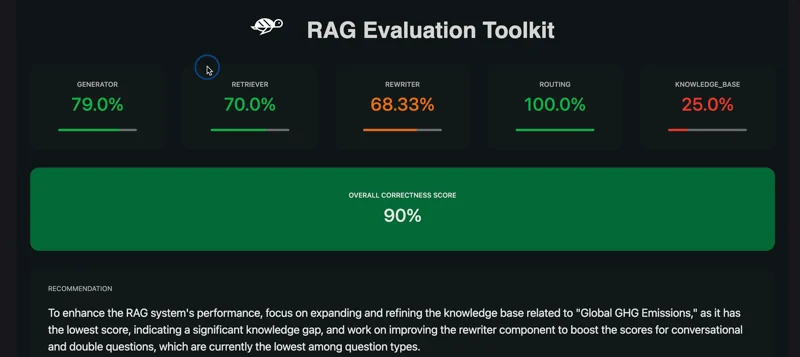
| ✅ Stable | giskard-scan | Agent vulnerability scanner + RAG/quality evaluation — red teaming, prompt injection, jailbreaks & harmful content (vulnerability_scan, successor of v2 Scan), plus knowledge-base quality eval (quality_scan, successor of v2 RAGET) |
These build on three foundational libraries — giskard-core (shared utilities & telemetry), giskard-llm (provider-agnostic LLM routing), and giskard-agents (agent & workflow orchestration) — which are pulled in automatically and rarely used directly.
pip install giskard-checks
Giskard Checks is a lightweight library for creating evaluations (evals) that test LLM-based systems — from simple assertions to LLM-as-judge assessments. Unlike traditional unit tests, evals are designed for non-deterministic outputs where the same input can produce different valid responses.
Use Giskard Checks to:
Built-in evals include string matching, comparisons, regex, semantic similarity, and LLM-as-judge checks (Groundedness, Conformity, LLMJudge).
(inputs) -> outputs (optionally with trace)giskard.agents.Generator is an LLM client for workflows/judges — not the same as
giskard.checks input generators (LLMGenerator) that synthesize user messages.
import asyncio
from giskard.checks import Scenario, Groundedness


def get_answer(inputs: str) -> str:
    return "Paris"  # replace with your model / agent


async def main() -> None:
    scenario = (
        Scenario("test_france_capital")
        .interact(inputs="What is the capital of France?", outputs=get_answer)
        .check(
            Groundedness(
                name="answer is grounded",
                context="France is in Western Europe. Its capital is Paris.",
            )
        )
    )
    result = await scenario.run()
    result.print_report()


asyncio.run(main())
Groundedness is an LLM judge — install a provider extra (e.g. pip install "giskard[openai]") and set the matching API key. Default model: openai/gpt-4o-mini.
See the full docs for Suites, LLMJudge, multi-turn scenarios, and more.
pip install "giskard[scan]" # or: pip install giskard-scan
Giskard Scan is the red-teaming and vulnerability scanning layer for agentic systems. It generates adversarial test suites automatically from a plain-language description of your agent, covering prompt injection, harmful content, stereotypes, misinformation, and more.
Use Giskard Scan to:
ScenarioGenerator instances to generate_suite, or register them on vulnerability_suite_generator_registryimport asyncio
from giskard.scan import vulnerability_scan