
Skip to content
KitploitKITPLOIT
ToolsExploitsBlog
Log in
Submit
ToolsExploitsBlog
Submit

Hacking, PenTest, and Cybersecurity Tools for Your Security Arsenal!

Kitploit is a directory of hacking, cybersecurity, and pentesting tools. Discover the latest project updates to find vulnerabilities, analyze systems, automate testing, and strengthen your security.

··Feeds·Contact·Privacy·© 2026 Kitploit

Tool Directory

Categories

View all categories
Loading categories
SOCMIntelligence — A modular OSINT & SOCMINT framework for social media intelligence, investigation, and public data analysis. | Kitploit
Tools/GitHubGitHub/emrekybs/socmintelligence
OSINT (Open Source Intelligence)ReconnaissanceIdentity ManagementOSINT for Social EngineeringInformation GatheringDigital ForensicsSocial EngineeringUtilities & FrameworksThreat IntelligenceIncident ResponseCrawler
1820h 33m agoNot yet reviewed

Most Popular

View all →

Discover the most used tools by our community.

Explore all tools

Browse our collection of tools

View all tools →
Share
GitHub
emrekybs/socmintelligence

SOCMIntelligence

A modular OSINT & SOCMINT framework for social media intelligence, investigation, and public data analysis.

View Repository

SOCMIntelligence logo

SOCMIntelligence

Multi-platform SOCMINT / OSINT web tool.
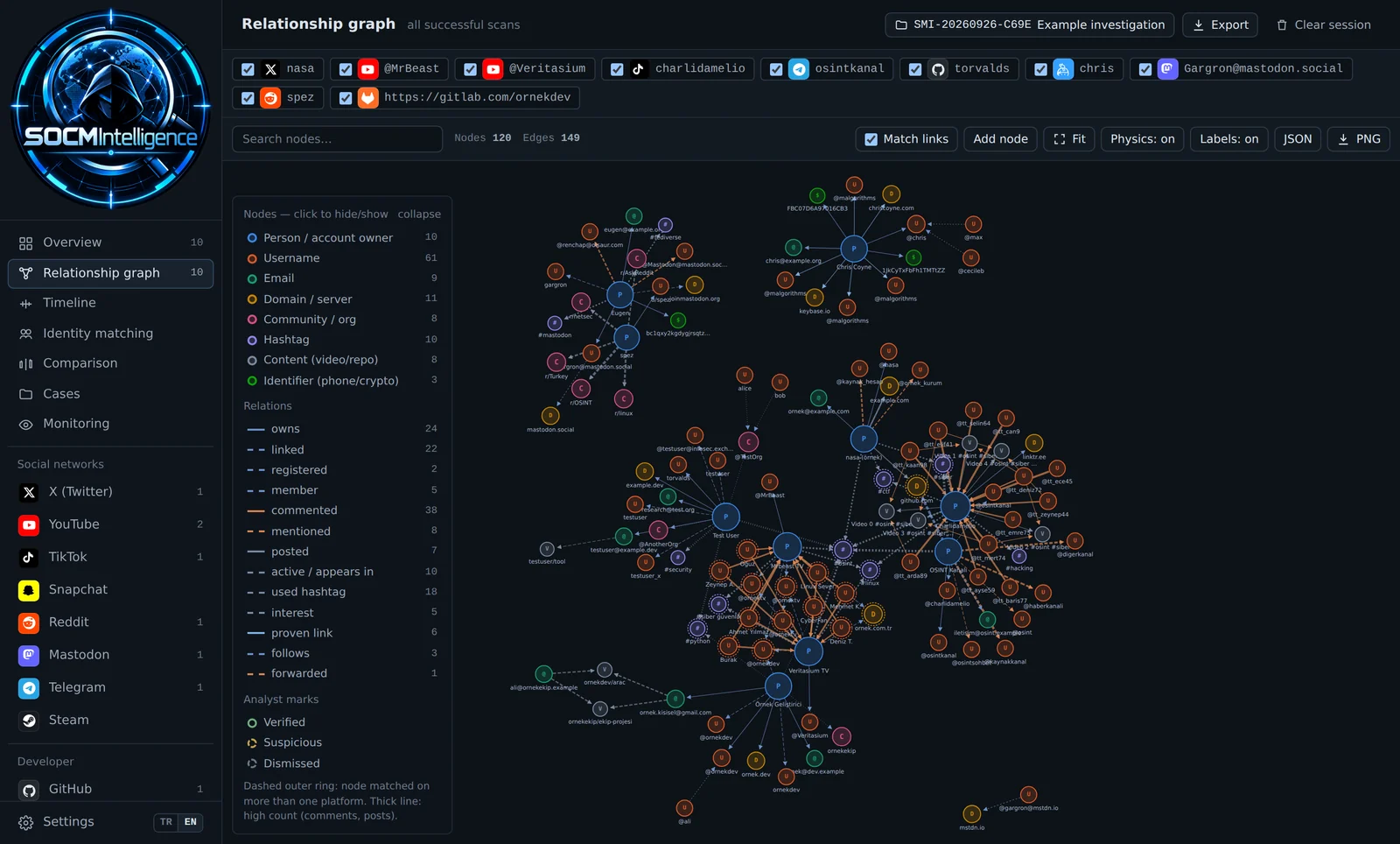
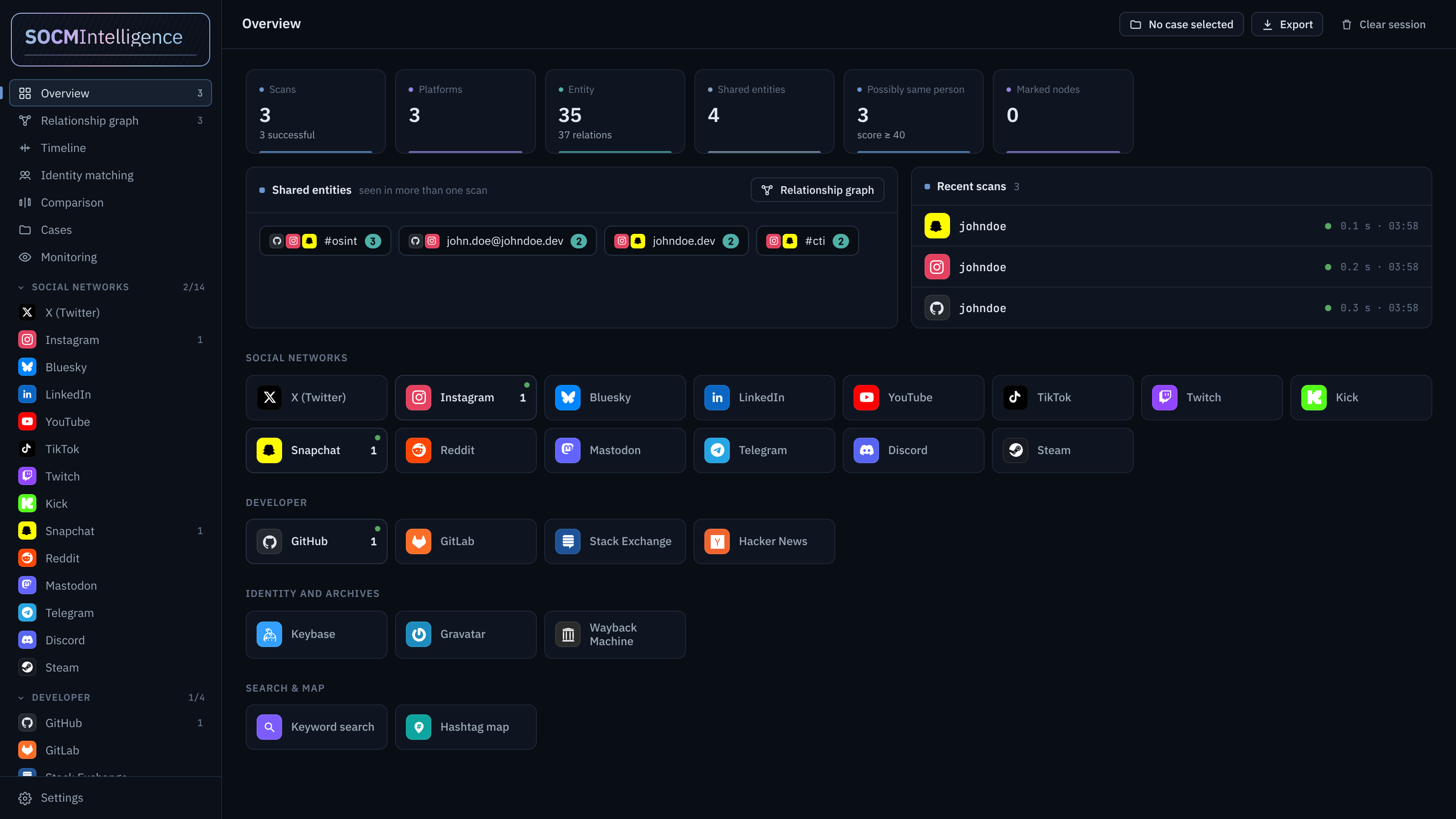
15 source modules, cross-platform identity graph, same-person scoring, case management and tamper-evident reports — in one FastAPI app that starts with a single command.

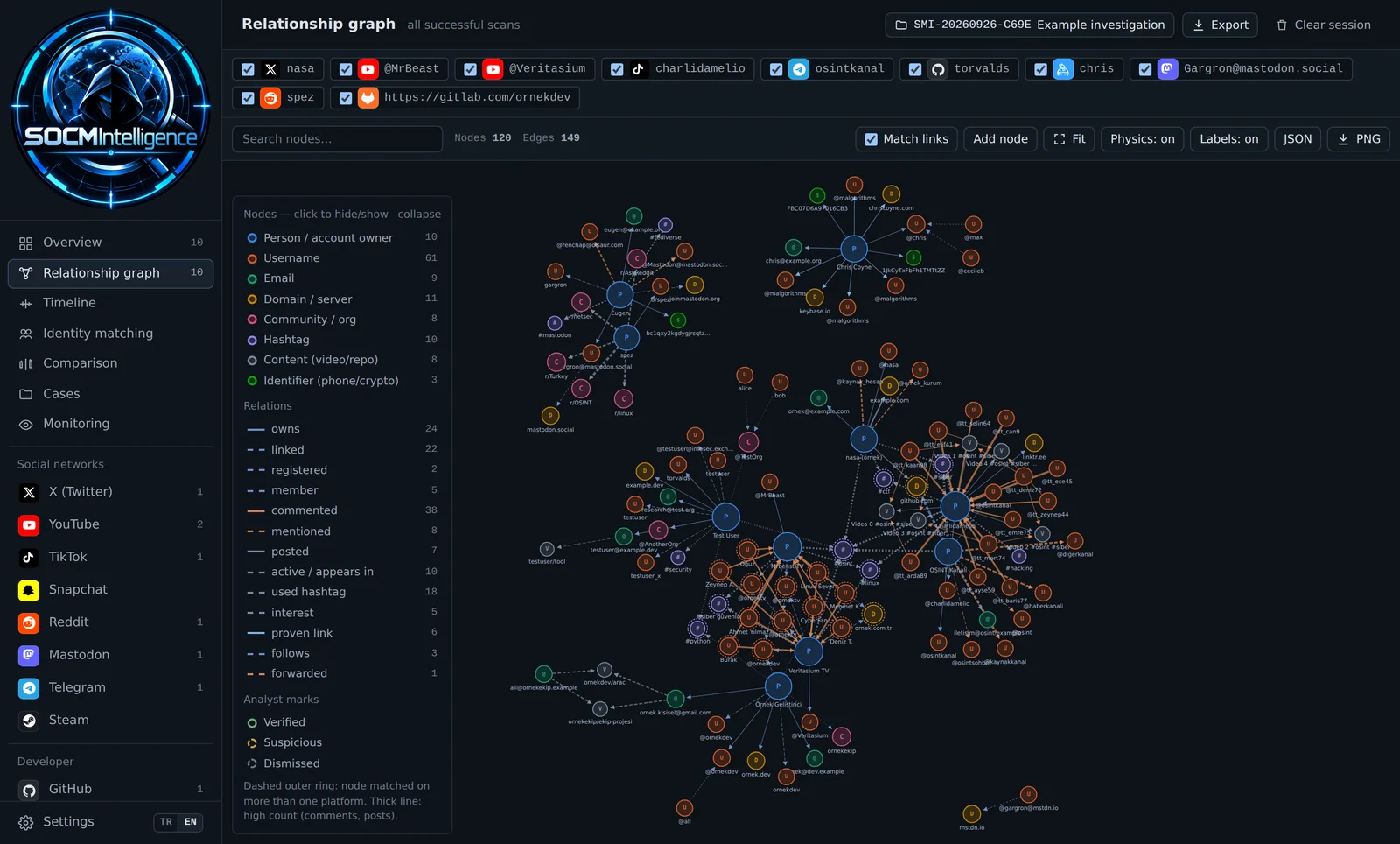
SOCMIntelligence relationship graph


What it is

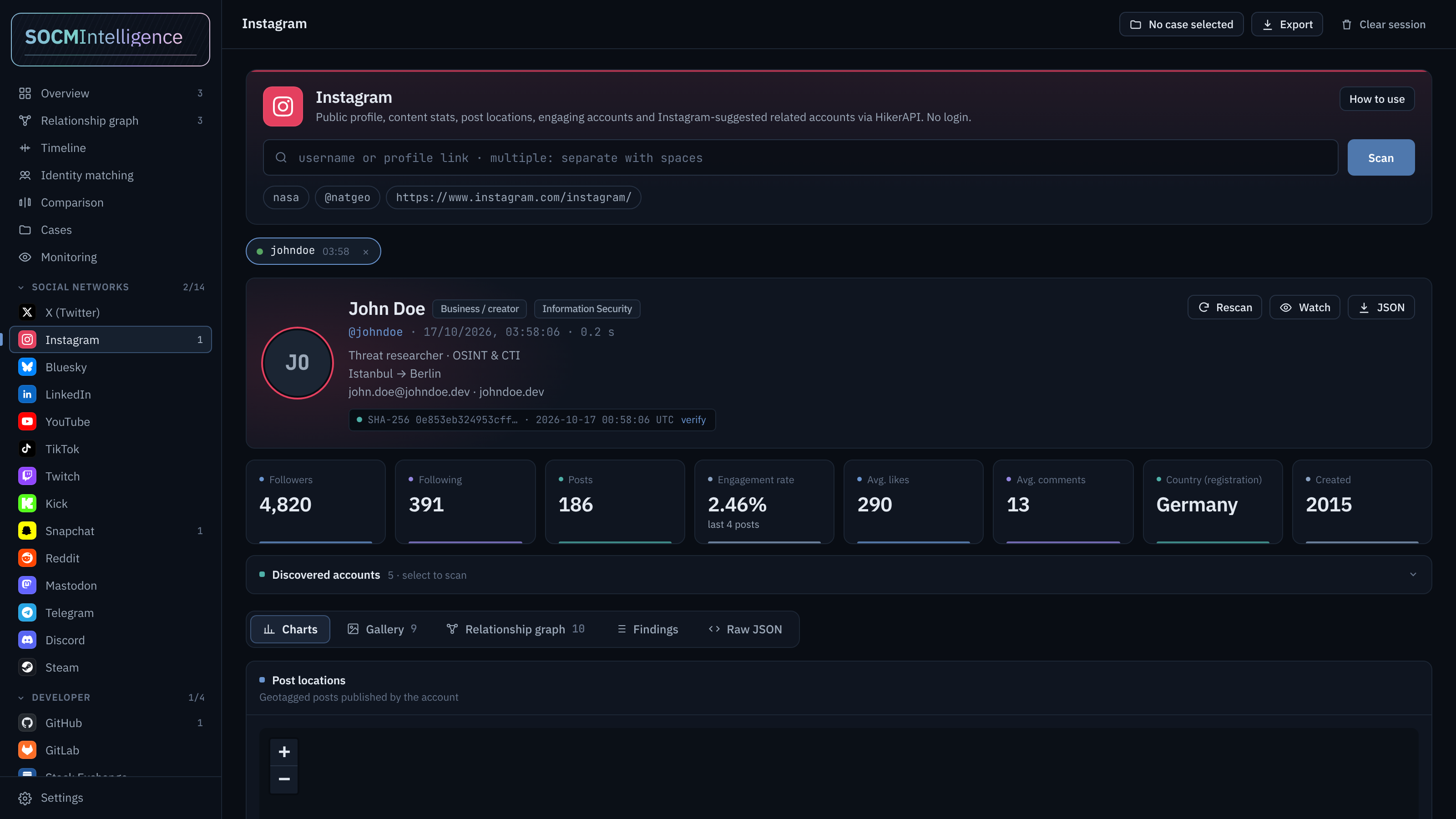
SOCMIntelligence collects public data from many platforms, turns each result into charts, finding tables and a relationship graph, and merges everything into a single cross-platform identity graph. Because the same account gets the same node ID everywhere, an email, domain or username that shows up in two different scans is automatically linked — so you can see who is who across services.

Modules

GroupModules
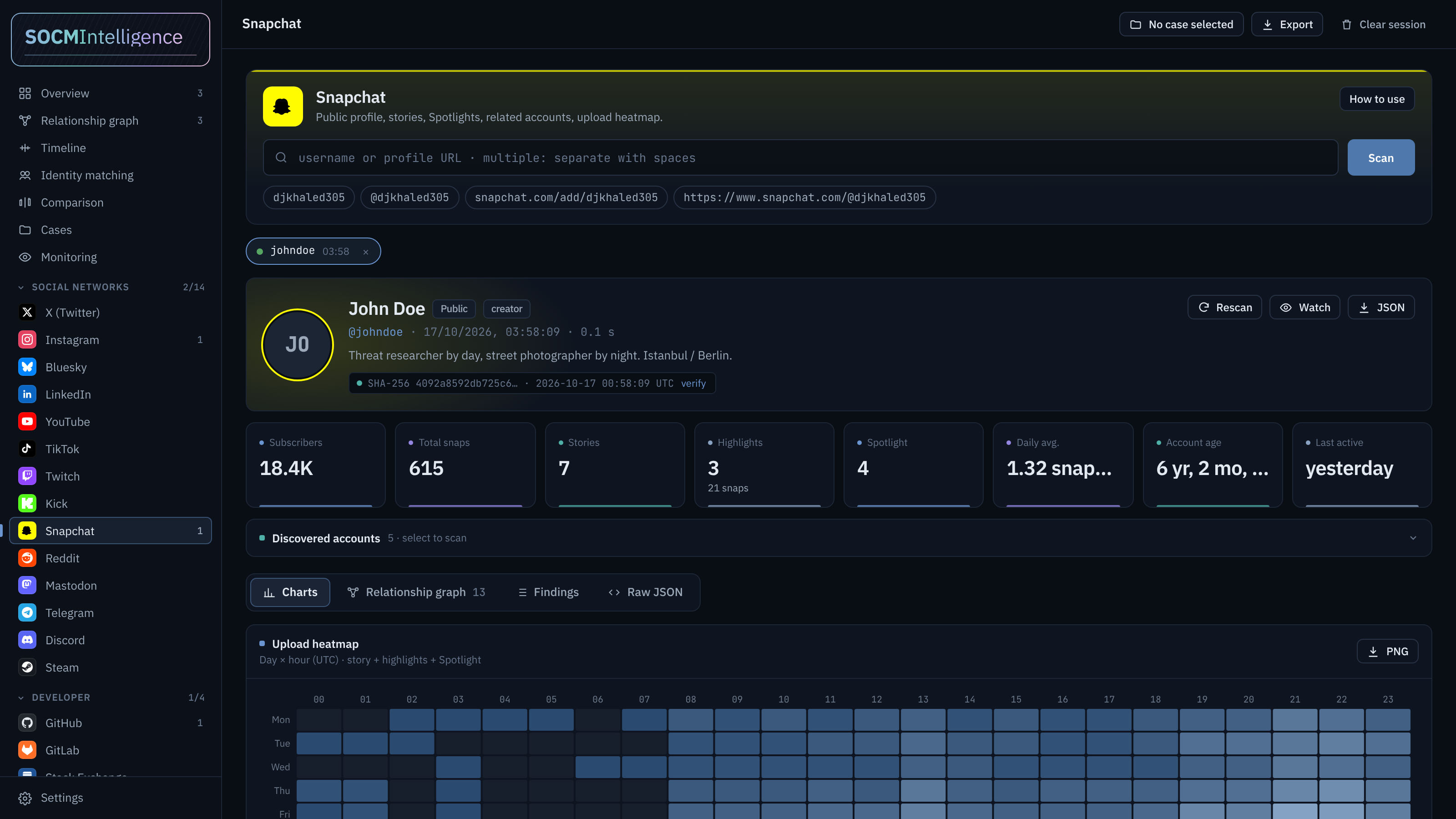
Social networksX (Twitter) · YouTube · TikTok · Snapchat · Reddit · Mastodon · Telegram · Steam
DeveloperGitHub · GitLab · Stack Exchange · Hacker News
Identity & archivesKeybase · Gravatar · Wayback Machine

Each module reads public data only (or an official API where a key is provided). There is no credential/session scraping of private accounts.

Features

  • Relationship graph — a D3 force graph that merges every successful scan. Cross-platform matches (shared email, domain, username), pivoting (double-click a node to scan it in the right module), search, type filters, PNG/JSON export.
  • Timeline — every account's posts, comments, uploads and account-creation events on one axis, plus an hour-overlap heatmap and hour-similarity table.
  • Identity matching — a 0–100 “same person?” score per account pair with reasons (verified/cryptographic link, shared email, username & display-name similarity, shared personal domain, avatar pHash, activity hours). Pairs ≥ 40 are drawn on the graph.
  • Comparison — put 2+ scanned accounts of the same module side by side (KPI table + bar chart, highest value highlighted).
  • Analyst marks — mark graph nodes Verified / Suspicious / Dismissed, add notes, add manual nodes and links. All saved to the case.
  • Case management — create a case, activate it, and scans/marks/notes are saved automatically. Import/export a .socmint package.
  • Change tracking (Monitoring) — rescan targets on a schedule and record what changed (fields, new/removed links).
  • Evidence integrity — every scan's raw data is hashed (SHA-256 over canonical JSON) at collection time; a verify button proves whether it was altered.
  • Exports — HTML / PDF report, Excel (.xlsx), GraphML (Gephi/yEd), GEXF (Gephi), Maltego CSV, JSON.
  • Bilingual UI — Turkish / English toggle (default Turkish); reports, spreadsheets, chart labels, date & number formats all follow the selected language.
  • Settings page — API keys, proxy / Tor / proxy-list rotation and rate limits, all managed from the UI instead of .env.

Quick start

root@kitploit:~
python3 -m venv .venv && source .venv/bin/activate
pip install -r requirements.txt
uvicorn server:app --host 0.0.0.0 --port 8000

Then open http://localhost:8000 — API docs at http://localhost:8000/docs.

Next runs only need:

root@kitploit:~
source .venv/bin/activate && uvicorn server:app --port 8000

Docker: docker compose up --build (single service).

Configuration

All configuration lives on the Settings page (saved to data/settings.json; .env is still read, Settings wins):

  • API keys — stored server-side, never returned to the browser (only “set” + last 4 chars are shown).
    • YOUTUBE_API_KEY — required for the YouTube module.
    • X_BEARER_TOKEN — X (Twitter) API v2. Without it the X module shows clearly-labelled sample data so you can preview the output before adding a token.
    • STEAM_API_KEY, STACKEXCHANGE_KEY, GRAVATAR_API_KEY, GITLAB_TOKEN — optional, unlock extra data.
  • Proxy / Tor — off, Tor, a single custom proxy, or a proxy list that rotates round-robin per scan (spreads rate limits).
  • Rate — parallel scan count and delay between requests.

Notes

  • X (Twitter): the free X plan is very limited — even with a token, post history may come back empty on some plans; the module labels that case.
  • Telegram reads only the public t.me/s/ preview (no login).
  • Gravatar receives only the MD5/SHA-256 hash of an email, never the email itself.
  • TikTok frequently rate-limits/bot-blocks; the module retries and distinguishes a real “not found” from a temporary block.
  • Time distributions are UTC. TikTok follower “growth” is an estimate (marked as such), not real history.
  • backend/app/tools/youtube_osint.py ships with a hardcoded fallback API key — replace it with your own from Settings and remove that line.

License

Apache License 2.0 — see LICENSE.

Download Tool