 desmondsanctity/cve-2022-44311
Out-Of-Bounds Read in html2xhtml : CVE-2022-44311

Html2xhtml v1.3 was discovered to contain an Out-Of-Bounds read in the function static void elm_close(tree_node_t *nodo) at procesador.c. This vulnerability allows attackers to access sensitive files or cause a Denial of Service (DoS) via a crafted html file.
CWE-125 Out-of-Bounds Read is a type of software error that can occur when reading data from memory. This can happen if the program tries to read beyond the end of an array, for example. Out of bounds reads can lead to crashes or other unexpected vulnerabilities, and may allow an attacker to read sensitive information that they should not have access to.
html2xhtml/src/procesador.c. (GHSA-28fm-qh2h-3mch)Html2xhtml is a command-line tool that converts HTML files to XHTML files. Html2xhtml can generate the XHTML output compliant to one of the following document types: XHTML 1.0 (Transitional, Strict and Frameset), XHTML 1.1, XHTML Basic and XHTML Mobile Profile.
The vulnerability was discovered due to a segfault error that occured when using the -t frameset option. A segmentation fault or segfault is a specific kind of error caused by accessing memory that does not belong to you. It’s a helper mechanism that keeps you from corrupting the memory and introducing hard-to-debug memory bugs.
With the use of Valgrind, a tool for finding memory access errors to heap memory (memory that is dynamically allocated with new or malloc) in C and C++ programs, the segfault error was debugged and it reported an invalid read of size 4 in the test case:
==1040381== Memcheck, a memory error detector
==1040381== Copyright (C) 2002-2017, and GNU GPL'd, by Julian Seward et al.
==1040381== Using Valgrind-3.18.1 and LibVEX; rerun with -h for copyright info
==1040381== Command: ./src/html2xhtml -t frameset report/vuln/id:000000,sig:11,src:001386+001369,time:12081510,execs:2336913,op:splice,rep:16
==1040381==
==1040381== Invalid read of size 4
==1040381==    at 0x40E911: elm_close (procesador.c:944)
==1040381==    by 0x410617: err_html_struct (procesador.c:1889)
==1040381==    by 0x40F20A: err_content_invalid (procesador.c:0)
==1040381==    by 0x40F20A: elm_close (procesador.c:959)
==1040381==    by 0x40E7C4: saxEndDocument (procesador.c:233)
==1040381==    by 0x40DF7A: main (html2xhtml.c:117)
==1040381==  Address 0x6f20d4 is not stack'd, malloc'd or (recently) free'd
==1040381==
==1040381==
==1040381== Process terminating with default action of signal 11 (SIGSEGV)
==1040381==  Access not within mapped region at address 0x6F20D4
==1040381==    at 0x40E911: elm_close (procesador.c:944)
==1040381==    by 0x410617: err_html_struct (procesador.c:1889)
==1040381==    by 0x40F20A: err_content_invalid (procesador.c:0)
==1040381==    by 0x40F20A: elm_close (procesador.c:959)
==1040381==    by 0x40E7C4: saxEndDocument (procesador.c:233)
==1040381==    by 0x40DF7A: main (html2xhtml.c:117)
==1040381==  If you believe this happened as a result of a stack
==1040381==  overflow in your program's main thread (unlikely but
==1040381==  possible), you can try to increase the size of the
==1040381==  main thread stack using the --main-stacksize= flag.
==1040381==  The main thread stack size used in this run was 8388608.
==1040381==
==1040381== HEAP SUMMARY:
==1040381==     in use at exit: 88,190 bytes in 13 blocks
==1040381==   total heap usage: 22 allocs, 9 frees, 2,218,413 bytes allocated
==1040381==
==1040381== LEAK SUMMARY:
==1040381==    definitely lost: 0 bytes in 0 blocks
==1040381==    indirectly lost: 0 bytes in 0 blocks
==1040381==      possibly lost: 0 bytes in 0 blocks
==1040381==    still reachable: 88,190 bytes in 13 blocks
==1040381==         suppressed: 0 bytes in 0 blocks
==1040381== Rerun with --leak-check=full to see details of leaked memory
==1040381==
==1040381== For lists of detected and suppressed errors, rerun with: -s
==1040381== ERROR SUMMARY: 1 errors from 1 contexts (suppressed: 0 from 0)
==1040419== Memcheck, a memory error detector
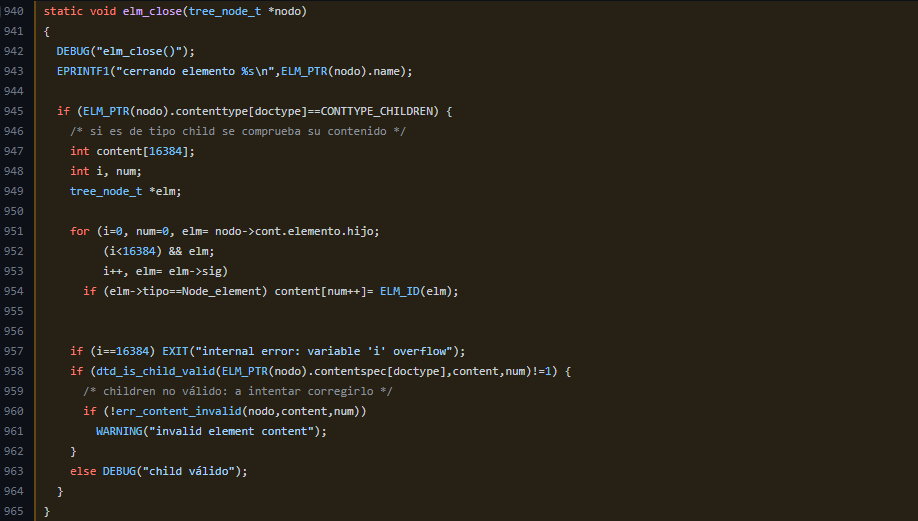
The error log from Valgrind led us to the following function where the segfault occured:
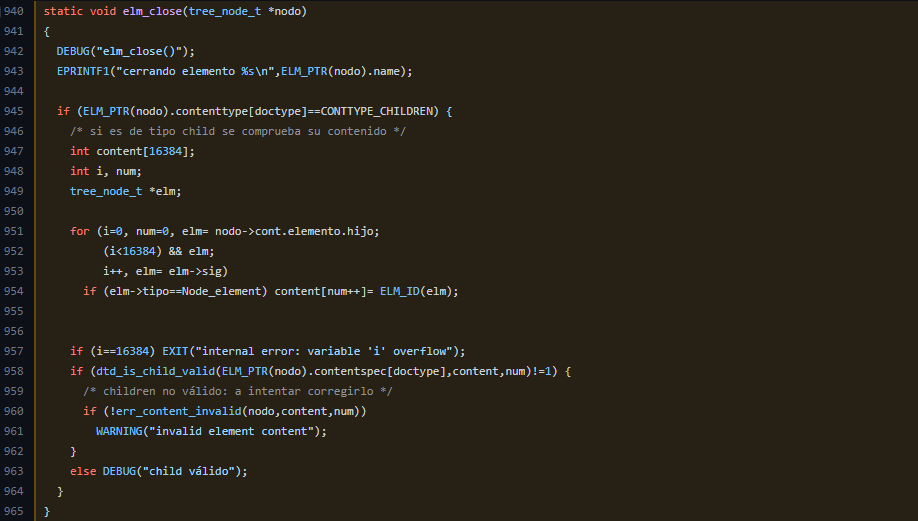
It was found that there is a missing type check in the function. The user was passing a node of type comment instead of element to the function and this results to out of bound read error. A user could provide a malformed document with an invalid ELM_PTR(nodo).contenttype[doctype], resulting in the following comparison in assembly:
cmp dword ptr [rbp + rax*4 + 0xc], 4
This vulnerability can be leveraged by attackers to read sensitive files, memory or locations using a doctored file.
| Severity | High 8.1 / 10 |
|---|---|
| Attack complexity | Low |
| Privileges required | None |
| User interaction | Required |
| Scope | Unchanged |
| Confidentiality | High |
| Integrity | None |
| Availability | High |
