 cyber-defence-campus/mole
A Binary Ninja plugin using backward slicing of variables as a driver for static taint analysis



Mole is a Binary Ninja plugin designed to identify interesting execution paths in binaries. It performs backward slicing on variables using Binary Ninja's Medium Level Intermediate Language (MLIL) in Static Single Assignment (SSA) form, forming the basis for a static taint analysis.
In Mole, a path refers to the flow of data between a defined source and sink. What constitutes an "interesting" path depends on the analysis goals. For instance, when searching for vulnerabilities, one might look for paths where untrusted inputs (sources) influence sensitive operations (sinks) in potentially dangerous ways.
The following list highlights some of Mole's current features:
Operation Mode: Mole can be run either within Binary Ninja's UI or in headless mode. Headless mode is particularly useful for scripted analysis across a large number of binaries. Conversely, using Mole within the UI is ideal for closely investigating detected paths.
Path Identification:
.bndb format). Paths can also be exported, for example, when performing headless analysis across many binaries on a file system, allowing identified paths to be later imported for easier exploration within Binary Ninja.Path Analysis With AI: Mole can interact with local or remote Large Language Models (LLMs) via the OpenAI API (see Usage). The models are used to analyze identified paths and reason whether a given path corresponds to an exploitable vulnerability or not. The LLM attempts to classify the vulnerability and assign a severity level, which can help prioritize which paths are worth further investigation by an analyst. Mole provides a basic set of tools that the LLM can use to request additional information about the binary under analysis.
Inter-Procedural Variable Slicing: Mole supports slicing MLIL variables across function boundaries - a task that presents several challenges. For instance, statically determining a function's effective caller(s) is often difficult or even impossible. As a result, the implemented approach is an approximation. While not perfect, it performs reasonably well across a wide range of practical scenarios.
Basic Pointer Analysis: Mole currently implements a simplified strategy for tracking pointer usage. Like inter-procedural slicing, this approach is a simplification with inherent limitations (e.g. it cannot track global variables). Nevertheless, it performs well in many practical cases and is planned to be improved in future versions.
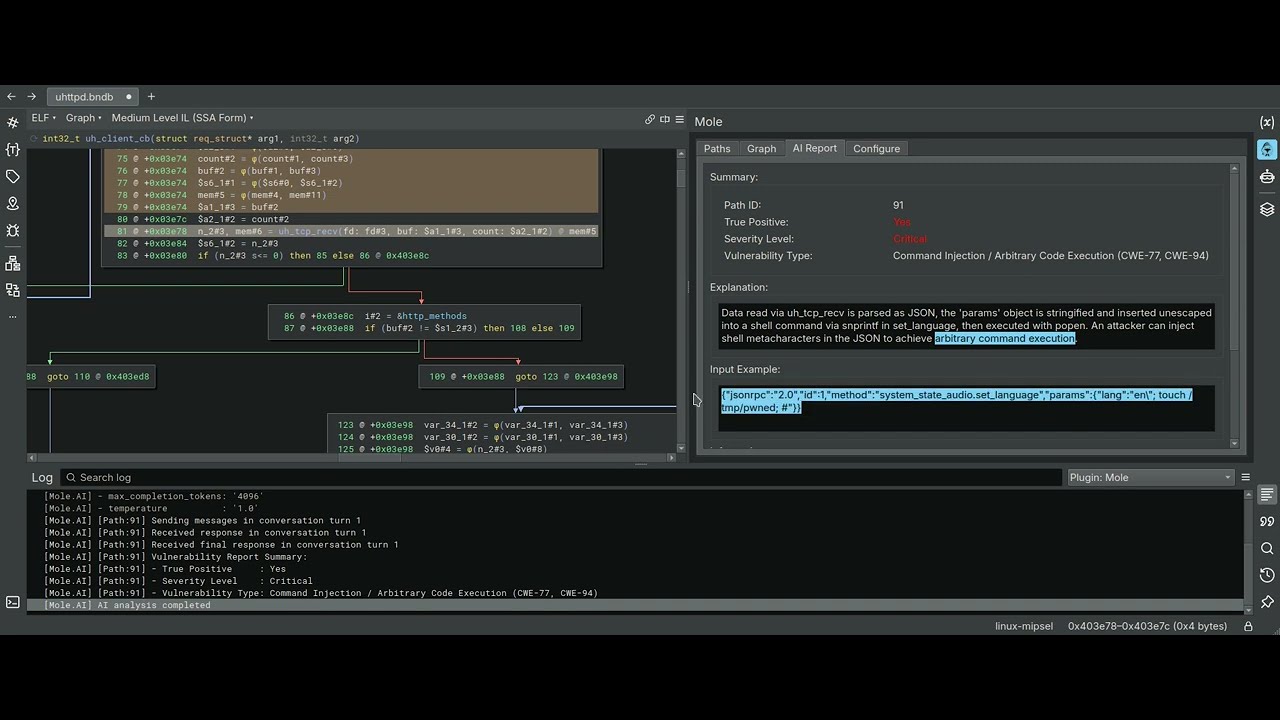
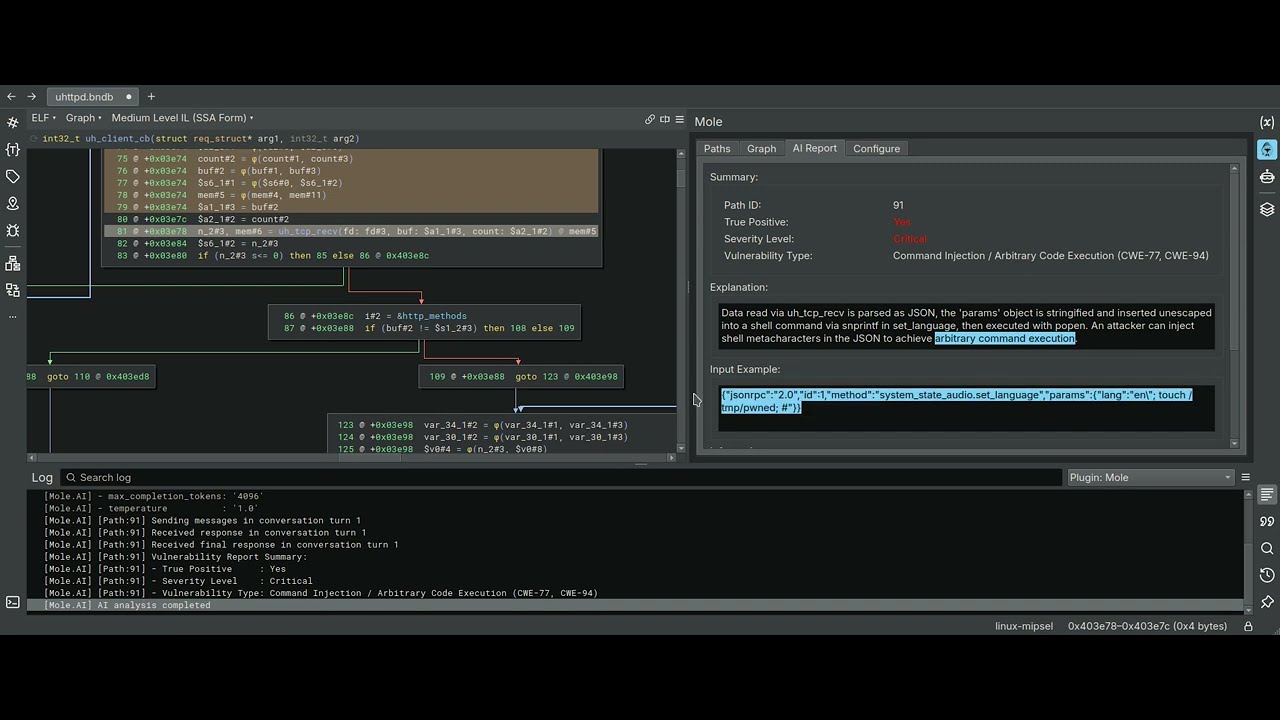
See Mole in action as it exposes CVE-2021-4045, an unauthenticated command injection flaw in the TP-Link Tapo C200 IP camera (click the image below to watch on YouTube):
Mole is currently a work in progress. If you encounter a bug, have a useful new unit test that highlights a false positive or negative, or have a suggestion for a new feature, please consider opening an issue or contribute via pull request. Also note that the current unit tests have only been verified on linux-x86_64 and linux-armv7 binaries so far.
If you have an interesting success story - such as finding a vulnerability with the help of Mole - we would love to hear about it! Feel free to share your experience with us.

