
Skip to content
KitploitKITPLOIT
ToolsBlog
Submit
ToolsBlog
Submit

Hacking, PenTest, and Cybersecurity Tools for Your Security Arsenal!

Kitploit is a directory of hacking, cybersecurity, and pentesting tools. Discover the latest project updates to find vulnerabilities, analyze systems, automate testing, and strengthen your security.

··Feeds·Contact·Privacy·© 2026 Kitploit

Tool Directory

Categories

View all categories
Loading categories
sharepoint-toolshell-micro-postmortem — Reproducible incident micro-postmortem for on-prem Microsoft SharePoint “ToolShell” (CVE-2025-53770): ATT&CK snapshot, “logs that matter” table, three hunts (KQL/SPL/Sigma), first-4-hours comms, sample data, and figures. Built for fast triage; no org data; SharePoint Online out of scope. | Kitploit
Tools/GitHubGitHub/cameloo1/sharepoint-toolshell-micro-postmortem
ReconnaissanceVulnerability AnalysisForensicsWeb SecurityPenetration TestingThreat IntelligenceLearning & EducationIncident ResponseCurated Resources

Most Popular

View all →

Discover the most used tools by our community.

Explore all tools

Browse our collection of tools

View all tools →
Log Analysis
GitHubcameloo1/sharepoint-toolshell-micro-postmortem

sharepoint-toolshell-micro-postmortem

View Repository
18 months agoNot yet reviewed

About

Reproducible incident micro-postmortem for on-prem Microsoft SharePoint “ToolShell” (CVE-2025-53770): ATT&CK snapshot, “logs that matter” table, three hunts (KQL/SPL/Sigma), first-4-hours comms, sample data, and figures. Built for fast triage; no org data; SharePoint Online out of scope.

Share

Incident Micro-Postmortem — Microsoft SharePoint (On-Prem) “ToolShell” Campaign

This kit triages the mid-2025 “ToolShell” zero-day campaign against on-premises Microsoft SharePoint Server; SharePoint Online is out of scope. It delivers end-to-end reproducible hunts, comms, and figures without relying on external data.

Why this repo exists: accelerate analyst triage with reproducible detections and aligned executive communications.

Scope and Assumptions

  • On-prem Microsoft SharePoint Server only.
  • Likely attack flow: internet-exposed SharePoint/IIS → crafted deserialization/ViewState abuse → webshell deployment → potential machineKey/ValidationKey theft → token forgery → RCE/lateral movement.
  • Synthetic, illustrative data only; no real organizational telemetry or proprietary IOCs.

ATT&CK Snapshot

Techniques emphasized: T1190 (Exploit Public-Facing Application), T1059.001 (PowerShell), T1505.003 (Web Shell), T1078 (Valid Accounts), T1027 (Obfuscated/Complicated Files), T1003 (OS Credential Dumping), T1082 (System Information Discovery), T1021 (Remote Services), T1071 (Application Layer Protocol), T1567 (Exfiltration Over Web Services).
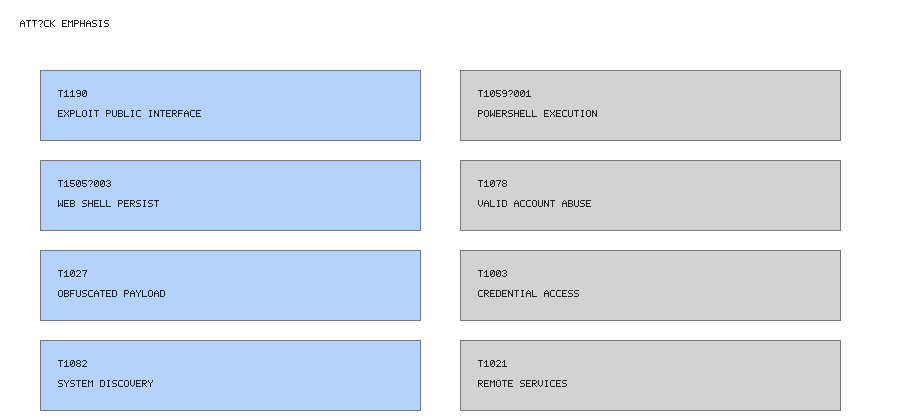
ATT&CK mini map

Logs That Matter (Table)

Run These Hunts Now

  • hunts/w3wp_powershell_encodedcommand.kql · SPL · Sigma: Catch encoded PowerShell spawned from IIS worker.
  • hunts/sharepoint_webshell_filecreate.kql · SPL · Sigma: Identify unexpected .aspx files within SharePoint web roots.
  • hunts/dns_newly_seen_post_iis_anomaly.kql · · : Surface low-prevalence DNS domains following IIS anomalies and suspicious IIS child processes.

How To Reproduce On This Repo

  • Review samples/example_events.json for representative Windows Security 4688, Sysmon 11, and DNS entries aligned to each hunt (benign noise included).
  • Expected outputs (abridged):
    • PowerShell spawn hunt: Account of the app pool service account, CommandLine containing -enc, with 3 malicious hits and 1 benign admin script note.
    • Webshell file create hunt: aggregation showing 2 .aspx paths under \inetpub\wwwroot\wss\VirtualDirectories\80\Layouts\ during the attack hour and a benign deployment entry.
    • DNS newly-seen hunt: domains cdn-msupdate.example, toolshare-sync.example tied to the IIS host IP with <5 total queries in 24h plus one benign corporate CDN domain ignored by thresholding.
  • False-positive tuning: align allowlists to documented admin automation windows, deployment change tickets, known CDN domains, and scripted maintenance tasks. Adjust time bins and prevalence thresholds based on platform norms; track service account behavior via baseline comparisons.

First 4 Hours — Comms Plan

  • See comms/first_4h.md for ready-to-send templates and placeholders.
  • Cadence: T+0–30 triage notification (stakeholders aligned), T+30–120 hourly scoping stand-ups, T+120–240 containment status plus executive brief aligned to the decision tree.
  • Decision tree visual: figures/decision-tree.png mirrors the ASCII logic in the comms pack.

Falsifiability and Limitations

  • If IIS app pool automation legitimately launches PowerShell with encoded scripts (e.g., DevOps tooling), the PowerShell hunt will trigger; maintain maintenance allowlists and track known automation accounts.
  • Rapid attacker cleanup or alternative tooling (e.g., unmanaged CLR webshells, C# assemblies) may evade file creation telemetry, especially if Sysmon coverage is incomplete or tamper-prone.

Future Work (Optional)

  • AppSec guardrails for SharePoint-adjacent apps: secret scanning for machine keys, CI checks for dangerous deserialization patterns, and web-root integrity monitoring during build pipelines.

Sources (Non-quoted, general references)

  • Microsoft security guidance (on-prem scope): https://www.microsoft.com/en-us/msrc/blog/2025/07/customer-guidance-for-sharepoint-vulnerability-cve-2025-53770
  • NVD CVE (mid-2025 SharePoint on-prem): https://nvd.nist.gov/vuln/detail/CVE-2025-53770
  • CISA advisory/MAR (mid-2025 SharePoint): https://www.cisa.gov/news-events/analysis-reports/ar25-218a

Vendor research:

  • Unit 42 — https://unit42.paloaltonetworks.com/microsoft-sharepoint-cve-2025-49704-cve-2025-49706-cve-2025-53770/
  • SentinelOne — https://www.sentinelone.com/blog/sharepoint-toolshell-zero-day-exploited-in-the-wild-targets-enterprise-servers/
  • Trend Micro — https://www.trendmicro.com/en_us/research.html (search: “SharePoint ToolShell CVE-2025-53770”)

After-Build Notes — How to Adapt to Live SIEM/EDR

  • Update index/table names (index=*, SecurityEvent, Sysmon) to match local data models (e.g., m365:security, wineventlog).
  • Replace placeholder fields (Account, ClientIP, TargetFilename) with environment-specific aliases or normalized schemas (e.g., user, ip_src, file_path).
  • Confirm timezone alignment; adjust ago(24h) or earliest windows to match fleet retention and detection latency.
  • Embed environment-specific allowlists (service accounts, deployment hosts) to reduce noise while preserving attacker coverage.
Download Tool
PhaseSignalLog SourceKey FieldsExample Pattern
Web tier/IISLong __VIEWSTATE blobs, unusual POSTs to /_layouts/*, rare UAs, 500/404 burstsIIS/W3C logs, SharePoint ULScs-uri-stem, cs-useragent, sc-status, payload lengthSpikes of large POST bodies followed by 500 errors
Process execw3wp.exe -> cmd.exe -> powershell.exe with -enc or -EncodedCommandWindows Security 4688ParentProcessName, NewProcessName, CommandLine, AccountC:\Windows\System32\inetsrv\w3wp.exe spawning PowerShell with encoded payload
File create/webshellUnexpected .aspx drops under \inetpub\wwwroot\wss\... or \_layouts\...Sysmon 11 / File integrity feedsTargetFilename, Image, HashesNew .aspx in \inetpub\wwwroot\wss\VirtualDirectories\80\App_Data\
Identity/tokenAbnormal session issuance, admin actions traced to service accountsSharePoint ULS, AD FS logsUser, ClientIP, CorrelationId, token claimsService account issuing multiple high-privilege tokens
DNS/ProxyNewly-seen low-prevalence domains after IIS anomaliesDNS, proxy, firewall logsquery, src_ip, count, prevalence scoresFirst-seen domain resolving shortly after PowerShell execution
SPL
Sigma