
Skip to content
KitploitKITPLOIT
ToolsBlog
Submit
ToolsBlog
Submit

Hacking, PenTest, and Cybersecurity Tools for Your Security Arsenal!

Kitploit is a directory of hacking, cybersecurity, and pentesting tools. Discover the latest project updates to find vulnerabilities, analyze systems, automate testing, and strengthen your security.

··Feeds·Contact·Privacy·© 2026 Kitploit

Tool Directory

Categories

View all categories
Loading categories
hush — Portable security rules for the action boundary of AI agents | Kitploit
Tools/GitHubGitHub/backbay-labs/hush
Cloud SecurityDevSecOpsSecret DetectionThreat IntelligenceSupply Chain SecurityIncident ResponseAI Security
GitHubbackbay-labs/hush

hush

Portable security rules for the action boundary of AI agents
View Repository
2311 month agoReviewed by Kitploit

Most Popular

View all →

Discover the most used tools by our community.

Explore all tools

Browse our collection of tools

View all tools →
Share
Website

HushSpec

Portable, open specification for AI agent security rules

CI License Spec Version crates.io npm PyPI

Spec · Docs · Rulesets · JSON Schema


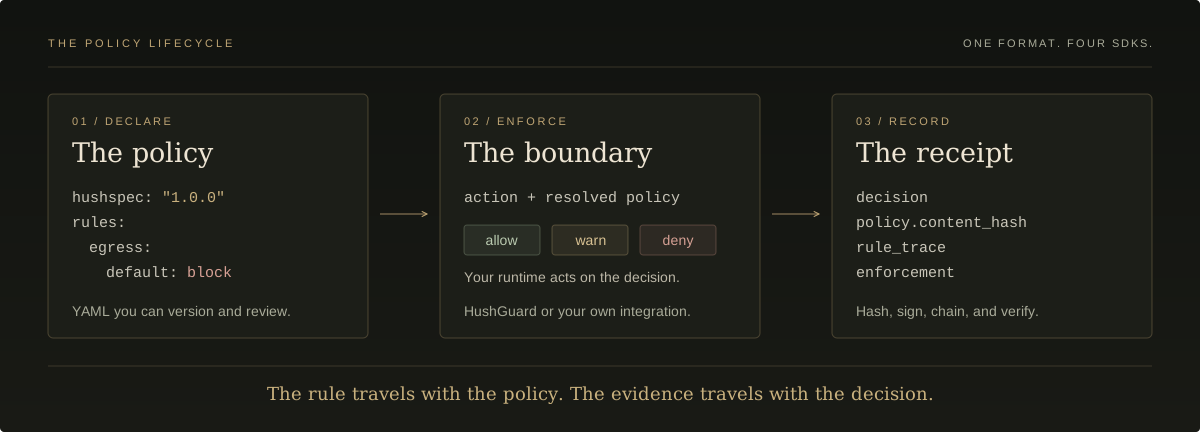
HushSpec is an open policy format for AI agent security rules. It defines what an agent may do at runtime, including filesystem access, network egress, tool usage, secret detection, and more, without prescribing how those controls must be enforced. That separation makes policies portable across runtimes, frameworks, and languages.

v0.1.1-alpha — The core spec, all four SDKs (Rust, TypeScript, Python, Go), and the h2h CLI are published and functional. Parse, validate, evaluate, merge, resolve, detect, sign, and audit your way through 10 rule types and 3 extension modules. The API surface is stabilizing but not yet frozen — expect refinements before v1.0.

Quick Example

root@kitploit:~
hushspec: "0.1.0"
name: production-agent

rules:
  forbidden_paths:
    patterns:
      - "**/.ssh/**"
      - "**/.aws/**"
      - "/etc/shadow"

  egress:
    allow:
      - "api.openai.com"
      - "*.anthropic.com"
      - "api.github.com"
    default: block

  tool_access:
    block: [shell_exec, run_command]
    require_confirmation: [file_write, git_push]
    default: allow

  secret_patterns:
    patterns:
      - name: aws_key
        pattern: "AKIA[0-9A-Z]{16}"
        severity: critical
    skip_paths: ["**/test/**"]

  shell_commands:
    forbidden_patterns:
      - "rm\\s+-rf\\s+/"
      - "curl.*\\|.*bash"

SDK Conformance

All four SDKs implement the full HushSpec pipeline, from parse and validate through resolution and evaluation.

Installation

CLI

Homebrew, npm, and prebuilt binaries become available starting with the first v0.x tag built by the release pipeline, once the release pipeline publishes artifacts, the tap formula, and the npm packages. Until then, install via Cargo.

All methods install the h2h command. See CLI Tool below.

Rust

root@kitploit:~
[dependencies]
hushspec = "0.1"

TypeScript

root@kitploit:~
npm install @hushspec/core

Python

root@kitploit:~
pip install hushspec

Go

root@kitploit:~
go get github.com/backbay-labs/hush/packages/go@main

Getting Started

Rust

root@kitploit:~
use hushspec::HushSpec;

let yaml_str = "hushspec: \"0.1.0\"\nname: example\n";
let spec = HushSpec::parse(yaml_str)?;
let result = hushspec::validate(&spec);
assert!(result.is_valid());

TypeScript

root@kitploit:~
import { parseOrThrow, validate } from '@hushspec/core';

const yamlString = 'hushspec: "0.1.0"\nname: example\n';
const spec = parseOrThrow(yamlString);
const result = validate(spec);
console.log(result.valid); // true

Python

root@kitploit:~
from hushspec import parse_or_raise, validate

yaml_string = 'hushspec: "0.1.0"\nname: example\n'
spec = parse_or_raise(yaml_string)
result = validate(spec)
assert result.is_valid

Go

root@kitploit:~
import (
    "fmt"

    "github.com/backbay-labs/hush/packages/go/hushspec"
)

yamlString := "hushspec: \"0.1.0\"\nname: example\n"
spec, err := hushspec.Parse(yamlString)
if err != nil {
    panic(err)
}
result := hushspec.Validate(spec)
fmt.Println(result.IsValid())

Evaluation

Each SDK exposes an evaluate() function that takes a parsed spec and an action, then returns a decision (allow, warn, or deny) plus matched rule details.

root@kitploit:~
import { parseOrThrow, evaluate } from '@hushspec/core';

const spec = parseOrThrow(policyYaml);
const result = evaluate(spec, { type: 'egress', target: 'api.openai.com' });
// result.decision === 'allow' | 'warn' | 'deny'
// result.matched_rule === 'egress'
root@kitploit:~
from hushspec import parse_or_raise, evaluate

spec = parse_or_raise(policy_yaml)
result = evaluate(spec, {"type": "egress", "target": "api.openai.com"})
assert result.decision in ("allow", "warn", "deny")

HushGuard Middleware

HushGuard wraps policy loading and evaluation behind a simple evaluate, check, and enforce interface for application code.

root@kitploit:~
import { HushGuard } from '@hushspec/core';

const guard = HushGuard.fromFile('./policy.yaml');
guard.enforce({ type: 'tool_call', target: 'bash' }); // throws HushSpecDenied if denied
root@kitploit:~
from hushspec import HushGuard

guard = HushGuard.from_file("./policy.yaml")
guard.enforce({"type": "tool_call", "target": "bash"})  # raises HushSpecDenied if denied

CLI Tool

The h2h CLI covers the common policy workflow: validate, test, evaluate and explain single actions, lint, diff, format, initialize, sign, verify, and trigger panic mode.

root@kitploit:~
# Validate a policy against the HushSpec schema
h2h validate policy.yaml

# Run evaluation test suites
h2h test --fixtures ./tests/

# Evaluate one action and explain the decision
h2h eval policy.yaml --type egress --target api.example.com
h2h explain policy.yaml --type egress --target api.example.com

# Static analysis and linting
h2h lint policy.yaml

# Lint and auto-fix decision-neutral issues
h2h lint policy.yaml --fix

# Compare two policies and show effective decision changes
h2h diff old.yaml new.yaml

# Format policy files canonically
h2h fmt policy.yaml

# Scaffold a new policy project
h2h init --preset default

# Sign a policy with Ed25519
h2h sign policy.yaml --key h2h.key

# Verify a policy signature
h2h verify policy.yaml --key h2h.pub

# Generate a new Ed25519 keypair
h2h keygen

# Emergency override (deny-all kill switch)
h2h panic activate --sentinel /tmp/hushspec.panic
h2h panic deactivate --sentinel /tmp/hushspec.panic

See Installation above for install options — Homebrew, npm, Cargo, or prebuilt binaries.

Decision Receipts (Audit Trail)

evaluate_audited() generates structured decision receipts with rule traces, policy summaries, and optional content redaction. Receipts conform to hushspec-receipt.v0.schema.json and are designed to support audit-heavy environments such as SOC 2, HIPAA, PCI-DSS, and FedRAMP.

root@kitploit:~
import { parseOrThrow, evaluateAudited } from '@hushspec/core';

const spec = parseOrThrow(policyYaml);
const receipt = evaluateAudited(spec, action, {
  enabled: true,
  include_rule_trace: true,
  redact_content: false,
});
// receipt.decision, receipt.rule_evaluations, receipt.policy_summary

Receipt sinks (FileReceiptSink, ConsoleReceiptSink, FilteredSink, MultiSink, CallbackSink) are available in all four SDKs for routing receipts to storage, logging, or OTLP endpoints.

Detection Pipeline

The detection pipeline plugs prompt injection, jailbreak, and exfiltration checks into the evaluation flow. Regex-based reference detectors ship with all SDKs, and custom detectors can be registered through DetectorRegistry.

root@kitploit:~
import { parseOrThrow, evaluateWithDetection, DetectorRegistry } from '@hushspec/core';

const registry = DetectorRegistry.withDefaults();
const result = evaluateWithDetection(spec, action, registry, {
  enabled: true,
  prompt_injection_threshold: 0.5,
});
// result.detection_results contains matched patterns and confidence scores
Framework Adapters

Prebuilt adapters translate framework-specific tool calls into HushSpec evaluation actions.

Observability

The EvaluationObserver interface and ObservableEvaluator wrapper emit structured events for every evaluation, policy load, and policy reload. Built-in observers include JsonLineObserver, ConsoleObserver, and MetricsCollector.

root@kitploit:~
import { ObservableEvaluator, JsonLineObserver, MetricsCollector } from '@hushspec/core';

const evaluator = new ObservableEvaluator();
evaluator.addObserver(new JsonLineObserver(process.stderr));
evaluator.addObserver(new MetricsCollector());
const result = evaluator.evaluate(spec, action);
Policy Signing

Policies can be signed with Ed25519 keys and verified at load time. The CLI provides sign, verify, and keygen commands. The signature format conforms to hushspec-signature.v0.schema.json.

root@kitploit:~
# Generate a keypair
h2h keygen --output-dir mykeys

# Sign a policy (creates policy.yaml.sig)
h2h sign policy.yaml --key mykeys/h2h.key

# Verify the signature
h2h verify policy.yaml --key mykeys/h2h.pub
Emergency Override (Panic Mode)

Panic mode is a deny-all kill switch that can be activated immediately without redeploying policies. You can trigger it with a sentinel file, the CLI, or an API call. While panic mode is active, every evaluation returns deny.

root@kitploit:~
# Activate panic mode
h2h panic activate --sentinel /tmp/hushspec.panic

# Deactivate
h2h panic deactivate --sentinel /tmp/hushspec.panic
root@kitploit:~
import { activatePanic, deactivatePanic, isPanicActive } from '@hushspec/core';

activatePanic();
// All evaluate() calls now return deny
deactivatePanic();
Policy Loading and Hot Reload

Policies can be loaded from local files, HTTPS URLs (with ETag caching and SSRF protection), or built-in rulesets. PolicyWatcher and PolicyPoller support hot reload without restarting the process.

root@kitploit:~
import { PolicyWatcher, HushGuard } from '@hushspec/core';

const guard = HushGuard.fromFile('./policy.yaml');
const watcher = new PolicyWatcher('./policy.yaml', {
  onChange: (newSpec) => guard.swapPolicy(newSpec),
});
watcher.start();

10 Core Rules

Extensions

HushSpec supports optional extension modules for more advanced policy behavior:

ExtensionPurpose
PostureDeclarative state machine for capabilities and budgets
OriginsOrigin-aware policy projection (Slack, GitHub, email, etc.)
DetectionThreshold config for prompt injection, jailbreak, threat intel
root@kitploit:~
extensions:
  posture:
    initial: standard
    states:
      standard: { capabilities: [file_access, egress] }
      restricted: { capabilities: [file_access] }
    transitions:
      - { from: "*", to: restricted, on: critical_violation }
  detection:
    prompt_injection:
      block_at_or_above: high

Built-in Rulesets

Ready-to-use policies live in rulesets/:

Using with Clawdstrike

HushSpec documents load natively in Clawdstrike:

root@kitploit:~
// Auto-detects HushSpec vs Clawdstrike-native format
let policy = clawdstrike::Policy::from_yaml_auto(yaml)?;
root@kitploit:~
# Convert between formats
hush policy migrate policy.yaml --to hushspec

Repo Structure

root@kitploit:~
spec/              Normative specification, including core and extension docs
schemas/           JSON Schema definitions
crates/            Rust crates
  hushspec/          Core library: parse, validate, merge, resolve, evaluate, detect, sign
  hushspec-cli/      CLI tool
  hushspec-testkit/  Conformance test runner
packages/          Language SDKs for TypeScript, Python, and Go
rulesets/          Built-in security rulesets
fixtures/          Conformance and evaluation fixtures
docs/              mdBook documentation site
generated/         Generated shared SDK contract artifacts
scripts/           Code generation and CI tooling

Design Principles

  • Fail-closed: Unknown fields are rejected, and invalid documents fail with explicit errors.
  • Stateless: Core rules are pure declarations with no runtime state.
  • Engine-neutral: The spec does not require a specific enforcement engine, detector, or plugin model.
  • Extensible: Posture, origins, and detection stay optional instead of bloating the core format.

Specification

The normative spec lives in spec/. JSON Schema definitions for programmatic validation are in schemas/. Full documentation is in docs/.

License

Apache-2.0. See LICENSE.

Download Tool
CapabilityRustTypeScriptPythonGo
Parse + Validate (Level 1)YesYesYesYes
Merge (Level 2)YesYesYesYes
Resolve (Level 2+)YesYesYesYes
Evaluate (Level 3)YesYesYesYes
Audit Trail (Level 4)YesYesYesYes
DetectionYesYesYesYes
ObservabilityYesYesYesYes
Receipt SinksYesYesYesYes
MethodCommand
Homebrew (macOS/Linux)brew install backbay-labs/tap/h2h
npmnpm install -g @hushspec/cli (or npx @hushspec/cli validate policy.yaml)
Cargo (from source)cargo install hushspec-cli
Prebuilt binariesGitHub Releases — h2h-<tag>-<target>.tar.gz + SHA256SUMS, provenance-attested
FrameworkAdapterSDK
Claude / AnthropicmapClaudeToolToAction, createSecureToolHandlerTypeScript
OpenAImapOpenAIToolCall, createOpenAIGuardTypeScript
MCP (Model Context Protocol)mapMCPToolCall, createMCPGuardTypeScript
root@kitploit:~
import { HushGuard, mapClaudeToolToAction } from '@hushspec/core';

const guard = HushGuard.fromFile('./policy.yaml');
const action = mapClaudeToolToAction(toolUseBlock);
guard.enforce(action);
RulePurpose
forbidden_pathsBlock access to sensitive filesystem paths
path_allowlistAllowlist-based read/write/patch access
egressNetwork egress control by domain
secret_patternsDetect secrets in file content
patch_integrityValidate diff safety (size limits, forbidden patterns)
shell_commandsBlock dangerous shell commands
tool_accessControl tool/MCP invocations
computer_useControl CUA actions
remote_desktop_channelsControl remote desktop side channels
input_injectionControl input injection capabilities
RulesetDescription
defaultBalanced security for AI agent execution
strictMaximum security, minimal permissions
permissiveDevelopment-friendly, relaxed limits
ai-agentOptimized for AI coding assistants
cicdCI/CD pipeline security
remote-desktopComputer use agent sessions
panicDeny-all emergency override