 aloshdenny/reverse-synthid
reverse engineering Gemini's SynthID detection


Discovering, detecting, and surgically removing Google's AI watermark through spectral analysis
Visit us on PitchHut
This fork adds a drag and drop desktop app for the V3 bypass, no command line needed after setup. See gui/README.md for setup and usage.







SynthID encodes an imperceptible pattern directly into pixel values. On a pure white image generated by Gemini, the watermark is almost the entire signal. Amplify the high-frequency residual and it looks like this:
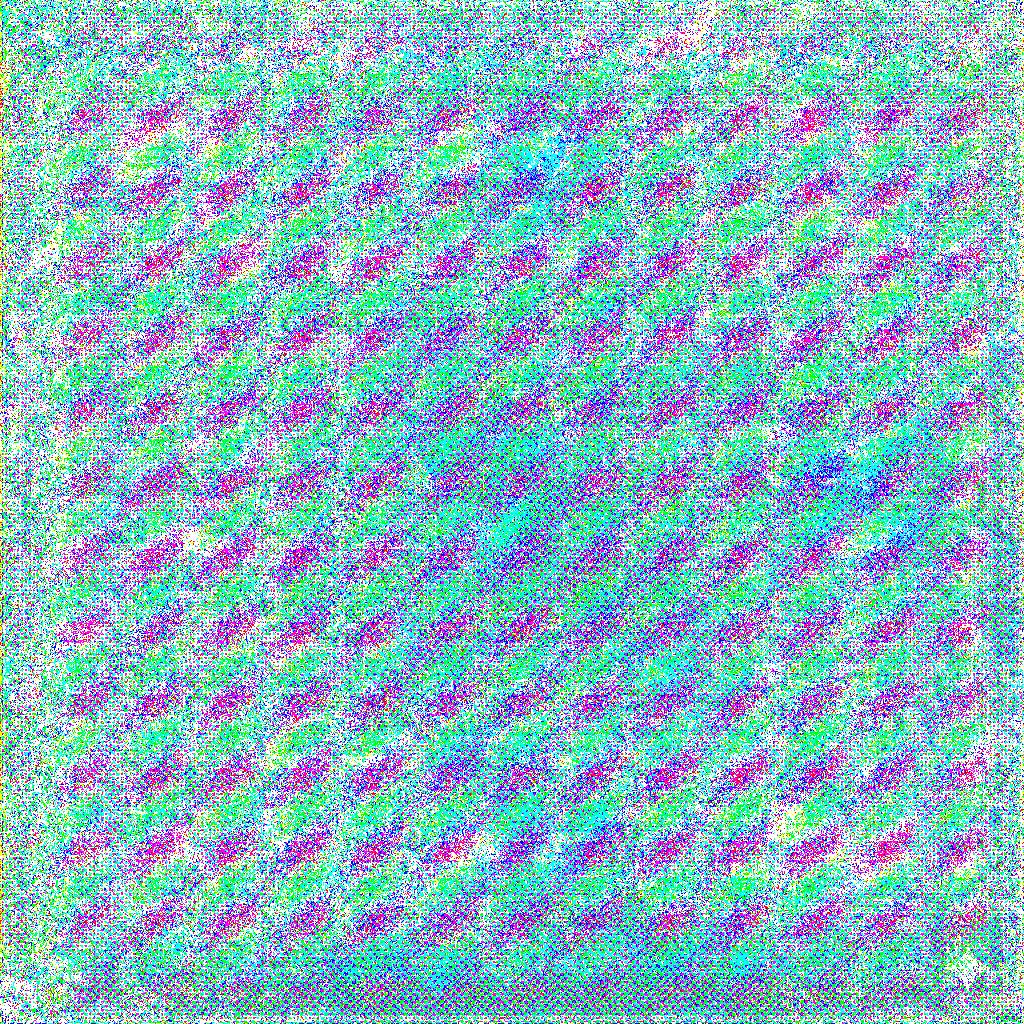
Amplified SynthID carrier pattern extracted from a pure-white Gemini image. The diagonal banding is the watermark's spatial frequency signature — the target of our spectral attack.
This project reverse-engineers Google's SynthID watermarking system — the invisible watermark embedded into every image generated by Google Gemini. Using only signal processing and spectral analysis (no access to the proprietary encoder/decoder), we:
gemini-3.1-flash-image-preview and nano-banana-pro-preview, cross-color phase consensus over 6 solid backgrounds, and a human-in-the-loop calibration loop that tunes per-carrier subtraction strength from manual Gemini-app detection talliesVT-OxFF built a really cool visualizer to view the process of how SynthID watermark is added to images here (also available in repo description)!
After six iterative rounds of adversarial development, Round 06's bypass_v4_final / bypass_v4_nuke pipeline defeats the Gemini SynthID detector on both gemini-3.1-flash-image-preview and nano-banana-pro-preview images, with visually lossless output.
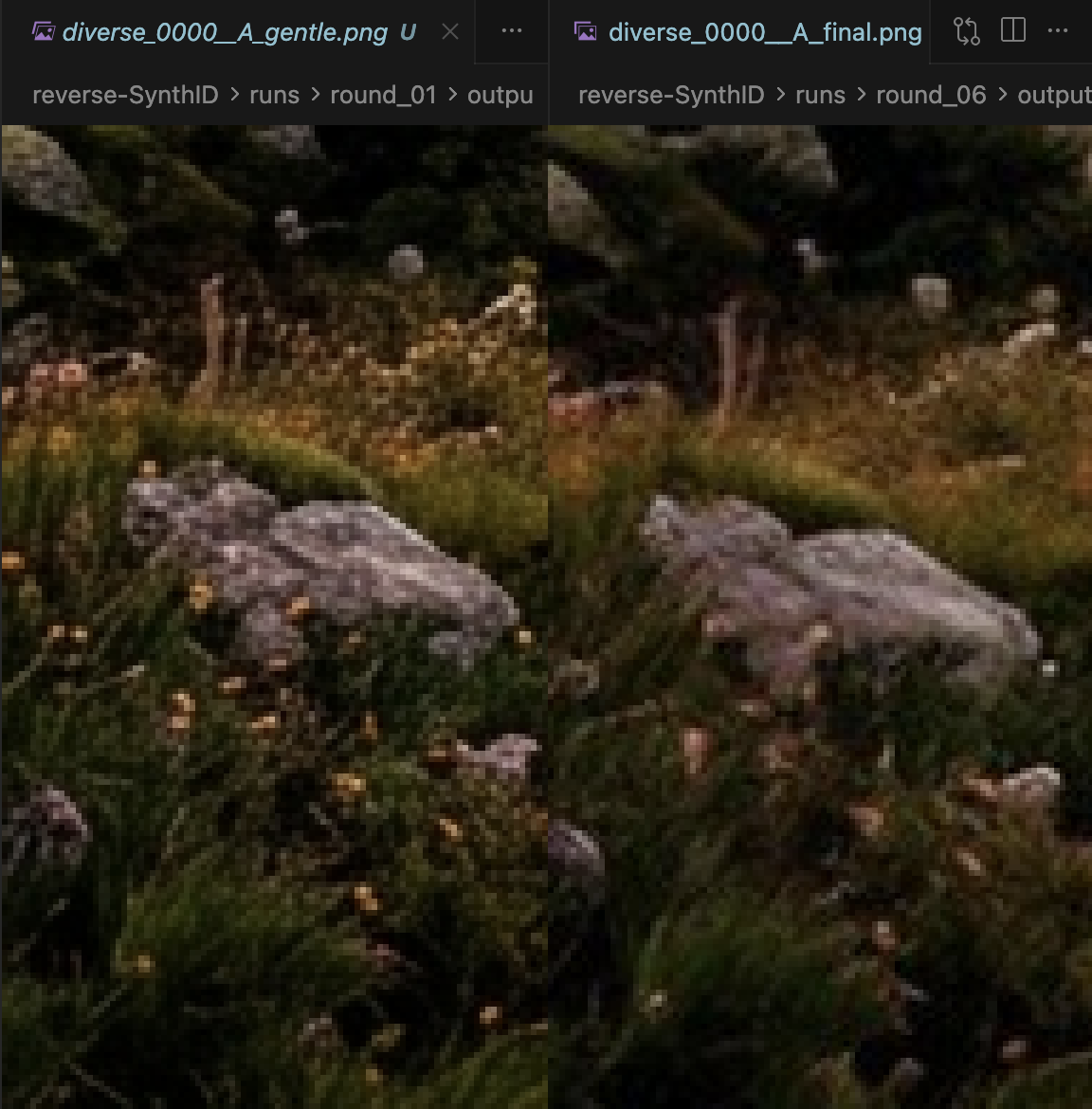
Left: Round 01 output (gentle spectral subtraction only). Right: Round 06 output (final — VAE + elastic warp + squeeze + color + JPEG). Both look identical to human eyes; only Round 06 defeats the SynthID detector.
| Round | Strategy | Outcome |
|---|---|---|
| 01 | Conservative spectral subtraction (gentle) | ✗ |
| 02 | Aggressive spectral subtraction + JPEG | ✗ |
| 03 | Blog-guided absolute bin targeting | ✗ |
| 04 | Denoise-residual phase extraction | ✗ |
| 05 | Diffusion-VAE re-generation + geometric warp | ✗ |
| 06 | All-in-one: VAE + elastic fragmentation + squeeze + color + JPEG | ✓ |
The breakthrough in Round 06 came from treating the Gemini app's own published failure-mode list as an attack specification:
"When an AI-generated image is part of a complex collage, layered behind other elements, or has many different textures and patterns placed over it, the detector may struggle to isolate the specific signature from the overall file." — Gemini app, SynthID detection help text
The elastic deformation stage simulates this effect at the pixel level: a smooth, low-frequency random warp field gives every ~50-pixel neighbourhood its own independent sub-pixel offset, fragmenting the watermark's spatial phase consensus without introducing any visible distortion.
V4 is a ground-up re-think of the codebook built on a much richer dataset:
gemini-3.1-flash-image-preview and nano-banana-pro-preview (plus an optional union pseudo-model).black, white, blue, green, red, gray) per model per resolution, plus gradient and diverse as content baselines.carrier_weights is updated based on manual Gemini-app detection feedback.For each frequency bin (fy, fx) and channel ch:
consensus(fy, fx, ch) = | mean_over_colors( exp(i * phase_color(fy, fx, ch)) ) |
Values near 1.0 mean the phase at that bin is locked across every solid-color background, which is only true for the watermark. Content bins collapse to < 0.3 because their phase is randomized by different color tints. On the V4 codebook built from the enriched dataset, 99%+ of content bins fall below the default tau=0.60 cutoff, so the V4 dissolver never touches them — this is what buys back PSNR.
flowchart LR
    dataset[reverse-synthid-dataset<br/>model x color x resolution] --> build[scripts/build_codebook_v4.py]
    build --> codebook[artifacts/spectral_codebook_v4.npz]
    codebook --> dissolve[scripts/dissolve_batch.py]
    input[watermarked inputs] --> dissolve
    dissolve --> variants[final / nuke variants]
    variants --> gemini[Gemini app<br/>manual SynthID detection]
    gemini --> feedback[detection feedback]
    feedback --> calibrate[scripts/calibrate_from_feedback.py]
    calibrate -->|updates carrier_weights| codebook
# 1. Build the codebook from the enriched hierarchical dataset
python scripts/build_codebook_v4.py \
    --root /path/to/reverse-synthid-dataset \
    --output artifacts/spectral_codebook_v4.npz
