 akaihigurashi/plex2scan
Find Plex Media Servers affected by Plex2Shell (CVE-2026-96652 and three more)


Finds Plex Media Servers affected by Plex2Shell, the chain of four flaws (CVE-2026-96652, CVE-2026-96654, CVE-2026-96655, CVE-2026-96656) that lets attackers take over a Plex Media Server older than 1.43.3.10861 without logging in. Part of shouldipanic.ch.
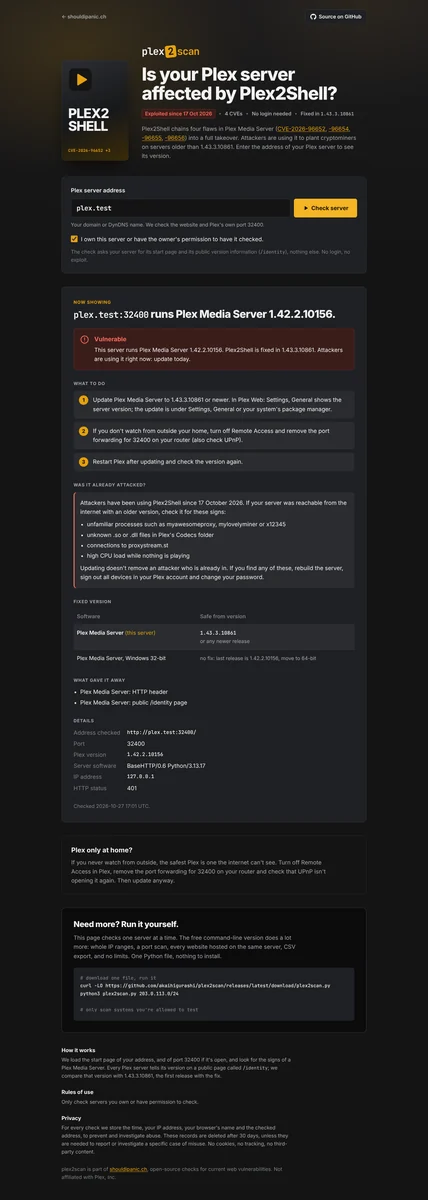
Plex2Shell has been exploited since 17 October 2026 (cryptominers, proxies) and is on CISA's Known Exploited Vulnerabilities list. Every Plex Media Server older than 1.43.3.10861 that can be reached from the internet is at risk.
plex2scan comes in two forms:
plex2scan.py: a single Python file with no dependencies for checking
your own servers: IP ranges, port scan including Plex's port 32400, vhost
discovery and the Plex version check.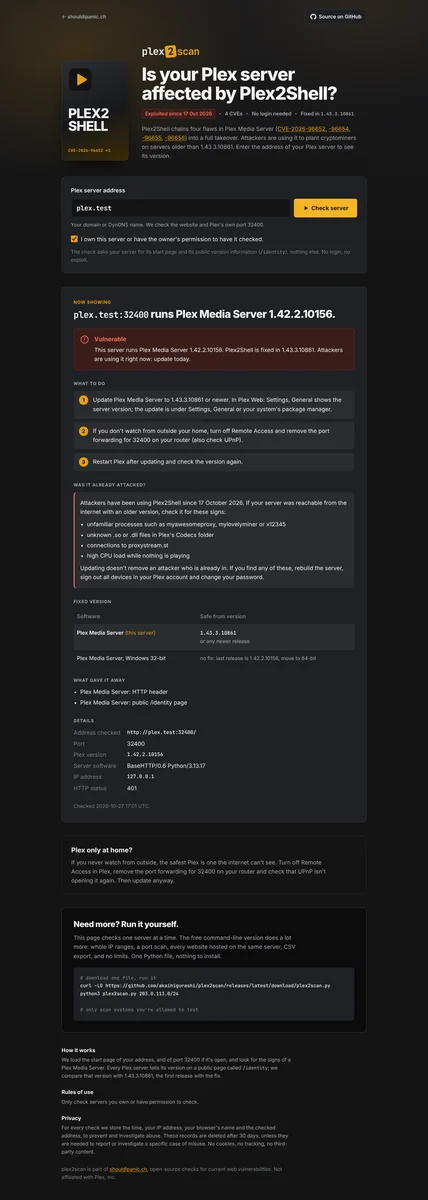
Every Plex Media Server answers GET /identity without a login and tells its
version there. plex2scan loads the start page (to recognise Plex by its
X-Plex-Protocol header or the Plex Web page) and asks /identity once.
Nothing else is sent: no login, no exploit.
curl -LO https://github.com/akaihigurashi/plex2scan/releases/latest/download/plex2scan.py
python3 plex2scan.py 203.0.113.0/24
Python 3.8 or newer, nothing to install. Examples:
python3 plex2scan.py 203.0.113.10                     # 21 ports incl. 32400 + every vhost on the IP
python3 plex2scan.py 203.0.113.10:32400               # only Plex's own port
python3 plex2scan.py plex.example.ch                  # a Plex behind a reverse proxy
python3 plex2scan.py 203.0.113.0/24 --names domains.txt    # + hostnames from your own data
python3 plex2scan.py 203.0.113.10 -p all -o out.csv   # all 65535 ports, CSV output
python3 plex2scan.py -h                               # all options
| Status | Meaning |
|---|---|
VULNERABLE | Plex Media Server older than 1.43.3.10861 |
POSSIBLY VULNERABLE | Plex Media Server found, version hidden |
PATCHED | Plex Media Server 1.43.3.10861 or newer |
NOT DETECTED | No Plex Media Server visible |
Results are listed worst first, with a short reason. Hidden results (closed ports,
errors, vhosts that only show the default site) appear with -a, the evidence with -v.
| Option | What it does |
|---|---|
-p LIST | Ports: web (20 common ports + 32400, default), all, or 80,443,32400 |
-n | No port scan, only 443 and 80 |
--names FILE | Your own hostname list, checked as vhosts |
--no-vhosts | Don't look for other websites on the same IP |
-a / -v | Show hidden results / show the evidence |
-o FILE | Also write all results to CSV |
-d | Debug: every request, header and match |
-q | No banner (for scripts) |
-V | Print the version |
-h | All options |
myawesomeproxy,
mylovelyminer or x12345, unknown .so/.dll files in Plex's Codecs folder,
connections to proxystream.st, high CPU load while nothing plays. Updating
doesn't remove an attacker who is already in.AlienVault OTX and HackerTarget work without keys. VirusTotal, Shodan and SecurityTrails need an API key, read from environment variables:
| Variable | Source |
|---|---|
PANIC_VT_KEY | VirusTotal passive DNS |
PANIC_SHODAN_KEY | Shodan hostnames |
PANIC_SECURITYTRAILS_KEY | SecurityTrails reverse IP |
Keep them in a .env file only you can read, and load it just for the scan:
( set -a; . ./.env; set +a; python3 plex2scan.py 203.0.113.10 )
--vt-key, --shodan-key and --securitytrails-key also work, but command-line
arguments are visible to other local users (ps) and end up in your shell history.
Key values are masked in error messages. (Thanks to Jonas Hüsser for this.)
docker run -d --name plex2scan --restart unless-stopped \
  -p 127.0.0.1:8091:8091 \
  -e PANIC_ORIGIN=https://plex2scan.example.ch \
  -v plex2scan-data:/data \
  ghcr.io/akaihigurashi/plex2scan:latest
Or with Compose: download docker-compose.yml, set
PANIC_ORIGIN, then docker compose up -d. The container listens on localhost
only; put a reverse proxy with TLS in front of it
(nginx example).
| Variable | Default | Purpose |
|---|---|---|
PANIC_ORIGIN | – | Public address. Requests from other origins are refused. Set it. |
PANIC_OPERATOR / PANIC_CONTACT | – | Optional contact section at the bottom of the page |
PANIC_IMPRINT_URL | – | Optional link to an existing imprint |
PANIC_TRUSTED_PROXY | 127.0.0.1,::1 | Proxies whose X-Real-IP header is trusted |
PANIC_DENY_HOSTS / PANIC_DENY_IPS | – | Never check these domains / addresses |
PANIC_AUDIT_DIR | /data/audit | Daily audit log files |
PANIC_RETENTION_DAYS | 30 | Audit files older than this are deleted |
The page has the same protections as php2scan: consent checkbox, audit log, VPN/Tor/datacenter clients refused, rate limit, result cache, public hostnames only with the connection pinned to the checked address, websites that are never checked (well-known services, the 100 most visited sites, government sites, sanctioned countries), and no access from sanctioned countries. Besides the website itself (443, then 80) the page only looks at port 32400, and only if it is open.
The scanner engine (fetching, fingerprinting, port scan, vhost discovery, web
server) lives in panic-core.
Everything specific to Plex2Shell is in check.py.
plex2scan.py and web.py are generated from both:
git clone https://github.com/akaihigurashi/panic-core ../panic-core
python3 ../panic-core/bundle.py check.py
GPL-3.0, see LICENSE. Fonts: Inter and JetBrains Mono (SIL Open Font License). Not affiliated with or endorsed by Plex, Inc.; "Plex" is their trademark.
