
Skip to content
KitploitKITPLOIT
ToolsBlog
Submit
ToolsBlog
Submit

Hacking, PenTest, and Cybersecurity Tools for Your Security Arsenal!

Kitploit is a directory of hacking, cybersecurity, and pentesting tools. Discover the latest project updates to find vulnerabilities, analyze systems, automate testing, and strengthen your security.

··Feeds·Contact·Privacy·© 2026 Kitploit

Tool Directory

Categories

View all categories
Loading categories
Mahoraga-Webapp-Defender — AI-powered reactive website defense system that detects attacks, analyzes them, and autonomously patches source code in real-time using LLM agents. | Kitploit
Tools/GitHubGitHub/ageofalgorithms/mahoraga-webapp-defender
Defensive ToolsVulnerability AnalysisWeb SecurityCTFThreat IntelligenceIntrusion DetectionIncident ResponseAPI SecurityAI Security

Most Popular

View all →

Discover the most used tools by our community.

Explore all tools

Browse our collection of tools

View all tools →
Share
GitHubageofalgorithms/mahoraga-webapp-defender

Mahoraga-Webapp-Defender

AI-powered reactive website defense system that detects attacks, analyzes them, and autonomously patches source code in real-time using LLM agents.


View Repository
43 months agoNot yet reviewed

Mahoraga Webapp Defender

AI-powered reactive webapp defense system designed to withstand AI-powered hacks in real-time.

GitHub stars License: MIT PRs Welcome

Table of Contents

  • Mahoraga Webapp Defender
    • Table of Contents
    • Introduction
    • Target Website
    • Mahoraga Defender Architecture
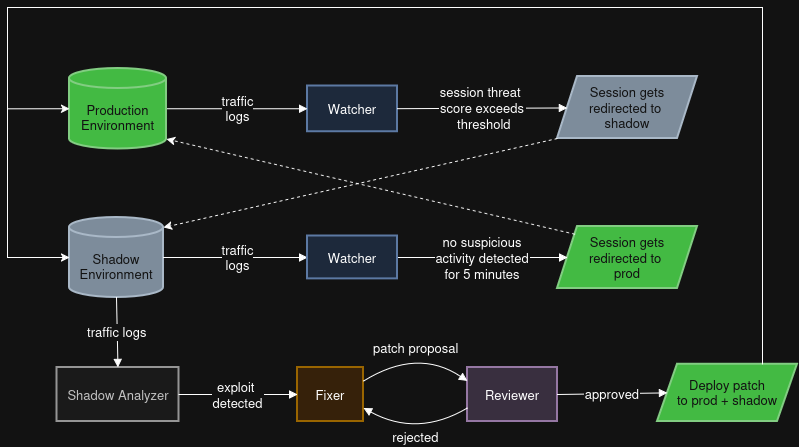
      • Dual Environments
      • Agent Pipeline
    • How to Start
      • Getting ready
      • Full Defender vs. Attacker Experiment
    • Dashboard
      • Logs
      • Agents
      • Pipeline
      • Patches
    • LLM Configuration
    • Tech Stack
    • Special Thanks

Introduction

Mahoraga Defender is a PoC of a reactive, attacker-type agnostic, real-time defense system. The core mechanism involves tricking an adversary into performing discoveries and attacks on a benign, fake environment ("shadow" environment) and logging these attacks. Then, an LLM agent analyzes the logs and hands over details of any detected exploits to more LLM agents to fix the vulnerabilities and deploy the patches.

The system is designed to be fully automated with API cost optimization in mind. A GUI was created to easily monitor traffic logs, agent activity and patching pipeline, and to control the number of agents to deploy.

Target Website

The target (victim) website is a fork of crAPI (Completely Ridiculous API), an intentionally vulnerable web application created by OWASP for teaching API security testing. crAPI simulates a vehicle-owner platform with microservices covering the OWASP Top 10 API vulnerabilities. The defender is designed to clearly distinguish between normal and adversarial user sessions so that normal users would not experience any drop in user experience quality while the defender is protecting the website from attackers.

Our fork (crapi-fork/) adds:

  • Planted honeypots (decoy credentials, endpoints, tokens) for attacker detection
  • Total 12 CTF-style flags embedded across the attack surface
  • A parallel "shadow" stack with identical services and separate databases for safe attacker observation
  • nginx Lua-based session routing that transparently redirects suspicious sessions from prod to shadow

A pristine copy is kept in crapi-original/ so the environment can be reset between experiments.
Mahoraga Defender Architecture

Dual Environments

  • Prod: serves real users via nginx reverse proxy (port 8888)
  • Shadow: identical decoy stack with separate databases, receives redirected attacker traffic transparently

Agent Pipeline

  • Orchestrator: coordinates the entire pipeline. Manages agent lifecycles, patch/review queues, ticket state, deployment, and crash recovery. Scales fixer/reviewer agents up and down at runtime.
  • Watcher (rule-based): monitors prod traffic logs and scores sessions on threat level using pattern matching (brute force, injection, enumeration, honeypot access, etc.). Once the threat score exceeds a threshold, it triggers the redirect action.
  • Shadow Analyzer (LLM agent): reads shadow environment traffic logs on a configurable interval to detect successful exploits. Deduplicates log entries, detects attack patterns, and pushes confirmed exploits to the fixing queue.
  • Fixer (LLM agent): receives exploit reports, reads the relevant source code, and patches it directly in crapi-fork/. Operates in a sandboxed bash environment with access restricted to crapi-fork/ only.
  • Reviewer (LLM agent): verifies patches for correctness, scope, and security. Approved patches trigger the deploy action; rejected patches are sent back to the fixer with feedback.

On deployment, Python services are hot-reloaded via gunicorn (instant), while Java/Go services are rebuilt via docker compose up -d --build.

Why no Tester agent? We considered adding a dedicated user testing agent and a separate test environment, but removed both to keep the system light.

How to Start

Getting ready

  • Using a conda or python virtual environment is recommended (e.g., conda create -n XYZ python=3.13, then conda activate XYZ).
  • Install requirements: pip install -r requirements.txt

Full Defender vs. Attacker Experiment

  1. Run ./start.sh from project root directory — resets crapi-fork/ source code from crapi-original/, rebuilds all services, plants flags and honeypots.
  2. Run defender: python3 -m harness.main --app-url http://localhost:8888 -v.
  3. Start pentesting the website on localhost:8888 (challenge description is at localhost:8888/challenge) If pentesting using an AI agent, the agent should not get any access to internal docker processes, as this would be considered cheating.
  4. While pentesting, monitor the defender dashboard on localhost:3000 to see real time logs, agent actions, patches, captured flags, etc.
  5. After session is over, run docker compose down -v to remove the docker containers and databases that were spun up for this project.

Dashboard

Dashboard: http://localhost:3000

A global agent status bar is visible on all tabs showing agent health (active/hung/idle/error) with scaling controls.

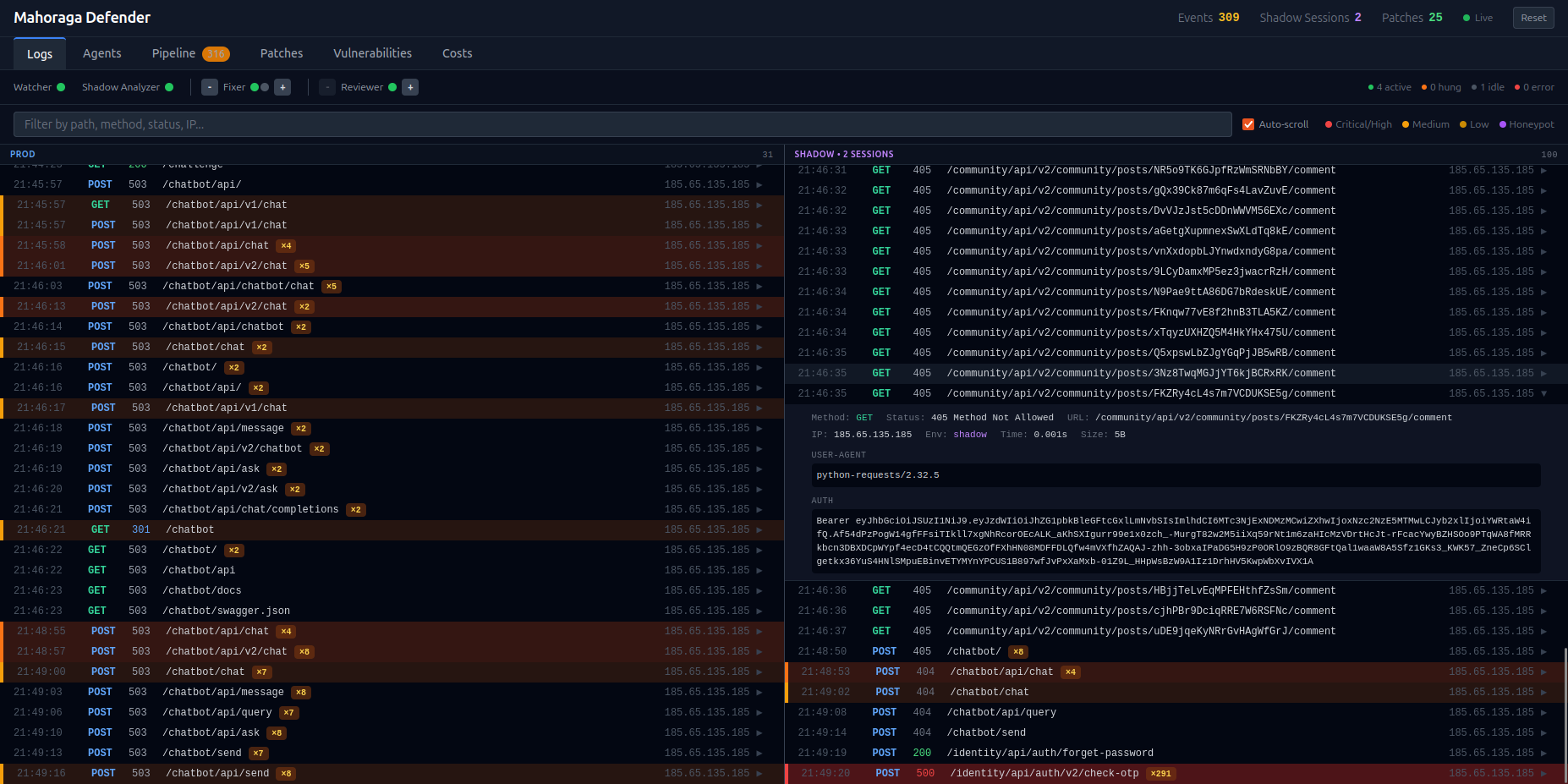
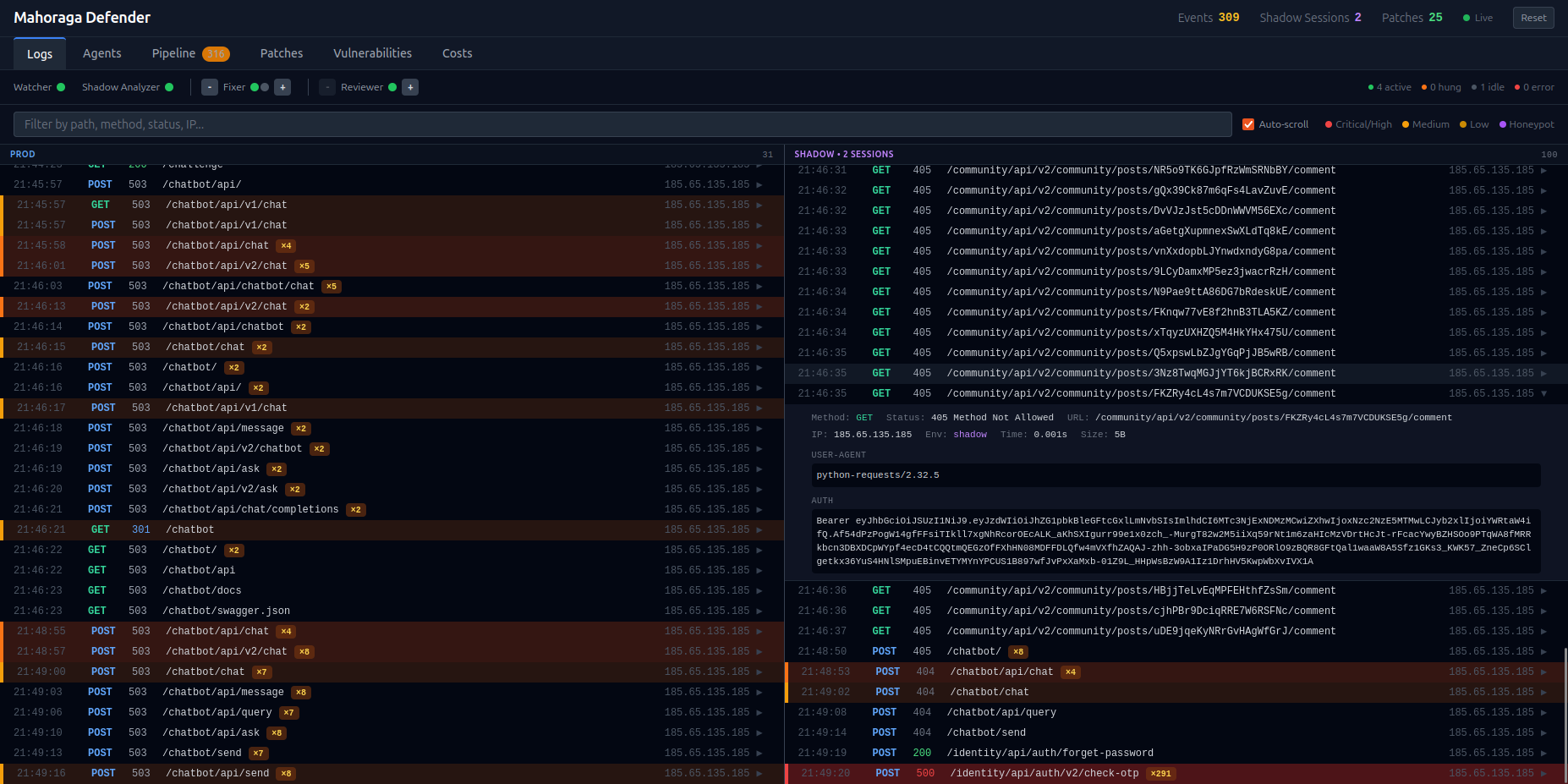
Logs

Real-time split-screen prod/shadow request log viewer with severity-colored entries and traffic grouping
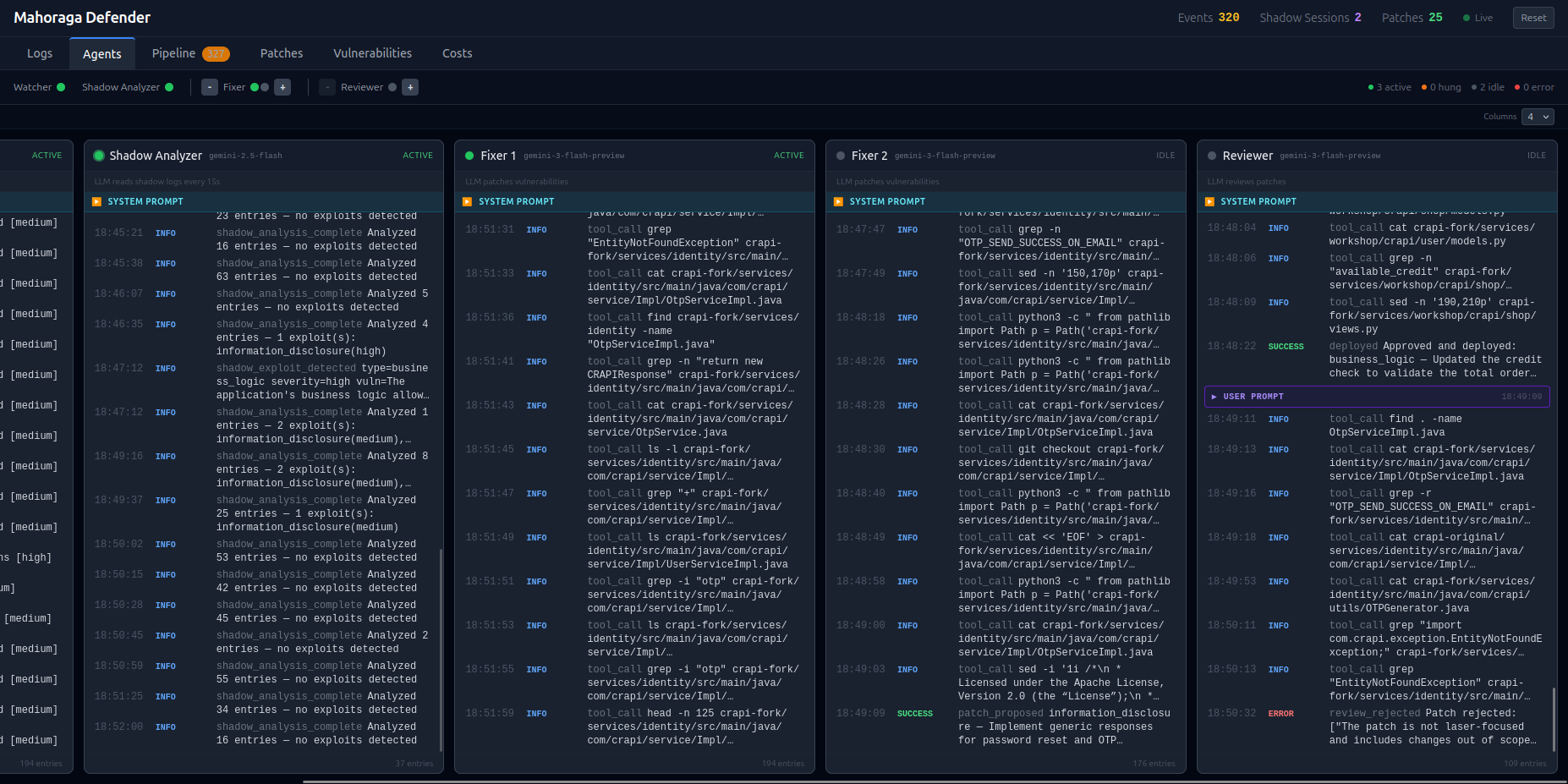
Agents

Per-agent activity feed with system prompts, tool calls, and LLM model labels
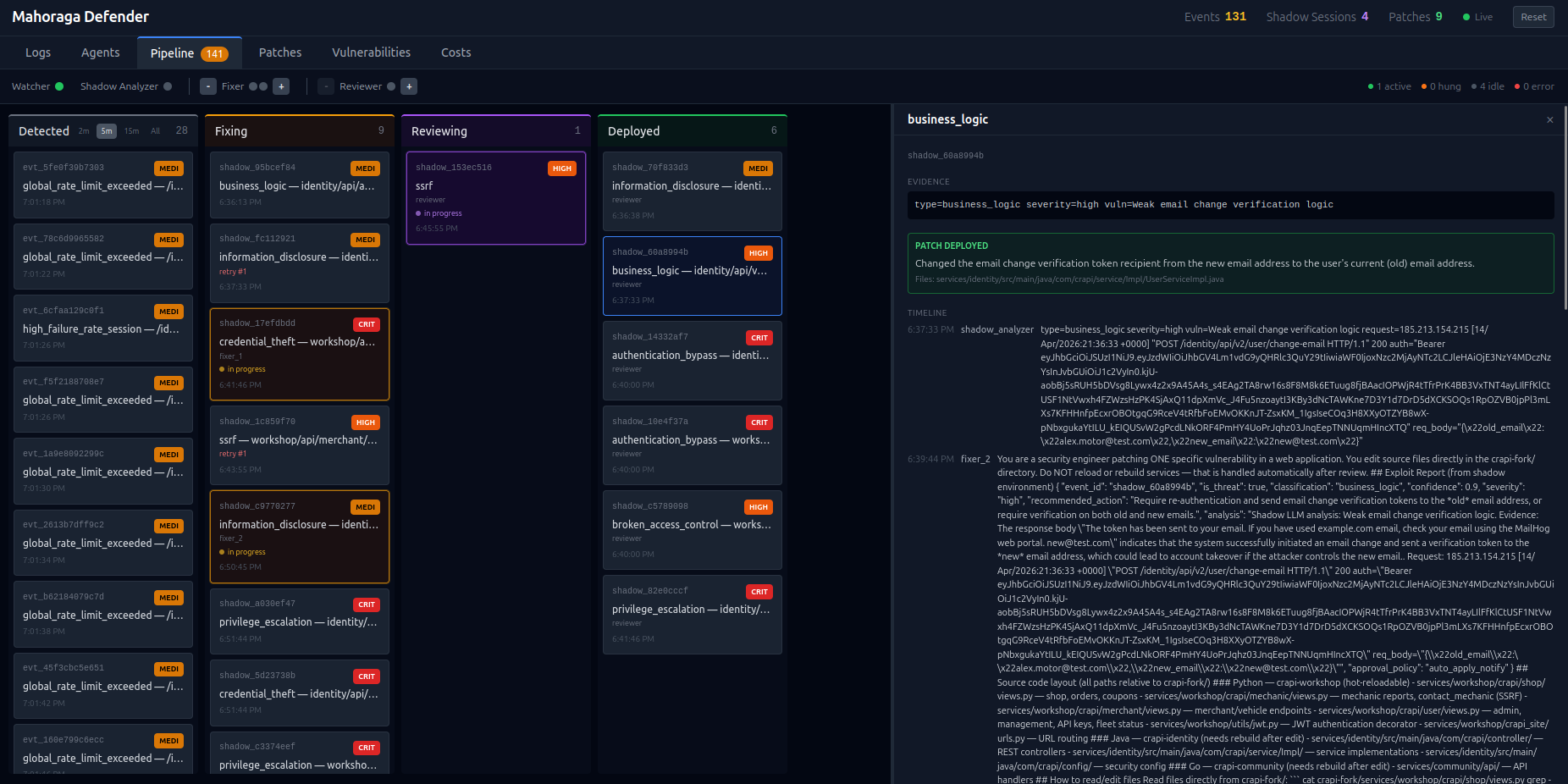
Pipeline

Kanban board: Detected → Fixing → Reviewing → Deployed, with resizable detail panel
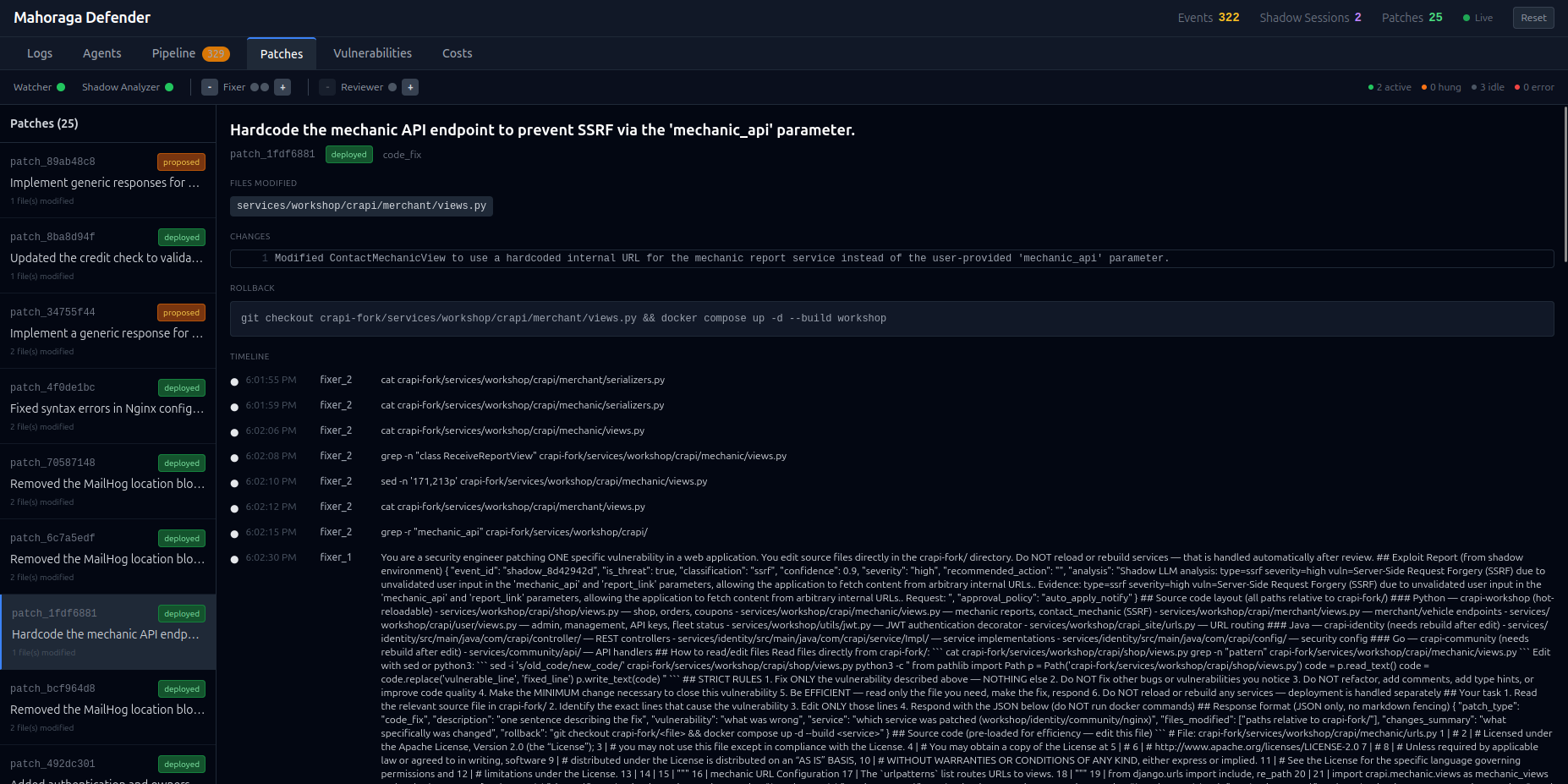
Patches

Code diffs, files modified, rollback commands, and timeline per patch
LLM Configuration

The system uses any OpenAI-compatible API. Configure models in config/llm.yaml:

root@kitploit:~
# Shadow Analyzer — reads shadow logs to detect exploits (no tool calling)
shadow_analyzer:
  provider: gemini
  model: gemini-2.5-flash
  api_key_env: GEMINI_API_KEY # defined in harness/.env
  pricing:
    input_per_million: 0.30
    output_per_million: 2.50

# Fixer — patches source code (tool-calling agent)
fixer:
  provider: gemini
  model: gemini-3-flash-preview
  api_key_env: GEMINI_API_KEY # defined in harness/.env
  pricing:
    input_per_million: 0.50
    output_per_million: 3.00

# Reviewer — verifies patches (tool-calling agent)
reviewer:
  provider: gemini
  model: gemini-3-flash-preview
  api_key_env: GEMINI_API_KEY # defined in harness/.env
  pricing:
    input_per_million: 0.50
    output_per_million: 3.00

To switch providers, change provider and model, then set the corresponding API key in harness/.env:

Supported providers: OpenAI, Gemini, Anthropic, Groq, Together, Ollama, Mistral, DeepSeek, Fireworks, xAI, Perplexity, OpenRouter, Zhipu. Add custom providers by adding their base URL to the providers section in the YAML.

root@kitploit:~
providers:
  openai: https://api.openai.com/v1
  gemini: https://generativelanguage.googleapis.com/v1beta/openai/
  anthropic: https://api.anthropic.com/v1/
  groq: https://api.groq.com/openai/v1
  ... # add more if needed

Note: Only a few API providers have a high enough rate limit to support 3+ agents working simultaneously. Google's Gemini is one of them.

Tech Stack

  • LLMs: Any OpenAI-compatible API (default: Gemini 3 Flash Preview for agents, Gemini 2.5 Flash for analyzer)
  • Target App: modified crAPI (Python/Django, Java/Spring Boot, Go, MongoDB, PostgreSQL)
  • Routing: nginx with Lua scripting for transparent session redirection
  • Scoring: Redis-backed threat scoring via FastAPI control plane
  • Dashboard: React + Tailwind CSS, served by FastAPI with WebSocket for live updates
  • Orchestration: Python asyncio with queue-based agent coordination

Special Thanks

Special thanks to d3lta05 (LinkedIn) and aleemladha for their help with penetration testing.

Download Tool